


Antarctica's Tourism Boom Raises Concerns about Contamination and Disease

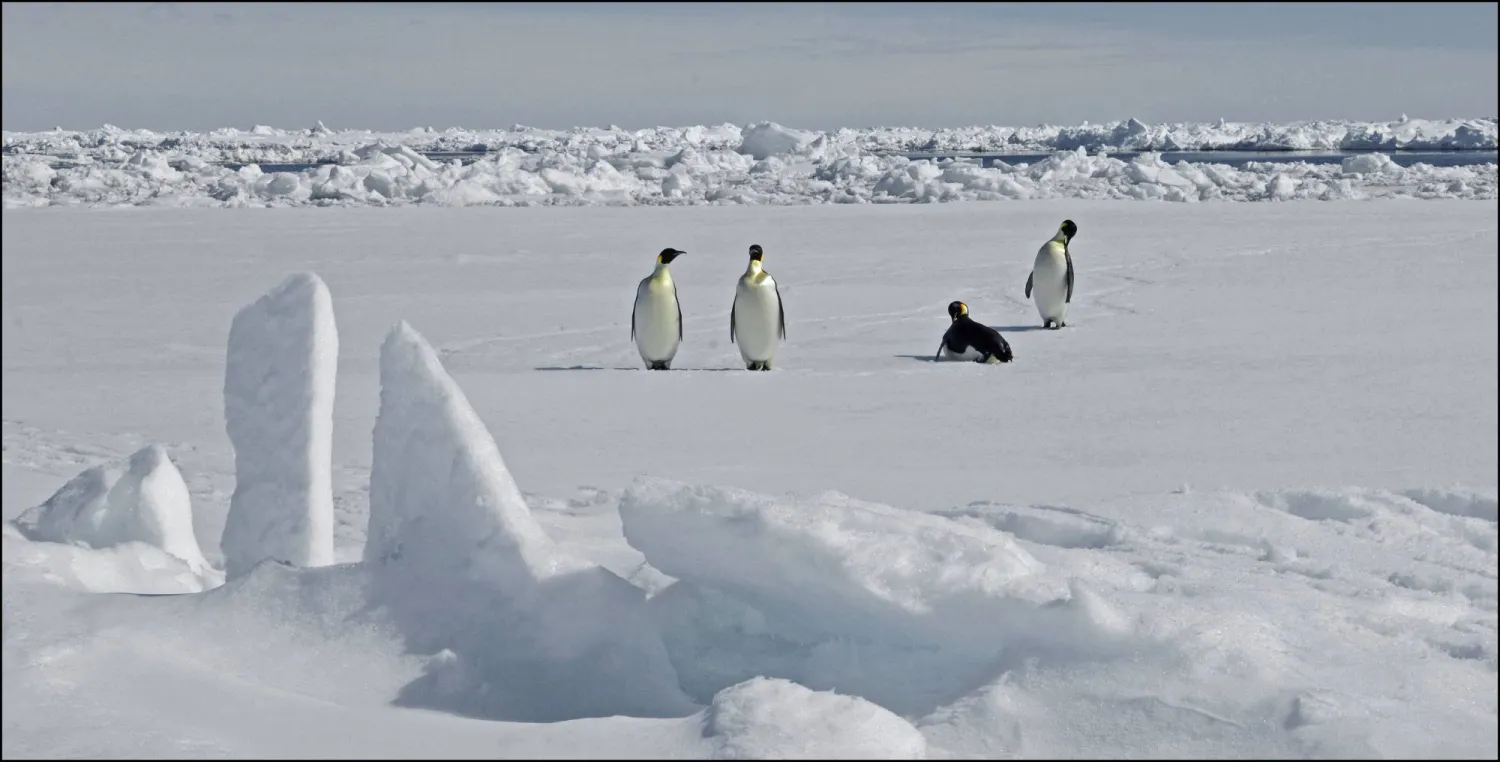
This handout photograph released by The British Antarctic Survey on April 8, 2026, shows Emperor Penguins on Antarctica on November 13, 2010. (Photo by PETER BUCKTROUT / BRITISH ANTARCTIC SURVEY / AFP)
TT

Antarctica's Tourism Boom Raises Concerns about Contamination and Disease

This handout photograph released by The British Antarctic Survey on April 8, 2026, shows Emperor Penguins on Antarctica on November 13, 2010. (Photo by PETER BUCKTROUT / BRITISH ANTARCTIC SURVEY / AFP)

Driven in part by fears that the frozen landscapes of Antarctica may be irreversibly melting away because of climate change, tourism to the bottom of the world is soaring. And experts warn that with more visitors comes an increased risk of contamination, illness and other damage to the continent.

While visitor numbers are still small — in part due to the high costs and time it can take — they are growing so fast that scientists and environmentalists are sounding alarms.

A deadly outbreak of the rare hantavirus aboard a Dutch ship on a weekslong polar cruise has brought attention to the growing tourism trend, The Associated Press said.

Most expeditions head to the Antarctic Peninsula, one of the fastest-warming places in the world. From 2002 to 2020, roughly 149 billion metric tons (164 billion tons) of Antarctic ice melted per year, according to the National Aeronautics and Space Administration.

A common route is to voyage south from Argentina toward Antarctica before heading north up the coast of Africa — the same route taken by the cruise ship MV Hondius.

“The sites you will see in Antarctica are extremely unique and not replicable anywhere else on the planet — the whales, the seals, the penguins, the icebergs — it’s all really stunning and it makes a huge impression on people,” said Claire Christian, executive director of the environmental group Antarctic and Southern Ocean Coalition.

Explosive growth of trips to the southern continent

In 2024, more than 80,000 tourists touched down on the vast ice-cloaked continent and 36,000 viewed from the safety of ships, according to data collected by the International Association of Antarctica Tour Operators.

The International Union of Concerned Scientists estimates that tourism to Antarctica has grown tenfold in the past 30 years.

That number could rise further in the next decade as costs fall with more ice-capable hulls hitting the water and technological advances, said Hanne Nielsen, a senior lecturer of Antarctic law at the University of Tasmania. Her colleagues at the university estimate the annual figure could triple or quadruple to over 400,000 visits in that time.

Some tourists come to Antarctica for “last chance tourism,” knowing the melting landscape is rapidly changing, Nielsen said.

Risks of contamination Officials have not indicated any evidence of contamination from the MV Hondius.

However, flocks of migratory birds brought avian flu from South America to Antarctica in recent years, according to the US Centers for Disease Control and Prevention.

That outbreak prompted the International Association of Antarctica Tour Operators and others to harden rules for tourists’ conduct and hygiene to protect visitors from being contaminated. To protect the fragile ecosystem from invasive species large and microscopic, visitors are told to stay away from animals and to avoid touching the ground with anything but their feet.

“There are rules that people are bound by when they’re heading south,” Nielsen said, describing her five voyages as a former guide. Crews and passengers use vacuums, disinfectants and brushes to scrub shoes and equipment clear of bugs, feathers, seeds and microbe-carrying dirt.

“Between the tongues and the laces of the boots you can find a lot of things,” she said.

Cruise ships have been struck by outbreaks of diseases like norovirus, which can spread quickly in a ship's close quarters. In 2020, a COVID-19 outbreak on the Diamond Princess turned the cruise ship into an incubator for the then-mysterious virus.

Hantavirus usually spreads by inhaling contaminated rodent droppings.

The Hondius' island hopping cruise The World Health Organization said Tuesday that MV Hondius left Ushuaia, Argentina, on April 1 and visited Antarctica and several isolated islands.

WHO is investigating possible human-to-human transmission on the cruise ship, said Dr. Maria Van Kerkhove, WHO’s director of epidemic and pandemic preparedness. Officials suspect the first infected person likely contracted the virus before boarding, she said, and officials have been told there are no rats on board.

Antarctica is governed by the Antarctic Treaty, which in 1959 enshrined the territory as a scientific preserve used only for peaceful purposes. A series of rules that followed “aim to ensure that all visits, regardless of location, do not adversely impact the Antarctic environment or its scientific and aesthetic values,” according to the treaty’s secretariat.

Companies and scientific ventures voluntarily comply with biosecurity guidelines and submit environmental impact assessments for Antarctic operations.

The treaty was written when tourism numbers were much lower, Christian said.

“Activity needs to be regulated appropriately, as you would with any of the world’s sensitive and precious ecological sites,” Christian said from Hiroshima, Japan, where she was preparing for an Antarctic Treaty Consultative Meeting. There she'll join calls to strengthen protections for Antarctica's penguins, whales, seabirds, seals and krill — tiny creatures at the base of the food chain.

For now, the lure of the frozen frontier continues to draw visitors.

“You can put a footprint in Antarctica and it’s still there 50 years later,” Christian said.


Bear Mauls Man to Death in Bulgaria

A bear smells a brick of ice on a hot afternoon at the Veermata Jijabai Bhosale Udyan and Zoo in Mumbai on May 10, 2026. (Photo by Punit PARANJPE / AFP)
TT

Bear Mauls Man to Death in Bulgaria

A bear smells a brick of ice on a hot afternoon at the Veermata Jijabai Bhosale Udyan and Zoo in Mumbai on May 10, 2026. (Photo by Punit PARANJPE / AFP)

A bear mauled to death a man at Vitosha, a mountainous region just outside Bulgarian capital Sofia, police told AFP on Sunday.

"The findings of the medical examiner and a wildlife expert show that marks found on the body are those of a female bear accompanied by her cub," a Sofia police spokesperson said.

Police did not disclose the age of the victim, but Bulgarian media reported him as being in his 30s.

His body was located Saturday afternoon near a road connecting two chalets in the northwestern part of the mountainous area around half an hour by road out of Sofia rising to 2,295 meters (7,500 feet) and located about 30 minutes from Sofia.

Vitosha is a popular hiking destination for residents of the Sofia, being home to a range of wild animals, including deer, roe deer, wild boars and wolves.

The area is believed to be home to around a dozen bears.

The last recorded case of a person killed by a bear in Bulgaria dates back to 2010, in the Rhodope Mountains in the country's south.


Saudi Arabia: Imam Turki Reserve Authority Reaffirms Commitment to Protecting Endangered Species

The Imam Turki bin Abdullah Royal Nature Reserve Development Authority logo
TT

Saudi Arabia: Imam Turki Reserve Authority Reaffirms Commitment to Protecting Endangered Species

The Imam Turki bin Abdullah Royal Nature Reserve Development Authority logo

The Imam Turki bin Abdullah Royal Nature Reserve Development Authority reaffirmed its commitment to protecting endangered wildlife species through a comprehensive ecosystem of environmental programs and initiatives aimed at preserving biodiversity, restoring ecological balance, and developing natural habitats within the reserve, coinciding with Endangered Species Day.

The authority emphasized that its efforts align with the objectives of Saudi Vision 2030 and the Saudi Green Initiative through a scientific and field-based approach focused on wildlife protection, the reintroduction of endangered species, and enhancing environmental sustainability within one of the Kingdom’s largest royal reserves.

These efforts contribute to preserving the national natural heritage for future generations.

The authority explained that the reserve is home to rich biodiversity, including several wildlife species of high environmental value. Environmental protection and monitoring teams continue to track wildlife, limit practices that negatively affect natural habitats, and implement specialized breeding and rehabilitation programs aimed at enhancing the survival and growth of threatened species in their natural environments.

The authority stressed that protecting endangered species is not only an environmental responsibility, but also an investment in ecosystem sustainability and quality of life.

It added that the development of vegetation cover, protection of natural resources, and promotion of community awareness constitute key pillars of its environmental strategy.

The impact of these efforts has been reflected in increased biodiversity and improved natural habitats within the reserve in recent years.


Spacecraft to Probe How Earth Fends Off Raging Solar Winds

This photograph shows the Smile spacecraft (gold) fixed to a Vega-C rocket adaptor (black cone) on 25 March 2026, in Kourou, French Guiana, in preparation for liftoff from Europe's Spaceport. (Photo by ESA / AFP)
TT

Spacecraft to Probe How Earth Fends Off Raging Solar Winds

This photograph shows the Smile spacecraft (gold) fixed to a Vega-C rocket adaptor (black cone) on 25 March 2026, in Kourou, French Guiana, in preparation for liftoff from Europe's Spaceport. (Photo by ESA / AFP)

A joint European-Chinese spacecraft is set to blast off Tuesday to investigate what happens when extreme winds and giant explosions of plasma shot out from the Sun slam into Earth's magnetic shield.

Particularly fierce solar storms can knock out satellites, threaten astronauts -- and create colorful auroras in the skies of northern and southern latitudes.

To find out more about this little-understood space weather, the van-sized SMILE spacecraft is tasked with making the first-ever X-ray observations of Earth's magnetic field.

The spacecraft is scheduled to launch on a Vega-C rocket at 0352 GMT on Tuesday from Europe's spaceport in Kourou, French Guiana, on the northeastern coast of South America.

Lift-off was originally planned for April 9, but was postponed due to a technical issue.

SMILE -- or the Solar Wind Magnetosphere Ionosphere Link Explorer -- is a joint mission between the European Space Agency (ESA) and the Chinese Academy of Sciences.

"What we want to study with SMILE is the relationship between the Earth and the Sun," explained Philippe Escoubet, an ESA scientist working on the project.

Solar wind is a stream of charged particles shot out from the Sun. Sometimes this wind is kicked up into a huge storm by massive eruptions of plasma called coronal mass ejections.

Hurtling at around two million kilometers (1.2 million miles) an hour, these powerful blasts take a day or two to reach Earth. When they arrive, Earth's magnetic field acts as a shield, deflecting most of the charged particles.

However, during particularly intense events, some particles can penetrate our atmosphere, where they have the potential to take out power grids or communication networks. They also create dazzling auroras known as the northern or southern lights, AFP reported.

During the worst geomagnetic storm on record in 1859, bright auroras were seen as far south as Panama -- and telegraph operators around the world were given electric shocks.

Solar winds can now also pose a danger to satellites orbiting Earth, as well as astronauts sheltering inside space stations.

Given these threats, scientists want to learn more about space weather, so the world can better forecast and prepare for big blasts in the future.

To help with this endeavor, the SMILE mission plans to detect the X-rays emitted when charged particles from the Sun interact with the neutral particles of Earth's upper atmosphere.

The spacecraft will observe this phenomenon from several important locations, including the magnetopause -- where the magnetic shield deflects solar particles.

It will also soar above the Earth's poles, where X-ray photons are visible, according to Dimitra Koutroumpa of France's CNRS institute who is working on the mission.

On Tuesday, the spacecraft will be placed 700 kilometers above Earth before heading on an extremely elliptical orbit.

SMILE will be at an altitude of 5,000 kilometers when it flies over the South Pole, where it will transmit data to a research station in Antarctica called Bernardo O'Higgins.

But the spacecraft will be 121,000 kilometers above Earth when it swings over the North Pole, to take in a far wider view over a longer period of time.

Among other things, this will allow the mission to "observe the northern lights non-stop for 45 hours at a time for the first time ever", according to the ESA.

The spacecraft has four scientific instruments, including a UK-built X-ray imager, as well as a UV imager, ion analyzer and magnetometer all made by the Chinese Academy of Sciences.

SMILE is expected to start collecting data just an hour after it is put into orbit.

The mission is designed to run for three years, but could be extended if all goes well.
