


Judge: Alaska wildlife Agents Can Kill Bears from Helicopters in Effort to Protect Caribou

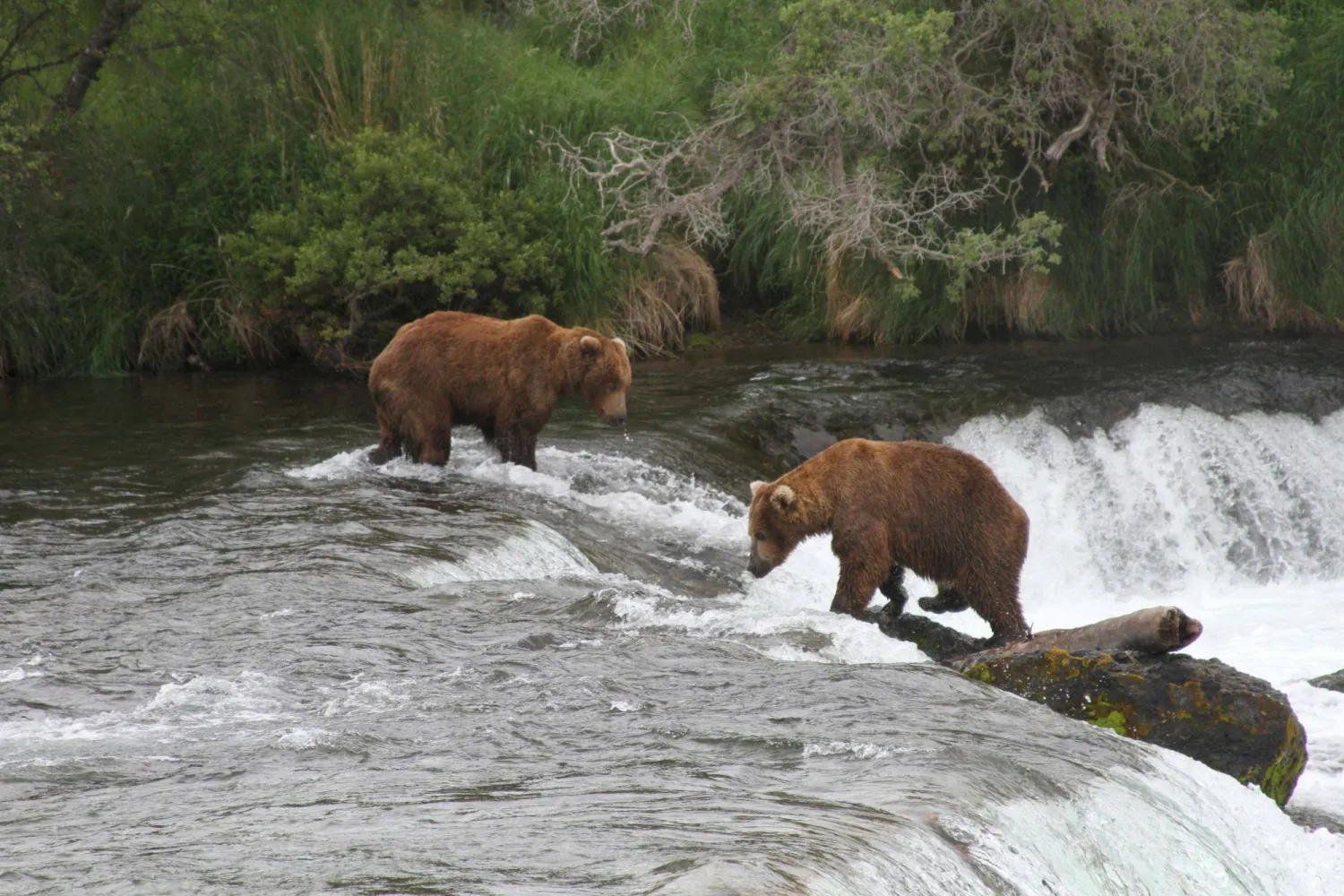
FILE - Two brown bears look for salmon at Brooks Falls in Katmai National Park and Preserve, Alaska, July 4, 2013. (AP File Photo/Mark Thiessen, File)
TT

Judge: Alaska wildlife Agents Can Kill Bears from Helicopters in Effort to Protect Caribou

FILE - Two brown bears look for salmon at Brooks Falls in Katmai National Park and Preserve, Alaska, July 4, 2013. (AP File Photo/Mark Thiessen, File)

Alaska wildlife agents can resume shooting and killing black and brown bears — including from helicopters — as part of a plan to help recover a caribou herd that was once an important source of food for Alaska Native hunters, a judge ruled Wednesday.

Two conservation groups, the Alaska Wildlife Alliance and Center for Biological Diversity, sought to halt the program while their lawsuit challenging its legality plays out. But Superior Court Judge Adolf Zeman said the groups had failed to show that the state acted without a reasonable basis for approving the plan.

The timing of the ruling is important: The Mulchatna caribou herd in southwest Alaska is expected to begin calving soon. The babies are particularly susceptible to being eaten by bears or wolves.

State officials see the bear-killing program as important to helping the caribou herd recover. The herd, which once provided up to about 4,770 caribou a year for subsistence hunters from dozens of communities, peaked at around 190,000 animals.

But the caribou population began declining in the late 1990s and early 2000s, and by 2019 numbered around 13,000 animals. Last year, the population was estimated around 16,280, according to the state Department of Fish and Game. Hunting has not been allowed since 2021.

The state killed 180 bears from 2023 to 2024, most of them brown bears, plus 11 more last year, according to the conservation groups' lawsuit. The groups argue that the Alaska Board of Game last year authorized reinstating the program without key data on the bears’ population numbers and sustainability.

Cooper Freeman, Alaska director at the Center for Biological Diversity, said in a statement the groups want to see the caribou herd thrive, “but the state simply hasn’t shown that the unrestrained killing of bears is going to help us get there.”

“We need to stop this disgraceful waste of the state’s limited resources and work based on science to protect all our wildlife,” The Associated Press quoted Freeman as saying.

State attorneys have said that officials took a “hard look” at factors related to bear numbers in adopting the plan.

“The herd has persisted at low numbers but started showing a positive response since 2023, when bear removal during calving seasons began,” they wrote in a court filing.

The Alaska Department of Law welcomed Zeman's decision “to allow this management program to continue during the upcoming caribou calving season, a crucial time for herd recovery,” spokesperson Sam Curtis said by email. The department represents the board and Department of Fish and Game.

“Continuing this program makes sense in light of the scientific record,” Curtis said.

Attorneys with Trustees for Alaska, representing the conservation groups, are reviewing the ruling and “will consider all available options,” spokesperson Madison Grosvenor said by email.

The program has been the subject of ongoing litigation. A judge last year, in a case previously brought by the Alaska Wildlife Alliance, found fault with the process in which it was adopted and concluded the state lacked data on bear sustainability.

Emergency regulations implemented by the state were later struck down. A subsequent public process was announced surrounding plans to reauthorize the program, which the board did last July.


Prince William to Sell Parts of Royal Estate to Reinvest in Local Communities

Football - FA Cup - Final - Chelsea v Manchester City - Wembley Stadium, London, Britain - May 16, 2026 William, Prince of Wales, before the start of the match. (Reuters)
TT

Prince William to Sell Parts of Royal Estate to Reinvest in Local Communities

Football - FA Cup - Final - Chelsea v Manchester City - Wembley Stadium, London, Britain - May 16, 2026 William, Prince of Wales, before the start of the match. (Reuters)

Britain's Prince ‌William will sell off parts of his vast Duchy of Cornwall estate over the next decade to help fund plans to invest more than 500 million pounds ($670 million) in local communities, including affordable housing and environmental projects.

The sales were reported by the Times newspaper to equate to 20% of the estate which is one of Britain's biggest landowners with a portfolio that includes ‌large swathes ‌of land as well as commercial ‌and ⁠residential properties.

"The Duchy ⁠should exist to make a positive impact, particularly in the communities where we can make the biggest difference," said Will Bax, Chief Executive of the Duchy of Cornwall.

"That ambition requires significant investment and, in some cases, means rebalancing what ⁠we own in order to ‌be as impactful as ‌possible to our communities, now and in the future."

Bax ‌said the money would be "largely funded ‌by reinvesting capital from across the Duchy, alongside development income, partnerships and some borrowing."

William, who received a private income of more than 20 million pounds from the ‌Duchy last year, and his father King Charles have in recent years ⁠faced ⁠criticism over the way their estates have been managed. Aides say William has been looking closely at management of the Duchy since inheriting it in 2022.

In 2024, a Sunday Times report and separate TV documentary accused Charles and his heir William of making millions from the country's health service, army and schools from charges imposed by their respective estates.

The Duchy subsequently reduced rents significantly for a number of charity and community tenants.


Escaped Tiger Shot Dead by German Police

Local media say the tiger belongs to controversial trainer Carmen Zander, also known as Germany's "Tiger Queen" - AFP
TT

Escaped Tiger Shot Dead by German Police

Local media say the tiger belongs to controversial trainer Carmen Zander, also known as Germany's "Tiger Queen" - AFP

German police said Monday they had shot dead a tiger that escaped from an enclosure run by a woman nicknamed the "Tiger Queen" after it attacked one of the keepers.

Police told AFP that the animal had seriously injured a 72-year-old man, who was being treated in hospital after the attack in the eastern city of Leipzig.

The incident happened Sunday on the city's outskirts and involved an "escaped tiger which was killed by police using firearms," the police spokesman said.

Police said they were "able to locate the animal in an allotment complex" nearby and that it had to be killed "to prevent danger to those present".

One allotment gardener told the Bild newspaper: "First we heard sirens and then right afterwards a helicopter came and lots of police", who warned the allotment owners to stay inside.

"Then there were suddenly several shots."

The animal belonged to tiger trainer Carmen Zander, who told Bild that the tiger shot dead was called Sandokan.

According to Zander's website, Sandokan was a nine-year-old, 280-kilogram (615 pound) Bengal-Siberian mix.

The website describes the animal as "a scaredy-cat" that could "quickly become overwhelmed and insecure" and could therefore attack "more quickly and unexpectedly" than the other animals.

Zander, known as the "Tiger Queen", has faced criticism in the past for the conditions in which the animals are kept at her enclosure.

Animal rights group PETA charged that veterinary authorities "share responsibility for this tragic incident" by having failed to act against the facility sooner and demanded that the remaining animals there be confiscated.

The district authority said in a statement to AFP that it had "for some time been working to improve the housing conditions of the tigers" at the site.

Zander had been instructed to comply with regulations "so that all animals have access to the necessary indoor and outdoor space, or to adjust the number of animals to the space currently available".


Japan Arrests Americans over Stunt at Baby Monkey Punch's Zoo

Tourists have flocked to the Ichikawa City Zoo to see the macaque named Punch, who was abandoned by his mother shortly after his birth. Yuichi YAMAZAKI / AFP
TT

Japan Arrests Americans over Stunt at Baby Monkey Punch's Zoo

Tourists have flocked to the Ichikawa City Zoo to see the macaque named Punch, who was abandoned by his mother shortly after his birth. Yuichi YAMAZAKI / AFP

Two American nationals were arrested in Japan after a stunt in which one entered the monkey enclosure at a zoo where a baby macaque named Punch became a global internet sensation this year, police said Monday.

One of the men, who identified himself as a 24-year-old college student, was arrested Sunday after climbing over a fence and dropping into a dry moat surrounding the monkey exhibit at Ichikawa City Zoo outside Tokyo.

The other man, who was filming the act, identified himself as a 27-year-old singer.

Images on social media showed a person scaling the fence in a costume that included a smiley face head with sunglasses, prompting the monkeys to scatter.

The men did not come close to the animals, and were quickly apprehended by zoo officials, said an official at Ichikawa Police who spoke with AFP on a traditional condition of anonymity.

The two men face charges of forcible obstruction of business, which they refute, the police official said.

The duo did not have formal identifications with them and initially tried to lie to police about their names, he added.

The arrests follow a massive surge in domestic and international visitors to the zoo, driven by Punch's viral fame.

The baby monkey became an internet star this year after the zoo posted photos of Punch clutching an IKEA plush orangutan for comfort after being rejected by his mother.

Punch was raised in an artificial environment after being born in July, and began training to rejoin his troop earlier this year.

Punch's predicament sparked huge interest online, spawning a devoted fanbase under the hashtag #HangInTherePunch.

An unprecedented number of tourists are flocking to Japan, but some residents have become fed up with unruly behavior.

Last year, a Ukrainian YouTuber with more than 6.5 million subscribers was arrested after livestreaming himself trespassing in a house in the Fukushima nuclear exclusion zone.

And a US livestreamer known as Johnny Somali was arrested in 2023 for allegedly trespassing onto a construction site.
