


Gaza Surfers Find Rare Moments of Joy Taking to the Waves

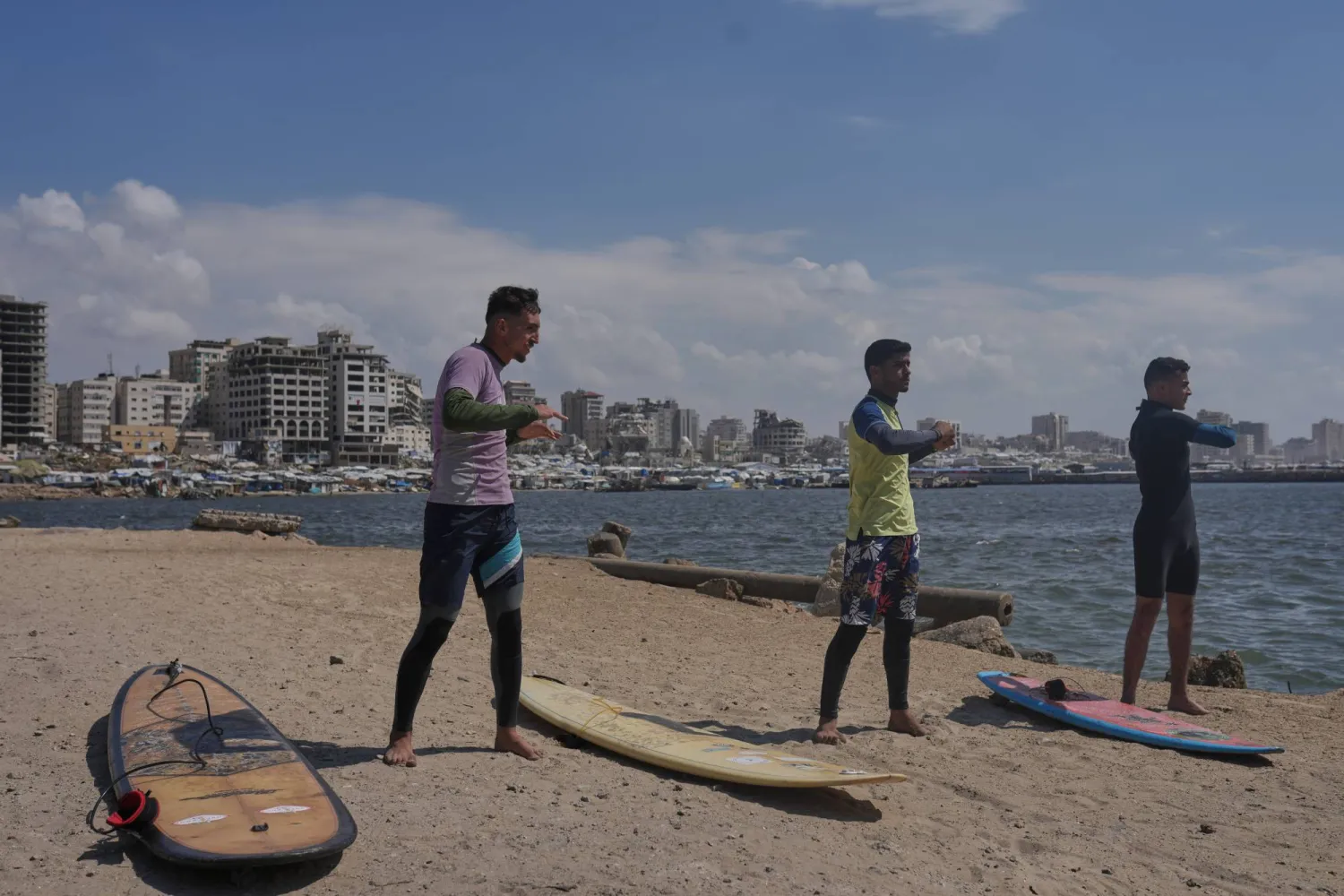
Palestinians Tahseen Abu Assi, left, Khalil Abu Jayyab, center, and Abed Rahim Alostaz warn up before surfing on the beach in Gaza City, Monday, May 4, 2026. (AP Photo/Jehad Alshrafi)
TT

Gaza Surfers Find Rare Moments of Joy Taking to the Waves

Palestinians Tahseen Abu Assi, left, Khalil Abu Jayyab, center, and Abed Rahim Alostaz warn up before surfing on the beach in Gaza City, Monday, May 4, 2026. (AP Photo/Jehad Alshrafi)

Despite the dire humanitarian crisis across the Gaza Strip, where a fragile ceasefire remains in place, a handful of Palestinian surfers are finding joy — and relief — riding the waves of the territory’s Mediterranean coastal waters.

Only three or four men still surf due to a shortage of surfboards and the materials needed to fix damaged ones, said Tahseen Abu Assi, a surfer in Gaza City.

Abu Assi carried his surfboard with him through every displacement he endured during the two-year war because, he said, he wouldn't be able to replace it.

“If something happened to it I won’t be able to get another one,” he said, noting that no boards have entered the Palestinian territory since 2007.

Surfboards are among sports equipment and other products that are banned by Israel.

On Tuesday, Abu Assi was among three surfers who took to the sea off the Gaza City port, including Khalil Abu Jiab, who road the high waves with his arms raised in joy.

After the war began, the Israeli military heavily restricted sea activity in Gaza, with the United Nations reporting that some fishermen were attacked onshore or at sea, including incidents involving fishermen using paddle boats.

Last year, Israel declared Gaza’s waters a “no-go zone,” banning fishing, swimming and sea access, making surfing risky.

Fishing and swimming are prohibited and dangerous in the waters off northern and southern Gaza. It's also risky to enter the waters off central Gaza, where Gaza City is located, due to Israeli patrols.
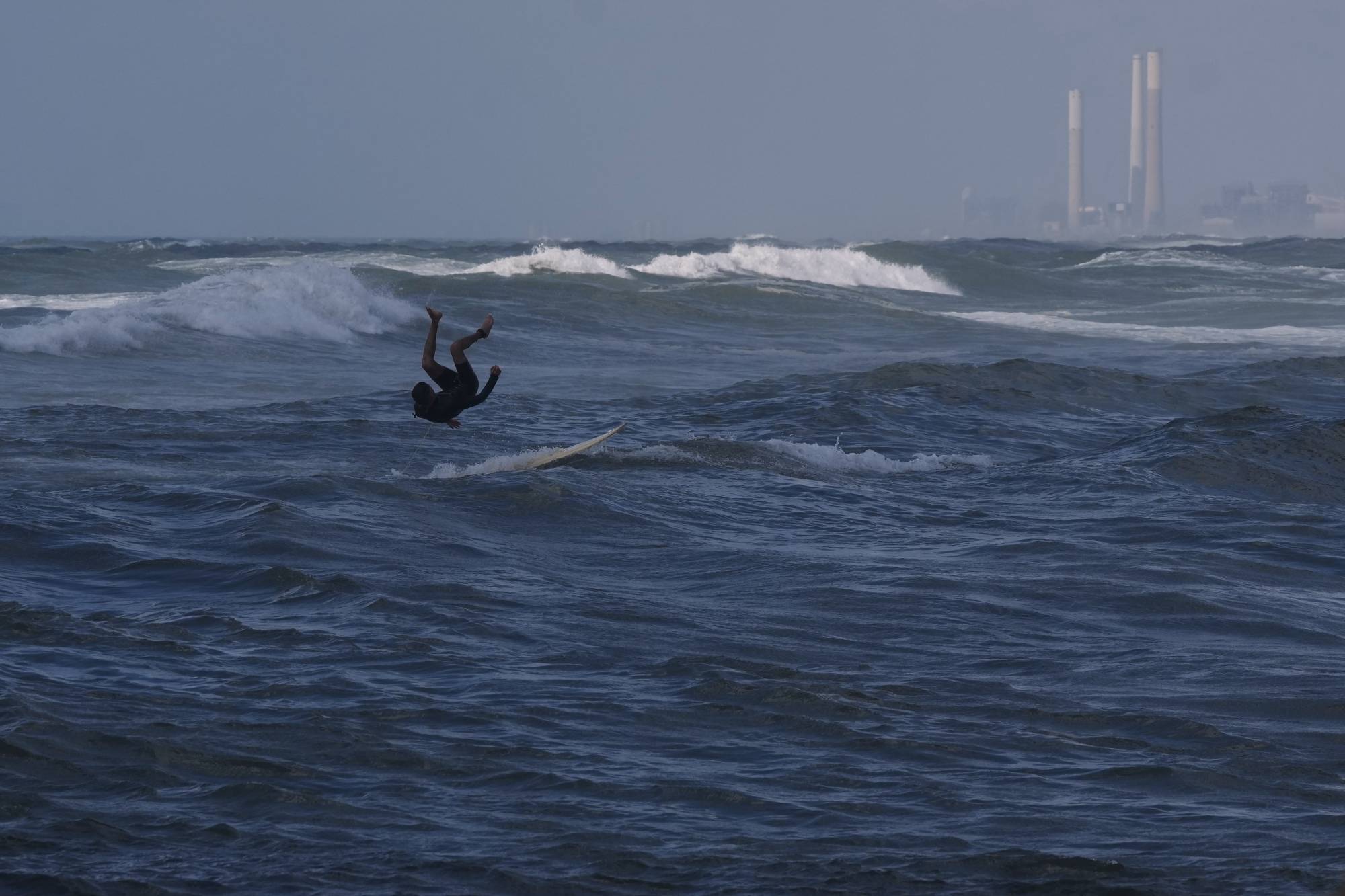
A Palestinian jumps into the waters of the Mediterranean Sea as he surfs on the beach in Gaza City, Monday, May 4, 2026. (AP Photo/Jehad Alshrafi)

“There is fear of course, but we can’t leave this sport," The Associated Press quoted Abu Assi as saying. "During the war, in the middle of the war, in the middle of the bombing and the planes above us, we used to go down and practice this sport.”

Gaza’s waves rarely rise high enough for surfing, so when they do, surfers drop everything to get in the water, he added.

Intense fighting across the enclave eased after a shaky ceasefire took effect on Oct. 10, but deadly Israeli strikes have continued, with both Hamas and Israel accusing each other of violating the truce.

Palestinians continue to struggle to secure food, clean water, medical care and shelter after the war caused widespread destruction, dismantled healthcare infrastructure and displaced most of the territory’s residents.

But for the territory's few surfers, there is relief, even if only fleeting, when they take to the waves.

“As soon as the sea gets high, you leave your work and leave your whole life,” Abu Assi said. "Work can be caught up on, as they say. We go practice this sport.”



Blue Origin Rocket Explosion is Bad News for Both Bezos and NASA

Video of the Blue Origin New Glenn rocket explosion showed the spacecraft combusting into a massive fireball. JohnCn (@JConcilus) on X / UGC/AFP
TT

Blue Origin Rocket Explosion is Bad News for Both Bezos and NASA

Video of the Blue Origin New Glenn rocket explosion showed the spacecraft combusting into a massive fireball. JohnCn (@JConcilus) on X / UGC/AFP

Space exploration is filled with setbacks, but the spectacular explosion of Blue Origin's New Glenn rocket on Thursday night marked a significant blow to not only the company, which was founded by billionaire Jeff Bezos, but also NASA, with the two collaborating for the upcoming US Moon missions.

"Spaceflight is unforgiving," NASA Administrator Jared Isaacman said in a post on X soon after the explosion, promising to "support a thorough investigation of this anomaly," which happened during a ground test and resulted in no injuries.

The rocket -- which stands 98 meters (321 feet) tall and is the most powerful in Blue Origin's fleet -- exploded around 9:00 pm local time Thursday (0100 GMT Friday).

It was undergoing a ground test in Cape Canaveral, Florida in preparation of an upcoming flight when it blew up in a massive fireball, sending shockwaves throughout the space industry.

While anomalies during ground tests are relatively frequent, such explosions are rare, and the magnitude of the blast caused significant damage not only to the spacecraft but the launch pad itself, according to photos of the aftermath released Friday.

"It will take some time to rebuild their pad," Florida congressman Mike Haridopolos, whose district includes Cape Canaveral, told broadcaster Fox News on Friday.

Blue Origin declined an AFP request for additional details on the incident, extent of damage or the ongoing investigation, which is conducted alongside NASA and the US Space Force.

The New Glenn rocket will remain grounded while the investigation is conducted.

- Moon Mission -

The vessel is at the heart of Blue Origin's ambition and NASA's Artemis lunar program, and could have implications for the company's role going forward.

"I have no doubt they will recover but I'm wondering how does this affect Artemis," Clayton Swope, deputy director of the Aerospace Security Project at the Center for Strategic and International Studies, told AFP.

NASA has also tasked rival space exploration company SpaceX to develop lunar landers for transporting astronauts and equipment to the surface of the Moon to establish a base.

SpaceX has seen its own challenges in recent months, and Blue Origin had emerged as a promising alternative for NASA, with the US space agency awarding a new contract to it for the lunar mission earlier this week.

- Major setback -

But these projects depend on the New Glenn rocket, and with its explosion coming shortly after a malfunction causing a satellite mission failure last month, the anomalies could disrupt NASA's tight mission schedule.

NASA is aiming to test an in-orbit rendezvous between a spacecraft and one or two lunar landers in 2027 as part of Artemis III, and carry out a crewed lunar landing before the end of 2028, before the end of US President Donald Trump's time in office.

Thursday's explosion also deals a major setback to another Bezos project, the Amazon Leo satellite internet constellation, which seeks to compete with SpaceX's Starlink but relies on the New Glenn rocket, among others, to launch its satellites, according to Swope.

The Blue Origin rocket blowing up is not the only time an explosion has rocked Cape Canaveral.

Ten years ago, a SpaceX Falcon 9 rocket blew up during a ground test before launching, destroying a $200 million satellite it was supposed to carry.


Half of France Hits New Monthly Records in Heatwave

 Tennis - French Open - Roland Garros, Paris, France - May 29, 2026 A spectator uses a tap outside the courts during the matches. (Reuters)
Tennis - French Open - Roland Garros, Paris, France - May 29, 2026 A spectator uses a tap outside the courts during the matches. (Reuters)
TT

Half of France Hits New Monthly Records in Heatwave

 Tennis - French Open - Roland Garros, Paris, France - May 29, 2026 A spectator uses a tap outside the courts during the matches. (Reuters)
Tennis - French Open - Roland Garros, Paris, France - May 29, 2026 A spectator uses a tap outside the courts during the matches. (Reuters)

Towns and villages in more than half of France have smashed temperature records for the month of May over the past week during an unusually early heatwave, a climatologist said Friday.

"More than half of France has experienced at least one monthly heat record -- whether in minimum and/or maximum temperatures -- during this episode, which is colossal," said Matthieu Sorel, a climatologist at French weather service Meteo France.

Temperatures were expected to cool over the weekend.

From Saturday to Wednesday, there were around 109 monthly minimum temperature records and 266 monthly maximum temperature records, he added.

France beat a national record for a month of May earlier this week, peaking with a national thermal average indicator of 24.9C on Tuesday.

On Thursday, the temperature in the southwestern city of Angouleme hit a maximum of 37.8C, the highest it had ever been in any part of France in May.

Studies and scientific bodies agree that heatwaves in Europe are becoming more frequent.

Meteo France says that of the 51 heatwaves recorded nationwide since 1947, 34 have come since 2000 and 26 since 2011.

Global average temperatures are likely to continue at or near record levels this year and for the next four years afterwards, the United Nations warned on Thursday.


Pigeons May Be Navigating with Their Liver, Study Suggests

Palestinian girl Ilan, 4, feeds pigeons at the Flag Square in the coastal city of Tyre, southern Lebanon, 20 May 2026. (EPA)
TT

Pigeons May Be Navigating with Their Liver, Study Suggests

Palestinian girl Ilan, 4, feeds pigeons at the Flag Square in the coastal city of Tyre, southern Lebanon, 20 May 2026. (EPA)

A surprising gut feeling may help pigeons find their way home.

Animals use various techniques to navigate including following the stars and remembering key landmarks. Birds, fish and turtles orient themselves using Earth's magnetic field as a compass. But it's not yet clear how exactly they do this.

Pigeons are a well-known group of frequent flyers that can traverse hundreds of miles (hundreds of kilometers) in a single day. For thousands of years, humans have used them to carry news, notes and military messages.

Scientists have long tried to untangle how pigeons travel without getting lost. Some think the birds detect magnetic cues using light-sensitive molecules in their eyes, while others suggest it happens in the beak or inner ear.

“The magnetic sense has been this mystery for almost 100 years,” said Martin Wikelski with the Max Planck Institute of Animal Behavior in Germany.

In a new study, Wikelski and other researchers decided to draw back the curtain on pigeons' navigational secrets. They searched for magnetic clues in the birds' organs and found a strong signal in an unexpected place: the liver.

Specialized immune cells in the pigeon's liver break down red blood cells and store iron. When scientists temporarily stripped pigeons of those immune cells and let them fly, the birds “just couldn't find their way,” said Christian Kurts with the University of Bonn in Germany. That suggested the iron-rich liver cells might play a role in their sense of direction.

The birds' magnetic compasses only got scrambled on overcast days. That's because they also use the sun as a navigational guide.

Scientists have previously wondered whether immune cells could be involved in magnetic sensing, but the new study published Thursday in the journal Science is the first to present a full-fledged theory.

“I would never have guessed it, but once it was explained to me, it makes sense,” said behavioral ecologist Albert Kao with the University of Massachusetts Boston, who had no role in the study.

The immune cells are located near nerve fibers in the liver. That might be how they transmit their “magnetic sense” to the brain “and help the pigeons to navigate,” said study co-author Clivia Lisowski with the University of Bonn.

The researchers think other birds and animals like mice could operate using a similar magnetic GPS. But outside experts say more work is needed to verify the pigeons navigate this way and to firm up how these signals get to the brain.

While the researchers found the strongest magnetic signal in the pigeons' livers, such immune cells have also been spotted in other areas including the beak and spleen.

It's possible this magnetic puzzle doesn't have a single answer, wrote veterinary pathologist Simon Spiro and biologist Hal Drakesmith in an accompanying editorial. The birds could use different techniques to sense magnetic fields depending on the task, be it traveling long distances or finding a specific destination.

“Indeed, it could be prudent to have more than one way of getting home in the dark,” they wrote.