


'Ghost of the Forest' Returns to Kenya as Conservationists Reintroduce Rare Antelope into the Wild

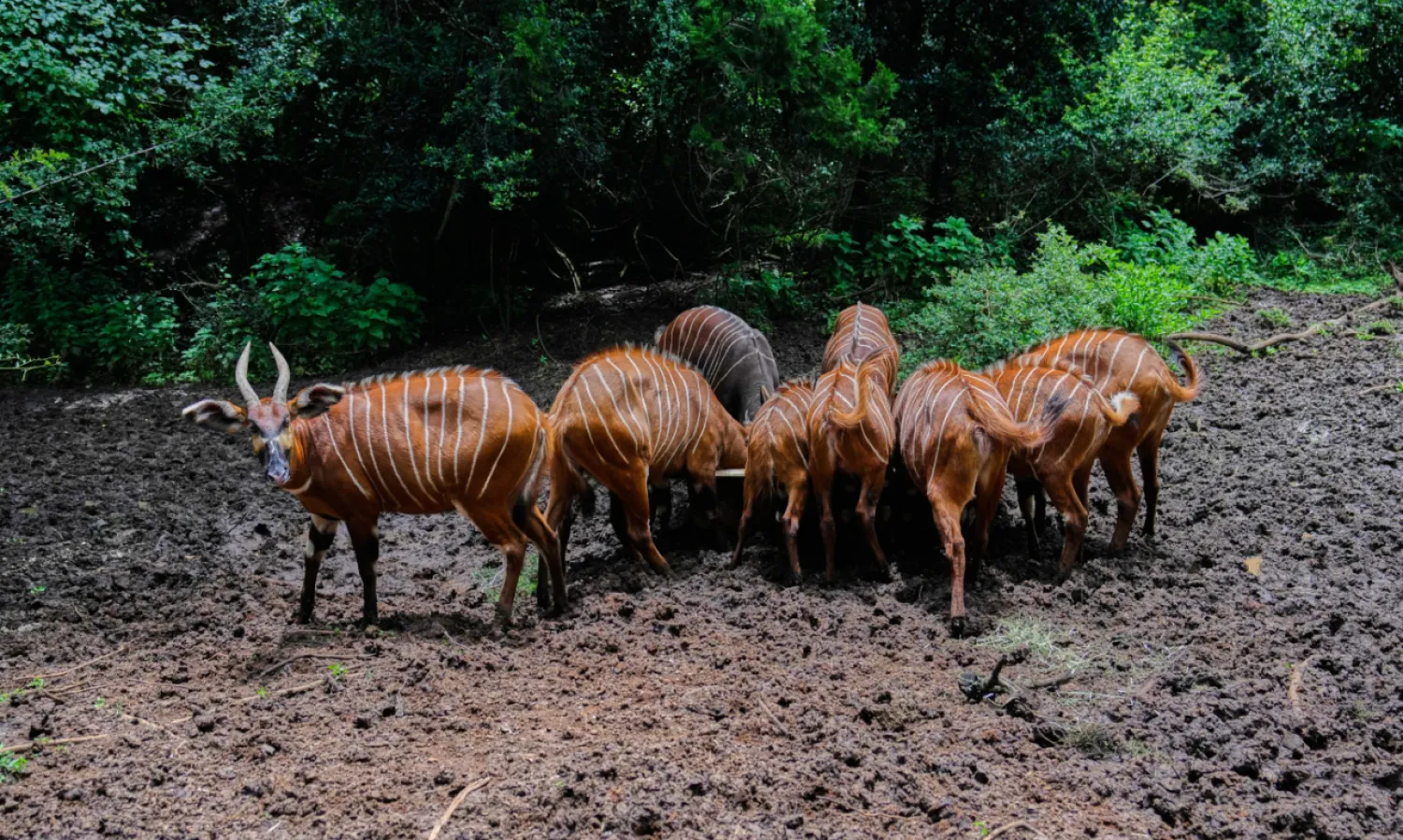
Critically endangered mountain bongos feed in a forest enclosure at the Mount Kenya Wildlife Conservancy in Nanyuki, Laikipia County, Kenya, Saturday, May 9, 2026. (AP Photo/Brian Inganga)
TT

'Ghost of the Forest' Returns to Kenya as Conservationists Reintroduce Rare Antelope into the Wild

Critically endangered mountain bongos feed in a forest enclosure at the Mount Kenya Wildlife Conservancy in Nanyuki, Laikipia County, Kenya, Saturday, May 9, 2026. (AP Photo/Brian Inganga)

The mountain bongo has become the ghost of the forest, hard to spot amid the dense shrubs due to its ability to camouflage.

A critically endangered species, the animal is being slowly reintroduced into the wild by conservationists to increase the number of the rare antelope that are indigenous to Kenya’s forests.

The mountain bongo is a rare antelope known for its brown skin and distinct white stripes. With fewer than 100 individuals left in the wild, a conservancy based in Kenya is breeding them and slowly reintroducing them into the wild, with a target of 750 wild bongos by 2050, The AP news reported.

Located on the misty slopes of Kenya’s highest mountain, Mount Kenya, and on the edge of the forest, the 1,250-acre Mount Kenya Wildlife Conservancy in the Nanyuki area has been restoring the survival instincts of zoo-bred bongos. They want to ensure the animals can feed without human assistance, escape from predators, and build a strong immunity against diseases in the wild.

Last week, the conservancy imported a new batch of four male bongos from the European Association of Zoos and Aquaria though the Czech Republic. These new arrivals, currently quarantined and under constant observation, will interbreed with descendants of 18 bongos that arrived at the conservancy in 2004 from the United States to ensure a more diverse genetic pool.

The conservancy’s head, Dr. Robert Aruho, says inbreeding among bongos with similar genes is discouraged while rebuilding the population of this critically endangered species.

“We want bongos that are not only strong in body, but strong in the genes they pass to the next generation,” he said.

Bongos are native to Kenya’s Mount Kenya, Aberdare, Eburu and Mau forests, which play a key role in protecting the forests that are vital to the country’s water supply.

The last wild bongo was spotted in the Mount Kenya forest in 1994 before the conservancy reintroduced the first 10 bongos to the wild in 2022. Today, they roam among the orange climber vines and shrubs that form part of their favorite plants.

The bongo population dwindled after thousands of them died in disease outbreaks in the 1960s. In the 1980s, conservationist Don Hunt exported 36 of the species to the U.S. as insurance to be bred in captivity, with a plan to return them to the wild when conditions improved.

When the Mount Kenya Wildlife Conservancy was opened in 2004, 18 descendants of these bongos were imported and have since interbred, bringing the conservancy’s population to 102 bongos.

Caroline Makena, 33, grew up in the Mount Kenya region and remembers hearing stories about bongos from her grandmother, who said they were her community’s favorite bush meat. However, Makena never got to see one until she came to work as a gardener at the conservancy.

“I never knew the bongos were this beautiful, and I think my community loved them not just for the meat but because of their beauty,” she said.

The bongos are shy and can camouflage despite their distinct white stripes, and these attributes are critical for their survival in the wild.

Andrew Mulani, the bongo program assistant at the conservancy, said the bongos are monitored for months before being reintroduced into the wild to ensure that the shyest ones are selected because docile animals would fall easily to predators.

His most fulfilling moment was when the fourth calf was born in the wild last year, an indication that the bongos are thriving in their native habitat and that their population will certainly increase.

Bongos have a gestation period of nine months, a factor that has negatively impacted their slow population growth. They are also sensitive and react to some plants and weather conditions compared to other species in the antelope family that thrive in the same ecosystem.

As the team of conservationists in Mount Kenya races to save the critically endangered species, supplementing the bongos’ shrub diet with special nutritious pellets, thousands of tourists who visit the conservancy annually marvel at their spiraled horns, hoping the ghost of the forest will become a more common sight in Kenya’s forests.



Blue Origin Rocket Explosion is Bad News for Both Bezos and NASA

Video of the Blue Origin New Glenn rocket explosion showed the spacecraft combusting into a massive fireball. JohnCn (@JConcilus) on X / UGC/AFP
TT

Blue Origin Rocket Explosion is Bad News for Both Bezos and NASA

Video of the Blue Origin New Glenn rocket explosion showed the spacecraft combusting into a massive fireball. JohnCn (@JConcilus) on X / UGC/AFP

Space exploration is filled with setbacks, but the spectacular explosion of Blue Origin's New Glenn rocket on Thursday night marked a significant blow to not only the company, which was founded by billionaire Jeff Bezos, but also NASA, with the two collaborating for the upcoming US Moon missions.

"Spaceflight is unforgiving," NASA Administrator Jared Isaacman said in a post on X soon after the explosion, promising to "support a thorough investigation of this anomaly," which happened during a ground test and resulted in no injuries.

The rocket -- which stands 98 meters (321 feet) tall and is the most powerful in Blue Origin's fleet -- exploded around 9:00 pm local time Thursday (0100 GMT Friday).

It was undergoing a ground test in Cape Canaveral, Florida in preparation of an upcoming flight when it blew up in a massive fireball, sending shockwaves throughout the space industry.

While anomalies during ground tests are relatively frequent, such explosions are rare, and the magnitude of the blast caused significant damage not only to the spacecraft but the launch pad itself, according to photos of the aftermath released Friday.

"It will take some time to rebuild their pad," Florida congressman Mike Haridopolos, whose district includes Cape Canaveral, told broadcaster Fox News on Friday.

Blue Origin declined an AFP request for additional details on the incident, extent of damage or the ongoing investigation, which is conducted alongside NASA and the US Space Force.

The New Glenn rocket will remain grounded while the investigation is conducted.

- Moon Mission -

The vessel is at the heart of Blue Origin's ambition and NASA's Artemis lunar program, and could have implications for the company's role going forward.

"I have no doubt they will recover but I'm wondering how does this affect Artemis," Clayton Swope, deputy director of the Aerospace Security Project at the Center for Strategic and International Studies, told AFP.

NASA has also tasked rival space exploration company SpaceX to develop lunar landers for transporting astronauts and equipment to the surface of the Moon to establish a base.

SpaceX has seen its own challenges in recent months, and Blue Origin had emerged as a promising alternative for NASA, with the US space agency awarding a new contract to it for the lunar mission earlier this week.

- Major setback -

But these projects depend on the New Glenn rocket, and with its explosion coming shortly after a malfunction causing a satellite mission failure last month, the anomalies could disrupt NASA's tight mission schedule.

NASA is aiming to test an in-orbit rendezvous between a spacecraft and one or two lunar landers in 2027 as part of Artemis III, and carry out a crewed lunar landing before the end of 2028, before the end of US President Donald Trump's time in office.

Thursday's explosion also deals a major setback to another Bezos project, the Amazon Leo satellite internet constellation, which seeks to compete with SpaceX's Starlink but relies on the New Glenn rocket, among others, to launch its satellites, according to Swope.

The Blue Origin rocket blowing up is not the only time an explosion has rocked Cape Canaveral.

Ten years ago, a SpaceX Falcon 9 rocket blew up during a ground test before launching, destroying a $200 million satellite it was supposed to carry.


Half of France Hits New Monthly Records in Heatwave

 Tennis - French Open - Roland Garros, Paris, France - May 29, 2026 A spectator uses a tap outside the courts during the matches. (Reuters)
Tennis - French Open - Roland Garros, Paris, France - May 29, 2026 A spectator uses a tap outside the courts during the matches. (Reuters)
TT

Half of France Hits New Monthly Records in Heatwave

 Tennis - French Open - Roland Garros, Paris, France - May 29, 2026 A spectator uses a tap outside the courts during the matches. (Reuters)
Tennis - French Open - Roland Garros, Paris, France - May 29, 2026 A spectator uses a tap outside the courts during the matches. (Reuters)

Towns and villages in more than half of France have smashed temperature records for the month of May over the past week during an unusually early heatwave, a climatologist said Friday.

"More than half of France has experienced at least one monthly heat record -- whether in minimum and/or maximum temperatures -- during this episode, which is colossal," said Matthieu Sorel, a climatologist at French weather service Meteo France.

Temperatures were expected to cool over the weekend.

From Saturday to Wednesday, there were around 109 monthly minimum temperature records and 266 monthly maximum temperature records, he added.

France beat a national record for a month of May earlier this week, peaking with a national thermal average indicator of 24.9C on Tuesday.

On Thursday, the temperature in the southwestern city of Angouleme hit a maximum of 37.8C, the highest it had ever been in any part of France in May.

Studies and scientific bodies agree that heatwaves in Europe are becoming more frequent.

Meteo France says that of the 51 heatwaves recorded nationwide since 1947, 34 have come since 2000 and 26 since 2011.

Global average temperatures are likely to continue at or near record levels this year and for the next four years afterwards, the United Nations warned on Thursday.


Pigeons May Be Navigating with Their Liver, Study Suggests

Palestinian girl Ilan, 4, feeds pigeons at the Flag Square in the coastal city of Tyre, southern Lebanon, 20 May 2026. (EPA)
TT

Pigeons May Be Navigating with Their Liver, Study Suggests

Palestinian girl Ilan, 4, feeds pigeons at the Flag Square in the coastal city of Tyre, southern Lebanon, 20 May 2026. (EPA)

A surprising gut feeling may help pigeons find their way home.

Animals use various techniques to navigate including following the stars and remembering key landmarks. Birds, fish and turtles orient themselves using Earth's magnetic field as a compass. But it's not yet clear how exactly they do this.

Pigeons are a well-known group of frequent flyers that can traverse hundreds of miles (hundreds of kilometers) in a single day. For thousands of years, humans have used them to carry news, notes and military messages.

Scientists have long tried to untangle how pigeons travel without getting lost. Some think the birds detect magnetic cues using light-sensitive molecules in their eyes, while others suggest it happens in the beak or inner ear.

“The magnetic sense has been this mystery for almost 100 years,” said Martin Wikelski with the Max Planck Institute of Animal Behavior in Germany.

In a new study, Wikelski and other researchers decided to draw back the curtain on pigeons' navigational secrets. They searched for magnetic clues in the birds' organs and found a strong signal in an unexpected place: the liver.

Specialized immune cells in the pigeon's liver break down red blood cells and store iron. When scientists temporarily stripped pigeons of those immune cells and let them fly, the birds “just couldn't find their way,” said Christian Kurts with the University of Bonn in Germany. That suggested the iron-rich liver cells might play a role in their sense of direction.

The birds' magnetic compasses only got scrambled on overcast days. That's because they also use the sun as a navigational guide.

Scientists have previously wondered whether immune cells could be involved in magnetic sensing, but the new study published Thursday in the journal Science is the first to present a full-fledged theory.

“I would never have guessed it, but once it was explained to me, it makes sense,” said behavioral ecologist Albert Kao with the University of Massachusetts Boston, who had no role in the study.

The immune cells are located near nerve fibers in the liver. That might be how they transmit their “magnetic sense” to the brain “and help the pigeons to navigate,” said study co-author Clivia Lisowski with the University of Bonn.

The researchers think other birds and animals like mice could operate using a similar magnetic GPS. But outside experts say more work is needed to verify the pigeons navigate this way and to firm up how these signals get to the brain.

While the researchers found the strongest magnetic signal in the pigeons' livers, such immune cells have also been spotted in other areas including the beak and spleen.

It's possible this magnetic puzzle doesn't have a single answer, wrote veterinary pathologist Simon Spiro and biologist Hal Drakesmith in an accompanying editorial. The birds could use different techniques to sense magnetic fields depending on the task, be it traveling long distances or finding a specific destination.

“Indeed, it could be prudent to have more than one way of getting home in the dark,” they wrote.