


In India, Heat-triggered Insurance Offers 'Some Relief'

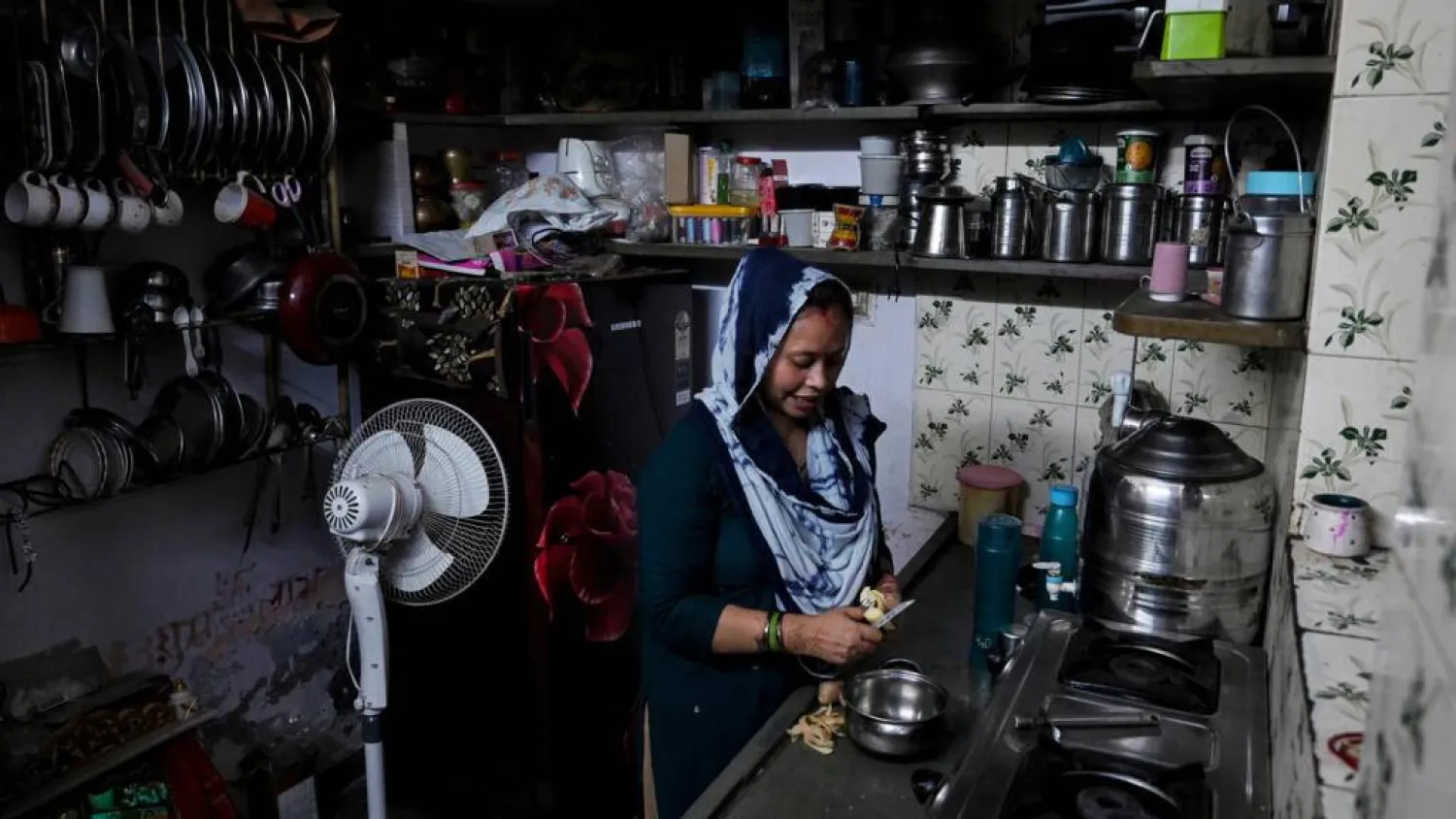
Rakhi Gulshan Singh, a seamstress and policyholder of a heat insurance scheme, preparing a meal inside her single-room rented home in Ahmedabad. Shammi MEHRA / AFP
TT

In India, Heat-triggered Insurance Offers 'Some Relief'

Rakhi Gulshan Singh, a seamstress and policyholder of a heat insurance scheme, preparing a meal inside her single-room rented home in Ahmedabad. Shammi MEHRA / AFP

Clothes seller Lata Solanki used to face a devastating choice when India's summer heat hit dangerous levels: risk her health going door-to-door for sales, or lose her income?

But now the 42-year-old is part of an insurance scheme that pays out when temperatures hit a threshold, so she can stay home without jeopardizing her finances, said AFP.

The "parametric" model pays out automatically when specific triggers are breached, in Solanki's case after two consecutive days at 43.72 degrees Celsius.

The payout is modest, but it helps, she told AFP in Ahmedabad, one of India's hottest cities.

"At least we feel there is some support," she said. "Because of the heat, the fan runs day and night. The bill goes up."

In 2023, the year before she joined the scheme, Solanki kept working during a heatwave and ended up sick at home for 20 days, losing at least 2,000 rupees ($21) in income.

The following year, she received 750 rupees from the scheme, small but more than the cost of the premium, and a relief in a country where the average monthly rural household income is 10,000 rupees ($105).

India lost an estimated 247 billion hours of labor to extreme heat in 2024, equivalent to nearly $194 billion in economic losses, according to the Lancet Countdown research group.

Agriculture and construction bore the brunt, and climate change is accelerating the number of days of extreme heat India sees.

Parametric insurance is seen as a way to protect the most vulnerable from climate impacts like heat, but also heavy rain.

In India's northeastern state of Nagaland, the government has insured its entire population against economic losses due to heavy rainfall under a parametric model since 2024.

The federal government is examining how to extend the schemes more widely to "supplement insurance mechanisms and reinforce protection to the people".

- 'Some relief' -

Unlike traditional insurance, parametric policies do not require individual damage assessments.

Instead, payouts are triggered automatically by heavy rain, high heat or even air pollution.

The scheme helping Solanki is a collaboration between the non-profit Mahila Housing Trust (MHT) and global insurer Go Digit, supported by the Climate Resilience for All initiative.

MHT program manager Nital Rahul Patel said the idea emerged after surveys and discussions with women workers in Ahmedabad, where temperatures sometimes hit 45C (113F).

"They would say it is very hot every year," she said. "But when we broke down their expenses, we realized incomes were falling by 2,000-2,500 rupees ($21-26) over four months of summer."

The scheme began in 2024 with 26,000 women across Gujarat. Their 354-rupee premium was covered by Climate Resilience for All.

In 2025 enrolment rose, but the scheme made no payments because the temperature threshold was not met.

This year, the trigger has been revised down to 42.74 degrees Celcius, and the scheme aims to cover more than 30,000 women.

If temperatures hit the threshold for two days, they will qualify for payments ranging from 850 to 2,000 rupees ($21).

Higher temperatures trigger higher payments, but the amount is a one-off, not cumulative. It is assessed and paid at the end of the heat season in September.

Rakhi Gulshan Singh, a seamstress earning around 4,000 rupees a month, signed up even though she works indoors.

"When I run the sewing machine, it becomes even hotter," the 30-year-old said, who got a payout in 2024. "It is small, but it gives some relief."

- 'Faster and more transparent' -

Adarsh Agarwal, appointed actuary at Go Digit, said his company has covered more than 50,000 people since it began working on parametric insurance two years ago.

While still a "niche product", he said demand has increased.

There is now "more knowledge and more curiosity", he told AFP, and his firm has offered both heat and air-quality parametric schemes.

Payment thresholds are set based on historical weather data and intended to be "practical, sustainable and aligned to the intended segment while managing basis risk", he added.

The schemes can be "faster and more transparent" than traditional insurance, said Aniruddha Bhattacharjee, senior researcher for climate resilience and engineering at Climate Trends.

But payouts tend to be small, and effectiveness depends on how accurately trigger thresholds reflect actual ground realities, since models are largely built on historical data.

India's government weather forecasters are already predicting boiling, above-average temperatures in May and June, which Solanki joked might turn out to be good news.

"Maybe we will get a payout," she said.

But regardless, she plans to stay enrolled "even if it means paying the premium from our pockets".



Russia Unblocks Roblox after Widespread Child Anger

People rest outside the Kremlin on a warm summer day in downtown Moscow, Russia, 05 June 2026. EPA/MAXIM SHIPENKOV
TT

Russia Unblocks Roblox after Widespread Child Anger

People rest outside the Kremlin on a warm summer day in downtown Moscow, Russia, 05 June 2026. EPA/MAXIM SHIPENKOV

Russia has lifted its ban on the popular gaming platform Roblox, after tens of thousands of children and parents sent letters complaining about the measure.

The platform -- which allows users to build their own games and share them with others -- was among Russia's most popular mobile games, tying third with TikTok in usage time among children in early 2025, according to Kaspersky Lab, a Moscow-based global cybersecurity firm.

In a statement published Wednesday, Russia's digital ministry said Roblox had successfully implemented measures to "protect children, including by launching a mechanism to restrict access to games by age group.”

"Roblox has also committed to continuing to combat the spread of undesirable content on the platform," the statement added.

Russia banned access to the US-owned platform last December, accusing it of distributing extremist materials and promoting "LGBT propaganda.”

A Roblox spokesperson told AFP at the time that the company was committed to safety and respected "local laws and regulations.”

Ekaterina Mizulina, the head of Russia's state-sponsored internet censorship watchdog, said in December she had received "63,000 emails" from disgruntled schoolchildren and parents commenting on the ban.

"This raises a question. Perhaps it's time to look for other ways to combat pedophiles and provocateurs who target children online?" she said.

Around 100 million people use Roblox daily, with under-13s accounting for around 40 percent of its 2024 users, according to the company.

Kremlin spokesman Dmitry Peskov said Thursday that Roblox's unblocking in Russia "shows that all services can return if they comply with the law,” in comments to the state TASS news agency.


Moose Put Down after Wandering Into Central Oslo

People and personell from the wildlife board mill around a dead moose that had strayed into Majorstuen,a inner city area in Oslo, Norway on, June 11, 2026. (Photo by Javad Parsa / NTB / AFP)
TT

Moose Put Down after Wandering Into Central Oslo

People and personell from the wildlife board mill around a dead moose that had strayed into Majorstuen,a inner city area in Oslo, Norway on, June 11, 2026. (Photo by Javad Parsa / NTB / AFP)

Norwegian police said Thursday that a moose that had wandered into downtown Oslo, drawing curious crowds, had been shot and killed.

Videos taken by witnesses and published by Norwegian media show the disoriented animal galloping through the streets of the Norwegian capital, weaving around cars and pedestrians.

"For animal welfare reasons, the moose was put down" by the wildlife authorities, AFP quoted the police as saying.

Although such incidents remain rare -- moose tend to avoid metropolitan areas -- this is the second such incident recorded in two days in Scandinavia.

On Tuesday, a young moose was put down in Sweden after it strayed into the streets of Stockholm.


WWI Soldier's Postcard from Home Helps Unite his Family after a Century

A poppy wreath and a photo next to the grave of Private Thomas Redvers Whitaker during a burial ceremony for six British soldiers of World War I, at the CWGC's Tyne Cot Cemetery in Zonnebeke, Belgium, Wednesday, June 10, 2026. (AP Photo/Virginia Mayo)
TT

WWI Soldier's Postcard from Home Helps Unite his Family after a Century

A poppy wreath and a photo next to the grave of Private Thomas Redvers Whitaker during a burial ceremony for six British soldiers of World War I, at the CWGC's Tyne Cot Cemetery in Zonnebeke, Belgium, Wednesday, June 10, 2026. (AP Photo/Virginia Mayo)

A postcard belonging to a World War I soldier whose body was found with five comrades during an excavation has helped reunite distant descendants more than a century after his death on the Western Front.

Dozens of mourners attended a memorial service in western Belgium on Wednesday during which six new white marble headstones were dedicated to the British soldiers whose remains were recently identified through the use of archival research and DNA analysis, The Associated Press reported.

The six burials at the Tyne Cot Cemetery included that of Pvt. Thomas Whitaker, who died in the trenches carrying a postcard from Bradford, in north east England, where some of his relations still live.

At the ceremony were three members of the Whitaker family. Under sunshine piercing the gray drizzle, Joe Whitaker, 22, read aloud a poem written in honor of his great-great-uncle: “At peace in foreign hills, he finally drifts away to sleep, his mind on Bradford mills.”

The soldier's postcard proved to be a crucial piece of evidence that helped British government researchers establish his identity and ultimately linked Joe's family with another, estranged, branch of the Whitaker family.

Joe said: “The thought that (Thomas) might have been thinking of home, comforted by this postcard that he kept on him from Bradford — we were all quite taken aback by that.”

He said writing a poem “felt like the right thing to do.”

Alexia Clark, a commemorations case worker at the UK Ministry of Defense’s Joint Casualty and Compassionate Centre (JCCC), said the six soldiers were found during an excavation in western Belgium. But the discovery of the postcard on one of them proved to be a crucial “hint.”

She added: “And then actually when we looked at the missing list and went, ‘Oh we have got one from Bradford! Great, there’s a strong chance that he is going to be one of them.‘”

By matching the postcard with other found artifacts, including a Lewis Gun and uniforms, the JCCC researchers — known as “the war detectives” -- were able to zero in on a likely group of men from the more than half a million British soldiers still missing from World War I.

The team contacted potential relatives for DNA samples, and the analysis confirmed the identity not only of Thomas Whitaker, but also privates Horace Frederick Cook, Frederick Martin, Charles Richard Russels, Courtney Darvill Hart and Joseph Turnley -- all members of 2/4 Battalion Queen’s Royal West Surrey Regiment.

Paul Turnley was presented with a British flag folded into a triangle given by the military in honor of the sacrifice of his relation, Pvt. Joseph Turnley.

“Just a privileged to be laying a relative of ours to rest, to watch, to be present and then to be passed the flag... it was the greatest treasure actually,” said Paul, in tribute to his grandfather’s cousin.

As nearby cows, students and bike riders watched along an adjacent farm road, a military musician played a martial lament on a cornet, while prayers were said by the Rev. Adéle Rees.

Then Pvt. Jone Wainile of the Princess of Wales’s Royal Regiment honor guard read the poignant Kohima Epitaph: “When you go home tell them of us and say, ‘For your tomorrow, we gave our today.’”

Paul Whitaker said: “My children, my grandchildren, anyone, can come and know where Thomas is, and that is a lovely thing to have. It’s just a real privilege to have Thomas be one of the ones that has been found.”