NASA's Psyche Spacecraft Buzzing Mars on its Way to Rare Metal Asteroid

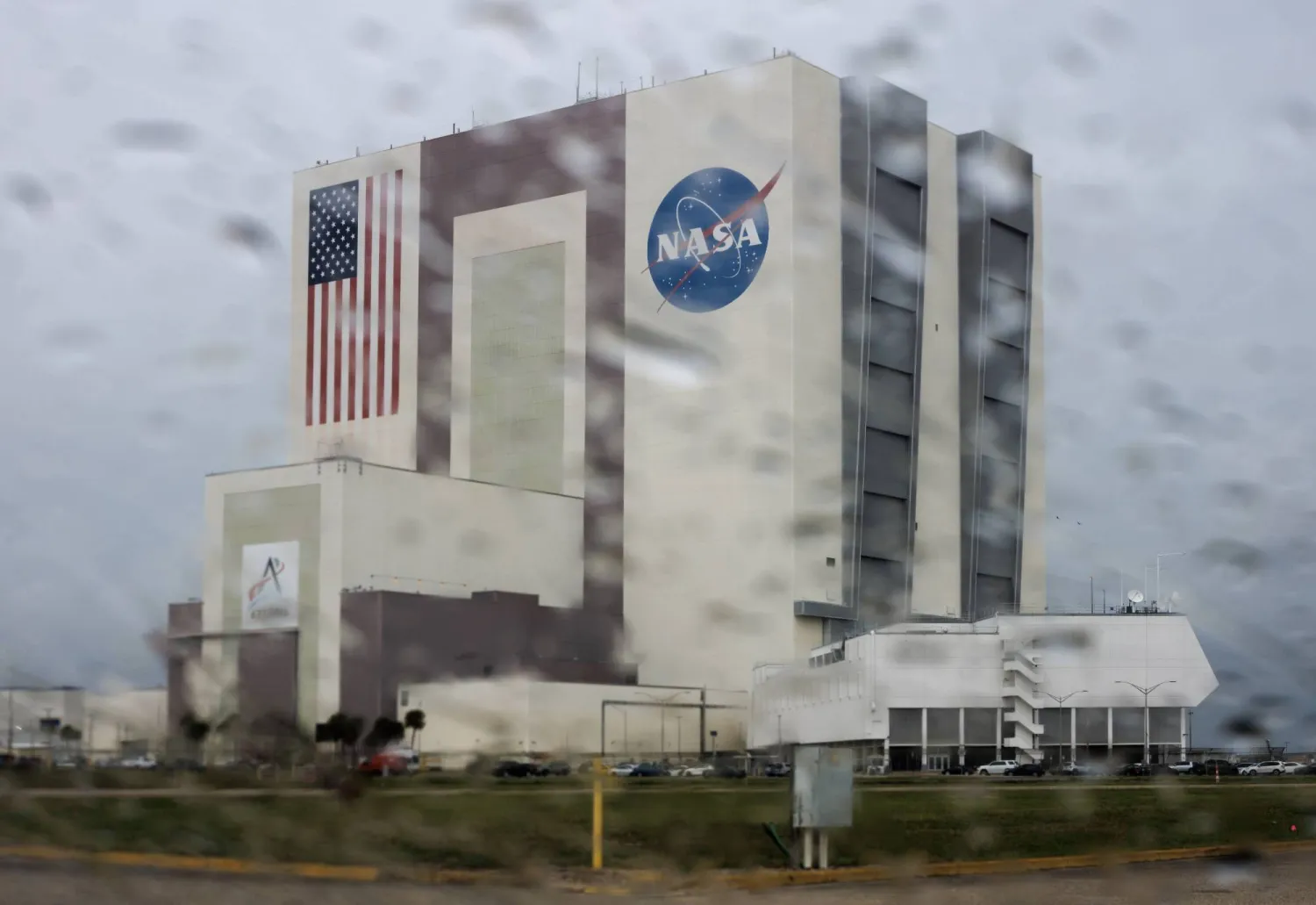
The NASA Vehicle Assembly Building is seen at Kennedy Space Center in Titusville, Florida, USA, 12 May 2026. EPA/CRISTOBAL HERRERA-ULASHKEVICH
TT

NASA's Psyche Spacecraft Buzzing Mars on its Way to Rare Metal Asteroid

The NASA Vehicle Assembly Building is seen at Kennedy Space Center in Titusville, Florida, USA, 12 May 2026. EPA/CRISTOBAL HERRERA-ULASHKEVICH

A NASA spacecraft chasing a rare metal asteroid swings past Mars this week for a gravity boost, snapping thousands of pictures as practice for the main encounter in 2029.

Named Psyche like the asteroid it’s after, the robotic explorer will slingshot past the red planet at 12,333 mph (19,848 kph) on Friday, The Associated Press reported.

It will be an especially close flyby, with Psyche passing within 2,800 miles (4,500 kilometers) of Mars, equivalent to the distance between the US east and west coasts. Then it will barrel toward the asteroid belt between Mars and Jupiter that is home to its enticing target.

All of the spacecraft’s science instruments will be on for the Mars pass. NASA’s two Mars rovers along with a small fleet of US and European orbiters will make surface and atmospheric observations at the same time for comparison.

Psyche's cameras already are photographing Mars, appearing as a crescent on approach and a nearly full sphere once it’s in the rearview mirror. The different views will serve double duty, allowing operators to fine-tune their instruments while providing “just plain beautiful photos,” Arizona State University’s Jim Bell, the imaging team leader, said in a statement.

While the asteroid belt is swarming with millions of objects, most are made of rock or ice.

Only a small percentage are thought to be metal-rich like Psyche, a potato-shaped asteroid roughly 173 miles long and 144 miles wide (278 kilometers by 232 kilometers).

Scientists suspect the asteroid may be the exposed nickel and iron core of a fledgling planet that was stripped down by cosmic collisions. Studying such an object up close can yield information about the dawn of our solar system 4.6 billion years ago, and why and how Earth spawned life.

Launched in 2023, the spacecraft is midway through its six-year roundabout journey to Psyche in the outer fringes of the asteroid belt, three times farther from the sun than Earth. It should arrive in 2029, slipping into orbit around the asteroid for two years of study. The van-sized spacecraft runs on solar electric propulsion, using xenon gas thrusters.


Scientists Dig Up Southeast Asia's Largest Dinosaur in Thailand

Artist reconstruction of the Cretaceous Period sauropod dinosaur Nagatitan chaiyaphumensis, whose fossils were unearthed in Thailand, seen in this illustration released on May 14, 2026. Patchanop Boonsai/Handout via REUTERS
TT

Scientists Dig Up Southeast Asia's Largest Dinosaur in Thailand

Artist reconstruction of the Cretaceous Period sauropod dinosaur Nagatitan chaiyaphumensis, whose fossils were unearthed in Thailand, seen in this illustration released on May 14, 2026. Patchanop Boonsai/Handout via REUTERS

Along a meandering river in a warm and arid region that is now Thailand roughly 113 million years ago, a plant-eating behemoth almost 90 feet (27 meters) long browsed on the treetops without much fear of predators due to its sheer size. This was Nagatitan chaiyaphumensis, the largest-known dinosaur from Southeast Asia, Reuters reported.

Researchers have unearthed skeletal remains of Nagatitan, a member of the dinosaur lineage called sauropods known for having a long neck, long tail, small head and four columnar legs.

The fossils of this Cretaceous Period dinosaur were first spotted by a villager in Thailand's northeastern province of Chaiyaphum. Scientists over a period of years then dug up spine, rib, pelvis and leg bones including a front leg bone - the humerus - measuring 5.8 feet (1.78 meters) long.

Based on the dimensions of its humerus and femur, the corresponding hind leg bone, the researchers estimated Nagatitan's body mass at 25 to 28 tons. Its head and teeth were not among the fossils recovered, but the researchers have a good idea of its feeding preferences based on other sauropods.

"Nagatitan was probably ⁠a bulk ⁠browser that focused on consuming high volumes of vegetation that required little to no chewing such as conifers and possibly seed ferns," said Thitiwoot Sethapanichsakul, a University College London doctoral student in palaeontology and lead author of the research published on Thursday in the journal Scientific Reports.

The climate was probably subtropical, with some forests, but also savanna-like and shrubland habitats. Nagatitan lived alongside various other dinosaurs as well as flying reptiles called pterosaurs. The rivers were teeming with crocodiles and fish including freshwater sharks.

The ecosystem's largest predator was a relative of the giant African meat-eating dinosaur Carcharodontosaurus, probably about 26 feet (8 meters) long and around 3.5 tons.

"At that size, it was dwarfed by ⁠Nagatitan. At full size, Nagatitan likely had very little to fear in terms of predation," Sethapanichsakul said.

Predators probably avoided attacking healthy adults of any large sauropod species because of the danger of being squashed. But they may have targeted old or sick adults or vulnerable babies.

"Indeed, sauropods are known to have grown very quickly after hatching, and this probably relates to the dangers of predation. The sooner sauropods could become large, the safer they were because they would have been more difficult to tackle," University College London paleontologist and study co-author Paul Upchurch said.

Sauropods included the largest land animals in Earth's history. Nagatitan was huge by any standard, but not on the scale of some South American sauropods such as Argentinosaurus and Patagotitan that topped 100 feet (30 meters) long.

Nagatitan's name references Naga, a serpent-like being in some Asian religious traditions that is prominently depicted in various Thai temples. In all, there are 14 named dinosaurs known from Thailand.

The names of several large sauropods include the word titan.

Sethapanichsakul said it might be appropriate ⁠to call Nagatitan Southeast Asia's ⁠last "titan" because the region became a shallow sea later in the Cretaceous, meaning no more sauropods would live there.

Nagatitan provides insight into sauropod diversity in the region. Not many sauropods are known from Southeast Asia, and Nagatitan is the largest and the geologically youngest of them. Nagatitan belonged to a subgroup of sauropods that possessed bones with lots of internal air sacs and thin walls, traits that lightened their skeletons.

This group originated around 140 million years ago, achieved a global distribution and, around 90 million years ago, became the only sauropods left worldwide, thriving until the dinosaur age ended 66 million years ago with an asteroid impact.

Nagatitan lived at a time when Earth's atmospheric carbon dioxide levels were climbing, corresponding to high global temperatures.

"Sauropods seem to have become particularly large at this time, with gigantic forms living in South America, China, probably North Africa, and now with Nagatitan a fairly large one in Southeast Asia," Upchurch said.

"This possible relationship between large body size and high climatic temperatures is not fully understood, but it's likely that the high temperatures had an impact on the plant fodder that was important to sauropods, which were very large-bodied herbivores. Nagatitan gives a glimpse of the period leading up to the eventual peak in body size and temperatures about 10 to 15 million years later," Upchurch said.


US: Tourist Arrested after Video Shows Rock Hurled at Endangered Hawaiian Monk Seal's Head

Igor Mykhaylovych Lytvynchuk was charged with harassing and attempting to harass a protected animal after being seen throwing a rock at a Hawaiian monk seal. Photo: US Attorney's Office District of Hawaii
TT

US: Tourist Arrested after Video Shows Rock Hurled at Endangered Hawaiian Monk Seal's Head

Igor Mykhaylovych Lytvynchuk was charged with harassing and attempting to harass a protected animal after being seen throwing a rock at a Hawaiian monk seal. Photo: US Attorney's Office District of Hawaii

A tourist who drew widespread condemnation in Hawaii after a witness recorded him chucking a coconut-sized rock at “Lani,” a beloved, endangered Hawaiian monk seal off a Maui beach, was arrested Wednesday by federal agents.

Igor Mykhaylovych Lytvynchuk, 38, of Covington, Washington, is charged with harassing a protected animal, the US attorney's office in Honolulu said, adding that National Oceanic and Atmospheric Administration special agents arrested him near Seattle. He was scheduled to appear in US District Court in Seattle on Thursday.

The court docket didn’t list an attorney, and a person who answered the phone at a number associated with Lytvynchuk declined to comment.

A state Department of Land and Natural Resources officer last week investigated a report of Hawaiian monk seal harassment in Lahaina, the community that was largely destroyed by a deadly wildfire in 2023. A witness showed the officer video of the seal swimming in shallow water while a man watched from shore, The Associated Press reported.

“In the cellphone video, the man can be seen holding a large rock with one hand, aiming, and throwing it directly at the monk seal," prosecutors said a criminal complaint. The rock, described by a witness as the size of a coconut, narrowly missed the seal's head, but caused the “animal to abruptly alter its behavior,” the complaint said.

When a witness confronted the man, he said "he did not care and was ‘rich’ enough to pay any fines," the complaint said.

Maui Mayor Richard Bissen, in a video posted on social media after the incident, vowed consequences for anyone who harms Hawaii's wildlife.

“Many of our residents know her, watch over her and care deeply about her well-being,” he said. “Lani, we have your back.”

Lytvynchuk is charged with harassing and attempting to harass an endangered Hawaiian monk seal.

Hawaiian monk seals are a critically endangered species. Only 1,600 remain in the wild.

If convicted, Lytvynchuk, faces up to one year in prison for each charge. He also faces a fine of up to $50,000 under the Endangered Species Act and a fine of up to $20,000 under the Marine Mammal Protection Act.


Historic Swiss Solar-powered Plane Crashes Into Sea

(FILES) The Solar Impulse 2 solar powered airplane flies off Kapolei, Hawaii, on March 3, 2016 on a all-day test flight. (Photo by Eugene TANNER / AFP)
TT

Historic Swiss Solar-powered Plane Crashes Into Sea

(FILES) The Solar Impulse 2 solar powered airplane flies off Kapolei, Hawaii, on March 3, 2016 on a all-day test flight. (Photo by Eugene TANNER / AFP)

The experimental plane Solar Impulse 2, which completed a historic round-the-world trip in 2016 without using jet fuel, crashed into the Gulf of Mexico recently, its owner revealed.

Flown by Swiss pilots Bertrand Piccard and Andre Borschberg, Solar Impulse 2 circumnavigated the globe in 17 stages, covering a remarkable 26,700 miles (43,000 kilometers) across four continents, two oceans and three seas, in 23 days of flying without using a drop of fuel.

Three years after the globe-trotting flight, the solar-powered vessel was sold to Skydweller Aero, which converted the aircraft into a drone to carry out "controlled ditching," the company said in a press release issued Tuesday.

Skydweller Aero said Solar Impulse 2 took off from Stennis, Mississippi on April 26 but crashed into the Gulf of Mexico on May 4, AFP reported.

"Ultimately, a record-breaking flight of 8 days and 14 minutes validates the reality of perpetual, solar-powered flight in a military mission-relevant environment," the company said, in reference to a US Navy exercise in which the vessel was used.

The US National Transportation Safety Board said it was investigating the accident.