
Wordle Heads to Primetime as Media Seek Puzzle Reinvention

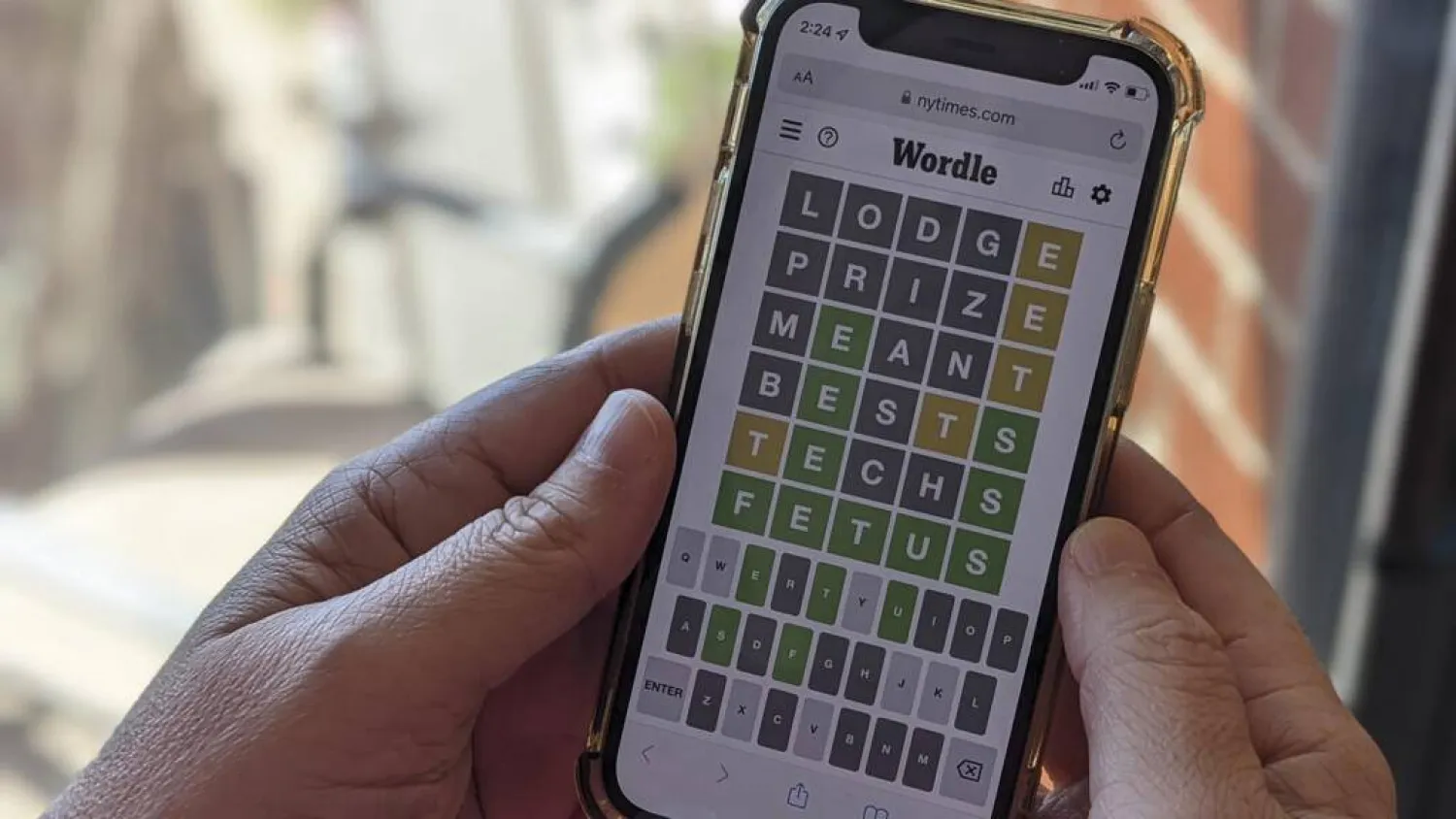
This photo illustration shows a person playing online word game Wordle on a mobile phone. Michael Draper / AFP/File
TT

Wordle Heads to Primetime as Media Seek Puzzle Reinvention

This photo illustration shows a person playing online word game Wordle on a mobile phone. Michael Draper / AFP/File

News organizations are racing to add puzzles and games to their digital offerings, hoping to replicate the success of a strategy The New York Times has been quietly perfecting for years -- and is now taking to primetime television.

US broadcaster NBC is producing a game show based on the word puzzle Wordle to be hosted by morning TV news anchor Savannah Guthrie, with a premiere set for 2027.

For Jonathan Knight, the Times' head of games, it is the logical extension of a property that has become a global phenomenon.

"Wordle kind of blew the doors open in terms of being very approachable -- anybody can do it," Knight told AFP on the sidelines of the Web Summit in Vancouver, Canada.

The road to greenlight the TV show took around two and a half years, Knight said, with the Times insisting on co-producing rather than simply licensing the name.

"It's Hollywood, you never know. Everyone believed in the idea of it. But then, will it be good? Will it be true to Wordle? Those are all questions we had to answer through a development process."

The television deal is the latest chapter in a growth story that evolved over time.

Knight arrived at the Times games division in 2020 to find Spelling Bee and the traditional crossword as the main app attractions.

Spelling Bee, launched in 2018 and adapted from a print puzzle, had already begun pulling in a younger audience with its mobile format and ranking system.

By 2019, Knight said, the trajectory was clear enough that the company began investing heavily in a full portfolio.

"You could really see the opportunity -- not just for a crossword puzzle, but for a collection of games," he noted.

Then Wordle arrived and reset all expectations.

Created by Welsh software engineer Josh Wardle as a personal project, the game grew from 90 players in November 2021 to more than two million just weeks later.

The Times acquired it in early 2022, and in Knight's telling, it "turbocharged" everything the team had been putting in place.

"It kind of blew the doors open in terms of a very approachable, anybody-can-do-it game. Everybody solves it, whether it's in two tries or six. It doesn't take that long and it feels great."

- Come for the games -

The Times has since reported its games were played more than eight billion times in a single year, the majority by Wordle players.

The business logic underpinning all of it is a subscription model that distinguishes the Times sharply from traditional game companies.

"A lot of people come just for the games... And that's great, because it grows our overall subscriber base, and eventually some of those folks are going to experiment with everything else we have to offer," Knight said.

The model has not gone unnoticed, with news media companies pushing their own games products.

In the most recent example, Time magazine this week launched Time Games, featuring online word puzzles and jigsaws made from its iconic magazine covers.

Microsoft-owned LinkedIn hired three-time world Sudoku champion Thomas Snyder as its first-ever puzzlemaster and initially launched three daily puzzle games modeled on the short, habit-forming design the Times pioneered -- a number that has grown.

Netflix has made similar moves.

- 'Understand your audience' -

Knight said he constantly fields questions from international media executives, but urges caution about treating the Times' playbook as a simple template.

"You have to understand your audience at its core," he said. "Users will reject it if you're just trying to shove a puzzle down their throat that has no connection to your core values as a company."

Internally, the division remains in constant experimentation mode. Games are tested and cut if they fail to clear the bar.

Innovation continues on existing titles as well, including puzzle variants, cross-game challenges and themed days that have developed a devoted following.

"April Fools' is sort of our Super Bowl," Knight said.


Moose Put Down after Wandering Into Central Oslo

People and personell from the wildlife board mill around a dead moose that had strayed into Majorstuen,a inner city area in Oslo, Norway on, June 11, 2026. (Photo by Javad Parsa / NTB / AFP)
TT

Moose Put Down after Wandering Into Central Oslo

People and personell from the wildlife board mill around a dead moose that had strayed into Majorstuen,a inner city area in Oslo, Norway on, June 11, 2026. (Photo by Javad Parsa / NTB / AFP)

Norwegian police said Thursday that a moose that had wandered into downtown Oslo, drawing curious crowds, had been shot and killed.

Videos taken by witnesses and published by Norwegian media show the disoriented animal galloping through the streets of the Norwegian capital, weaving around cars and pedestrians.

"For animal welfare reasons, the moose was put down" by the wildlife authorities, AFP quoted the police as saying.

Although such incidents remain rare -- moose tend to avoid metropolitan areas -- this is the second such incident recorded in two days in Scandinavia.

On Tuesday, a young moose was put down in Sweden after it strayed into the streets of Stockholm.


WWI Soldier's Postcard from Home Helps Unite his Family after a Century

A poppy wreath and a photo next to the grave of Private Thomas Redvers Whitaker during a burial ceremony for six British soldiers of World War I, at the CWGC's Tyne Cot Cemetery in Zonnebeke, Belgium, Wednesday, June 10, 2026. (AP Photo/Virginia Mayo)
TT

WWI Soldier's Postcard from Home Helps Unite his Family after a Century

A poppy wreath and a photo next to the grave of Private Thomas Redvers Whitaker during a burial ceremony for six British soldiers of World War I, at the CWGC's Tyne Cot Cemetery in Zonnebeke, Belgium, Wednesday, June 10, 2026. (AP Photo/Virginia Mayo)

A postcard belonging to a World War I soldier whose body was found with five comrades during an excavation has helped reunite distant descendants more than a century after his death on the Western Front.

Dozens of mourners attended a memorial service in western Belgium on Wednesday during which six new white marble headstones were dedicated to the British soldiers whose remains were recently identified through the use of archival research and DNA analysis, The Associated Press reported.

The six burials at the Tyne Cot Cemetery included that of Pvt. Thomas Whitaker, who died in the trenches carrying a postcard from Bradford, in north east England, where some of his relations still live.

At the ceremony were three members of the Whitaker family. Under sunshine piercing the gray drizzle, Joe Whitaker, 22, read aloud a poem written in honor of his great-great-uncle: “At peace in foreign hills, he finally drifts away to sleep, his mind on Bradford mills.”

The soldier's postcard proved to be a crucial piece of evidence that helped British government researchers establish his identity and ultimately linked Joe's family with another, estranged, branch of the Whitaker family.

Joe said: “The thought that (Thomas) might have been thinking of home, comforted by this postcard that he kept on him from Bradford — we were all quite taken aback by that.”

He said writing a poem “felt like the right thing to do.”

Alexia Clark, a commemorations case worker at the UK Ministry of Defense’s Joint Casualty and Compassionate Centre (JCCC), said the six soldiers were found during an excavation in western Belgium. But the discovery of the postcard on one of them proved to be a crucial “hint.”

She added: “And then actually when we looked at the missing list and went, ‘Oh we have got one from Bradford! Great, there’s a strong chance that he is going to be one of them.‘”

By matching the postcard with other found artifacts, including a Lewis Gun and uniforms, the JCCC researchers — known as “the war detectives” -- were able to zero in on a likely group of men from the more than half a million British soldiers still missing from World War I.

The team contacted potential relatives for DNA samples, and the analysis confirmed the identity not only of Thomas Whitaker, but also privates Horace Frederick Cook, Frederick Martin, Charles Richard Russels, Courtney Darvill Hart and Joseph Turnley -- all members of 2/4 Battalion Queen’s Royal West Surrey Regiment.

Paul Turnley was presented with a British flag folded into a triangle given by the military in honor of the sacrifice of his relation, Pvt. Joseph Turnley.

“Just a privileged to be laying a relative of ours to rest, to watch, to be present and then to be passed the flag... it was the greatest treasure actually,” said Paul, in tribute to his grandfather’s cousin.

As nearby cows, students and bike riders watched along an adjacent farm road, a military musician played a martial lament on a cornet, while prayers were said by the Rev. Adéle Rees.

Then Pvt. Jone Wainile of the Princess of Wales’s Royal Regiment honor guard read the poignant Kohima Epitaph: “When you go home tell them of us and say, ‘For your tomorrow, we gave our today.’”

Paul Whitaker said: “My children, my grandchildren, anyone, can come and know where Thomas is, and that is a lovely thing to have. It’s just a real privilege to have Thomas be one of the ones that has been found.”


The Indian Workers Training AI Robots to Take their Jobs

Indian housewife Nagireddy Sriramyachandra wears a smartphone on her head as she records her actions through motion capture while slicing mangoes at her home in Chennai. R.Satish BABU / AFP
TT

The Indian Workers Training AI Robots to Take their Jobs

Indian housewife Nagireddy Sriramyachandra wears a smartphone on her head as she records her actions through motion capture while slicing mangoes at her home in Chennai. R.Satish BABU / AFP

With a smartphone strapped to her head, Indian housewife Nagireddy Sriramyachandra films herself slicing mangoes to train AI-powered robots to take on household jobs in the future.

Earning just over two dollars for an hour of video, her mundane recordings are invaluable for global tech companies teaching machines how to move like humans in the real world, said AFP.

The 25-year-old is one of a growing army of thousands of AI system trainers in the world's most populous country.

"Who else will give you 250 rupees an hour just for doing housework?" said Sriramyachandra from her kitchen in Chennai in southern India's Tamil Nadu state.

"I may get a robot myself in the future," she added.

Artificial intelligence chatbots and image generators crunch reams of digital data, but building systems to navigate real-life environments is more challenging.

Developers think feeding first-person footage, called "egocentric data", into specialized AI models will help robots copy humans.

Some AI trainers work at home, others in factories or specialized studios -- using video glasses, head-mounted cameras and motion sensors.

"It blares 'hands not detected' when I'm not recording properly," said Sriramyachandra, who sends recordings via a special app to the AI data company Objectways.

The firm, which has offices in India and the United States, lists Fortune 500 multinationals as clients. It works with Amazon SageMaker, a platform for machine learning models.

- 'Better things' -

The humanoid robot market is booming, with investment bank Morgan Stanley predicting there could be over a billion in use by 2050, mostly for industrial and commercial purposes.

"Folding clothes, coffee making... cooking a very specific thing, sandwich making," Objectways head Ravi Shankar said, listing videos requested by clients.

"Some jobs are supposed to be taken over, so humans can go and do better things."

In India, the emerging field of spatial AI is providing new employment -- for now.

The 50-year-old CEO is US-based, but hires workers from Tamil Nadu, where he grew up, one of India's international technology hubs.

At a Karur textile factory, busy with workers attaching labels to caps and ironing cloth bags, AFP saw eight people wearing head cameras and smart glasses supplied by Objectways.

India has positioned itself as a global middleman for the creation, processing and annotation of AI data.

"It's likely that these data collection services will increase", said digital labor expert Aditi Surie, from the Indian Institute for Human Settlements in Bengaluru.

- Informal workers -

India is aggressively developing its AI industry, but its leaders are aware that, alongside the technology's much-hyped benefits, automation poses risks.

Government think-tank NITI Aayog said that most discussions around artificial intelligence and labor "focus on white-collar professionals and predict an almost certain loss of jobs in the segment" without urgent action.

"Little attention, if any, is paid to how AI can serve India's 490 million informal workers, the very people who form the backbone of our economy," it said in a report released ahead of a global AI summit in India this year.

The think-tank has examined how the technology could help or harm dozens of professions -- from cobblers to sewer cleaners, farmers to tea sellers.

For the last decade, 55-year-old Ponni has sat on a roadside in Bengaluru, the city known as India's Silicon Valley, making flower garlands.

She, too, has been paid to have a phone strapped to her forehead.

"The next generation... who might have to do work similar to mine -- they will face a problem," Ponni said.

- Always wearing a camera -

At an Objectways studio, AI system trainers film themselves performing household tasks in fake, fully furnished apartment rooms.

After several thousand hours of filming, the wallpaper is changed to provide clients with variety.

"Today I sit here, tomorrow I stand there," said engineering graduate Rani N., 21, on a break from filming herself, once again, folding a towel.

Each video lasts about four minutes, and she records around 90 a day -- on nearly every conceivable spot on the bed.

She says the job is "tolerable", but feels like she's always wearing a camera.

In other rooms, colleagues arranged pencil sharpeners, water bottles and crayons in patterns, recording with depth-sensor cameras.

Qanat Consulting Services in Andhra Pradesh, an Objectways subcontractor, supplies about a dozen larger data firms with recordings.

Some of its 2,000 contributors perform tasks with motion-sensor bands on their "wrists, hands and legs", CEO Thaslim Pattan said.

Manish Agarwal of Bengaluru-based Humyn Labs, not related to Objectways, records conversations as well as videos.

Contributors discuss assigned topics -- ranging from politics to entertainment -- for clients wanting to process speech patterns.

Agarwal denies that robots will steal jobs, believing that networks of humans and robots "will work together" one day, he said.

"A welder in India could be managing a welder-robot in Prague," he said.