

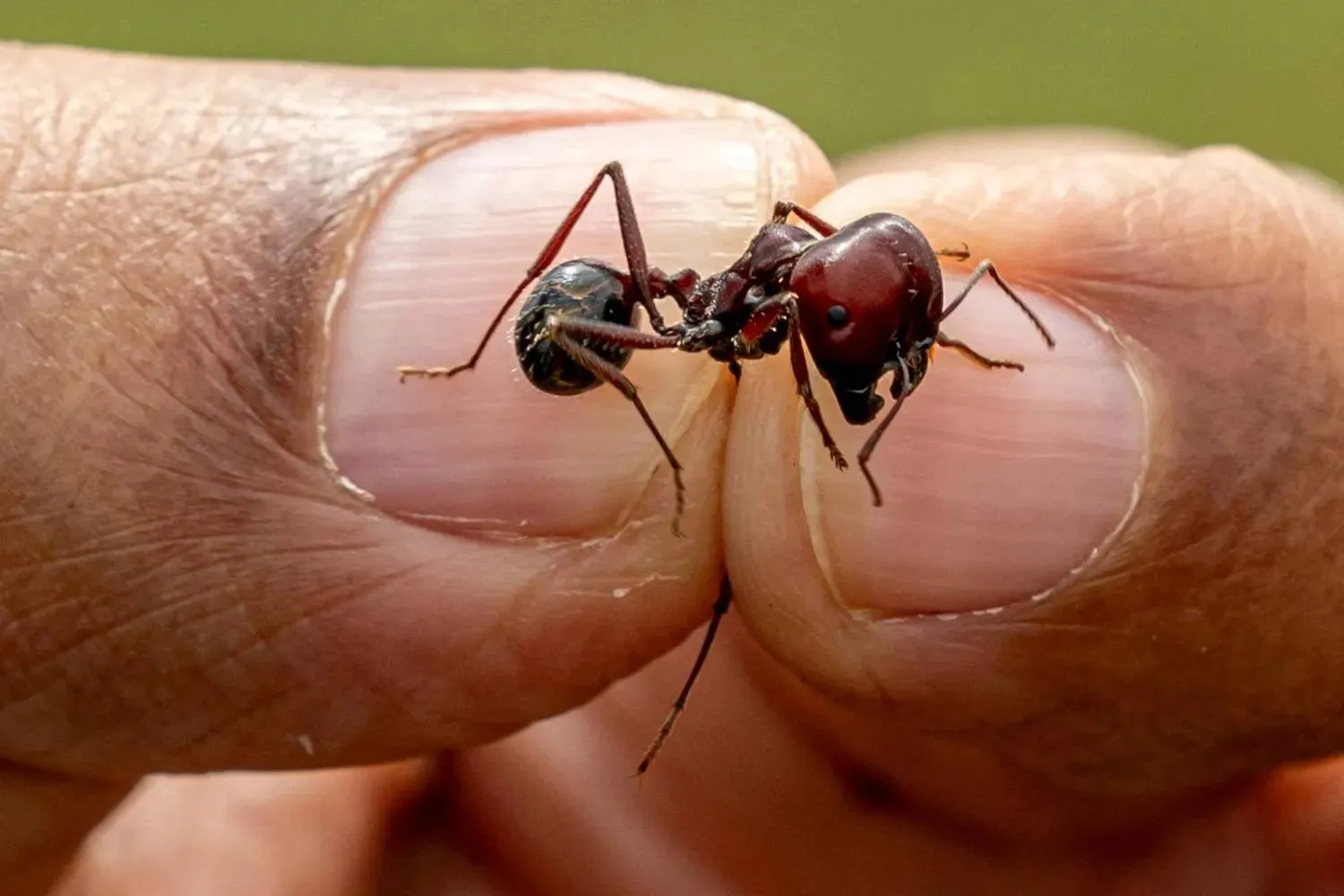

African Ants at the Center of International Smuggling … Queen Sold for Over $1,000

Ants become the center of an international smuggling trade (AFP) 
TT

African Ants at the Center of International Smuggling … Queen Sold for Over $1,000

Ants become the center of an international smuggling trade (AFP) 

Kenyan ant expert Dino Martins gushes over the red and black insects that have become the center of an international smuggling trade.

Martins has been visiting the network of nests of these Giant African Harvester Ants outside Nairobi for 40 years.

“They're big and bold... They're the tigers of the ant world,” the entomologist told AFP.

“Each nest here has just one queen and she is the mother who founded this nest 40, 50 or even 60 years ago,” he said.

Martins was shocked when he learned that thousands of queens from this Messor cephalotes species were being harvested and shipped abroad in syringes and test tubes to be sold for hundreds of dollars each.

The trade came to light in Kenya last year when two Belgian teenagers were arrested in possession of nearly 5,000 queen ants, and accused of “biopiracy.”

Kenyan authorities fear a new form of poaching, focused less on ivory and furs, and more on insects, reptiles and rare plants.

The judge even compared it to the slave trade.

“Imagine being violently removed from your home and packed into a container with many others like you... It almost sounds as if the reference above is to the slave trade,” he said in his ruling.

The Belgians were handed a fine of around $8,000, but as more cases have emerged, sentences have hardened: last month a Chinese national was sentenced to one year in prison for attempting to traffic 2,000 ants.

On several European websites, the queens go for around 200 euros ($230).

Colonies can take 20-30 years to produce new queens. They provide all manner of services to the ecosystem: dispersing grass seeds, aerating the soil, and providing food for animals like pangolins.

Martins also considers the smuggling trade unethical simply because “ants have feelings.”

The trade “exploded” with the arrival of the internet, said Jerome Gippet, a researcher at the Swiss University of Fribourg.

Formerly the interest of a few passionate individuals, it eventually gave way to sophisticated networks of collectors, intermediaries and smugglers.

A study Gippet published in 2017 found more than 500 ant species -- a third of the total -- were sold online. More than 10% were potentially invasive with uncertain impacts on foreign ecosystems.

“I'm not advocating for a ban on the ant trade. It's very useful in educational terms, in terms of reconnecting with nature, or simply providing enjoyment... But it has to be done responsibly,” he said.


2 Humpback Whales Set Records Swimming between Australia and Brazil

This photo provided by the Pacific Whale Foundation in May 2026, shows a humpback whale breaching off the coast of Australia. (Pacific Whale Foundation via AP)
TT

2 Humpback Whales Set Records Swimming between Australia and Brazil

This photo provided by the Pacific Whale Foundation in May 2026, shows a humpback whale breaching off the coast of Australia. (Pacific Whale Foundation via AP)

Scientists have spotted two humpback whales that made separate, record-breaking crossings between Australia and Brazil.

The whales were identified by their distinctive tail markings at the two locations about 9,000 miles (14,500 kilometers) apart. They traveled in opposite directions and journeyed farther than any humpback known so far.

“It’s a very rare event, but it is a really wonderful demonstration of just how wide-ranging these animals are,” said Phillip Clapham, former head of a NOAA whale research program who was not involved with the new findings.

Humpback whales are known for roaming long distances across major oceans in predictable patterns, typically following migration routes learned from their mothers. They feed on krill and small fish in the warmer months and breed in tropical waters over winter.

It's difficult to track the movements of creatures that spend most of their lives underwater. In the new study, scientists analyzed over 19,000 whale images taken in the past four decades by research groups and citizen scientists, The Associated Press reported.

Recognition software helped to identify the whales based on their tails' color patterns and jagged edges. Researchers pinpointed two different whales at breeding sites in eastern Australia and Brazil over the years, suggesting they had crossed from one place to the other.

One whale traveled just over 9,300 miles (15,000 kilometers), outranking previous recordholders including a humpback that swam from Colombia to Zanzibar.

The findings were published Tuesday in the journal Royal Society Open Science.

Since the photos only depict the whales at the beginning and end of their journeys, researchers don't know the exact route they took.

Whales don't typically travel between mating sites so it's not yet clear why these two separately embarked on their journeys. They may have met other whales on shared feeding grounds and split off instead of returning to where they came from, study co-author Stephanie Stack with the Pacific Whale Foundation said in an email.

“Finding not one but two individuals that have crossed between Australia and Brazil challenges what we thought we knew about how separate these populations really are,” Stack said.

Such odysseys are more difficult for whales in the Northern Hemisphere, where massive continents make traveling across oceans tougher.

Scientists said the record journey shows just how far humpback whales can go. These methods can also help keep track of them as climate change warms oceans, possibly changing where krill live and where humpbacks might go to feed and breed.


Animal Welfare Groups: 3 South African Zoo Elephants Are Depressed, Sue to Move Them

FILE - Charley, an ageing four-ton African elephant, is trained to enter a transport container, on Aug. 9, 2024 at the Pretoria, South Africa's, National Zoological Gardens. (AP Photo, File)
TT

Animal Welfare Groups: 3 South African Zoo Elephants Are Depressed, Sue to Move Them

FILE - Charley, an ageing four-ton African elephant, is trained to enter a transport container, on Aug. 9, 2024 at the Pretoria, South Africa's, National Zoological Gardens. (AP Photo, File)

The mental well-being of three elephants in a zoo in South Africa is the subject of an unusual court case, with animal welfare groups saying they are depressed and should be moved to a larger conservation park where they can be happy.

The case this week will ask a South African court to decide if the state is meeting its legal obligations with regard to the welfare of the animals and the conditions in which they are kept, according to David Bilchitz, a board member at Animal Law Reform South Africa, one of the groups bringing the case.

Experts would show in court that the elephants are unhappy, The Associated Press quoted Bilchitz as saying. The animal welfare groups said a part of the South African Constitution puts an obligation on authorities to look after animals.

The zoo in question in Johannesburg is publicly owned and has defended its management of the elephants, saying they are well cared for.

Bilchitz said elephants have highly complex social structures and specific physical and mental needs, and generally live in herds of 20-50 animals that roam large areas in the wild.

He said that the three elephants at the zoo — named Lammie, Ramadiba and Mopane — live in an enclosure not much bigger than a soccer field with none of the typical stimulation that elephants need, like trees to forage from and mud pools to bathe in.

“They are sad, depressed and frustrated,” Bilchitz told AP. “They are listless and stand around.”
He said the elephants had shown signs of psychological distress, like standing and rocking and other “repetitive compulsive behavior.”

Johannesburg Zoo said in a statement that there had been a “media scourge” over the condition of the elephants and maintained they were healthy and also popular with zoo staff and visitors. It also said that relocating elephants from zoos to semiwild sanctuaries is not always successful.

There is a kind of precedent for the case. In 2024, an old bull elephant called Charley was relocated from another South African zoo to a game reserve after he outlived his elephant companions at the zoo and animal experts believed he was lonely.

The zoo agreed that Charley should be taken to the reserve to retire after he spent decades in captivity, including around 16 years in a circus.


Starbucks Korea Fires CEO Over Controversial 'Tank Day' Promotion

A customer leaves a Starbucks coffee shop in Seoul on May 19, 2026. (AFP)
TT

Starbucks Korea Fires CEO Over Controversial 'Tank Day' Promotion

A customer leaves a Starbucks coffee shop in Seoul on May 19, 2026. (AFP)

Starbucks Korea's chief executive has been sacked over a campaign perceived as referring to a bloody historical incident, according to BBC.

The promotion, which used the English words “Tank Day,” was for Starbucks Korea’s Tank Series drink tumblers touted to have “spacious volume” for a large amount of coffee.

Launched on Monday, the campaign coincided with the anniversary of the Gwangju Uprising crackdown, sparking calls to boycott Starbucks Korea and prompted a harsh rebuke from President Lee Jae Myung.

Many felt the “tank” motif referenced the vehicles deployed by the military government in May 1980 to crush pro-democracy protesters, BBC wrote.

Starbucks Korea rolled back the promotion hours after it launched. Shinsegae, the conglomerate that owns the majority stake in the coffee chain, apologized for “inappropriate marketing” and fired the chain's chief executive Sohn Jeong-hyun.

According to local reports, Starbucks Korea initially clarified that the Tank Series was one of several series of tumblers it was rolling out in a campaign running from May 15 to 26.

“We sincerely apologize for causing inconvenience and concern to our customers due to this,” the company said. “We have immediately suspended the event and will review and improve our internal processes to prevent similar incidents from recurring in the future.”

Starbucks' headquarters in the US also issued an apology, acknowledging that “while unintentional, [the incident] should never have happened.”

“We recognize the deep pain and offense this has caused, particularly to those who honor the victims, their families, and all who contributed to Korea's democratization,” it said.

“I can't believe they thought they could pull off something like this and people would just let it slide... it's utterly absurd and infuriating,” an X user wrote early on Tuesday.

Several also put out calls on social media to boycott both Starbucks Korea and Shinsegae.

South Korea's president was among those who criticized the campaign, saying it “insults the victims and the bloody struggle” of the residents of the southern city of Gwangju.

“What on earth were they thinking, knowing how many lives were taken that day and how seriously that set back our country's justice and history?

“I am outraged by such a low-class merchant's inhumane behavior, which denies our country's values of basic human rights and democracy,” Lee wrote on an X post.

Reports estimate that hundreds of demonstrators were killed in the southern city of Gwangju on May 18, 1980.

Further investigations into the massacre later confirmed that troops deployed by the military regime of Chun Doo-hwan committed rape and sexual assault.

Since then, May 18 has frequently been depicted in films and television shows as a day of national trauma for South Korea while also commemorated annually as a day of democracy.

The Gwangju Uprising set South Korea on its path toward democracy. It became a rallying cry for activists over the following seven years, culminating in a movement in June 1987 which toppled Chun's regime.

Some in South Korea claim the Starbucks Korea campaign also references the 1987 movement.

Shinsegae's group chairman Chung Yong-jin called the Starbucks campaign “an inexcusable mistake that trivialized the suffering and sacrifices of all those who have dedicated themselves to the democracy of this country.”

In a statement on Tuesday, he pledged to “thoroughly investigate” the approval procedures behind the event and “re-examine the review process” for marketing content across all its affiliates.

Since it sold off its stakes in July 2021, Starbucks Coffee Company, headquartered in the US, no longer has any involvement in Starbucks's operations in South Korea.

Shinsegae's subsidiary E-mart owns a 67.5% controlling stake in Starbucks Korea, while the remaining share is owned by Singapore's sovereign wealth fund GIC.
