



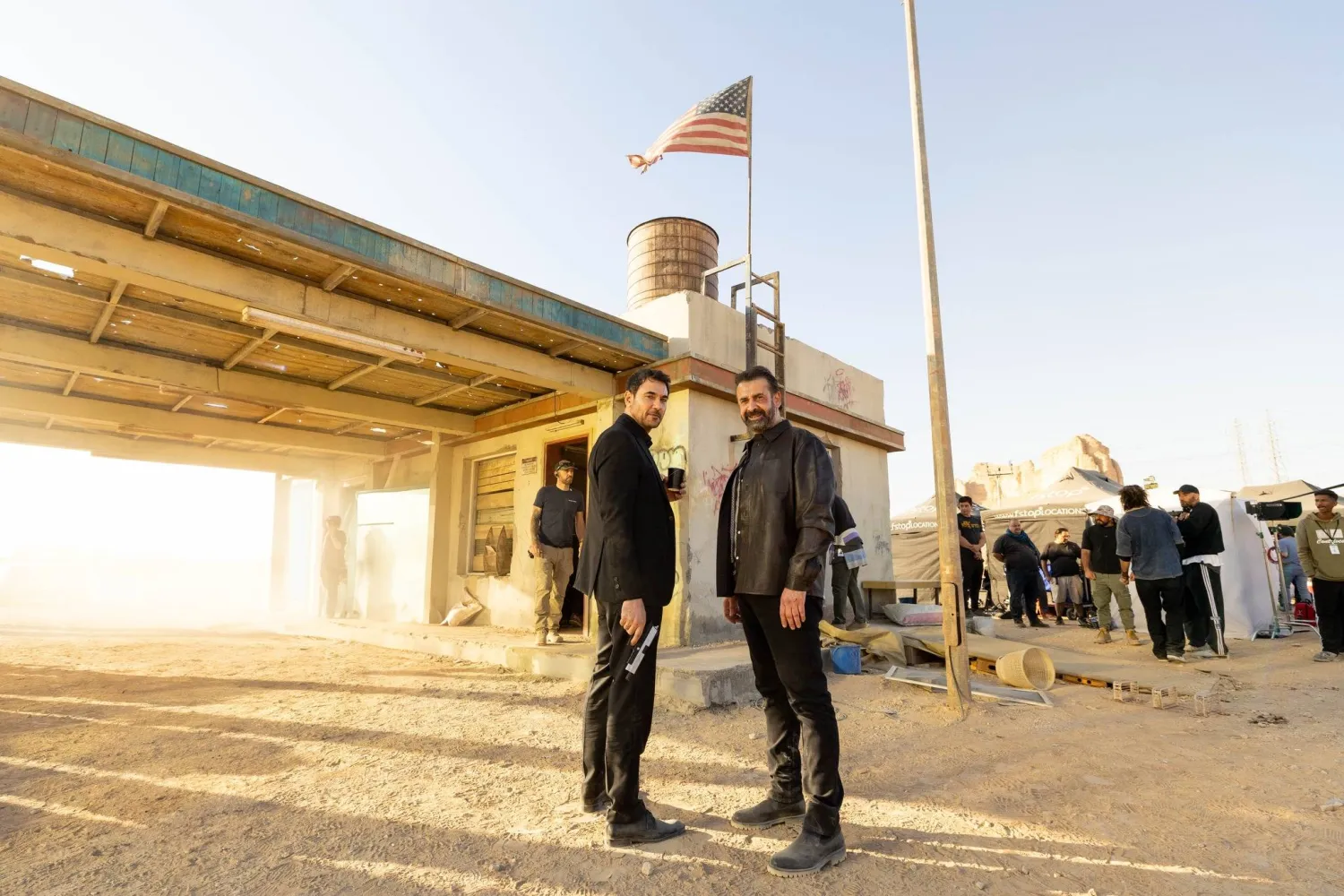

The makers of “7 Dogs” set out to do more than produce an action film to international standards. Their aim was to deliver a visual spectacle shaped by Saudi Arabia’s General Entertainment Authority, built on a strategic vision for a transcontinental thriller with Hollywood-level technical standards, while preserving a Middle Eastern identity and cultural voice.
The film, which opened in Cairo on Friday evening in the presence of its makers, was written by Egyptian screenwriter Mohamed el-Dabbah, who was tasked with turning the Entertainment Authority’s ambitious vision into a fully developed screenplay.
El-Dabbah did not write a conventional chase story. He built a fast-paced, dramatic structure driven by escalating events and centered on the infiltration of an international criminal network, requiring a coherent narrative that could sustain the film’s heavy visual and action momentum.
The decisive moment that moved the project from concept to production came during the 2024 global tour for “Bad Boys: Ride or Die.”
During that period, Belgian-Moroccan directors Adil El Arbi and Bilall Fallah visited Riyadh and held a lengthy meeting with adviser Turki Alalshikh, chairman of Saudi Arabia’s General Entertainment Authority. Their talks focused on the major advances in Saudi Arabia’s film infrastructure.
The meeting reviewed Riyadh’s growing logistical capabilities and its ability to attract major global productions. Alalshikh then presented the idea for the film, drawing an immediate and enthusiastic response from the directing duo, who saw it as a chance to apply their experience in American cinema to a new production environment.
Riding the momentum of their film’s record commercial success at the Saudi and global box office, the directors became convinced that regional audiences were eager for action films made with a global sensibility.
A large-scale production partnership was formed to provide the financial and technical resources needed to carry out the project without restrictions or creative compromise.
To give the film its international scope, producer Ivan Atkinson was brought in as the project’s logistical maestro. His first task was to build a creative front by recruiting department heads with extensive experience in big-budget filmmaking, ensuring that every technical detail met contemporary Hollywood standards.
Among them was renowned production designer Paul Kirby, known for creating complex architectural spaces and adapting them to serve the drama.
Atkinson also brought in the global stunt and fight design team 87eleven, the celebrated group behind the combat identity of the “John Wick” franchise, giving the film a decisive edge in its action sequences.
The directors approached the script through rhythm. They wanted a visual experience with the pace and dynamism of modern video games. That choice pushed the editing and cinematography teams toward extremely fast movement, with a highly flexible camera designed to keep viewers alert as they follow the layers of the international conspiracy.
According to the film’s crew, preparatory workshops began in Riyadh months before filming.
The screenplay went through detailed technical reviews by el-Dabbah, the directors and the fight team to balance the characters’ human drama with the film’s action. The aim was to ensure the chases and explosions served the dramatic line rather than felt forced into the story.
Adil and Bilall’s artistic vision centered on breaking the stereotype of Middle Eastern action films that rely on easy visual solutions. They insisted on shooting the dangerous scenes with rough realism, which required the cast to undergo long, demanding physical training so they could perform complex fight movements themselves under the supervision of Hollywood stunt experts.
Sela Studios helped clear the logistical hurdles by providing advanced filming, lighting and lens equipment, including tools that had not previously been used in the region.
That production support allowed cinematographer Robrecht Heyvaert to create a visual identity that blends the warm colors of the East with the cooler, contemporary palette of modern global action cinema, according to sources from the production company.
The chemistry between El Arbi and Fallah important. The two worked in close coordination, with one focusing on the actors and dramatic performance while the other concentrated on visual design, camera movement and special effects.
The arrangement helped maintain a fast and efficient production flow on crowded, detail-heavy sets.
Early preparations required complex schedules to manage the movement of international stars and coordinate their filming dates in Riyadh. The logistics team created a flexible system that accommodated the project's evolving demands, allowing principal photography to begin on schedule amid enthusiasm and strict professional discipline from all parties involved.
The General Entertainment Authority placed government and security facilities at the filmmakers’ disposal, allowing them to close key areas and film complex car chases on open streets. That regulatory flexibility demonstrated that Riyadh can offer not only closed studios but also entire urban spaces ready to serve as stages for large-scale action scenes.
In the film, 7 Dogs is not presented as a conventional gang. It is written as a complex cross-border intelligence and criminal entity, an octopus-like network of businessmen and influential figures running globalized organized crime from distant locations. That makes it an invisible threat that cannot easily be tracked by traditional security methods.
The main dramatic trigger is the organization’s creation of a highly dangerous synthetic drug called Pink Lady. The lethal compound is not just a product for sale. It drives the plot, turning the conflict from a local criminal case into a major security threat that mobilizes international security agencies and INTERPOL.
To confront the network, Egyptian INTERPOL officer Khaled Al Azazi, played by Ahmed Ezz, launches a wide-ranging intelligence operation to infiltrate the organization from within.
His investigation leads him to a fragile lead, a professional transcontinental criminal named Ghali Abu Dawood, played by Karim Abdel Aziz. Ghali has close ties to The Seven Dogs’ pillars, making him the only one who can bring down the destructive network.
The disciplined officer and the elusive criminal are forced into an uneasy alliance. The stark contrast between a man who represents the law and another who embodies pragmatism and life outside it creates a tense dynamic marked by suspicion, shifting loyalties and deep psychological conflict throughout the journey.
Alongside Karim Abdel Aziz and Ahmed Ezz, the cast includes international names such as Monica Bellucci, Giancarlo Esposito, Bollywood star Salman Khan, Sanjay Dutt, Max Huang, Tara Emad, Nasser Algassabi, and Sayed Ragab. The geographic and cultural diversity of the cast reflects the organization’s reach across continents.
Bellucci plays Julia, the luxurious and dark European face of the organization. The character combines extreme elegance with absolute cruelty, creating a striking visual contrast with the Eastern characters.
The participation of Salman Khan as Johar and Sanjay Dutt as Ranjit adds strong visual and action energy to the film’s Asian track. Their screen presence is used in large-scale action scenes marked by violent combat, turning the Mumbai segment into an action climax tied to the broader dramatic arc.
Saudi actor Nasser Algassabi brings a local flavor and Gulf depth to the film’s web of international relationships.
His character serves as the logistical link in the region. Egyptian actress Tara Emad plays a young intelligence operative working in the shadows to support Khaled, alongside Jessica, played by Lebanese actress Sandy Bella, a member of the INTERPOL team.


