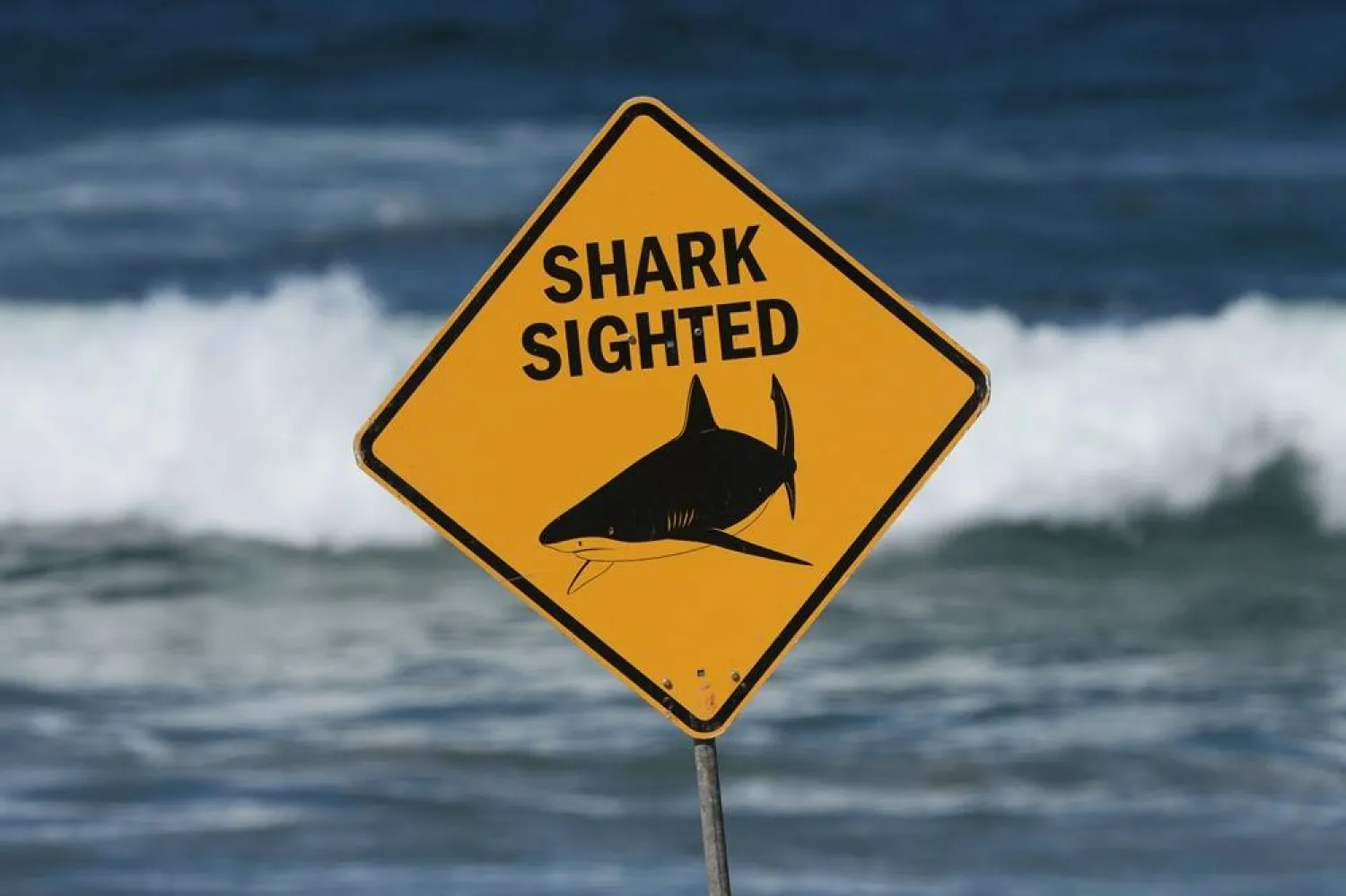
Shark Kills Man in Australia’s Queensland State

A sign is seen at the site of a fatal shark attack at Dee Why Beach in Sydney, Australia, Saturday, Sept. 6, 2025. (AP)
TT

Shark Kills Man in Australia’s Queensland State

A sign is seen at the site of a fatal shark attack at Dee Why Beach in Sydney, Australia, Saturday, Sept. 6, 2025. (AP)

A man has died after a shark attack in northern Queensland state in Australia, police said on Sunday.

The 39-year-old died from his injuries at a boat ramp after he was pulled from the water following the attack at Kennedy Shoal, Queensland police said in statement.

Emergency services were called to Hull River Heads boat ramp just before 12:00 pm, police said.

"The man was retrieved from the water and died from his injuries," the statement said.

The man died at the boat ramp, Queensland Ambulance said.

The site is 160 kilometers (100 miles) south of the popular tourist city of Cairns.

The attack follows a fatal shark attack a week ago in Western Australia.


‘Party in the Back’: Competitors Vie for European Mullet Crown

A woman attends the annual European Mullet Cup in Audregnies, southern Belgium, on May 23, 2026. (AFP)
TT

‘Party in the Back’: Competitors Vie for European Mullet Crown

A woman attends the annual European Mullet Cup in Audregnies, southern Belgium, on May 23, 2026. (AFP)

Hundreds of distinctively coiffured participants gathered this weekend in southern Belgium for the annual European Mullet Championship to celebrate the once-maligned hairstyle.

Best captured by the tagline "business in the front, party in the back", the mullet typically combines a closely cropped fringe and sides with flowing locks down the back of the neck.

Popularized in the 1980s, it fell dramatically out of fashion before making a somewhat subversive comeback in recent years.

This year's European championship is the fourth to be held since a group of enthusiasts in Belgium borrowed the idea from Australia of staging a competition.

Would-be champions for this edition came from as far afield as France, Spain and England.

For many of those involved, the mullet is much more than a hairdo -- it has become a way of life.

"The mullet is open -- to others, to difference, to adventure. It has a wild side," said event spokesman David Hubert, who goes by the pseudonym Edgar Funkel.

In the quest to be crowned with the title of best mullet in Europe, hopefuls first had to fill out a questionnaire explaining more about themselves.

"Of course, we choose a great hairstyle, but what we really want is to choose a wonderful person," said jury member Lolita Demoustiez, 39 -- known as Dalita.

"What matters is that the person carrying the mullet truly embodies values such as tolerance, kindness and the freedom to be oneself."

Belgian competitor Christine, 60, said her striking new haircut had helped her get through a recent difficult period in her life.

"It feels absolutely brilliant, and I still haven't taken any antidepressants," she said, showing off her silver grey do.

"Long live the mullet!"

Around 50 finalists were selected to show off their mullets before the cheering crowds.

Winners were selected in a range of categories, including junior mullet, traditional mullet, unusual mullet and veteran mullet.

Eventually, the overall champions for 2026 were selected: the duo of Berenice, 44, and Samuel, 46 -- better known to their fans as BesaMulet.


Bangladesh Puts AI in Driving Seat to Tackle Terrible Traffic

In April, Dhaka police linked traffic cameras to artificial intelligence software designed to automatically detect violations. Munir UZ ZAMAN / AFP
TT

Bangladesh Puts AI in Driving Seat to Tackle Terrible Traffic

In April, Dhaka police linked traffic cameras to artificial intelligence software designed to automatically detect violations. Munir UZ ZAMAN / AFP

Bangladesh's densely populated capital, infamous for grinding gridlock, has launched its first AI-powered traffic enforcement system in a bid to bring order to one of the world's most congested cities.

Across Dhaka, buses, cars, motorcycles and pedal rickshaws jostle for space -- seeming to treat signals, pedestrian crossings and even traffic police as obstacles to overcome.

On-the-spot police fines often spark arguments, confrontations are common, and officers are sometimes struck by vehicles refusing to obey commands.

"Those who violate the rules turn against us," traffic sergeant SM Nazim Uddin told AFP.

"But since AI was introduced, people behind the wheel have started obeying the law -- and we have been spared the everyday quarrels."

Despite repeated attempts to modernize traffic management, the city of more than 22 million people had remained reliant on manual control, with officers stretching ropes across roads before traffic lights turned green.

But in April, Dhaka police linked traffic cameras to artificial intelligence software designed to automatically detect violations.

Motorist Hannan Rahman Jibon, 28, was among the first drivers caught.

"I ran a red light and the owner of my car, who was sitting at home, received a text message saying that the vehicle had violated traffic rules," said Jibon, who was hit with an automatic 2,000 taka ($16) fine.

"I am more careful now, with cameras installed in many different parts."

- 'Getting results' -

One study, by the US National Bureau of Economic Research, ranked Dhaka as the "slowest city" in the world.

With an average speed of just 4.8 kilometers (3 miles) per hour, according to a World Bank and Bangladesh University of Engineering and Technology study, it is quicker to walk.

City police spokesman N.M. Nasiruddin said the AI system used existing traffic-monitoring camera feeds -- with the software identifying offences ranging from signal and lane violations to illegal parking.

Coverage does not stretch across all the city, and manual traffic enforcement will be phased out over time, but police say it is changing behavior.

"We have started getting results," Nasiruddin said. "We have prosecuted at least 300 vehicles."

Inside a control room at police headquarters, analyst Sharmin Afroze, 52, monitored a bank of live traffic feeds, plugged into the AI system, where violations it flags are checked by humans.

"Before, police used to stop vehicles, check papers and determine fines," Afroze told AFP, noting that in a single day, the system had recorded nearly 800 traffic violations.

For now, police are only fining the worst offenders -- while giving the others a warning.

- 'Do not follow rules' -

Still, officials admit the technology faces hurdles.

"We are facing some challenges too," Afroze said. "For example, some number plates are blurred or too small to identify."

Police are working with the road transport authority to address the issue, while additional features -- such as vehicles driving on footpaths -- will be added soon.

The system also currently targets motor vehicles, and police are still considering how to regulate Dhaka's vast fleet of pedal rickshaws, a defining feature of the city's traffic.

Hasib Mohammed Ahsan, a professor at Bangladesh University of Engineering and Technology, said the long-term success of the system would depend less on technology -- and more on whether authorities consistently enforce the rules.

"We have spent huge amounts of money on traffic signals and their upgrades, but those efforts were never sustained," Ahsan said.

"We do not follow rules, there is no consistency in our planning, and there is no accountability for failure."


'Extremely Dangerous': Cycle-mad Amsterdam Slams Brakes on 'Fatbikes'

Fatbikes are seen by many as the scourge of the cycle path. Lina Selg / AFP
TT

'Extremely Dangerous': Cycle-mad Amsterdam Slams Brakes on 'Fatbikes'

Fatbikes are seen by many as the scourge of the cycle path. Lina Selg / AFP

Fast, fashionable mode of transport for some, scourge of the cycle path for others: in bike-mad Amsterdam, complaints about "fatbikes" have driven authorities to impose an unprecedented ban in one of the city's top parks.

Hugely popular with children, fatbikes -- so called for their ultra-thick tires -- are electric bikes that look like squat motorcycles and can reach speeds of up to 60 kilometers (37 miles) per hour, said AFP.

Competing for space on busy cycle paths in the famously flat Netherlands, many classic cyclists see fatbikes as a menace due to their superior speed and size.

Complaints of "fatbike gangs" of youths tearing around Dutch cities and causing havoc are also commonplace.

A petition against "aggressive fatbikers" in Amsterdam has garnered 2,400 signatures, complaining: "Pavements are racetracks. Public space no longer feels safe."

So city authorities have decided to ban them in the Vondelpark, a busy park that attracts locals and hordes of tourists on hire bikes or roller skates.

"We get a huge amount of complaints," said Melanie van der Horst, the Amsterdam city official who introduced the ban.

"A few years ago, we only got around 20 complaints about fatbikes. Now we have more than 2,000," she told AFP in an interview in the park.

Aside from the nuisance value, there is a safety aspect, given the fatbikes' popularity among children, added the official.

Fatbikes are supposed to have a maximum speed of around 25 kph, but they are often illegally souped up to reach anywhere between 50 and 60 kph.

"Imagine an 11-year-old child driving around town at 50 kph on a big, souped-up fatbike. It's extremely dangerous," said van der Horst.

Children have been rushed to hospital with serious injuries after fatbike accidents, she said, including brain injuries and torn knee ligaments.

"Doctors say it is the same level of impact as a motorcycle accident."

- 'Goes very fast' -

Visitors to the Vondelpark generally welcomed the ban, with a healthy dollop of the liberal skepticism for which Amsterdam is world-famous.

"I don't think you should ban anything but I do believe that they should have started maybe by banning kids under a certain age... because I think that's the biggest issue," said Aleksandar Rankovic.

"For the park and the people who just want to have peace, I think it's a good thing," the 47-year-old football coach told AFP.

Tanja Meuris, who has recently moved into the area, also welcomed the ban, but admitted she didn't see the difference between a fatbike and a classic electric bike.

"I have an electric bike myself and I think that this thing goes very fast and it can be dangerous if not handled well," said Meuris, 27, a psychologist.

Officially introduced on May 11, the ban applies to all fatbikes with an electric motor and whose tires are more than seven centimeters (about three inches) wide.

From next week, anyone caught riding a fatbike in the Vondelpark will be hit in the wallet.

People over 16 will have to pay a fine of 115 euros ($133). Children between 12 and 15 pay half that.

Children under 12 get away without having to pay the fine, but their parents are informed.

Amsterdam authorities are keeping a close eye on the effects of the ban, which could potentially be extended to other parts of the capital.

Officials in Enschede, in the east of The Netherlands, have also taken action against fatbikes, banning them in the city center.

"We've never seen anything like this before. That's why, to protect our children, I would like to see a national law passed," said van der Horst.

"I would actually just like to get to a situation where children, especially the youngest ones, are simply not allowed to ride these bikes," she said.