


Oldest Pearl Harbor Survivor Is Keeping Memory of the Surprise Bombing Alive at 106

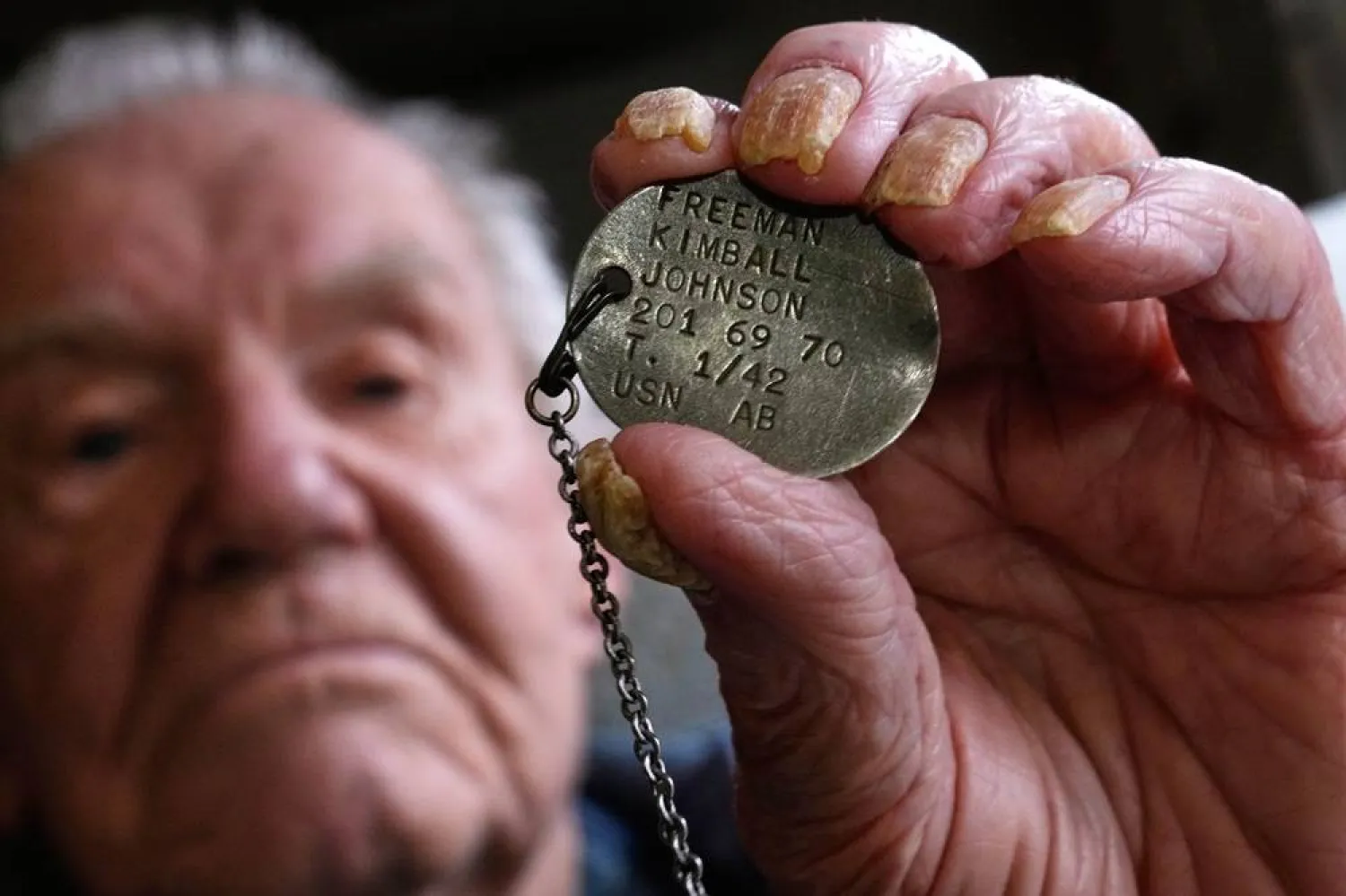
 Freeman K. Johnson, a 106-year-old Pearl Harbor survivor, holds up his dog tag, May 6, 2026, in Centerville, Mass. (AP)
Freeman K. Johnson, a 106-year-old Pearl Harbor survivor, holds up his dog tag, May 6, 2026, in Centerville, Mass. (AP)
TT

Oldest Pearl Harbor Survivor Is Keeping Memory of the Surprise Bombing Alive at 106

 Freeman K. Johnson, a 106-year-old Pearl Harbor survivor, holds up his dog tag, May 6, 2026, in Centerville, Mass. (AP)
Freeman K. Johnson, a 106-year-old Pearl Harbor survivor, holds up his dog tag, May 6, 2026, in Centerville, Mass. (AP)

On the day of the Pearl Harbor attack, the country's oldest living survivor of the Japanese bombing was far below deck helping repair one the boilers of the USS St. Louis.

Freeman Johnson, who turned 106 in March, never witnessed the surprise attack. He never heard his shipmates firing antiaircraft guns at the attacking planes — shooting down a torpedo plane. By the time he was topside, the St. Louis, a light cruiser, had evaded midget submarines and safely set out to sea.

"While all the rigamarole was going on topside, I was inside a steam drum. Couldn’t see anything, absolutely nothing," said Johnson, a Centerville, Massachusetts, resident whose living room is filled with mementos and photos of his Navy service, including photos of the St. Louis and him as a young sailor, along with a collection of Navy challenge coins and ribbons representing the places he visited. He still has his military identification tag — popularly known as dog tag.

Even as the St. Louis headed into the Pacific Ocean, Johnson, whose job was known as a fireman on the ship, knew little about the attack.

"We were way out to sea, way out. You couldn’t see any land at all. All you saw was ocean," he said. "I was just a sailor, just a swabbie, I was not an officer. They don’t tell you anything if you don’t need to know. And I didn’t need know it. So they tell you nothing."

When he visited schools, children often asked Johnson whether he was scared that day. "You’re not scared. You’re too busy to be scared," he said, his gravelly voice rising. "Besides, you don’t know what you’re scared of. You can’t see anything. What are you afraid of?

One of only 11 survivors

Johnson became the oldest survivor after World War II Navy veteran Ira "Ike" Schab died in December. He was 105. With Schab's passing, there remain only 11 survivors of the surprise attack, which killed just over 2,400 troops and propelled the United States into the war. The United States mourns the nation’s fallen service members on Memorial Day, which takes place Monday.

Every year, there is a remembrance ceremony at the military base’s waterfront for Pearl Harbor survivors.

About 2,000 survivors attended the 50th anniversary event in 1991. A few dozen have showed in recent decades. In 2024, only two made it. That is out of an estimated 87,000 troops stationed on Oahu that day. None made the pilgrimage to Hawaii last year.

Growing recognition

For most of his life, Johnson avoided the spotlight and talked little about surviving the bombing. After all, he was one of the tens of thousands sailors who were there on that tragic day. He recalled his wife, Ruth, "thought that was something special" so she called the Navy and "the girl laughed at her."

But as the oldest survivor, he's become a local celebrity and the reluctant face of one of the most important events in World War II. Johnson showed up at his 106th birthday party in a limousine and was mugged by television cameras. He gets letters from all over the world and is routinely called a hero wherever he goes out.

Johnson, who is hard of hearing, needs a walker to get around and suffers from congestive heart failure, can recall his wartime experience down to the smallest detail. A 19-year-old who was unemployed and living at home in Waltham, Johnson said he feared being drafted so he signed up for the Navy — because he felt it would be less physically taxing than the Army.

"As a kid, I walked. If I wanted to go somewhere, I walked or took my bicycle. But I didn't want to walk from France to Germany," he said, sitting in a recliner, dressed in an oversized flannel shirt and waving his hands like an orchestra conductor.

"It's a long way carrying a knapsack with you ... Water for a day, food for a day, a 9-pound Springfield rifle all on your back and walking through the mud," he said. "No thanks. That’s why I joined the Navy."

Witnessing history

Johnson's memories have less to do with battles while on the St. Louis, and later aboard the USS Iowa, than their significant roles in history. He helped commission the Iowa and recalled the battleship's preparations in November 1943 ahead of transporting President Franklin D. Roosevelt to the Tehran Conference with British Prime Minister Winston Churchill and Soviet dictator Josef Stalin.

The ship was equipped with two elevators and a bathtub. All the ammunition and much of the oil was removed to lighten the ship as it made its way down the Potomac River to pick up Roosevelt. It was reloaded before the ship headed out to sea.

"It was a big meeting," Johnson said, recalling how the crew were photographed with Roosevelt. "I don’t know what they talked about, but I didn’t need to know. We picked him back up, brought him home."

Johnson also witnessed the war's end aboard the Iowa. He was on the Iowa's mast watching the surrender ceremonies about a mile away in Tokyo Bay aboard the USS Missouri on Sept. 2, 1945.

"I could see the boats coming up with the Marines escorting the Japanese onto ship and sitting around a table," he said. "It was all over. That was the end of the war. A bunch of us got together — the war is over. Let's go home."

Telling the story of Pearl Harbor

These days, his daughter, Diane Johnson, is often by his side. They live together and always take a trip on Dec. 7, often attending Pearl Harbor remembrance events, including the 65th and 80th anniversary in Hawaii. She often poses questions to get her father talking and likes to nag him that he has "a responsibility" to share the story of Pearl Harbor —- especially for children who know little about the bombing.

"It’s kind of overwhelming when you think of it. Well, the 106 is what gets me," she said. "When I think about his history, he’s at the beginning, he’s at middle, he is at the end when he witnessed the surrender. It’s something."

Johnson began getting more attention several ago, when Diane Johnson heard a local television report suggesting the last survivor in the state had died. She called to correct the record and that raised his profile. Johnson also started making regular appearances in the Cape Cod St. Patrick's Parade, often leading from the front.

"I wish more people were like him today. He just gets on and doesn't complain about anything," said Desmond Keogh, the chairman of the parade who has accompanied Johnson. "It's what this country was all about. They were just a different generation. They did what was best for their country."

For all the attention to Pearl Harbor, the gruff Johnson, who is known for his cackling laugh and mischievous smile, doesn't see it as a defining moment in his life.

That would have been getting married after the war to his late wife and having three daughters. He also worked for years in a machinist shop, then in a convenience store and, finally, delivering meals to seniors — all jobs he retired from, the last one at the age of 90.

"Pearl Harbor just happened. I can’t put it any other way," he said.


Brooch Given to First Passenger to Board Doomed Steamship Found at Roadshow

The brooch contains a dedication with the date April 21 1894 (AP)
TT

Brooch Given to First Passenger to Board Doomed Steamship Found at Roadshow

The brooch contains a dedication with the date April 21 1894 (AP)

A brooch given to the first passenger to board a Dundee-built steamship 37 years before she sank has surfaced at an antiques roadshow.

The decorative item was presented to Elizabeth Anderson on April 21 1894, the date of the maiden voyage of the SS Citrine, according to the British website ‘itv News.’

Built by Dundee shipbuilders W B Thompson & Co, the Citrine was one of a number of vessels in the Glasgow-based “Gem line,” all of which were named after gemstones or minerals.

The shipping firm was owned by William Robertson, who started out with a single barge in 1852 before growing it into one of the largest coastal bulk shipping fleets in Britain.

The brooch was presented to Anderson by Robertson and is inscribed with the words “SS Citrine, April 21 1894, Elizabeth McIntyre Anderson, from William Robertson.”

The sides of the gold-colored item are shaped as a ship’s rope and its center has been designed as a life ring mounted with a citrine stone, echoing the name of the vessel.

The Citrine sank on March 17 1931 after striking rocks at Bradda Head, Port Erin, on the Isle of Man.

Accounts at the time described the ship’s final moments in darkness, heavy weather and confusion, and the disaster claimed the lives of nine of her 11 crew members.

William Robertson had been dead for 12 years by the time of the sinking but the business remained in family hands under his sons, William Francis Robertson and James Robertson.
The brooch was discovered at a WeBuyVintage roadshow in Fleetwood, Lancashire.


NASA Robot Mission Aiming to Rescue Space Telescope

This handout photo released by NASA on July 31, 2004, shows the Swift spacecraft being unwrapped in Hangar AE at Cape Canaveral Air Force Station at Kennedy Space Center, Florida. (Photo by Handout / NASA / AFP)
TT

NASA Robot Mission Aiming to Rescue Space Telescope

This handout photo released by NASA on July 31, 2004, shows the Swift spacecraft being unwrapped in Hangar AE at Cape Canaveral Air Force Station at Kennedy Space Center, Florida. (Photo by Handout / NASA / AFP)

NASA on Tuesday is set to launch a daring robotic rescue mission, a long shot bid to prevent one of its aging telescopes from vanishing into dust.

If successful, the effort could pave the way for giving other satellites a second life.

The operation is set to last several months, kicking off with the launch of a robot designed to rescue the Swift space telescope that's currently falling towards Earth.

Without intervention, Swift is expected to soon burn up in the atmosphere.

The rescue spacecraft developed by the US startup Katalyst is slated to lift off Tuesday at 1023 GMT from a Pacific Ocean atoll aboard a small rocket named Pegasus.

The rocket-propelled launch vehicle will not take off from a launch pad. Instead, it will be released from a jet.

"Everything about this mission is so crazy," said NASA astrophysicist Regina Caputo with a laugh during an interview with AFP.

After it reaches an orbit near that of the telescope, the robot must locate Swift across the vastness of space.

The aim is then for the robot to maneuver around the telescope and latch on with three movable arms.

It will then vie to tow Swift into a stable orbit over the course of at least a month, rescuing it from destruction by moving it about 300 kilometers higher.

"This is a lot of firsts stacked on top of each other," said Shawn Domagal-Goldman, the director of NASA's astrophysics division, during a recent call with reporters.

"I'm just deeply thankful that we're even giving this a go."

The idea of such a rescue might seem odd at first glance.

The Neil Gehrels Swift Observatory telescope was launched in 2004, and was originally designed for a two-year mission.

The device was intended to study gamma-ray bursts, what Caputo called "the most energetic things that happen in the universe."

She likened it to a supercharged version of a supernova, which is a dramatic, explosive death of a star.

Gamma-ray bursts are extremely brief, she explained, so the telescope was placed at an altitude of approximately 600 kilometers in low Earth orbit, so it could remain in constant communication with researchers.

But with that pro came a con -- at such an altitude, the device without its own propulsion would eventually drift closer to Earth and burn up in the atmosphere.

Caputo said that phenomenon was expected and normal, because when the Sun is in its more active cyclical stages, it emits more particles and causes an expansion of Earth's atmosphere.

That creates drag, meaning satellites in low Earth orbit lose altitude.

Yet when forecasts in early 2025 indicated the telescope was nearing the end of its life, NASA began considering a possible rescue.

"We decided, yeah, we want to go save this one this time, because of how special it is," said Domagal-Goldman.

Despite its age, the Swift telescope remains in high demand within the scientific community, not least for its rapid response capabilities.

Should it burn up, it could not be immediately replaced.

The mission attempting unprecedented maneuvers has a projected cost of $30 million to save the device, which originally cost $250 million.

The rescue robot named LINK will have to overcome numerous challenges and unknowns.

For example, engineers do not have a clear picture of what the back of the telescope actually looks like -- even though that's where the robot must latch on.

With a laugh, Caputo projected the chances of success at "maybe 50-50."

Still, both NASA and the company Katalyst believe the mission -- which could run into the fall -- might pave the way for new possibilities in spacecraft management, and is worth a shot.

Robert Lamontagne, a vice president at Katalyst, said during a call with journalists that it could represent the "start of a new model" to "refuel, reposition, repurpose, repair, and even upgrade satellites, even if they were never prepared for it."


Rare Dinosaur Fossil from Antarctica is Found Tucked Away in a Drawer

This image provided by the Natural History Museum shows a fossil found in Antarctica that belongs to a group of dinosaurs called titanosaurs. (Natural History Museum via AP)
TT

Rare Dinosaur Fossil from Antarctica is Found Tucked Away in a Drawer

This image provided by the Natural History Museum shows a fossil found in Antarctica that belongs to a group of dinosaurs called titanosaurs. (Natural History Museum via AP)

Scientists have stumbled on a rare dinosaur fossil from Antarctica, tucked away for decades in a drawer.

The bone comes from the tail of a long-necked, plant-eating dinosaur called a titanosaur. Scientists haven't yet identified the species it belongs to, The Associated Press reported.

It was discovered in 1985 during an expedition to Antarctica's James Ross Island and collected by geologist Mike Thomson. Working with the British Antarctic Survey, Thomson was mapping the area's rock layers and collected marine reptile fossils to help with future dating efforts. He recorded the find as a large reptile.

Decades later, paleontologist Mark Evans spotted the bone in the British Antarctic Survey's collections and wondered whether it might be a dinosaur.

He and other researchers analyzed the shape of the bone and compared it to other more complete dinosaur remains, confirming their discovery. The findings were published on Monday in the journal Acta Palaeontologica Polonica.

Dinosaur fossils are rare to find in Antarctica because of the unforgiving ice caps. But millions of years ago, when this dinosaur lived, the region was populated by lush forests — a “rather different and much more hospitable place than we think of today,” said study co-author Paul Barrett with the Natural History Museum in London.

At about 23 feet (7 meters) long, the dinosaur was small for its group and may have been young when it died. Scientists don't know how the creature met its end, but they think its body floated away from the coast and sank to the sea floor, becoming fossilized in marine rock.

Technology has come a long way since the dinosaur tail bone was first found, allowing researchers to peer inside bones and gain even more detailed information about ancient creatures. Thomson died in 2020 before the fossil was identified as belonging to a dinosaur.

“If he were still with us, he would be delighted to know what this was,” Evans, a study co-author, said.
