


Light, Flight, and Rights: 250 Years of US History in 30 Objects

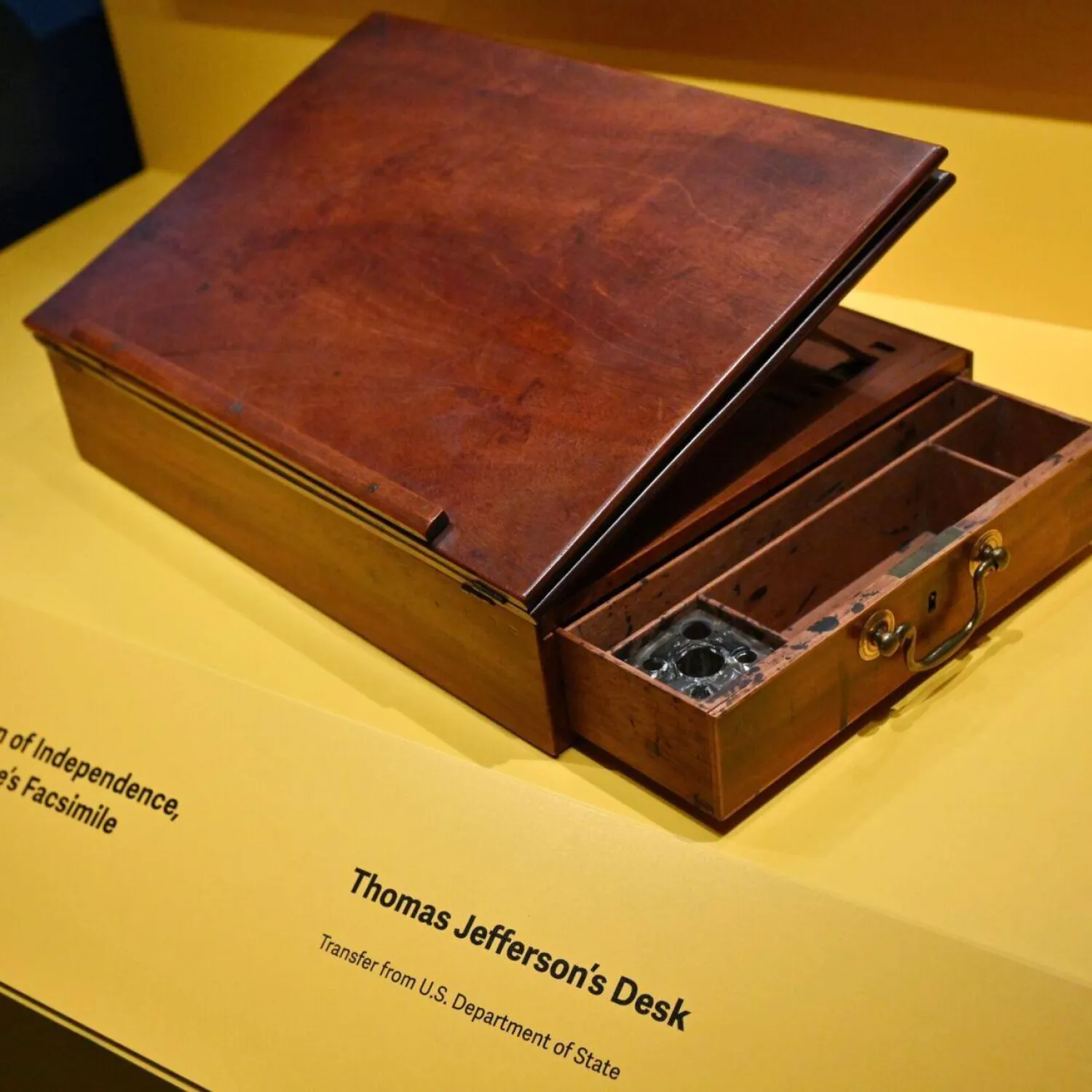
Thomas Jefferson's desk, on which he drafted the Declaration of Independence, can be seen on display by The Smithsonian for its 'American Aspirations' exhibition. Mandel NGAN / AFP
TT

Light, Flight, and Rights: 250 Years of US History in 30 Objects

Thomas Jefferson's desk, on which he drafted the Declaration of Independence, can be seen on display by The Smithsonian for its 'American Aspirations' exhibition. Mandel NGAN / AFP

How do you choose just 30 artifacts from millions to encapsulate 250 years of American history?

That's the question the government-funded Smithsonian Institution posed itself as the United States gears up for the anniversary of the nation's July 4, 1776, Declaration of Independence.

Among the answers: a small ink-stained mahogany desk, an antique light bulb, a brown leather flight suit and a baseball jersey.

These exhibits and others that present some highlights of America's faltering progress toward a perfect union go on show for two months in Washington next Tuesday ahead of the semi quincentennial.

"It's a daunting task," said Abeer Saha, who was one of a handful of curators tasked with choosing from 150 million objects across the Smithsonian -- which runs more than 20 museums and galleries. He spent more than two years on the project.

"What we've tried to do is find those highlights, those moments, those stories that best exemplify the ways in which Americans have sought to realize the founding ideals first expressed in the Declaration of Independence by Thomas Jefferson."

President Donald Trump has taken a series of norm-shattering steps to put himself at the center of attention on the 250th Independence anniversary.

But Abeer said the painstaking selection of artifacts, which have never been in the same room before, was done without any political interference.

To an AFP reporter, the only visible imprint of the current US president -- whose administration has also sought to sanitize negative history at US national parks -- was a "Trump-Vance" election campaign badge alongside those of a roster of modern presidents from both parties.

- Freedom, innovation, pathfinders -

The exhibition, "American Aspirations," is housed in a vaulted red sandstone hall inside the grand Smithsonian Castle, the institute's original premises on the National Mall. It was previewed by journalists on Thursday.

Appropriately enough, it starts with the small desk used by Jefferson to draft the declaration of independence from Britain that began with the timeless words: "We hold these truths to be self-evident, that all men are created equal."

The desk looks more like a small, table-top easel. It was designed for Jefferson by a Philadelphia cabinet maker and folds out to reveal a green baize writing top.

Lisa Kathleen Graddy, a Smithsonian curator of American political history, said Jefferson had an eye on history, and affixed a note to the inside of the desk authenticating it as the one used to write the declaration.

Nearby, is a large poster, with text penned by famed slavery abolitionist Frederick Douglass, that was carried in a 1863 parade during the Civil War that calls "Men of Color, To Arms! To Arms!"

It is one of several exhibits that address the struggle for greater freedom over the centuries, including against slavery and in modern times for civil rights.

There is the typed text of Martin Luther King Jr.'s 1963 speech, "I Have a Dream," and a jersey worn by Roberto Clemente, the first Latino to be inducted into the Baseball Hall of Fame.

There are also signifiers of economic and scientific progress.

They include a nugget from the California gold rush; an 1879 lightbulb by Thomas Edison; a mainframe component from ENIAC, the first general-purpose electronic computer that was built in 1946 and weighed 30 tons.

And on the theme of "pursuit of new horizons," there are artifacts from two pathfinding women who took to the skies.

There's the leather flight suit of Amelia Earhart, who was the first woman to fly across the Atlantic but disappeared over the Pacific in 1937 as she attempted to fly around the world.

Beside it is the pale blue flight jacket of Sally Ride, a physicist who in 1983 became the first American woman in space.

"She really shifted the way in which Americans and the world would look at who could go into space," said Jennifer Levasseur, a curator at the National Air and Space Museum.


Half of France Hits New Monthly Records in Heatwave

 Tennis - French Open - Roland Garros, Paris, France - May 29, 2026 A spectator uses a tap outside the courts during the matches. (Reuters)
Tennis - French Open - Roland Garros, Paris, France - May 29, 2026 A spectator uses a tap outside the courts during the matches. (Reuters)
TT

Half of France Hits New Monthly Records in Heatwave

 Tennis - French Open - Roland Garros, Paris, France - May 29, 2026 A spectator uses a tap outside the courts during the matches. (Reuters)
Tennis - French Open - Roland Garros, Paris, France - May 29, 2026 A spectator uses a tap outside the courts during the matches. (Reuters)

Towns and villages in more than half of France have smashed temperature records for the month of May over the past week during an unusually early heatwave, a climatologist said Friday.

"More than half of France has experienced at least one monthly heat record -- whether in minimum and/or maximum temperatures -- during this episode, which is colossal," said Matthieu Sorel, a climatologist at French weather service Meteo France.

Temperatures were expected to cool over the weekend.

From Saturday to Wednesday, there were around 109 monthly minimum temperature records and 266 monthly maximum temperature records, he added.

France beat a national record for a month of May earlier this week, peaking with a national thermal average indicator of 24.9C on Tuesday.

On Thursday, the temperature in the southwestern city of Angouleme hit a maximum of 37.8C, the highest it had ever been in any part of France in May.

Studies and scientific bodies agree that heatwaves in Europe are becoming more frequent.

Meteo France says that of the 51 heatwaves recorded nationwide since 1947, 34 have come since 2000 and 26 since 2011.

Global average temperatures are likely to continue at or near record levels this year and for the next four years afterwards, the United Nations warned on Thursday.


Pigeons May Be Navigating with Their Liver, Study Suggests

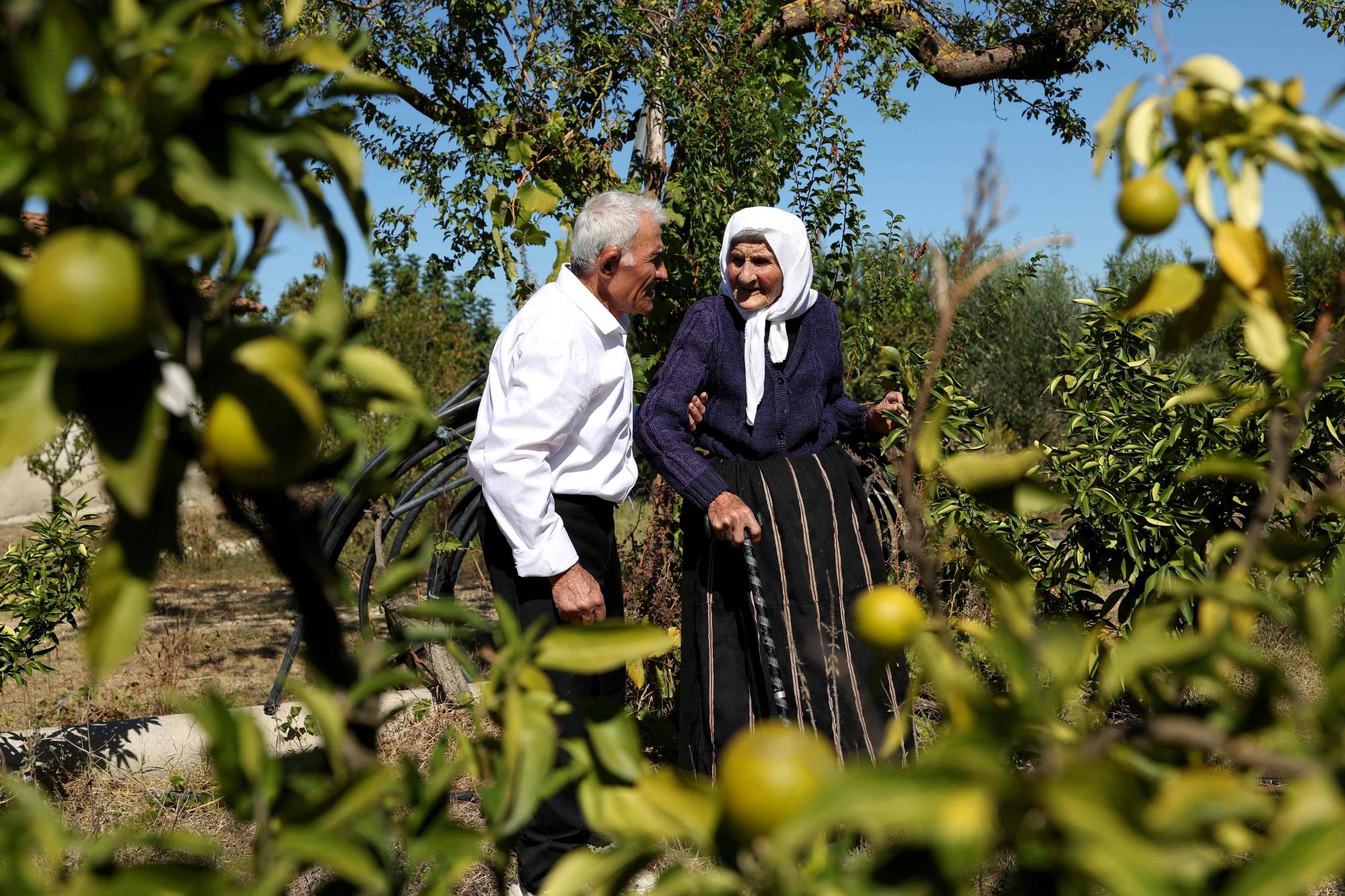
Palestinian girl Ilan, 4, feeds pigeons at the Flag Square in the coastal city of Tyre, southern Lebanon, 20 May 2026. (EPA)
TT

Pigeons May Be Navigating with Their Liver, Study Suggests

Palestinian girl Ilan, 4, feeds pigeons at the Flag Square in the coastal city of Tyre, southern Lebanon, 20 May 2026. (EPA)

A surprising gut feeling may help pigeons find their way home.

Animals use various techniques to navigate including following the stars and remembering key landmarks. Birds, fish and turtles orient themselves using Earth's magnetic field as a compass. But it's not yet clear how exactly they do this.

Pigeons are a well-known group of frequent flyers that can traverse hundreds of miles (hundreds of kilometers) in a single day. For thousands of years, humans have used them to carry news, notes and military messages.

Scientists have long tried to untangle how pigeons travel without getting lost. Some think the birds detect magnetic cues using light-sensitive molecules in their eyes, while others suggest it happens in the beak or inner ear.

“The magnetic sense has been this mystery for almost 100 years,” said Martin Wikelski with the Max Planck Institute of Animal Behavior in Germany.

In a new study, Wikelski and other researchers decided to draw back the curtain on pigeons' navigational secrets. They searched for magnetic clues in the birds' organs and found a strong signal in an unexpected place: the liver.

Specialized immune cells in the pigeon's liver break down red blood cells and store iron. When scientists temporarily stripped pigeons of those immune cells and let them fly, the birds “just couldn't find their way,” said Christian Kurts with the University of Bonn in Germany. That suggested the iron-rich liver cells might play a role in their sense of direction.

The birds' magnetic compasses only got scrambled on overcast days. That's because they also use the sun as a navigational guide.

Scientists have previously wondered whether immune cells could be involved in magnetic sensing, but the new study published Thursday in the journal Science is the first to present a full-fledged theory.

“I would never have guessed it, but once it was explained to me, it makes sense,” said behavioral ecologist Albert Kao with the University of Massachusetts Boston, who had no role in the study.

The immune cells are located near nerve fibers in the liver. That might be how they transmit their “magnetic sense” to the brain “and help the pigeons to navigate,” said study co-author Clivia Lisowski with the University of Bonn.

The researchers think other birds and animals like mice could operate using a similar magnetic GPS. But outside experts say more work is needed to verify the pigeons navigate this way and to firm up how these signals get to the brain.

While the researchers found the strongest magnetic signal in the pigeons' livers, such immune cells have also been spotted in other areas including the beak and spleen.

It's possible this magnetic puzzle doesn't have a single answer, wrote veterinary pathologist Simon Spiro and biologist Hal Drakesmith in an accompanying editorial. The birds could use different techniques to sense magnetic fields depending on the task, be it traveling long distances or finding a specific destination.

“Indeed, it could be prudent to have more than one way of getting home in the dark,” they wrote.


Legacy of Himalaya’s ‘Sherlock Holmes’ Lives on in Digital

This photograph taken on May 20, 2026, shows mountaineers climbing a slope lined up during their ascent from the Hillary Step to summit Mount Everest in Nepal. (Furte Sherpa / AFP)
TT

Legacy of Himalaya’s ‘Sherlock Holmes’ Lives on in Digital

This photograph taken on May 20, 2026, shows mountaineers climbing a slope lined up during their ascent from the Hillary Step to summit Mount Everest in Nepal. (Furte Sherpa / AFP)

In a crowded Kathmandu restaurant far from Nepal's famed icy peaks, Billi Bierling questions climbers about their ascents, preserving each triumph in the Himalayan Database, mountaineering's revered 60-year-old register of success.

German climber Bierling, 58, inherited the stewardship of the archive from her mentor, the late Elizabeth Hawley, an American journalist who began the post-expedition interviews in Nepal while covering an American Everest expedition in 1963.

"It was her fascination," Bierling told AFP, after interviewing a Russian and a Ukrainian climber about their ascent of Manaslu, the world's eighth-highest mountain.

"She never climbed," Bierling said. "She never even went to a base camp -- but the people interested her."

Hawley's 50 years of chronicling climbs in the Himalayas earned her the moniker "the Sherlock Holmes of the mountaineering world" from Edmund Hillary, who with Tenzing Norgay made the first summit of Everest.

By the time she passed away in 2018, she had built a reputation as one of the most authoritative voices on Himalayan mountaineering.

The database she began had become the definitive record of Himalayan expeditions -- used by climbers, historians and researchers alike.

"She was very, very keen on her data, on her information," said Bierling, who first met Hawley in 2001 -- when she was in Nepal to climb the 7,129-metre (23,390-foot) Baruntse -- and began assisting her in 2004.

She described how Hawley would give the same grilling to all -- whether a climbing legend or an unknown.

"It didn't matter whether you were Reinhold Messner or you were Ueli Steck," she said, referring to the Italian great who made the first solo ascent of Everest, as well as the late Swiss speed climber.

"Or if you were Billi Bierling, a nobody," she said with a smile.

Bierling is now part of the team that continues her work, updating the vast database year after year.

At a time when each year more climbers are attempting the world's highest peaks than ever before, the task of recording the ascents is even more important.

- '40 drawers of reports'-

But times have changed.

In the 1970s, Hawley would drive to Kathmandu's airport in her blue Volkswagen Beetle, spotting those carrying the tell-tale heavy mountaineering boots as they walked off the two or three international flights a week.

Soon, it was the mountaineers who would seek her out.

In 1991, American climber Richard Salisbury, recognizing the archive's historical importance and fragility, proposed digitizing it.

It took nearly 11 years, Salisbury told AFP, a painstaking effort to convert "nearly 40 full file drawers" of meticulous handwritten expedition reports into a searchable digital resource.

"It was very important for a mountaineer to have their summit recorded in the Himalayan Database," said Garrett Madison, who has organized expeditions in Nepal since the 2000s, speaking to AFP from Everest base camp.

"If it wasn't recorded, it didn't happen."

Japanese climber Tatsuro Sugimoto, in Kathmandu after completing the first ascent of the 6,473-meter (21,237-foot) Jarkya, said the database was key for mountaineers seeking new records and routes.

"It is useful; we can check which mountains are unclimbed," he said.

- 'Need an army' -

Its scale, like climbing, has expanded exponentially.

Commercial expeditions now send hundreds of climbers each season, some summiting more than one peak.

"At one point I thought, 'this is no longer possible'," Bierling said. "I would be only running around. More and more mountains were being commercialized."

The database now supplements its records with official expedition numbers from Nepal's Ministry of Tourism.

"If we wanted to meet everybody in person, we'd need an army of 100 people," Bierling said. "It's all so quick. People come and go, they fly in, they fly out."

Nepal has issued a record 492 Everest permits for foreigners this season, with a city of tents set up at the foot of the mountain for climbers and support staff.

The focus has shifted to significant ascents, including first summits or new routes that push boundaries.

"The interesting climbs we chase," she said.

But the database still follows one of Hawley's key principles: first, trust the climber.

"Only when doubt arises do we dig in and look into it," said volunteer Tobias Pantel, 39.

"Then we can check the topography in their photographs and if other climbers are contradicting the claims."

As a result, some climbs are tagged "disputed", said Bierling.

"I often wonder what would Miss Hawley say," she said.
