


Australian Researchers Teach Brain Cells to Play 'Doom'

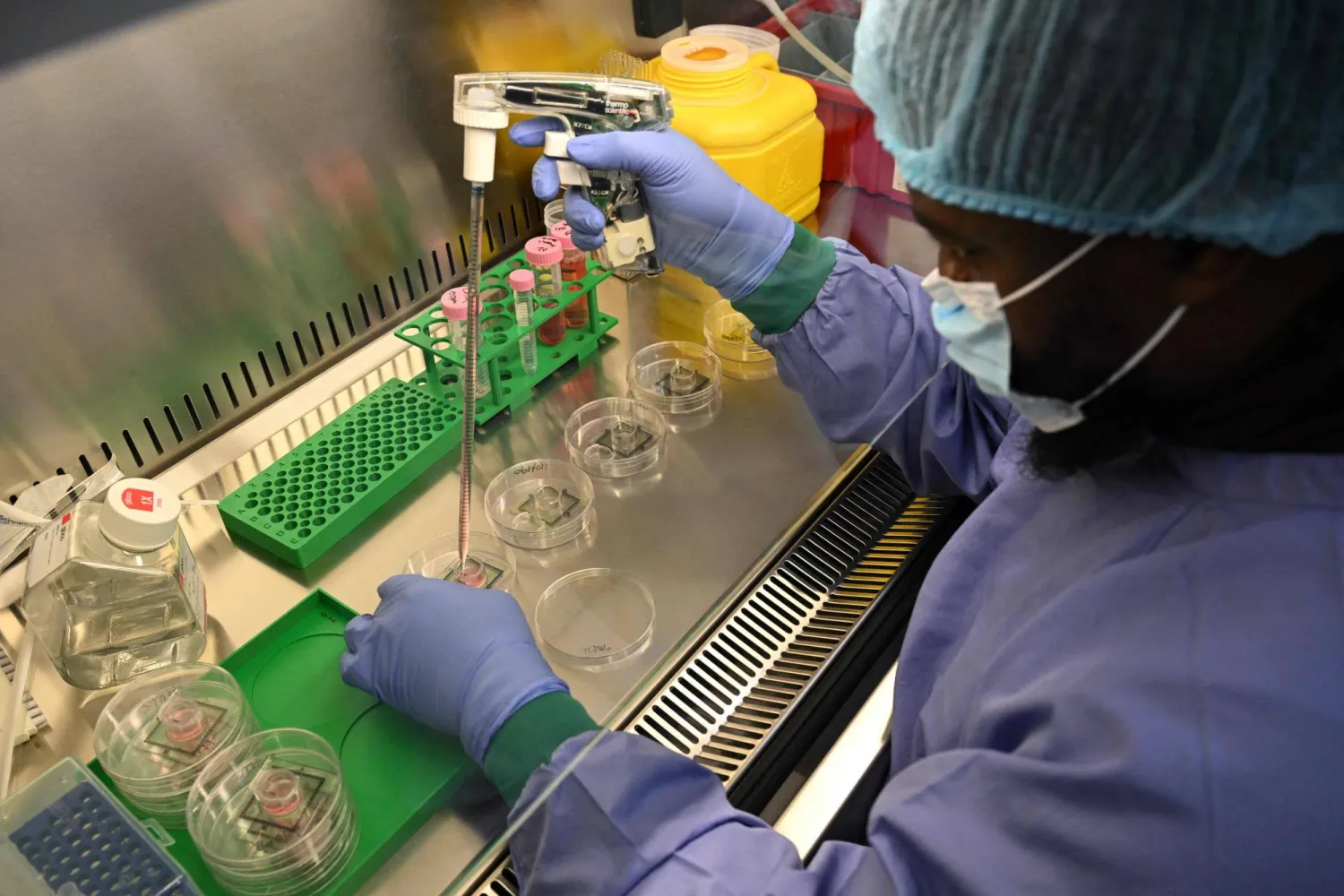
In this photo taken on May 5, 2026, senior scientific specialist Kwaku Dad Abu Bonsrah pipettes nutrients onto neurons on Micro Electrode Array (MEA) chips at Cortical Labs' Physical Containment Level 2 (PC2) laboratory in Melbourne. (Photo by William WEST / AFP)
TT

Australian Researchers Teach Brain Cells to Play 'Doom'

In this photo taken on May 5, 2026, senior scientific specialist Kwaku Dad Abu Bonsrah pipettes nutrients onto neurons on Micro Electrode Array (MEA) chips at Cortical Labs' Physical Containment Level 2 (PC2) laboratory in Melbourne. (Photo by William WEST / AFP)

Australian researchers have trained lab-grown brain cells on a silicon computer chip to play the nineties shooter game "Doom" and say they are just scratching the surface of what the neurons could be capable of doing.

It's the science-fiction work of biotech boffins at Cortical Labs, who researched and developed the technology that harnesses the workings of the brain's networking system.

Each so-called "biological computer" contains around 200,000 living human brain cells, grown from stem cells that were harvested from blood donations.

Having mastered the simple computer game "Pong", where a paddle is moved up and down to send a ball across a screen, the brain cells have moved on to bigger things.

Initially, the neurons were at the "level of a beginner who's never played a video game before," Alon Loeffler, Cortical Labs' senior application scientist, told AFP.

"Doom" involves a chaotic 3D game-world where the user is required to explore its surroundings and dispatch enemies -- no easy task for a clump of cells.

"They were walking into walls a lot, shooting the walls, turning around, doing funny things like that," Loeffler said.

"And then eventually they started targeting the enemies more regularly and correctly."

It's not the cleanest execution, however. One demon takes several attempts to slaughter, with shots fired in multiple directions before the target is hit.

But the mind-bending research proves the neurons can adapt to stimuli in real time and complete goal-directed learning, Cortical Labs say.

The researchers converted the digital environment in "Doom" into patterns of electrical signals the neurons on the chip could understand.

When an enemy appears, specific electrodes stimulate the neurons on the special chip called a CL1, causing them to react.

Different patterns of neuron activity produce specific responses, such as firing the gun or moving left or right.

Researchers monitor the electrical activity of the neurons from a computer screen connected to the CL1, represented by thousands of tiny dots.

From this data, the team adjusts their input to influence and train the neuron's activity.
The CL1 isn't limited to computer games -- the chip can be coded to perform a range of applications, from drug screening to AI-like machine learning.

"We are just scratching the surface of what these neural cultures can achieve when integrated in systems like our CL1," said chief scientific and operations officer Brett Kagan.

"Our neural cultures have been explored for a variety of tasks," he said -- everything from "robotics, real-time learning tasks that are similar to AI, as well as healthcare, medicine, disease modelling, drug screening and even personalised medicine".

Kagan describes the CL1 chip as "a more sustainable and more powerful form of intelligence".

The human brain runs on an estimated 20 watts of power, a level of efficiency that silicon computing and artificial intelligence have not yet been able to replicate.

While it's "not aimed to replace what AI is doing" it's intended to "give us abilities that we've never had before", Kagan said.

The cells have a six-month lifespan and aren't yet capable of producing consistent, programmable results.

But analysts say the project's value could lie in its more sustainable power consumption compared to regular chips.

"We need better ways to manage that power envelope and get higher levels of efficiency," William Keating, CEO of semiconductor research company Ingenuity, said.

"This isn't wacky science or some bunch of scammers. This is real science and it's making real progress."



Dead Humpback Whale Brought to Shore in Denmark with Autopsy Set Next Week

30 May 2026, Denmark, Anholt: The dead whale is being pulled ashore on the Danish island of Anholt. (dpa)
TT

Dead Humpback Whale Brought to Shore in Denmark with Autopsy Set Next Week

30 May 2026, Denmark, Anholt: The dead whale is being pulled ashore on the Danish island of Anholt. (dpa)

The carcass of a humpback whale, whose life and death captivated Germans for months as the mammal became repeatedly stranded in the Baltic Sea, was dragged Saturday onto a Danish beach after two weeks of the body languishing in shallow waters.

The whale had gained the nicknames “Timmy” and “Hope” as German media outlets sent push alerts and updated live blogs with the status of its health since it was first spotted off the German coast on March 3.

The whale was found dead on May 14, stranded just off the small island of Anholt in the Kattegat, the broad strait between Denmark and Sweden that connects the Baltic Sea to the North Sea.

The whale's death ended months of a spectacular and contentious rescue effort that culminated May 2, when the mammal was transported toward the North Sea in a barge in a final effort to guide it back to its natural habitat in the Atlantic Ocean.

The carcass will be examined next week to determine the cause of death, according to the Danish Environmental Protection Agency.

Danish news outlet “News5” on Saturday published a livestream of the carcass being dragged onto the shoreline by a cable attached to a truck on the beach.

It’s not clear why it swam into the Baltic Sea, which is far from its habitat and it wasn’t suited to, although some experts said it may have lost its way while swimming after a shoal of herring or during migration.


Austrian Protesters Shut Vital Motorway Connecting Germany to Italy

People demonstrate against transit traffic near the A13 Brenner Highway in the direction of Italy during the blockade of the Brenner Base Tunnel on May 30, 2026, on the Tyrolean Brenner Highway. (AFP)
TT

Austrian Protesters Shut Vital Motorway Connecting Germany to Italy

People demonstrate against transit traffic near the A13 Brenner Highway in the direction of Italy during the blockade of the Brenner Base Tunnel on May 30, 2026, on the Tyrolean Brenner Highway. (AFP)

Thousands of local residents shut down Austria's Brenner motorway on Saturday, a vital north-south corridor through the Alps between Germany and Italy, in protest at trucks and tourists perennially clogging up their roads.

The protest was led by Karl Muehlsteiger, mayor of Gries am Brenner, one of the towns in the shadow of the artery that snakes through the narrow, steep-sided Wipp Valley on giant concrete stilts.

The issue of ‌excess traffic and ‌pollution in the valley, which leads ‌to ⁠the Brenner Pass, ⁠has for decades been a source of tension between Austria and Germany. Local authorities in the Austrian state of Tyrol have introduced various measures to stem the flow, often prompting howls of protest across the border.

"You are making history!" Austrian news ⁠agency APA quoted Muehlsteiger as telling a ‌crowd of around 3,000 ‌protesters who gathered on the motorway at 1 p.m. to ‌block it symbolically, hours after police cordoned off ‌both ends of the corridor. Cars arriving there turned around and drove away.

The eight-hour shutdown from 11 a.m. did not cause the chaos many had feared as drivers ‌largely heeded warnings to stay away, even during what in some German states, ⁠including ⁠neighboring Bavaria, was a school holiday.

Trains passing along the same route were crowded, local media reported.

The provincial road that runs from town to town alongside the motorway was also closed to all but locals and local traffic.

In Italy, a suspected arson attack on electrical control units overnight disrupted rail traffic between Peri and Dolce, near Verona, on the Verona Porta Nuova–Brenner line.

Investigators were looking into possible links to radical environmentalist or anarcho-insurrectionist groups.


Blue Origin Rocket Explosion is Bad News for Both Bezos and NASA

Video of the Blue Origin New Glenn rocket explosion showed the spacecraft combusting into a massive fireball. JohnCn (@JConcilus) on X / UGC/AFP
TT

Blue Origin Rocket Explosion is Bad News for Both Bezos and NASA

Video of the Blue Origin New Glenn rocket explosion showed the spacecraft combusting into a massive fireball. JohnCn (@JConcilus) on X / UGC/AFP

Space exploration is filled with setbacks, but the spectacular explosion of Blue Origin's New Glenn rocket on Thursday night marked a significant blow to not only the company, which was founded by billionaire Jeff Bezos, but also NASA, with the two collaborating for the upcoming US Moon missions.

"Spaceflight is unforgiving," NASA Administrator Jared Isaacman said in a post on X soon after the explosion, promising to "support a thorough investigation of this anomaly," which happened during a ground test and resulted in no injuries.

The rocket -- which stands 98 meters (321 feet) tall and is the most powerful in Blue Origin's fleet -- exploded around 9:00 pm local time Thursday (0100 GMT Friday).

It was undergoing a ground test in Cape Canaveral, Florida in preparation of an upcoming flight when it blew up in a massive fireball, sending shockwaves throughout the space industry.

While anomalies during ground tests are relatively frequent, such explosions are rare, and the magnitude of the blast caused significant damage not only to the spacecraft but the launch pad itself, according to photos of the aftermath released Friday.

"It will take some time to rebuild their pad," Florida congressman Mike Haridopolos, whose district includes Cape Canaveral, told broadcaster Fox News on Friday.

Blue Origin declined an AFP request for additional details on the incident, extent of damage or the ongoing investigation, which is conducted alongside NASA and the US Space Force.

The New Glenn rocket will remain grounded while the investigation is conducted.

- Moon Mission -

The vessel is at the heart of Blue Origin's ambition and NASA's Artemis lunar program, and could have implications for the company's role going forward.

"I have no doubt they will recover but I'm wondering how does this affect Artemis," Clayton Swope, deputy director of the Aerospace Security Project at the Center for Strategic and International Studies, told AFP.

NASA has also tasked rival space exploration company SpaceX to develop lunar landers for transporting astronauts and equipment to the surface of the Moon to establish a base.

SpaceX has seen its own challenges in recent months, and Blue Origin had emerged as a promising alternative for NASA, with the US space agency awarding a new contract to it for the lunar mission earlier this week.

- Major setback -

But these projects depend on the New Glenn rocket, and with its explosion coming shortly after a malfunction causing a satellite mission failure last month, the anomalies could disrupt NASA's tight mission schedule.

NASA is aiming to test an in-orbit rendezvous between a spacecraft and one or two lunar landers in 2027 as part of Artemis III, and carry out a crewed lunar landing before the end of 2028, before the end of US President Donald Trump's time in office.

Thursday's explosion also deals a major setback to another Bezos project, the Amazon Leo satellite internet constellation, which seeks to compete with SpaceX's Starlink but relies on the New Glenn rocket, among others, to launch its satellites, according to Swope.

The Blue Origin rocket blowing up is not the only time an explosion has rocked Cape Canaveral.

Ten years ago, a SpaceX Falcon 9 rocket blew up during a ground test before launching, destroying a $200 million satellite it was supposed to carry.