

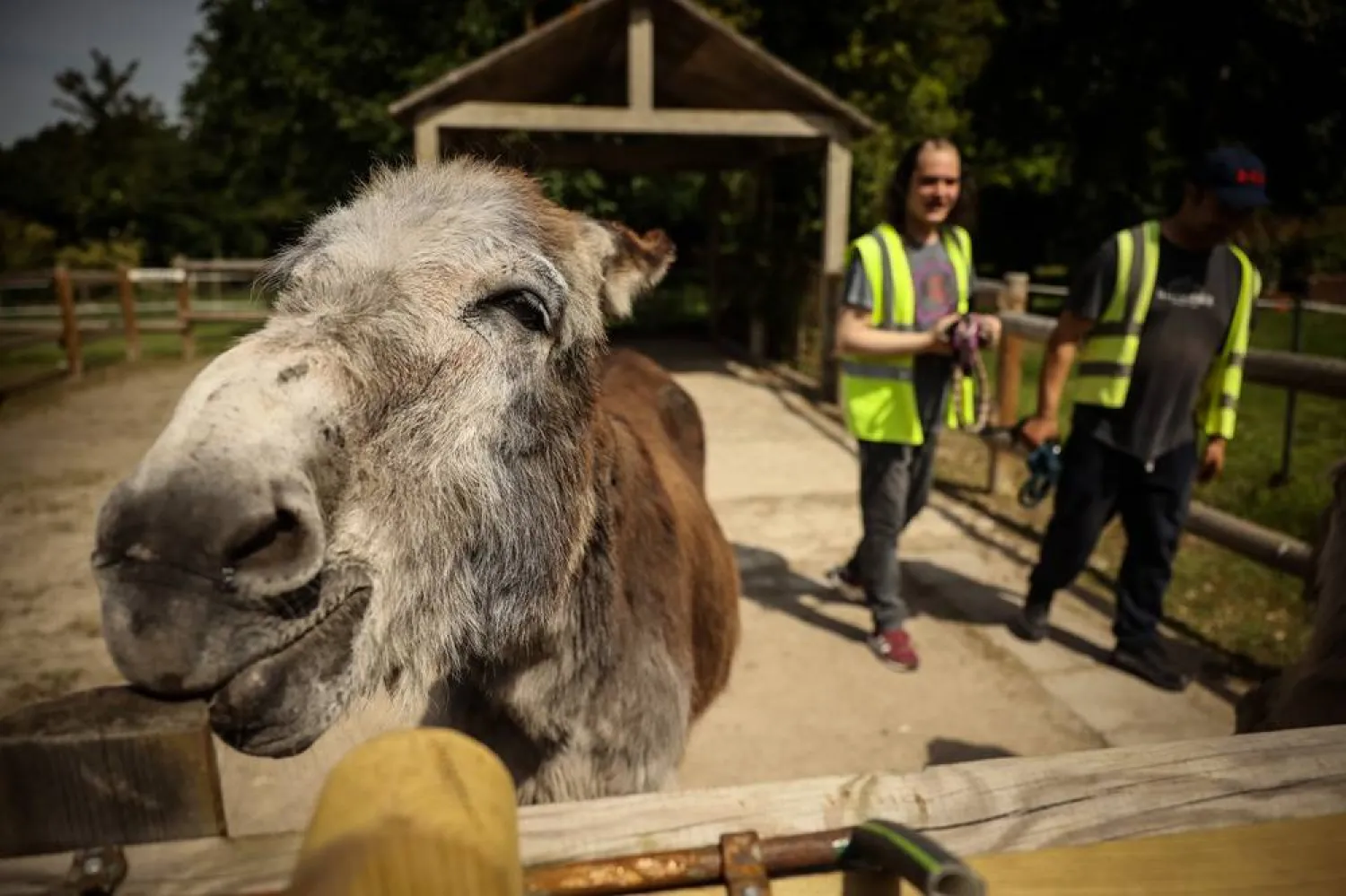

Patients Find Help with Therapy Donkeys at Psychiatric Hospital Near Paris

 Patients with mental health conditions participate in a therapy session involving donkeys at a psychiatric hospital in Neuilly-sur-Marne, in the eastern suburbs of Paris, Friday, May 29, 2026. (AP)
Patients with mental health conditions participate in a therapy session involving donkeys at a psychiatric hospital in Neuilly-sur-Marne, in the eastern suburbs of Paris, Friday, May 29, 2026. (AP)
TT

Patients Find Help with Therapy Donkeys at Psychiatric Hospital Near Paris

 Patients with mental health conditions participate in a therapy session involving donkeys at a psychiatric hospital in Neuilly-sur-Marne, in the eastern suburbs of Paris, Friday, May 29, 2026. (AP)
Patients with mental health conditions participate in a therapy session involving donkeys at a psychiatric hospital in Neuilly-sur-Marne, in the eastern suburbs of Paris, Friday, May 29, 2026. (AP)

Therapy donkeys are helping patients with mental health conditions recover in a psychiatric hospital unit outside Paris that's unique to France.

The 19th century farm buildings and wooded surroundings are a haven within the Ville-Evrard hospital complex in Neuilly-sur-Marne. On Friday, patients took the five donkeys for a walk and cared for them. Some confidently lifted their hooves to remove dirt. Many ended the session with a hug.

“When you take medication that helps you relax ... it’s exactly the same,” said Nathalie, a 60-year-old patient. She and others were identified by their first names only to protect their privacy.

“I’d call it animal medicine,” she said. “It brings relief. You stop thinking about everything else."

‘It helps you break away from the routine of treatment’

Patients attend the sessions free of charge as part of their treatment, which is funded by France’s public health system.

Participants are usually paired with a donkey — Nono, Pitou, Oscar, Manolo or Malraux. Over time, they become familiar with each other’s personalities.

Audrey Seffar, a nurse at the animal therapy unit, said Nathalie's progress after only a few sessions was significant.

“At first, she wouldn’t get out of the cart (provided for people with physical difficulties). But little by little, with encouragement, she did," Seffar said. "The animal serves as a mediator. It’s such an extraordinary one that today she was able to leave the cart and stand beside her donkey."

Another patient, Jérôme, 52, said the program helps reduce loneliness.

“Talking with people, taking part in activities I wouldn’t normally do, it helps me in my daily life,” he said.

He added: “It helps you break away from the routine of treatment and medication. Staying at home isn’t good for me.”

‘They’re emotional sponges’

The first donkeys arrived at Ville-Evrard hospital in 2016 as part of a project launched by Ermelinda and François Hadey.

Ermelinda, a nurse specializing in psychiatry, strongly believed in animal therapy benefits and thought donkeys, known for their calm and social nature, would be perfect. Her husband learned how to train donkeys for therapy work. Some of the animals were adopted through shelters after experiencing neglect or mistreatment.

“A donkey is very intelligent. It understands things very quickly, but you have to explain slowly,” François Hadey said. “Donkeys are calm, serene animals that are generally close to people. Once they’re involved in these interactions, they connect very well with patients. They’re emotional sponges.”

Since 2022, the animal therapy program has had official status as a health care unit in the hospital, allowing it to employ three full-time nurses. Volunteers with a nonprofit group help care for the animals.

The program has expanded to include guinea pigs, chickens, doves, goats, turtles and rabbits. Sessions are tailored to people’s needs and preferences, and smaller animals can be brought to hospital rooms.

Alicia Fabi, an 18-year-old nursing student, said the activity gives patients a chance to leave the hospital environment.

“Every time we come back from the activity, they say they feel good, calm and relaxed, and that they enjoyed the outing. That’s really positive,” she said.

Walking together also allows patients and health workers to develop a deeper relationship.

“We talk about many different things, their illness, their lives and just about everything else. We don’t focus only on the illness because we don’t want them dwelling on it all the time,” Fabi said.

They seek research into the benefits

Health workers say the sessions are designed as therapeutic interventions for living with anxiety, depression, autism, schizophrenia or other conditions. Staff said they can help improve emotional regulation, communication, social interaction and self-esteem.

“Everything we do with the animals allows us to work with the patient,” Ermelinda Hadey said. “We work on feeding the animal, which helps us address the patient’s own eating habits. We work on the animal’s hygiene, and by mirror effect, we work on the patient’s hygiene as well.”

Many patients take intensive treatments, including antipsychotic medications or sedatives, which can make it difficult to find the motivation to participate in activities, she said. That’s where the relationship to donkeys and other animals play a role, she stressed.

“It does not replace a doctor or a medical prescription, but it can help patients regain confidence and a sense of self-worth," Hadey said.

She said more scientific evaluation is needed. They would like animal therapy to be formally recognized by the psychiatric community as a complementary form of care.

“To do that, we need research. We have plenty of accounts from patients ... Caregivers who accompany them see the benefits every day as well. But doctors have so many other responsibilities that they don’t necessarily witness it firsthand,” she said.

At the end of Friday’s session, as patients chatted, a nurse summed up the program’s appeal: “Donkeys are my best colleagues.”



'I Thought I Would Perish': Everest Survivor Recounts Ordeal

Medics and rescuers carry mountaineer Dawa Sherpa upon his arrival at the HAMS Hospital in Kathmandu on June 4, 2026. (Photo by PRABIN RANABHAT / AFP)
TT

'I Thought I Would Perish': Everest Survivor Recounts Ordeal

Medics and rescuers carry mountaineer Dawa Sherpa upon his arrival at the HAMS Hospital in Kathmandu on June 4, 2026. (Photo by PRABIN RANABHAT / AFP)

A Nepali mountaineer who survived nearly a week on Mount Everest said he "chewed ice" to stay alive, as he recovered in a hospital after a miraculous rescue that stunned the climbing community.

Dawa Sherpa, 57, disappeared in brutal conditions on the upper slopes of the world's tallest mountain on May 30 during one of the final climbs of the spring season.

With few climbers still on the peak and his oxygen exhausted, relatives had given up hope and begun ritual mourning prayers, believing he had died on the mountain.

"I didn't think I would be alive," he told BBC Nepali on Friday from his hospital bed.

"I thought I would perish this way. I didn't get lost. As the oxygen ran out, I fell behind. After the oxygen finished, I couldn't walk."

Left stranded in freezing temperatures near Everest's "death zone", where oxygen levels are critically low, Dawa Sherpa said he survived for days with almost no food or water.

"I didn't eat anything for the first two days. Then I began chewing ice. It hurt my teeth. I chewed the ice hard," AFP quoted him as saying.

He survived on a few chocolates and snacks he found in his pockets.

"I soaked them in water and had them," he said.

Dawa Sherpa, also known as "Hillary" after legendary climber Edmund Hillary, had told others after his rescue that at one point he fell into a crevasse before managing to climb out.

"Stepping on the snow, I stood up and looked above... It felt I could get out from there," he said.

"I then looked for ropes and found one. Then I held on to it and walked... eventually I came down."

He said he walked day and night towards base camp until finally encountering people almost a week later.

He was found crawling towards the base camp on the morning of June 4 by the Sagarmatha Pollution Control Committee (SPCC), a Nepali team that helps set routes on Everest and clean up waste left behind.

"Boys from SPCC were going up to collect the waste. I met them. They carried me down."

He was flown to Kathmandu for treatment for frostbite, severe dehydration and a fractured thigh bone, doctors said.

"He is doing well. We had a chat," his daughter Mendo Lhamu Sherpa told AFP.

His survival has sparked celebration among fellow climbers, but also anger from family members who accused rescue teams of failing to locate him sooner.

Nepal Mountaineering Association President Fur Gelje Sherpa called the survival extraordinary but said the incident highlighted serious concerns over climber safety.

"It is irresponsible and inhumane to leave a person behind," he said. "I believe that an investigation committee must be formed to hold the responsible people accountable for this."

Everest guide Rinji Sherpa, who comes from the same village as Dawa Sherpa, said the climber was highly experienced and familiar with the dangers of high-altitude mountaineering.

"He is very lucky, he has had several close calls before but he has survived," he said.

At least five climbers -- two Indians and three Nepalis -- died during this year's Everest season.

More than 1,000 climbers reached Everest's summit this season, according to preliminary Nepali government figures, making it the busiest season on record.


Shark Attack Kills Man Off Western Australia Coast

A shark swims close to a diving cage during a shark cage diving experience off the coast of Gansbaai, Western Cape, South Africa, May 15, 2026. REUTERS/Esa Alexander
TT

Shark Attack Kills Man Off Western Australia Coast

A shark swims close to a diving cage during a shark cage diving experience off the coast of Gansbaai, Western Cape, South Africa, May 15, 2026. REUTERS/Esa Alexander

A man has died after being attacked by a shark while fishing off the coast of Western Australia state, police said on Saturday, the third fatal shark attack in Australia in three weeks.

The 35-year-old was attacked on Saturday morning while spearfishing with family off the state's south coast at Michaelmas Island, close to ⁠the town of ⁠Albany, about 388 km (241 miles) south of state capital Perth, police said.

Reuters said he was taken ashore where he was treated by paramedics but died of his ⁠injuries.

A 4.5 meter (14.8 feet) shark, of an unknown species, was spotted by a member of the public near Michaelmas Island, a nature reserve that receives few visitors, on Saturday, state authorities said.

On May 24, a 39-year-old man died after being attacked by a shark while fishing on ⁠the ⁠Great Barrier Reef. The death followed that of a 38-year-old mauled off an island near Perth 10 days earlier.

There are around 20 shark attacks in Australia every year but the vast majority are not fatal, according to data from conservation groups. Far more people drown on the country's beaches.


Excitement and Joy at Ljubljana Zoo after Birth of 3 Siberian Tiger Cubs

A visitor watches the Siberian tiger cubs with their mother on a screen at the zoo in Ljubljana. AP
TT

Excitement and Joy at Ljubljana Zoo after Birth of 3 Siberian Tiger Cubs

A visitor watches the Siberian tiger cubs with their mother on a screen at the zoo in Ljubljana. AP

A zoo in Slovenia's capital Ljubljana has presented its newest residents: three Siberian tiger cubs who were born there under two weeks ago.

The Siberian tiger is one of the world’s most endangered big cat species, with experts estimating that about 500 remain in the wild. Their survival is threatened primarily by habitat loss and poaching.

Zoo workers said the cubs were born to mother Arisa and father Ussuri, which arrived in Ljubljana in 2004, after careful planning and much hoping, The Associated Press reported.

“We were not really expecting, but hoping, working on it because we have a good breeding pair,” she said. Though the couple were introduced to each other at the right time “we weren't completely sure,” she added.

“So we were also a bit surprised and of course very happy,” Strus said.

Breeding wild animal species in enclosed spaces is known to be hard and often does not succeed.

The cubs, born on May 27, are highly vulnerable and need to be isolated from others except their mother, but zoo staff and visitors have been able see them on a screen streaming live video footage.

Visitors could be seen smiling as they watched the mother with her babies on the screen. Barbara Gallaido, from San Francisco, said the sight was “really fabulous.”

“I’ve seen tigers in the wild in India, but not like this, not with cubs,” she said. “It was really great.”

Arisa is a first-time mother at the age of 4, Strus said. She appears to be doing very well so far.

“She is constantly licking them (cubs,) breastfeeding them and they are resting together,” she said. “So far so good. But ... we still need to wait and see what will happen.”

According to Strus, tiger cubs open their eyes and begin hearing about two weeks after birth. She said the mother is expected to bring them out of the den for the first time when they are one month old.