


Steampunk Festival Creates an Unlikely Capital for Victorian Style and Sci-Fi Oddity in New Zealand

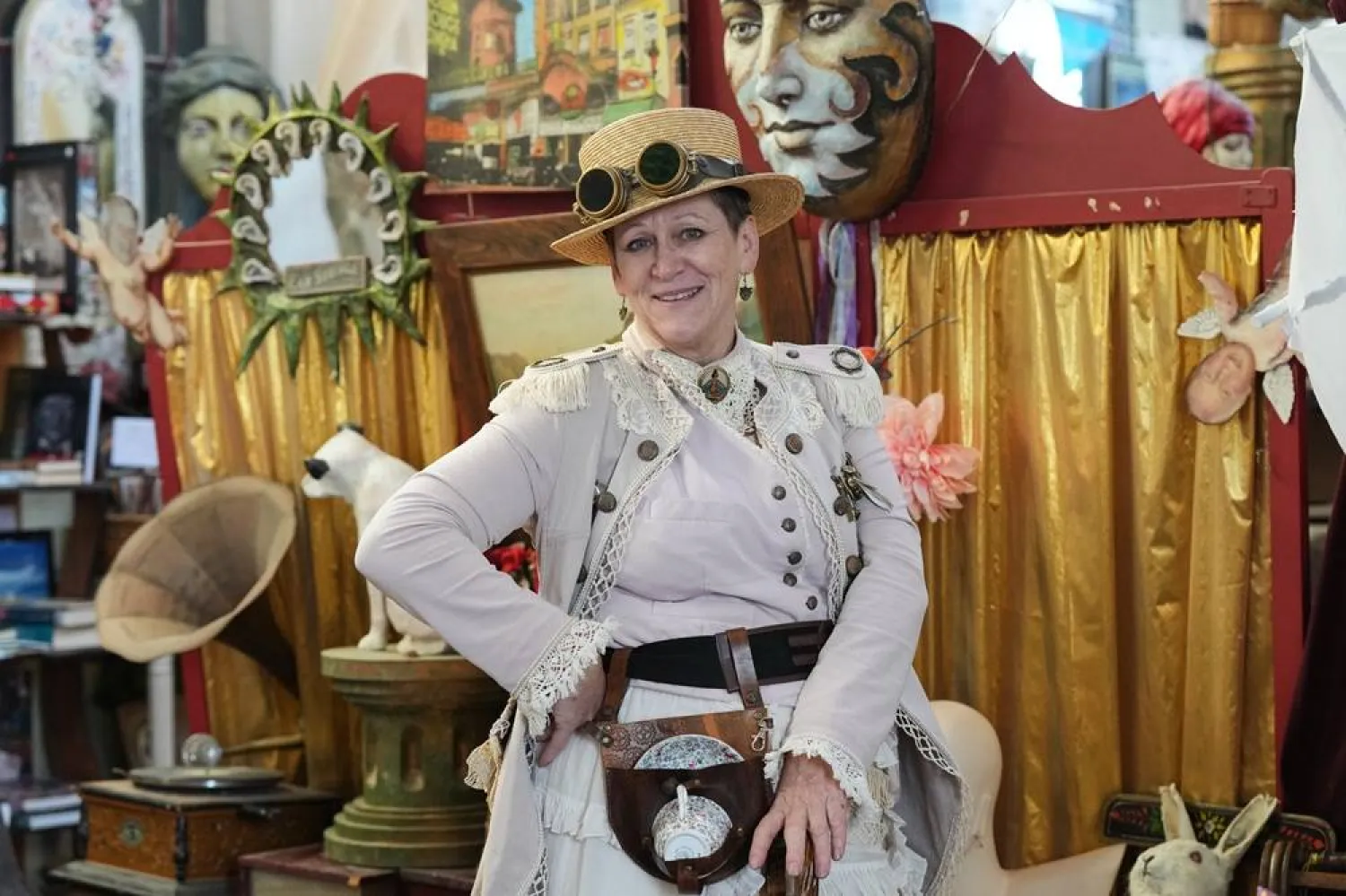
 Steampunk NZ Festival chair Lea Campbell, dressed as her steampunk persona Dusty Traveller, poses for a portrait during the annual event in Ōamaru, New Zealand, Friday, May 29, 2026. (AP)
Steampunk NZ Festival chair Lea Campbell, dressed as her steampunk persona Dusty Traveller, poses for a portrait during the annual event in Ōamaru, New Zealand, Friday, May 29, 2026. (AP)
TT

Steampunk Festival Creates an Unlikely Capital for Victorian Style and Sci-Fi Oddity in New Zealand

 Steampunk NZ Festival chair Lea Campbell, dressed as her steampunk persona Dusty Traveller, poses for a portrait during the annual event in Ōamaru, New Zealand, Friday, May 29, 2026. (AP)
Steampunk NZ Festival chair Lea Campbell, dressed as her steampunk persona Dusty Traveller, poses for a portrait during the annual event in Ōamaru, New Zealand, Friday, May 29, 2026. (AP)

The woman in the pink frock coat announced herself as steam curled from a strange brass contraption on her back.

“I am Lady Sarsaparilla Ovabyte, of the Coventry Ovabytes,” she said. “We are purveyors of fine cordials.”

Her companion peered through glasses made from fused-together forks.

“Captain Bob McSpoon, inventrepreneur,” he said.

On a Victorian-era street in rural Ōamaru, New Zealand, Ovabyte and McSpoon, who usually go by Juliet and Greg Thorn, weren’t the only ones wearing goggles or forks, or emitting steam. They were in the small town to attend the annual steampunk festival, a four-day love letter to being as odd as possible, which draws thousands of visitors from around the country and abroad.

Steampunk fuses Victorian aesthetics and mechanics with a science fiction twist to create a parallel universe imagining what the age of steam might have produced if it had continued to the present day. The genre is limited only by imagination, and the weirder the better.

Steampunks pride themselves on a knack for recycling and DIY, honing skills in sewing, metalworking, hat-trimming and steam mechanics as they dream up fantastical personas with outfits to match. During the year, attendees are bricklayers, engineers, artists and farmers, with many describing themselves as normally shy or reserved. But they had come to the festival to be seen.

“The first time you dress up and go out in public is really scary and then people get such a buzz out of it,” Juliet Thorn said. “It’s so cool that you take on a different personality.”

In its 17th year, whole traditions and sporting codes have sprung up around the steampunk festival, which is among the world’s best-known.

Hundreds crowded into upstairs rooms and old community halls for steampunk-themed contests. They raced to dunk cookies in cups of tea and cram the soggy results into their mouths before their competitors. A parasol-dueling contest looked like competitive vogueing judged on speed and style.

Michele Cotten won a fashion show displaying wild and upcycled outfits that participants spent months finessing. Cotten fused steampunk with the Star Trek universe to create a hooped dress made in the style of a navy Starfleet uniform. It was rigged with Christmas lights to evoke a galaxy and Cotten, a crowd favorite, strutted and posed to whoops from onlookers.

Then there was the teapot racing, in which competitors sent remote-controlled vehicles mounted with teapots around a fiendish obstacle course to the gasps and groans of a watching crowd.

“If you go out of bounds, that’s a disqualification,” said Ross McKay, one of the sport’s creators, who dreamed it up with his late wife and a friend. He has since introduced teapot racing to other steampunk events worldwide.

“It’s lots of fun and the judges will take bribes,” he added.

When McKay’s wife showed him pictures of steampunks, he recalled thinking, “What a bunch of weirdos," but the self-confessed “history geek and science fiction nerd” found plenty to love about the genre. The retired banker was soon enrolled in night classes for sewing.

Now he is Captain Roscoe Dangerfield, Inspector of Nuisances to Her Majesty Queen Victoria III, which combines the historical element of a real Victorian job with the fiction of a monarch who never lived.

The steampunk community had become his tribe, he said.

Small town is an unlikely steampunk capital

Ōamaru is the placid home to 14,000 people and 3,000 endangered native penguins, the latter of which live at the far end of town in a colony so pungent it can be smelled from the hill above.

The town on New Zealand’s South Island doesn’t feature the sweeping vistas popularized by the Lord of the Rings films, which bring tourists to nearby regions, and for years was mostly seen as a stopping point between the cities of Christchurch and Dunedin.

An architectural quirk has put Ōamaru on the map as what locals call the steampunk capital of the world. The town features a completely preserved Victorian street by the harbor, a legacy from the 19th century days when Ōamaru was a commercial and mercantile powerhouse as a departure point for meat, wool and grain exports from New Zealand to Britain.

The cream-colored stone buildings now form the backdrop for the festival's steampunk adventures. Later in the year the town also hosts a Victorian festival celebrating a historically accurate version of the era, with the events coexisting peacefully after the steampunks and Victorians decided the town was big enough for everyone.

Steampunk, a term coined in the 1980s, gives participants an opportunity to rewrite Victorian-era social conventions on the basis that if you are flying on a magic carpet or traveling through time, it doesn’t matter if you make the rest up.

“We’re an equal opportunity society,” said Iain Clark, who co-founded the festival and is widely known in the community as Agent Darling. “Women, unlike in Victorian times, can be anything. We have female engineers, captains of industry, captains of airships, adventurers, explorers, scientists.”

Sometimes all in the same week. Bringing a different outfit for each day of the event is common and fitting rooms at the festival’s headquarters allow for quick changes, with nothing strange enough to raise eyebrows.

In the street, a Star Wars trooper trudged past, followed by a pack of wolves. A French tourist nervously adjusting his crocheted and leather gloves was introduced to steampunk only three days earlier and immediately fell in love with the genre.



Hawaii’s Kilauea Sets Record for Lava Fountaining Episodes in Any 1 Eruption for the Volcano

This image released by the United States Geological Survey shows lava fountains from Kīlauea volcano on Monday, June 1, 2026, in Hawaii. (L. Gallant/USGS via AP)
TT

Hawaii’s Kilauea Sets Record for Lava Fountaining Episodes in Any 1 Eruption for the Volcano

This image released by the United States Geological Survey shows lava fountains from Kīlauea volcano on Monday, June 1, 2026, in Hawaii. (L. Gallant/USGS via AP)

The on-and-off eruption of Hawaii’s Kilauea volcano broke a record Monday with the number of periods it has produced fountains of lava since it began erupting in December 2024, the Hawaiian Volcano Observatory said.

Monday marked 48 fountaining episodes, setting the record for any one eruption on Kilauea, said Katie Mulliken, a geologist and spokesperson with the observatory.

Episodes are separated by periods during which little to no lava erupts. Since lava is coming from the same vents in a crater at Kilauea's summit, it is the same overall eruption, she said in an email.

There are several notable aspects of the current eruption, she said, including how accessible it is for viewing by residents and tourists.

An eruption during the 1980s, in which 47 lava fountaining episodes occurred over about 3 1/2 years, occurred in a more remote area, she said.

The ongoing eruption is also reshaping the topography at the summit, she said.

But the lava fountains also can impact neighboring communities with volcanic fragments and ash, known as tephra.

Kilauea, located on Hawaii’s Big Island, is one of the world’s most active volcanoes.


Fears of Hunger Overwhelm Guatemalan Village as El Nino Approaches

As the drought spreads and forecasts for the El Nino phenomenon grow increasingly bleak, a fear of hunger grips the residents of the Indigenous village of Cunen in northern Guatemala. Johan ORDONEZ / AFP
TT

Fears of Hunger Overwhelm Guatemalan Village as El Nino Approaches

As the drought spreads and forecasts for the El Nino phenomenon grow increasingly bleak, a fear of hunger grips the residents of the Indigenous village of Cunen in northern Guatemala. Johan ORDONEZ / AFP

While drought expands through Cunen as the specter of El Nino climate instability approaches, one fear has seized this indigenous Guatemalan village: death by hunger.

The rains still haven't come here, where local farmers fear the lack of water could ruin the subsistence crops they need to survive.

"If there isn't rain, (the crops) won't come...If there isn't anything we're going to die of hunger," Cecilia Pasa Sarat, a 38-year-old woman who has planted a small amount of corn, told AFP in Xetzac, a village in Cunen.

Cunen is a hard-to-reach mountainous region where the majority of the approximately 47,000 residents are poor, and rely on water from wells that are now going dry.

This village in the Indigenous Maya department of Quiche lays in the heart of the Dry Corridor, an arid mountainous stretch running through Honduras, El Salvador and Nicaragua that's become vulnerable to extreme climatic events.

Quiche was one of Guatemala's most hard-hit regions during the El Nino related food crisis in 2023. Some worry the crisis could return due to a lack of government support.

The phenomenon now fueling local residents' hunger fears occurs every two to six years as part of a natural climatic cycle that affects the surface temperatures on the Pacific Ocean.

It's expected to start between June and August, creating monthslong planetary ripple effects.

- Prolonged damage -

Weeks of drought have desiccated the dusty streets of Xetzac, where the creeks that usually irrigate the town's patchwork of corn, potato, broccoli and bean fields are evaporating under the brutal sun.

Taking refuge in the tree shade where the resin-scent of pines drifts down the hillside, Elvira Pasa says the eventual loss of the village harvests will only end in "hunger."

"We farm, we don't sell it, we just eat it," the 27-year-old community leader and mother of a two and seven-year-old son told AFP.

"Whatever we plant is what we eat. What will happen if it doesn't rain?" 43-year-old Lucia Rojop asks herself.

Her fears are well-founded: around 2.5 million Guatemalans face potential food insecurity due to the drought and the high probability of a powerful El Nino weather cycle.

The Guatemalan government says it has 1.1 million rations ready to distribute in the face of an emergency.

According to experts, the chance that El Nino could spiral into a more dangerous event depends on numerous atmospheric factors.

Governments across the dry countries of Central America raised alert levels over the El Niño phenomenon.

But El Nino isn't the only reason the situation is worsening.

Just in Guatemala, the "dry corridor" expanded from 40 to 160 municipalities since 2004, meaning almost half of the country has been subjected to climate change-fueled drought, according to the government.

El Nino has reduced by half, according to Alex Guerra, the director of the Private Institute for Investigation on Climate Change (ICC).

Cecilia Pasa walks through a puny corn farm, a clear testimony of the drought. "The plants can't take it anymore, the ground is drier, it's not humid anymore like it used to be," she says categorically.

It means that only half of her neighbors planted corn this year. Everyone else, including Catarina Sica, didn't even bother.

"There isn't rain, and the time has passed for us to plant," Sica says while showing the black, white, and yellow seeds still on the cob of corn.

- Migratory impact -

The brutal challenges of working the fields in Cunen, for years, were eased with remittances migrants sent home from the United States. Yet Donald Trump's mass deportations have taken away that support.

Around 24,000 Guatemalans have been deported this year, many from Quiche.

The deportations have paralyzed the construction of homes - the great dream of many migrants - as well as the jobs that go with it.

Families now deal with the crisis by raising pigs, sheep, chickens and turkeys for sale.

Sica's husband returned two years ago after saving enough money to build a concrete house. Now he works occasionally in agriculture, though the $10 daily wage he earns means the family diet is limited to beans, herbs and potatoes, like most locals.

"We're seeing what to do, but it all depends on God," the woman says with resignation.


Saudi Arabia Marks First Birth of One of World’s Rarest Animals in over 100 Years

 A new female is currently undergoing quarantine before joining the herd later this year from Jordan - SPA
A new female is currently undergoing quarantine before joining the herd later this year from Jordan - SPA
TT

Saudi Arabia Marks First Birth of One of World’s Rarest Animals in over 100 Years

 A new female is currently undergoing quarantine before joining the herd later this year from Jordan - SPA
A new female is currently undergoing quarantine before joining the herd later this year from Jordan - SPA

Wildlife conservation efforts have successfully recorded the birth of the first onager (Equus hemionus) on Saudi soil in more than 100 years at Prince Mohammed bin Salman Royal Reserve, marking the return of a species that had disappeared from the deserts of the Arabian Peninsula for over a century.

The reserve noted that the male onager was born in June 2025 as part of the Arabian rewilding program launched to reintroduce 23 native species to their former natural habitats. The birth has only now been announced after the onager successfully completed its first 12 months of life, as the first year is considered the most critical period for survival, with rates not exceeding 50%, SPA reported.

The reserve is also expecting the birth of two additional onagers this winter, a sign of the success of conservation efforts for the species, particularly in light of projections by the International Union for Conservation of Nature that its population could decline by 90% by 2050. Fewer than 600 individuals remain in the wild, following the organization’s 2025 upgrade of the species’ conservation status to Critically Endangered.

The reserve is focusing on enhancing the genetic diversity of its onager herd. A new female is currently undergoing quarantine before joining the herd later this year from Jordan, with the aim of establishing two separate breeding herds to boost long-term sustainability, genetic diversity, and adaptability.

The program reflects a pioneering vision for environmental conservation that goes beyond traditional approaches and is based on establishing national and regional partnerships needed to provide integrated solutions for wildlife conservation.