

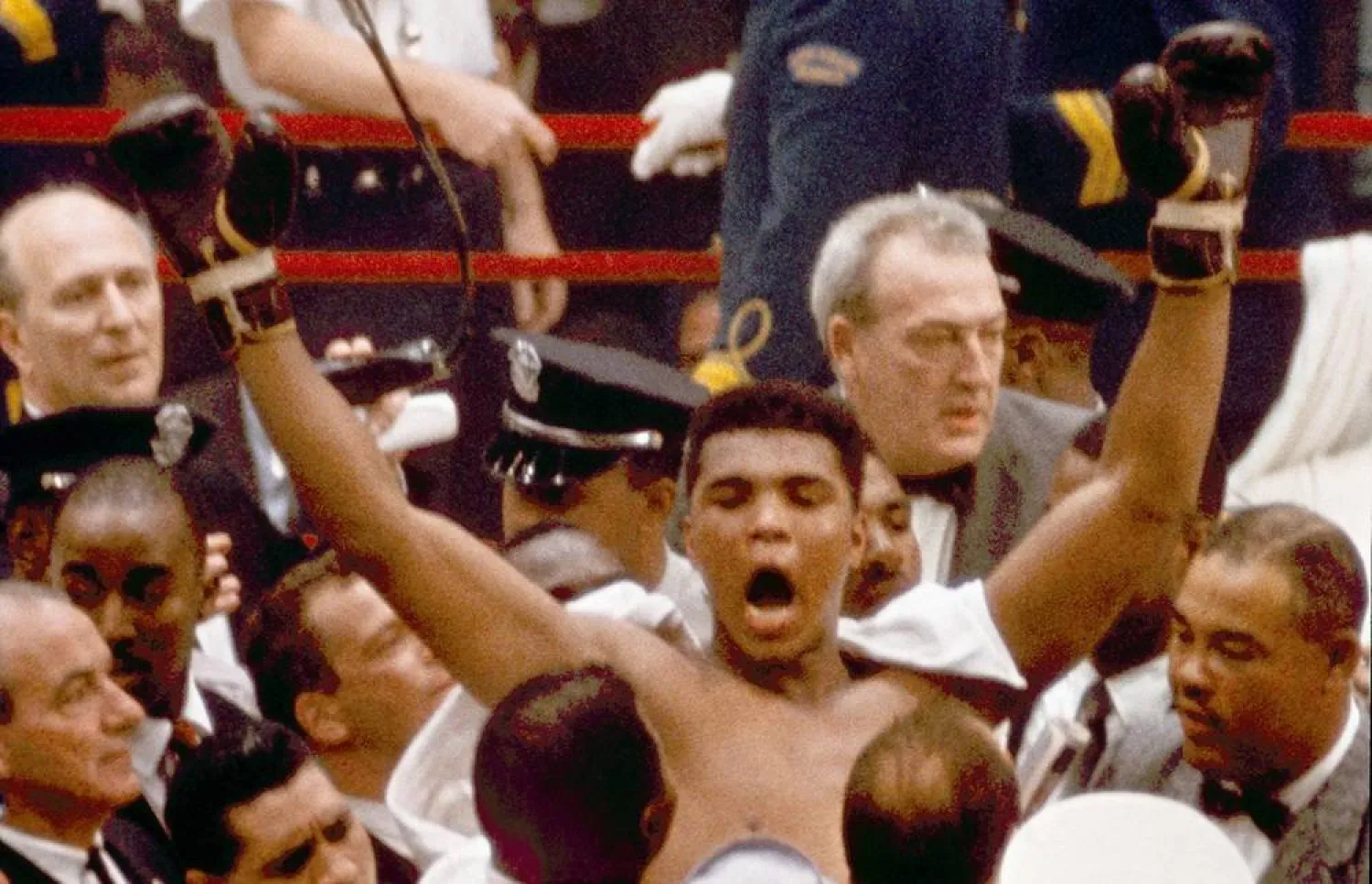

Muhammad Ali’s Family Reflects on the Champion Boxer’s Legacy 10 Years After His Death

In this Feb. 25, 1964, file photo, Muhammad Ali, or Cassius Clay at the time, strikes a familiar pose as he shouts "I am the greatest," as he leaves the ring, arms raised, following his defeat of former heavyweight boxing champion Sonny Liston, in Miami Beach, Fla. (AP file)
TT

Muhammad Ali’s Family Reflects on the Champion Boxer’s Legacy 10 Years After His Death

In this Feb. 25, 1964, file photo, Muhammad Ali, or Cassius Clay at the time, strikes a familiar pose as he shouts "I am the greatest," as he leaves the ring, arms raised, following his defeat of former heavyweight boxing champion Sonny Liston, in Miami Beach, Fla. (AP file)

Muhammad Ali's legacy extends beyond his stinging right jab, world titles and Olympic gold medal, to the heart and compassion he showed long after he left the ring, his wife Lonnie Ali said.

“He transcended boxing into every space you can imagine,” she told The Associated Press this week ahead of the 10-year anniversary of Ali’s death on June 3, 2016, after a long battle with Parkinson’s disease.

“Muhammad lived by this mantra: service to others is the rent we pay for our room here on earth," Lonnie Ali said during an interview at The Muhammad Ali Center in Louisville, Kentucky. “He showed up every day with kindness and empathy in his heart for people who are in need."

Ali, known as the “Louisville Lip” in his hometown, rose to prominence as a trash-talking world champion boxer in the 1960s and began speaking about civil rights issues as his star was rising. He is widely regarded as the most famous and influential boxer of all time, winning the heavyweight title three times.

The Ali Center is sponsoring a “Day of Compassion” on Wednesday, the 10th anniversary of his death, to promote acts of service and caring. Lonnie Ali, who serves as the center's lifetime director, said the hope is an expanding annual event to highlight works of service and volunteering.

The day will focus on one of "the core values that made up Muhammad Ali” in an increasingly divided country, she said.

“Today, we are in a place where we are losing touch with our humanity and with each other,” she said. “It’s causing rifts, not just in families and communities, but in this nation. We’re becoming increasingly polarized and separated, and sort of retreating to people who think like us, look like us, and not really reaching out.”

She also challenged political leaders to lead with compassion, noting the recent weakening of the 1965 Voting Rights Act by the Supreme Court.

“We should always be thinking about how we can uplift a community, not how we can make it harder for them,” Lonnie Ali said. “We want equal representation in this country. You can’t have equal representation when you’re denying people voting rights, you can’t do that.”

But there is hope, she said, and she saw that when the city of Louisville came together for a weeklong celebration of Ali's life in 2016. The week was capped by a funeral procession through the city and past her late husband's modest childhood home near downtown Louisville. Former President Bill Clinton and actor Billy Crystal spoke at his funeral, and Will Smith, who portrayed Ali in a 2001 movie, was a pallbearer.

The outpouring of love for Ali at his hometown funeral service was livestreamed to millions around the world. A decade later, Ali’s face graced a US Postal Service stamp for the first time, showing his enduring influence.

“We’re talking about people who traveled thousands of miles to come here, who had never met the man, never laid eyes on him personally, but wanted to ... give their last respects to him: kings, princes, presidents, heads of state, celebrities, sports figures,” Lonnie Ali said.



'I Thought I Would Perish': Everest Survivor Recounts Ordeal

Medics and rescuers carry mountaineer Dawa Sherpa upon his arrival at the HAMS Hospital in Kathmandu on June 4, 2026. (Photo by PRABIN RANABHAT / AFP)
TT

'I Thought I Would Perish': Everest Survivor Recounts Ordeal

Medics and rescuers carry mountaineer Dawa Sherpa upon his arrival at the HAMS Hospital in Kathmandu on June 4, 2026. (Photo by PRABIN RANABHAT / AFP)

A Nepali mountaineer who survived nearly a week on Mount Everest said he "chewed ice" to stay alive, as he recovered in a hospital after a miraculous rescue that stunned the climbing community.

Dawa Sherpa, 57, disappeared in brutal conditions on the upper slopes of the world's tallest mountain on May 30 during one of the final climbs of the spring season.

With few climbers still on the peak and his oxygen exhausted, relatives had given up hope and begun ritual mourning prayers, believing he had died on the mountain.

"I didn't think I would be alive," he told BBC Nepali on Friday from his hospital bed.

"I thought I would perish this way. I didn't get lost. As the oxygen ran out, I fell behind. After the oxygen finished, I couldn't walk."

Left stranded in freezing temperatures near Everest's "death zone", where oxygen levels are critically low, Dawa Sherpa said he survived for days with almost no food or water.

"I didn't eat anything for the first two days. Then I began chewing ice. It hurt my teeth. I chewed the ice hard," AFP quoted him as saying.

He survived on a few chocolates and snacks he found in his pockets.

"I soaked them in water and had them," he said.

Dawa Sherpa, also known as "Hillary" after legendary climber Edmund Hillary, had told others after his rescue that at one point he fell into a crevasse before managing to climb out.

"Stepping on the snow, I stood up and looked above... It felt I could get out from there," he said.

"I then looked for ropes and found one. Then I held on to it and walked... eventually I came down."

He said he walked day and night towards base camp until finally encountering people almost a week later.

He was found crawling towards the base camp on the morning of June 4 by the Sagarmatha Pollution Control Committee (SPCC), a Nepali team that helps set routes on Everest and clean up waste left behind.

"Boys from SPCC were going up to collect the waste. I met them. They carried me down."

He was flown to Kathmandu for treatment for frostbite, severe dehydration and a fractured thigh bone, doctors said.

"He is doing well. We had a chat," his daughter Mendo Lhamu Sherpa told AFP.

His survival has sparked celebration among fellow climbers, but also anger from family members who accused rescue teams of failing to locate him sooner.

Nepal Mountaineering Association President Fur Gelje Sherpa called the survival extraordinary but said the incident highlighted serious concerns over climber safety.

"It is irresponsible and inhumane to leave a person behind," he said. "I believe that an investigation committee must be formed to hold the responsible people accountable for this."

Everest guide Rinji Sherpa, who comes from the same village as Dawa Sherpa, said the climber was highly experienced and familiar with the dangers of high-altitude mountaineering.

"He is very lucky, he has had several close calls before but he has survived," he said.

At least five climbers -- two Indians and three Nepalis -- died during this year's Everest season.

More than 1,000 climbers reached Everest's summit this season, according to preliminary Nepali government figures, making it the busiest season on record.


Shark Attack Kills Man Off Western Australia Coast

A shark swims close to a diving cage during a shark cage diving experience off the coast of Gansbaai, Western Cape, South Africa, May 15, 2026. REUTERS/Esa Alexander
TT

Shark Attack Kills Man Off Western Australia Coast

A shark swims close to a diving cage during a shark cage diving experience off the coast of Gansbaai, Western Cape, South Africa, May 15, 2026. REUTERS/Esa Alexander

A man has died after being attacked by a shark while fishing off the coast of Western Australia state, police said on Saturday, the third fatal shark attack in Australia in three weeks.

The 35-year-old was attacked on Saturday morning while spearfishing with family off the state's south coast at Michaelmas Island, close to ⁠the town of ⁠Albany, about 388 km (241 miles) south of state capital Perth, police said.

Reuters said he was taken ashore where he was treated by paramedics but died of his ⁠injuries.

A 4.5 meter (14.8 feet) shark, of an unknown species, was spotted by a member of the public near Michaelmas Island, a nature reserve that receives few visitors, on Saturday, state authorities said.

On May 24, a 39-year-old man died after being attacked by a shark while fishing on ⁠the ⁠Great Barrier Reef. The death followed that of a 38-year-old mauled off an island near Perth 10 days earlier.

There are around 20 shark attacks in Australia every year but the vast majority are not fatal, according to data from conservation groups. Far more people drown on the country's beaches.


Excitement and Joy at Ljubljana Zoo after Birth of 3 Siberian Tiger Cubs

A visitor watches the Siberian tiger cubs with their mother on a screen at the zoo in Ljubljana. AP
TT

Excitement and Joy at Ljubljana Zoo after Birth of 3 Siberian Tiger Cubs

A visitor watches the Siberian tiger cubs with their mother on a screen at the zoo in Ljubljana. AP

A zoo in Slovenia's capital Ljubljana has presented its newest residents: three Siberian tiger cubs who were born there under two weeks ago.

The Siberian tiger is one of the world’s most endangered big cat species, with experts estimating that about 500 remain in the wild. Their survival is threatened primarily by habitat loss and poaching.

Zoo workers said the cubs were born to mother Arisa and father Ussuri, which arrived in Ljubljana in 2004, after careful planning and much hoping, The Associated Press reported.

“We were not really expecting, but hoping, working on it because we have a good breeding pair,” she said. Though the couple were introduced to each other at the right time “we weren't completely sure,” she added.

“So we were also a bit surprised and of course very happy,” Strus said.

Breeding wild animal species in enclosed spaces is known to be hard and often does not succeed.

The cubs, born on May 27, are highly vulnerable and need to be isolated from others except their mother, but zoo staff and visitors have been able see them on a screen streaming live video footage.

Visitors could be seen smiling as they watched the mother with her babies on the screen. Barbara Gallaido, from San Francisco, said the sight was “really fabulous.”

“I’ve seen tigers in the wild in India, but not like this, not with cubs,” she said. “It was really great.”

Arisa is a first-time mother at the age of 4, Strus said. She appears to be doing very well so far.

“She is constantly licking them (cubs,) breastfeeding them and they are resting together,” she said. “So far so good. But ... we still need to wait and see what will happen.”

According to Strus, tiger cubs open their eyes and begin hearing about two weeks after birth. She said the mother is expected to bring them out of the den for the first time when they are one month old.