Scientists Find New Species of Dragonfly, Grasshopper and a Fluorescent Spider

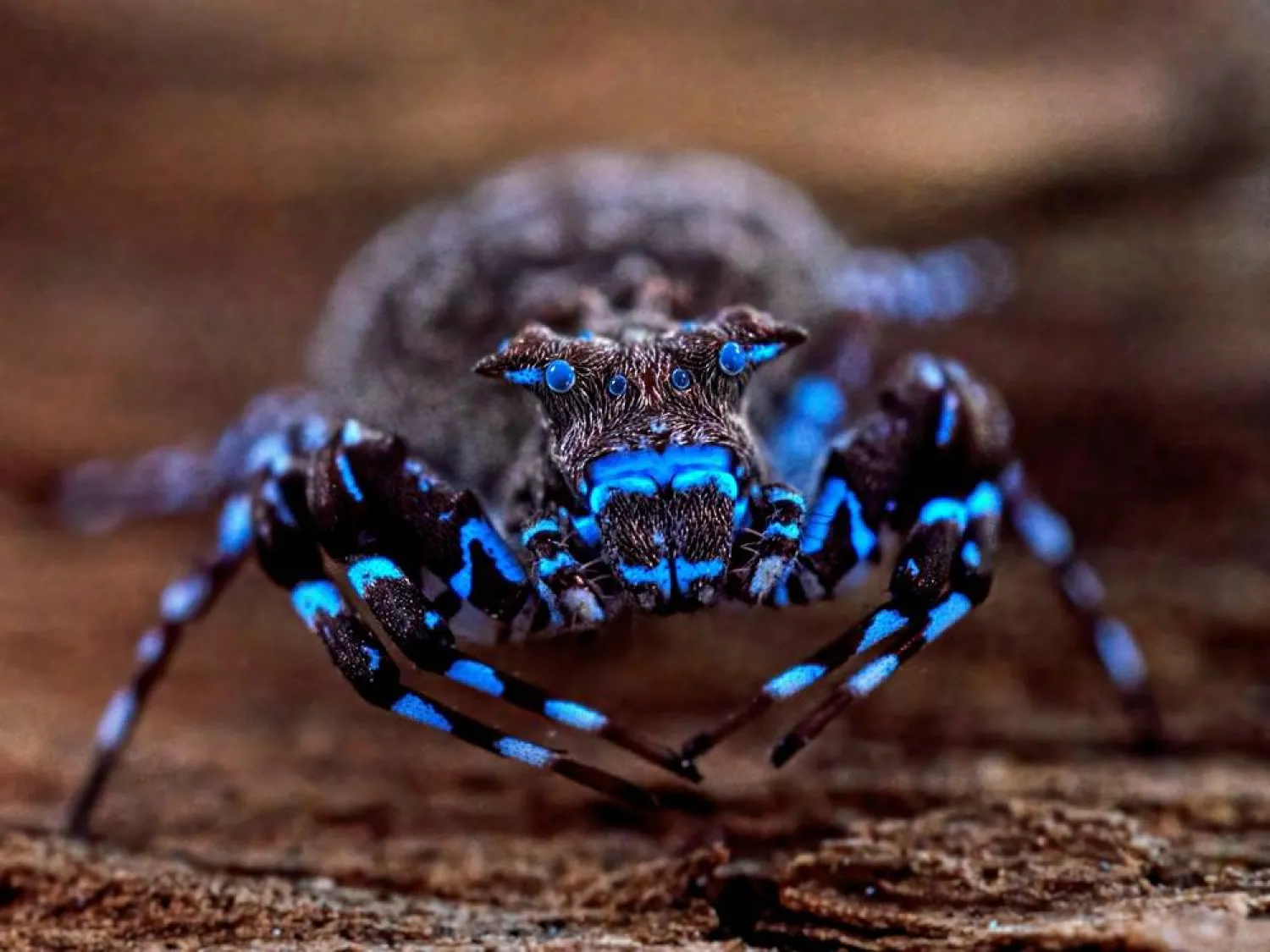
A crowned crab spider that fluoresces under UV light, discovered during a scientific expedition to Angola's remote Lisima plateau, is pictured in this handout image obtained by Reuters on June 3, 2026. (The Wilderness Project/Handout via Reuters)
TT

Scientists Find New Species of Dragonfly, Grasshopper and a Fluorescent Spider

A crowned crab spider that fluoresces under UV light, discovered during a scientific expedition to Angola's remote Lisima plateau, is pictured in this handout image obtained by Reuters on June 3, 2026. (The Wilderness Project/Handout via Reuters)

Wildlife ‌experts found eight new species of dragonfly, three unknown grasshoppers and some 60 new butterflies and moths in vivid hues during a trip to Angola's Lisima plateau in February, a conservation group said on Wednesday.

The Wilderness Project visited the waters that flow through the plateau and which feed four of Africa's major rivers: the Congo, Okavango, Zambezi and Cuanza.

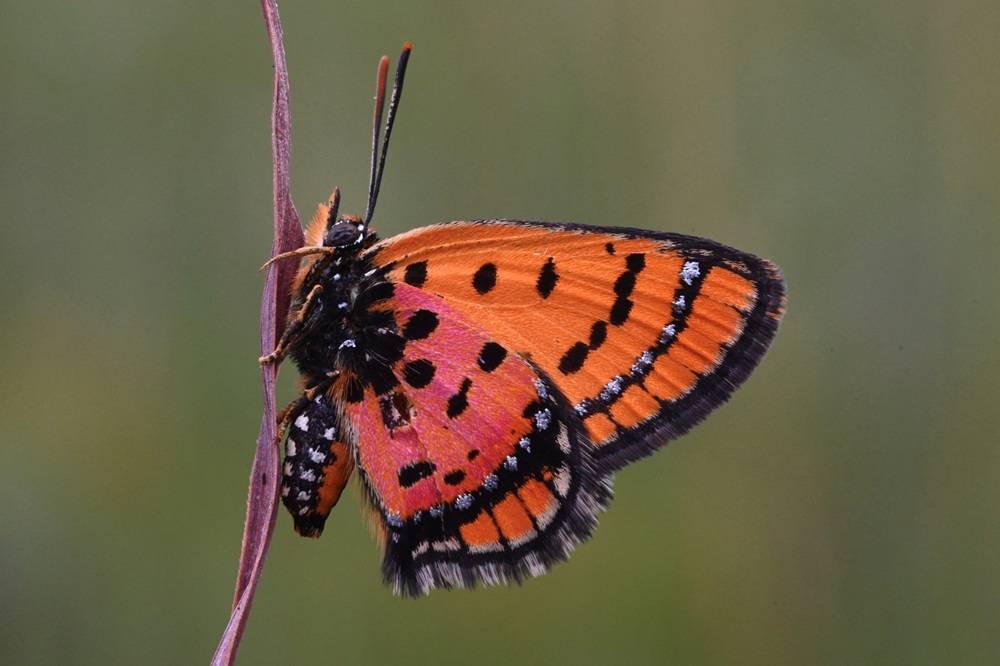
New species included an ‌armored, predatory ‌cricket, a previously undescribed species of ‌copper ⁠caterpillar and its adult ⁠butterfly, and a crowned crab spider that fluoresces under ultraviolet light.

Experts also found a new blood orange-hued species of ladybird orb-web spider which mimics ladybirds in signaling to predators with a bright color - normally a darker red - ⁠that it is too bitter or toxic.

"The ‌armored crickets are ‌very cool ... very fierce-looking," expedition leader Rob Taylor told ‌Reuters. "As a defense mechanism, they can actually squirt ‌fluid onto whoever's trying to attack them."

A new species of an adult butterfly, discovered during a scientific expedition to Angola's remote Lisima plateau, is pictured in this handout image obtained by Reuters on June 3, 2026. (The Wilderness Project/Handout via Reuters)

Scientists the world over are frantically trying to record species as they reckon with a global ecological crisis that ‌has put a million plant and animal species on the brink of extinction. ⁠

They ⁠estimate there are 8.7 million species in the world, of which science has identified only 1.5 million.

Many are fast disappearing because of human activity, with more than 800 animal species going extinct since around 1500.

Taylor said wildlife in the Lisima plateau was threatened by "tree-felling, deforestation and ... the artisanal diamond mining industry," as well as by slash-and-burn agriculture, which razes natural forests to use the soil for planting, only to see the nutrients wash away.


NASA's Newest Space Telescope Launches on a Quest to Explore the Hidden Universe

A SpaceX Falcon Heavy rocket is prepared for launch with NASA's Nancy Grace Roman Space Telescope aboard at the Kennedy Space Center in Cape Canaveral, Florida, US, August 29, 2026. (Reuters)
TT

NASA's Newest Space Telescope Launches on a Quest to Explore the Hidden Universe

A SpaceX Falcon Heavy rocket is prepared for launch with NASA's Nancy Grace Roman Space Telescope aboard at the Kennedy Space Center in Cape Canaveral, Florida, US, August 29, 2026. (Reuters)

NASA’s newest crown jewel blasted off Sunday to hunt for planets around other stars, explore secret dark energy and survey the cosmos like never before.

SpaceX launched the $4.3 billion Roman Space Telescope shortly after daybreak aboard a triple-the-fire-power Falcon Heavy rocket from Kennedy Space Center. Roman blazed toward an observation point 1 million miles (1.6 million kilometers) away that's home to the Webb Space Telescope, one of NASA's other big-ticket eyes in the sky.

The bus-sized telescope — named after the late Nancy Grace Roman, NASA’s first chief astronomer — will take more than three months to reach its destination. Once there, it will cast the widest gaze yet on the hidden parts of the universe from space, uncovering the unimaginable with unsurpassed speed.

“It’s going to find thousands of supernovae, tens of thousands of planets, billions of galaxies and tens of billions of stars,” said NASA science mission director Nicky Fox. “It’s going to be able to do things that we’ve never been able to do before with its massive field of view.”

Several minutes after the thunderous launch, the rocket's two reusable side boosters descended tail-first in a thrilling scene, producing sharp sonic booms as they landed back at Cape Canaveral. Soon afterward, the telescope separated successfully from the rocket's upper stage, drawing applause from ground controllers.

Fox was in tears watching the action unfold. “It's such a good day!” she said.

Roman’s field of view is more than 100 times wider than that of NASA’s Hubble Space Telescope, still churning out celestial glamour shots after 36 years in orbit. Webb joined the effort several years ago with an even narrower yet spot-on vision capable of zooming in on objects almost as old as the universe.

These three orbiting powerhouses will join forces — along with the European Space Agency’s Euclid spacecraft and the National Science Foundation’s Vera C. Rubin Observatory in Chile — to reveal some of the universe’s biggest secrets.

Inside the countless galaxies awaiting discovery are stars with planets. Once these new worlds are spotted by Roman, the more powerful and sensitive Webb will take aim to fill in the blanks.

“Roman’s vast reach will allow us to find the weird, the rare and the unusual,” senior project scientist Julie McEnery said on the eve of launch. “We’ll redefine what it means to find a needle in a haystack.”

Perhaps even more important, astronomers expect Roman to shed light on the dark matter and dark energy that make up most of the universe yet remain concealed. Roman's catalog of galaxies will help scientists ascertain how quickly the universe is expanding due to these puzzling, unseen forces.

Roman’s superpower is speed.

A month of Milky Way observations by Roman would take Hubble a century to complete, according to McEnery. Roman should make quick work of scanning the galactic bulge at dead center, she added, providing the deepest look yet into the heart of our galaxy.

Besides a wide-field infrared camera that matches Hubble’s sensitivity but is 1,000 times faster, Roman holds an instrument to block out starlight. This experimental, eclipse-creating coronagraph will allow Roman to directly image any planet, however faint, that might be orbiting the masked star.

The telescope is designed to be refueled, meaning if a robotic tanker becomes available in the coming decade, that could extend its life.

Launching nearly a year ahead of schedule and within budget, Roman is NASA's first space telescope to be named after a woman.

Retired NASA scientist Ed Weiler said the honor is long overdue. He coined the phrase “Mother of Hubble” for Roman, who hired him in 1978. Observatories above Earth’s obscuring atmosphere can see farther and better, she insisted after joining the brand new NASA in 1959. She died in 2018 at age 93.

“This is very, very fitting. I think Nancy would be very proud” that the namesake telescope will tackle some of the biggest, lingering questions about the universe such as dark energy, Weiler said.

Hubble launched in 1990 with a flawed mirror that required spacewalking astronauts’ dramatic intervention. Roman’s primary mirror is the same size as Hubble’s — nearly 8 feet (2.4 meters) in diameter — and is actually spy satellite surplus.

The National Reconnaissance Office donated two leftover mirrors to NASA more than a decade ago for repurposing. The second mirror is still in storage.


Saudi Food and Drug Authority Launches Kingdom’s First Food Composition Database

This initiative falls under efforts to advance national food data systems. (SPA)
TT

Saudi Food and Drug Authority Launches Kingdom’s First Food Composition Database

This initiative falls under efforts to advance national food data systems. (SPA)

The Saudi Food and Drug Authority (SFDA), represented by the National Nutrition Committee, has officially launched the Saudi Food Composition Database, the first national database of its kind in the Kingdom, reported the Saudi Press Agency on Sunday.

Developed under the Health Sector Transformation Program, a key initiative of Saudi Vision 2030, the platform provides accurate, reliable, and updated nutritional data on local foods and traditional dishes consumed across Saudi Arabia.

Built upon approved scientific methodologies and high-quality standards, the database contains comprehensive nutritional information including energy, carbohydrates, proteins, fats, vitamins, minerals, and dietary fiber.

It establishes a national reference for food composition data within health, research, and nutrition sectors.

The initiative strengthens evidence-based food and nutrition policy formulation, empowers scientific research and health studies, and raises community health and nutritional awareness. It also supports the food manufacturing sector in developing local products and elevating their nutritional value.

The database drives digital transformation across the health and food sectors by making data accessible, enabling developers to build digital tools to assess dietary patterns and nutritional status, thereby strengthening the integration of data, technology, and public health.

This initiative falls under efforts to advance national food data systems, support evidence-based decision-making, and improve nutritional health and quality of life, in alignment with the goals of Saudi Vision 2030.


Volunteers Rescue Climber Stranded on Small Ledge in California’s Sierra Nevada

This photo released by the Mono County Search and Rescue shows volunteers conducting an operation to rescue a man stranded on a ledge in the Sierra Nevada, Calif., on Aug. 22, 2026. (Mono County Sheriff Search and Rescue via AP)
TT

Volunteers Rescue Climber Stranded on Small Ledge in California’s Sierra Nevada

This photo released by the Mono County Search and Rescue shows volunteers conducting an operation to rescue a man stranded on a ledge in the Sierra Nevada, Calif., on Aug. 22, 2026. (Mono County Sheriff Search and Rescue via AP)

Volunteers carried out a more than 15-hour operation to rescue a man who got off route in the Sierra Nevada and was stranded on a small ledge, the Mono County Sheriff Search and Rescue Team said.

A four-person team carried out the rescue last weekend near Mammoth Lakes, California, in a precarious gully. The challenge came in having no time to spare with thousands of feet of vertical exposure below, said team spokesperson Mitchell Quiring.

The stranded climber had only one foot fully on the 6-inch (15-centimeter) ledge and was shaking out his legs and switching them to avoid tiring, said Quiring, who was part of the rescue team.

“Any fall would almost certainly be fatal,” the team wrote on its Facebook page.

Quiring said he credits the climber, Rob Martin, with having the strength and will to live.

“He was not going to give up. He was going to push until there was a solution,” Quiring said. “It’s what we train for, so there’s a lot of trust in leaning back on that.”

The volunteer group has long trained to carry out technical rescues. The rescuers are among those dispatched the Mono County Sheriff's Office in the Sierra Nevada, about 200 miles (322 kilometers) east of San Francisco.