

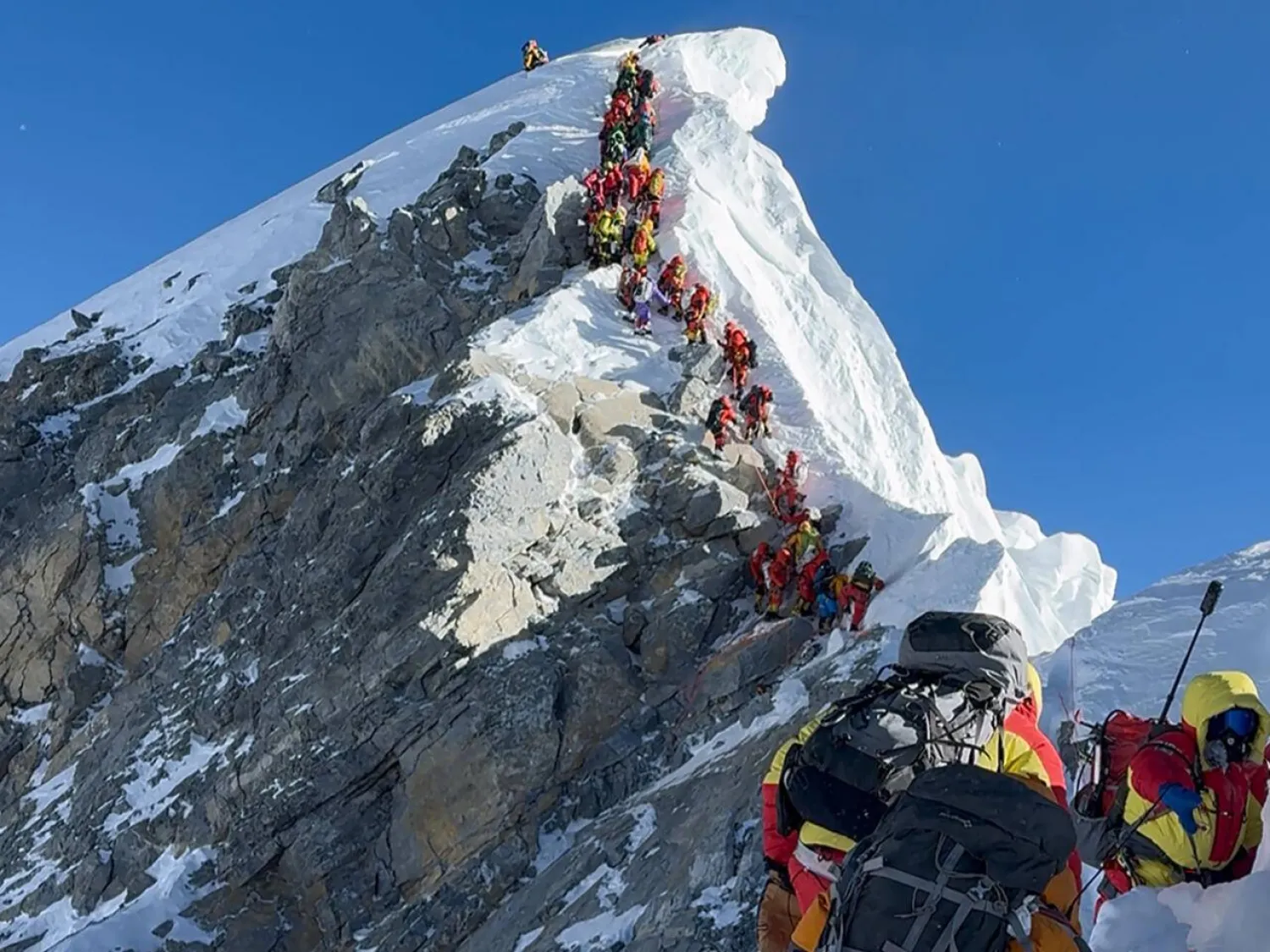

Nepali Climber Alive after Six Days Missing on Everest

This photograph taken on May 20, 2026, shows mountaineers on Everest. Furte Sherpa / AFP
TT

Nepali Climber Alive after Six Days Missing on Everest

This photograph taken on May 20, 2026, shows mountaineers on Everest. Furte Sherpa / AFP

A Nepali climbing guide who went missing on Mount Everest for six days and was feared dead has been found alive after crawling back to Base Camp, officials told AFP on Thursday.

The experienced Hillary Dawa Sherpa vanished on the upper reaches of the world's highest mountain early on May 30.

He was found on Thursday morning close to Base Camp by the Sagarmatha Pollution Control Committee (SPCC), a Nepali team that helps set routes on Everest and clean up waste left behind.

"He was crawling down," Pemba Sherpa of 8K Expeditions, which was overseeing search and rescue efforts, told AFP.

"A helicopter has been sent to bring him to a hospital in Kathmandu."

Climber Chris Thrall, a former British Royal Marine, said he successfully summited the 8,849-meter (29,032-foot) peak with Sherpa around 5:00 pm on May 29.

He posted a video message on Instagram on Wednesday morning what he thought was the death of Sherpa.

He called Sherpa an "absolute gentle giant of a man and a true 'tiger of the mountains'", in a post that assumed the worst.

Thrall described how on May 30 he had begun to descend from Camp Four -- at around 7,950m -- and just below the low-oxygen "death zone".

He said that as he descended, Sherpa stopped.

"He sat down for a rest with his backpack, these guys carry huge loads," he said.

"And I turned and I said, 'Hillary, are you okay, brother?' He said, 'Yes, yes, fine Chris, please go, go!' This is nothing new, you know, I'd go ahead, he'd go ahead."

As Thrall went down he found a Polish climber who was struggling after running out of supplementary oxygen and had suffered frostbite.

"It had been a long summit push. What should have been five days to the summit and back took us 11 days, that's how challenging the conditions were," said Thrall.

"So, do I go back for Sherpa, who's probably going to rock up and be fine, as he has done hundreds of times before?" he added.

"Or do I help my fellow climber, who's got no oxygen, frostbite in his fingers, and obviously you're never far off hypothermia up there?"

Thrall described tough conditions, sharing his oxygen cylinder with the Pole as they descended, taking 11 hours to get to Camp Three. It would usually take two hours.

He said: "I realized we had a really serious situation."

Search teams set out to find Sherpa but he was not seen again until Thursday morning, having made his way down on his own.

The climb was one of the last of the season, meaning that there were few other mountaineers on the peak.

At least five people have died this season -- two Indians and three Nepali climbers involved in Everest preparations.

More than one thousand climbers reached the summit of Everest this season, according to initial tallies by Nepali officials, making it the busiest season on record.



Baby Haaland in Peru: Newborns Take Names of World Cup Stars

Erling Haaland wears a viking helmet after beating the Ivory Coast at the World Cup. (Getty Images)
TT

Baby Haaland in Peru: Newborns Take Names of World Cup Stars

Erling Haaland wears a viking helmet after beating the Ivory Coast at the World Cup. (Getty Images)

In Peru, there is ‌a wave of new baby Haalands. In Argentina, Lionel has raced up the rankings, and in Mexico a girl was reportedly named after three football players. Parents in Latin America are already christening a new generation of babies after the stars of the World Cup.

Hundreds of newborns in Peru have been named for rising stars such as Norway's Erling Haaland, while names inspired by legacy icons like Lionel Messi, Brazil's Neymar and Portugal's Cristiano Ronaldo each count around 30,000 registrations, Ivan Torres, a spokesperson for Peru's civil registry RENIEC told Panamericana TV last week.

"Haaland is now Peruvian too," Torres said, noting one newborn was simply ‌named "Mundial" after the ‌Spanish shorthand for the World Cup. Peru did not ‌qualify ⁠for the tournament.

Many ⁠Latin Americans with teams not competing or knocked out have been unwilling to support Argentina — broadly seen as too Eurocentric — and thrown their support behind the Norwegian team, whose "Viking row" and Haaland-driven run to the quarter-finals for the first time won them legions of new fans.

In Mexico, which co-hosted the World Cup with the US and Canada, a picture of a birth certificate went viral on social ⁠media showing a baby girl named Quiñona Ysisidra Morita ‌Haaland Guevara - a reference to Mexican stars ‌Julián Quiñones and Gilberto Mora as well as the Norwegian striker.

Ysisidra is a play on "Y ‌si sí?", or "What if?", the upbeat mantra chanted by Mexican fans until ‌they were knocked out by England in the last 16.

Mexico's governance secretariat did not immediately verify the authenticity of the certificate.

In Argentina, Enzo, Emiliano and Lionel topped the list of most popular boy names in the northeastern province of Salta the week before ‌the final, according to local authorities who attributed the trend to the "World Cup phenomenon."

Argentina's World Cup team, who ⁠will play in ⁠Sunday's final, include midfielder Enzo Fernandez and goalkeeper Emiliano "Dibu" Martinez, as well as team captain Messi.

Fabiola Molina, who hosts Mexico City-based podcast "Sin manual para padres" ("No manual for parents"), told Reuters the trend had a history across Latin America dating back to Diego Maradona's 1986 goal against England.

"A few years ago when the Backstreet Boys were popular, many women were naming their sons Kevin and Brian, and that's why it's very common in countries like Bolivia, Chile and Argentina to find someone called Brian Gonzalez, for example."

"It's funny, but it could also be prejudicial to children when they grow up," she said. "Just because your name is Messi or Lionel, it doesn't mean you'll grow up to be a good soccer player — destiny won't carve that out for you."


Northeast Spain Wildfire Destroys Over 12,000 Hectares

Firefighters work at a site, following a wildfire in the municipality of Ores, northern Aragon region, Spain July 15, 2026, in this screengrab obtained from a video. (Spanish Military Emergency Unit/Handout via Reuters)
TT

Northeast Spain Wildfire Destroys Over 12,000 Hectares

Firefighters work at a site, following a wildfire in the municipality of Ores, northern Aragon region, Spain July 15, 2026, in this screengrab obtained from a video. (Spanish Military Emergency Unit/Handout via Reuters)

A major wildfire that has been raging for two days in northeast Spain has reduced more than 12,000 hectares of land to ash, regional authorities said Friday, warning of a "very high risk of spreading".

"The night has been very complex, very difficult. At this time, we estimate that the burned area exceeds 12,000 hectares" (29,650 acres), Roberto Bermúdez de Castro, who is responsible for security issues within the regional government of Aragon, told the media.

Spain is still reeling from another fire last week in the southern Andalusia region that killed 13 people -- including seven Britons and an American -- and destroyed 7,000 hectares, the deadliest such disaster in the country's recent history.

More than 450 firefighters backed by army reinforcements were battling the growing blaze near the city of Zaragoza, in a sparsely populated part of the Aragon region, where five small villages have been evacuated.

Peak temperatures of up to 40C have hit Aragon in recent days.

Scientists say human-driven climate change is increasing the length, intensity and frequency of extreme heat, which creates favorable conditions for the spread of wildfires and complicates firefighting efforts.

Prime Minister Pedro Sanchez warned Tuesday on a visit to fire-devastated Andalusia that Spain was facing a "complicated summer" for wildfires.


Scientists Find New Monkey Species in Congo's Rainforest

Two 'Likweli' monkeys of a newly-identified species of Colobus monkey, discovered in Lomami National Park, sit on a tree branch, in the Democratic Republic of the Congo, in this undated handout image. Daniel Rosengren, Frankfurt Zoological Society/Handout via REUTERS
TT

Scientists Find New Monkey Species in Congo's Rainforest

Two 'Likweli' monkeys of a newly-identified species of Colobus monkey, discovered in Lomami National Park, sit on a tree branch, in the Democratic Republic of the Congo, in this undated handout image. Daniel Rosengren, Frankfurt Zoological Society/Handout via REUTERS

Scientists have identified a new species of monkey in Democratic Republic of Congo's rainforest, distinguished by patches of light-colored skin around its mouth, Florida Atlantic University said in a statement.

The discovery marks only the fifth new monkey species identified in Africa in the last 75 ⁠years, according to ⁠the statement issued this week.

The species known by locals as "Likweli" was named Colobus congoensis by scientists.

Small in size, the black monkey ⁠has a distinctive "mask-like appearance" with a vivid orange-cream patch surrounding its mouth and nose.

The newly identified primate's roaring possesses a distinct acoustic structure, the research showed.

"This discovery reinforces how much biodiversity remains undocumented in the Central Congo Basin," Reuters quoted John ⁠Hart, ⁠a conservation scientist from the Lukuru Wildlife Research Foundation, as saying.

Researchers warn the monkey may already be at risk due to its small range area and population size and propose the International Union for Conservation of Nature should classify it as endangered.