
From Poplars to Pistachios, Afghans Rediscover the Value of Trees

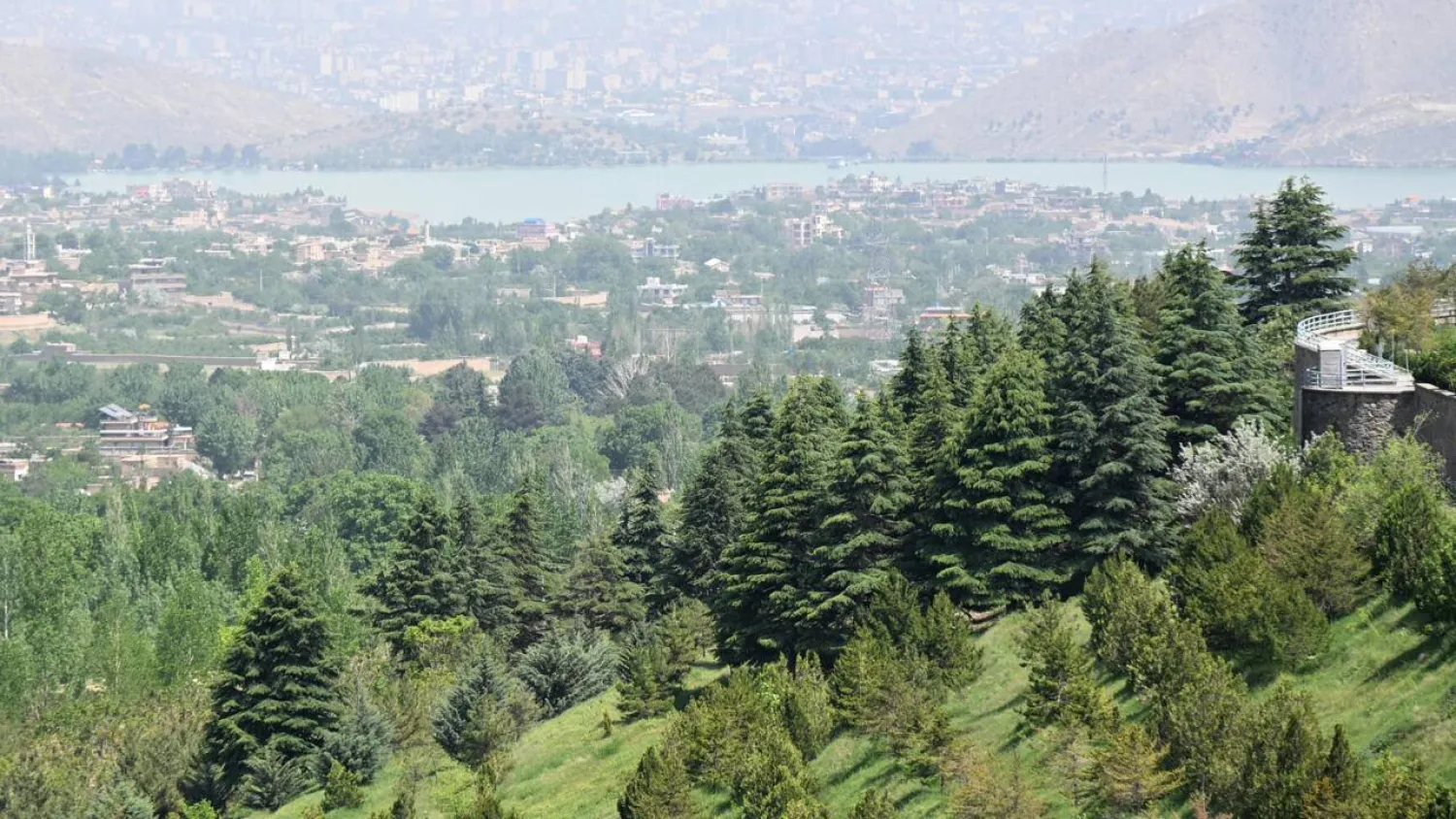
A forest near Qargha lake in Paghman district, Kabul province. Wakil KOHSAR / AFP
TT

From Poplars to Pistachios, Afghans Rediscover the Value of Trees

A forest near Qargha lake in Paghman district, Kabul province. Wakil KOHSAR / AFP

Under the shade of recently planted poplars in northeastern Afghanistan, village leader Ghulam Ali Poya is proud to see residents rediscover the value of trees after years of wartime deforestation.

"There were forests of pistachio trees," he told AFP, gesturing to the bare mountains that surround Char Bagh's mud homes.

"During the conflicts and the civil war, they were destroyed; no one could stop the logging."

From the 1979 Soviet invasion until the fall of the first Taliban government in the early 2000s, "around 50 percent of Afghanistan's forest cover was lost", said Mohammad Nasir Shalizi, a researcher at North Carolina State University.

In eastern Afghanistan, timber smuggling to Pakistan drove massive logging, while in the more arid central and northern "pistachio belt", residents used wood for heating and cooking.

But in the last two decades, deforestation has slowed "substantially", Shalizi said.

Forest cover has increased 35 percent nationwide since 2011, according to the National Statistics and Information Authority, though just 2.5 percent of Afghanistan was forested in 2025 and cover is still shrinking in some areas.

But experts say communities are working to improve forest cover. Both the US-backed government, in place until 2021, and the current Taliban administration have supported tree-planting campaigns.

In Char Bagh, the Aga Khan Development Network funded a kilometer-square grove which includes poplars, paulownias, pomegranates and persimmons.

- 'A model' -

The land belongs to farmer Bas Begum Ahmadi, who hopes to sell fruit and homemade jam, but it is also open to the community of 350 families.

"Having these trees makes me feel good; my environment is green, and we breathe fresh air," said the 45-year-old, who tends the trees with her husband to support their four children.

This "micro-forest" follows Japanese botanist Akira Miyawaki's principles: dense planting of mostly local species of varying heights.

It is noticeably cooler than the surrounding bare fields and offers twigs for stove fuel and leaves that feed livestock.

Micro-forests "restore ecosystems, improve soil fertility, help climate resilience, and support community livelihood," said Parisa Malikzada, Afghanistan agriculture coordinator for the organization, which has planted 500 micro-forests in seven provinces.

Poya said the forest, next to a river, prevents soil erosion during flooding and offers "a model for people".

"Everyone comes to have a look, and they'd like to have one too," he told AFP.

In Afghanistan, where many places are hard to reach and the state has limited funds, community-based forest management is the most effective approach to reforestation, experts told AFP.

- Penalties for tree cutting -

Afghan authorities have set a goal of planting 200 million trees between 2023 and 2030, relying partly on NGOs, the United Nations and the private sector.

"Last year, the target was eight million, but in the end, 17 million were planted," said Rohullah Amin, head of climate change at the General Environmental Protection Agency, where he has worked for more than a decade.

This year's goal is nine million.

Challenges include selecting native, climate-adapted species, water scarcity, and livestock damaging saplings.

Some forests have struggled with "lack of care or water", Amin acknowledged, including one site where drought killed 70 percent of the planted pines.

In some places, tribal councils protect forests and penalize residents who damage them. Elsewhere, "forest management associations" run by elected villagers and farmers have been set up.

The UN Food and Agriculture Organization has helped them plant five million trees since 2019, according to its climate change chief, Muhammad Safi.

- Birds coming back -

The government created nurseries to grow local species in places such as Paghman on state land on Kabul's outskirts.

Head gardener Mahmood Khwajazada carefully tends almond, pine nut and walnut trees, as well as deodar cedars, for distribution nationwide.

"Our Prophet said, 'Even if you have only one day left, plant a tree," he told AFP.

In Charikar, northeastern Afghanistan, where thousands of saplings were planted this year along streets, in parks and on hillsides, the municipality sees "a change" in people's attitude towards trees.

Ahmad Khalid Sabiri, a resident, said he volunteered to help plant "because it's beneficial for the environment".

Experts said more work is needed to protect the remaining old growth, as well as planting in forests rather than just in urban areas.

"There's good work happening, but far more needs to be done" to address the impact of global warming, according to Apoorva Oza, head of climate change at the Aga Khan Foundation.

In Char Bagh, Poya sees a beneficial effect of trees in biodiversity, with the return of long-absent birds.

"Don't build a cage for a bird; plant a tree near your house," he said.


Saudi Space Agency Launches Guide to Key Astronomical Events, Phenomena Visible in Saudi Skies Through 2030

The guide is part of the agency’s efforts to raise awareness of space and astronomy. (SPA)
TT

Saudi Space Agency Launches Guide to Key Astronomical Events, Phenomena Visible in Saudi Skies Through 2030

The guide is part of the agency’s efforts to raise awareness of space and astronomy. (SPA)

The Saudi Space Agency has launched an informational guide highlighting key astronomical events and phenomena expected to be visible in the skies over the Kingdom from 2026 to 2030, reported the Saudi Press Agency on Sunday.

The guide is part of the agency’s efforts to raise awareness of space and astronomy. It provides accessible scientific content to help the public and enthusiasts learn about celestial phenomena, their timings, and scientific characteristics.

The guide features 62 astronomical events over five years, including solar and lunar eclipses, meteor showers, planetary conjunctions and oppositions, as well as equinoxes and solstices. It provides simplified information and definitions for each event to enhance understanding and observation of astronomical phenomena.

It lists nine astronomical events in 2026, 12 in 2027, 14 in 2028, 15 in 2029, and 12 in 2030.

The agency said the guide serves as a simplified reference to help the public and enthusiasts learn about the timing and nature of major astronomical events. It provides guidance on observing them using safe, scientifically sound methods.

The guide builds on the agency’s efforts to promote knowledge and awareness of space and astronomy and enhance specialized educational content. These efforts include the Knowledge Space Portal, which provides accessible content on space science and concepts for students, researchers, enthusiasts, and the wider public.


NASA's Newest Space Telescope Launches on a Quest to Explore the Hidden Universe

A SpaceX Falcon Heavy rocket is prepared for launch with NASA's Nancy Grace Roman Space Telescope aboard at the Kennedy Space Center in Cape Canaveral, Florida, US, August 29, 2026. (Reuters)
TT

NASA's Newest Space Telescope Launches on a Quest to Explore the Hidden Universe

A SpaceX Falcon Heavy rocket is prepared for launch with NASA's Nancy Grace Roman Space Telescope aboard at the Kennedy Space Center in Cape Canaveral, Florida, US, August 29, 2026. (Reuters)

NASA’s newest crown jewel blasted off Sunday to hunt for planets around other stars, explore secret dark energy and survey the cosmos like never before.

SpaceX launched the $4.3 billion Roman Space Telescope shortly after daybreak aboard a triple-the-fire-power Falcon Heavy rocket from Kennedy Space Center. Roman blazed toward an observation point 1 million miles (1.6 million kilometers) away that's home to the Webb Space Telescope, one of NASA's other big-ticket eyes in the sky.

The bus-sized telescope — named after the late Nancy Grace Roman, NASA’s first chief astronomer — will take more than three months to reach its destination. Once there, it will cast the widest gaze yet on the hidden parts of the universe from space, uncovering the unimaginable with unsurpassed speed.

“It’s going to find thousands of supernovae, tens of thousands of planets, billions of galaxies and tens of billions of stars,” said NASA science mission director Nicky Fox. “It’s going to be able to do things that we’ve never been able to do before with its massive field of view.”

Several minutes after the thunderous launch, the rocket's two reusable side boosters descended tail-first in a thrilling scene, producing sharp sonic booms as they landed back at Cape Canaveral. Soon afterward, the telescope separated successfully from the rocket's upper stage, drawing applause from ground controllers.

Fox was in tears watching the action unfold. “It's such a good day!” she said.

Roman’s field of view is more than 100 times wider than that of NASA’s Hubble Space Telescope, still churning out celestial glamour shots after 36 years in orbit. Webb joined the effort several years ago with an even narrower yet spot-on vision capable of zooming in on objects almost as old as the universe.

These three orbiting powerhouses will join forces — along with the European Space Agency’s Euclid spacecraft and the National Science Foundation’s Vera C. Rubin Observatory in Chile — to reveal some of the universe’s biggest secrets.

Inside the countless galaxies awaiting discovery are stars with planets. Once these new worlds are spotted by Roman, the more powerful and sensitive Webb will take aim to fill in the blanks.

“Roman’s vast reach will allow us to find the weird, the rare and the unusual,” senior project scientist Julie McEnery said on the eve of launch. “We’ll redefine what it means to find a needle in a haystack.”

Perhaps even more important, astronomers expect Roman to shed light on the dark matter and dark energy that make up most of the universe yet remain concealed. Roman's catalog of galaxies will help scientists ascertain how quickly the universe is expanding due to these puzzling, unseen forces.

Roman’s superpower is speed.

A month of Milky Way observations by Roman would take Hubble a century to complete, according to McEnery. Roman should make quick work of scanning the galactic bulge at dead center, she added, providing the deepest look yet into the heart of our galaxy.

Besides a wide-field infrared camera that matches Hubble’s sensitivity but is 1,000 times faster, Roman holds an instrument to block out starlight. This experimental, eclipse-creating coronagraph will allow Roman to directly image any planet, however faint, that might be orbiting the masked star.

The telescope is designed to be refueled, meaning if a robotic tanker becomes available in the coming decade, that could extend its life.

Launching nearly a year ahead of schedule and within budget, Roman is NASA's first space telescope to be named after a woman.

Retired NASA scientist Ed Weiler said the honor is long overdue. He coined the phrase “Mother of Hubble” for Roman, who hired him in 1978. Observatories above Earth’s obscuring atmosphere can see farther and better, she insisted after joining the brand new NASA in 1959. She died in 2018 at age 93.

“This is very, very fitting. I think Nancy would be very proud” that the namesake telescope will tackle some of the biggest, lingering questions about the universe such as dark energy, Weiler said.

Hubble launched in 1990 with a flawed mirror that required spacewalking astronauts’ dramatic intervention. Roman’s primary mirror is the same size as Hubble’s — nearly 8 feet (2.4 meters) in diameter — and is actually spy satellite surplus.

The National Reconnaissance Office donated two leftover mirrors to NASA more than a decade ago for repurposing. The second mirror is still in storage.


Saudi Food and Drug Authority Launches Kingdom’s First Food Composition Database

This initiative falls under efforts to advance national food data systems. (SPA)
TT

Saudi Food and Drug Authority Launches Kingdom’s First Food Composition Database

This initiative falls under efforts to advance national food data systems. (SPA)

The Saudi Food and Drug Authority (SFDA), represented by the National Nutrition Committee, has officially launched the Saudi Food Composition Database, the first national database of its kind in the Kingdom, reported the Saudi Press Agency on Sunday.

Developed under the Health Sector Transformation Program, a key initiative of Saudi Vision 2030, the platform provides accurate, reliable, and updated nutritional data on local foods and traditional dishes consumed across Saudi Arabia.

Built upon approved scientific methodologies and high-quality standards, the database contains comprehensive nutritional information including energy, carbohydrates, proteins, fats, vitamins, minerals, and dietary fiber.

It establishes a national reference for food composition data within health, research, and nutrition sectors.

The initiative strengthens evidence-based food and nutrition policy formulation, empowers scientific research and health studies, and raises community health and nutritional awareness. It also supports the food manufacturing sector in developing local products and elevating their nutritional value.

The database drives digital transformation across the health and food sectors by making data accessible, enabling developers to build digital tools to assess dietary patterns and nutritional status, thereby strengthening the integration of data, technology, and public health.

This initiative falls under efforts to advance national food data systems, support evidence-based decision-making, and improve nutritional health and quality of life, in alignment with the goals of Saudi Vision 2030.