Parisians Will to Get a New Chance of Seine Swimming

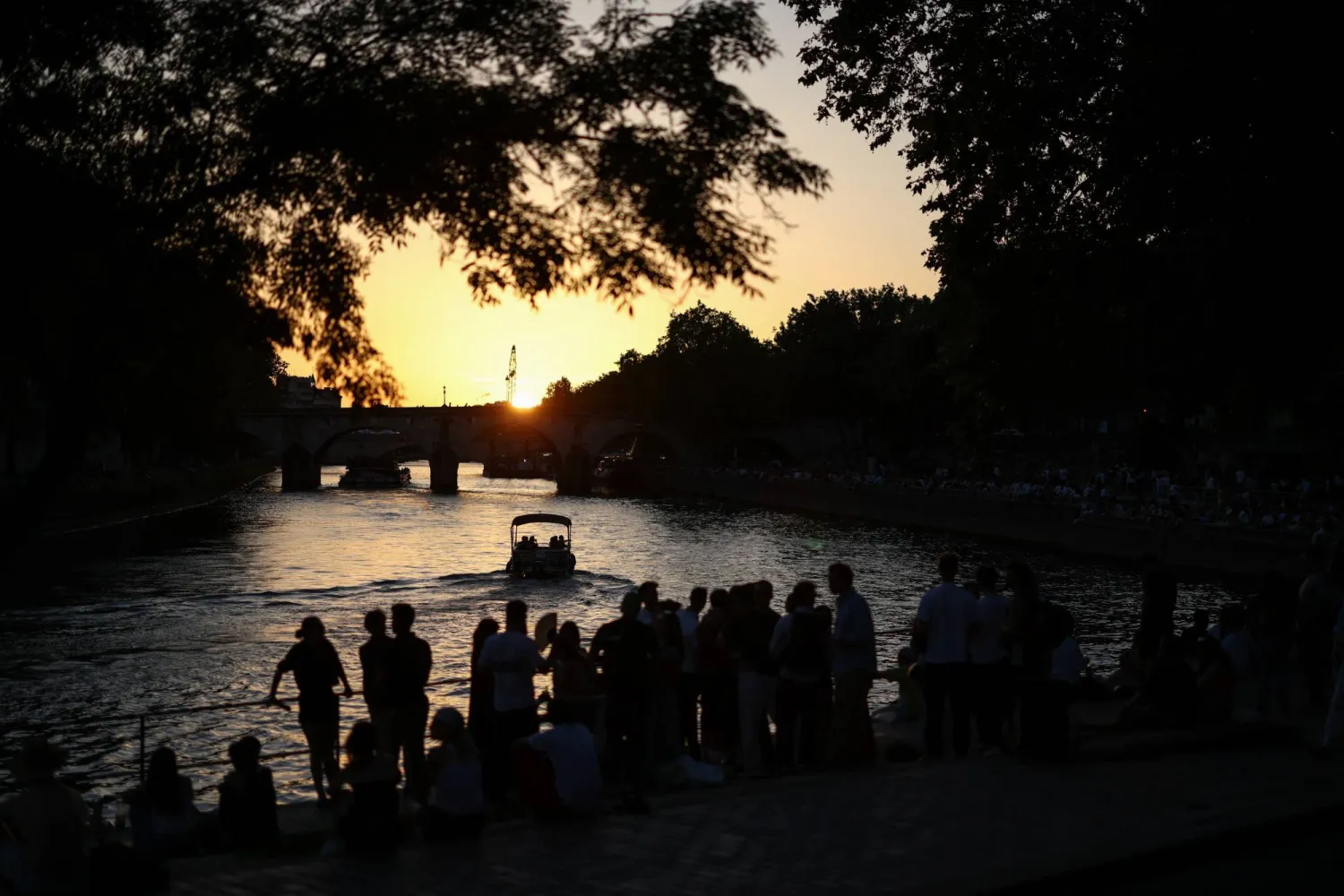
People gather on the banks of the Seine River as the sun sets amid a severe heat wave in Paris, France, May 26, 2026. (Reuters)
TT

Parisians Will to Get a New Chance of Seine Swimming

People gather on the banks of the Seine River as the sun sets amid a severe heat wave in Paris, France, May 26, 2026. (Reuters)

Swimmers will for the second year be able to cool off at designated points along the Seine River in Paris this summer, authorities said Friday, as well as along the Marne River in the suburbs.

In Paris, the swimming season was to open at three official bathing sites on July 4, the mayor's office said.

The Seine reopened to swimmers last summer for the first time in a century, after Paris poured more than a billion euros ($1.15 billion) into a years-long effort to making the waters clean enough to use in the 2024 Olympics.

Sites this year will again include the Bras de Grenelle near the Eiffel Tower, the Bras Marie -- a short walk from Notre-Dame -- and Bercy, on the eastern side.

Some 100,000 people last year queued to jump in, the city said, despite a slow start to the season with rain disrupting the water quality.

Some 50,000 swimmers jumped into the Marne River in the eastern suburbs last year.

The bathing spots in Joinville-le-Pont, Champigny-sur-Marne, Saint-Maur-des-Fosses and Maison-Alfort would again welcome swimmers. A fifth spot would be added this year at Neuilly-sur-Marne northeast of Paris.

French authorities warned against swimming in parts of the rivers without lifeguards.


Independent Researcher Exposes Basic Blunder in Scores of Cancer Studies

Researchers at the laboratory. (Cancer Research UK, Cambridge Institute)
TT

Independent Researcher Exposes Basic Blunder in Scores of Cancer Studies

Researchers at the laboratory. (Cancer Research UK, Cambridge Institute)

An independent researcher has uncovered potential blunder in scores of scientific studies, including cancer-related research, as a result of inappropriate antibody use in laboratory experiments, raising questions about the reliability of some of the results published in prestigious scientific journals.

The researcher found that scientists at Cambridge, Oxford, Stanford and other universities appear to have accidentally used the wrong ingredient in their experiments, muddling two proteins with similar names but entirely different sequences and functions.

Several British media outlets said researcher Sholto David reviewed the full text of 334 research papers to determine whether the antibody used in the studies was correctly intended for p16-ARC or incorrectly used to try and bind p16-INK4a.

P16-INK4a acts as a tumor suppressor by halting the cell cycle and is widely studied in cancer biology and is considered a key biomarker of ageing.

He found astonishing result: 95% of these papers have got it wrong.

“The vast majority of researchers who purchased antibodies have tried to use them to investigate p16-INK4a expression. Only 17 used these p16-ARC antibodies correctly,” he said in his research.

David said the implications are not good, to put it mildly.

“And these are not just insignificant papers. There are papers with hundreds of citations in high impact journals claiming to probe for p16-INK4a with antibodies which do not bind p16-INK4a,” he noted.


Indonesia Volcano Erupts, Forcing Airport to Close

Journalists photograph a screen showing the movement of volcanic ash from Mount Lewotobi Laki-laki at the Meteorology, Climatology and Geophysics Agency (BMKG) office in Maumere, East Nusa Tenggara, Indonesia, on June 5, 2026. (AFP)
TT

Indonesia Volcano Erupts, Forcing Airport to Close

Journalists photograph a screen showing the movement of volcanic ash from Mount Lewotobi Laki-laki at the Meteorology, Climatology and Geophysics Agency (BMKG) office in Maumere, East Nusa Tenggara, Indonesia, on June 5, 2026. (AFP)

A highly active volcano in eastern Indonesia erupted several times on Friday, spewing towering ash columns into the sky and forcing a local airport to close, authorities said.

Mount Lewotobi Laki-Laki on Flores Island erupted at 11:15 am (0315 GMT), sending volcanic material 2.5 kilometers (1.6 miles) into the air, the national volcanology agency said in a statement.

It came after several other eruptions earlier on Friday.

Lewotobi Laki-Laki falls under Indonesia's second-highest alert level for volcanic activity, with a five-kilometer exclusion zone in force around its crater.

The volcanology agency said residents near rivers should also remain on alert for hazardous floods of volcanic material, known as lahar, if heavy rain occurs.

Authorities have suspended operations at a local airport in the town of Maumere, about 60 kilometers west of Lewotobi Laki-Laki, affecting five domestic flights, airport head Partahian Panjaitan told AFP.

Laki-Laki means "man" in Indonesian, and the 1,584-meter (5,197-foot) volcano is twinned with a calmer 1,703-meter one named Perempuan after the Indonesian word for "woman".

Last July, Lewotobi Laki-Laki spewed a colossal 18-kilometer tower of ash, forcing the cancellation of 24 flights at the international airport on the resort island of Bali.

Indonesia, a vast archipelago nation, experiences frequent seismic and volcanic activity due to its position on the Pacific "Ring of Fire".


Rescued Orphaned Elephant Highlights Nigeria's Conservation Fight

Only 40 elephants are thought to live in Nigeria's Okomu forest, as their population has collapsed across the country. John OKUNYOMIH / AFP
TT

Rescued Orphaned Elephant Highlights Nigeria's Conservation Fight

Only 40 elephants are thought to live in Nigeria's Okomu forest, as their population has collapsed across the country. John OKUNYOMIH / AFP

As dawn breaks over Nigeria's Okomu National Park, an exhausted wildlife caretaker prepares milk formula for Agbaibor, a months-old orphaned forest elephant rescued after wandering out of the rainforest alone.

"The baby elephant has to take two liters of this per meal," said Joshua Aribasoye, one of those responsible for feeding and monitoring the calf around the clock in a makeshift pen at a ranger outpost inside the park in southern Edo state.

Forest elephants, smaller and more elusive than their savannah cousins, are endangered and their population has collapsed in recent decades largely because of habitat loss and poaching, AFP said.

Agbaibor -- named after the ranger who helped rescue him -- was found near a palm oil plantation bordering the protected forest late last year after being separated from the herd.

Rangers and conservationists tried to reunite the calf with its family by taking it back into the forest, but it soon wandered out again.

Fearing it would die alone or be attacked, park authorities and conservation group African Nature Investors (ANI) launched an emergency effort to nurse the animal, flying in elephant rehabilitation specialists from Zambia and assigning caretakers to raise him.

It has become a costly operation. ANI spends between four and five million naira (about $2,900-$3,600) a month on his care, including 77 kilograms of milk powder, alongside oats and nutritional supplements.

Conservationists expect the rehabilitation process to take another three to five years. They are building a new enclosure deeper inside the park, within elephant habitat, where the calf will gradually be exposed to the sounds and movements of wild herds before an eventual reintroduction.

"The calf will be cared for there... until it is integrated into a group," said ANI project manager Peter Abanyam.

- 200 remain -

The International Union for Conservation of Nature (IUCN) lists forest elephants as critically endangered, with conservationists estimating only around 200 remain in the country.

Roughly 40 are believed to live in and around Okomu -- one of Nigeria's last remaining rainforest ecosystems, covering about 24,000 hectares.

"Okomu is critical for conservation in Nigeria," said Abanyam.

"In a small ecosystem like this, housing 40 elephants is a huge number, and it needs to be protected at all costs."

But pressure on the forest is intensifying.

Logging, poaching, farming and expanding human settlements have fragmented large parts of the reserve, shrinking elephant corridors and increasing contact between wildlife and nearby communities.

Godstime Christopher, 26, once helped transport illegally logged timber out of the forest before being recruited as a ranger by ANI.

Today, he works with the organization's biomonitoring team, using camera traps to track elephant movements and identify poachers.

"When I became a ranger, I thought I would use that to exploit logging," he admitted. "But the training changed our mentality."

- 'Preserve what we have' -

Conservation groups say engaging local communities is essential if endangered wildlife is to survive in one of Africa's fastest-growing countries, where economic hardship often drives people deeper into protected forests in search of land, timber or bushmeat.

While the ranger program appears to have helped drive down poaching in the area, hunting for other species still disturbs the elephants and degrades their habitat, Christopher warned.

Back at the rehabilitation center, Agbaibor splashes in the mud, nudges his handler for attention and drinks from oversized bottles of milk formula.

For Aribasoye, the demanding work has become deeply personal.

"We are supposed to be like a mother to him," he said.

"Seeing him eating and playing is part of the joy... because I know we are working to preserve what we have left."