


Wild Black Bear in Japan Captured After Multi-Day Hunt Captures the Nation’s Attention

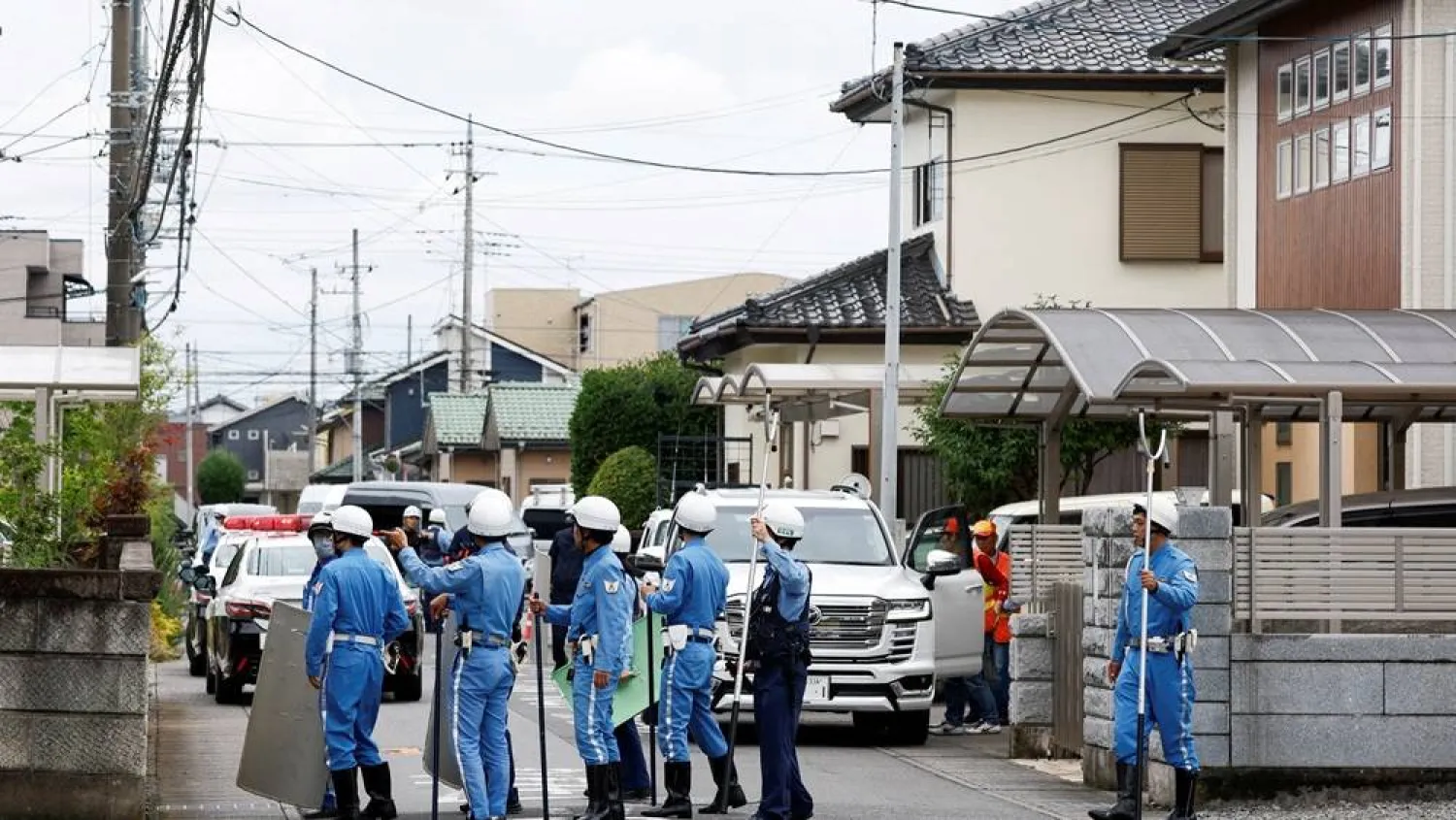
 Police officers with shields and sticks search for a bear at a residential area after a black bear was spotted in Utsunomiya, Tochigi Prefecture, Japan, June 9, 2026. (Reuters)
Police officers with shields and sticks search for a bear at a residential area after a black bear was spotted in Utsunomiya, Tochigi Prefecture, Japan, June 9, 2026. (Reuters)
TT

Wild Black Bear in Japan Captured After Multi-Day Hunt Captures the Nation’s Attention

 Police officers with shields and sticks search for a bear at a residential area after a black bear was spotted in Utsunomiya, Tochigi Prefecture, Japan, June 9, 2026. (Reuters)
Police officers with shields and sticks search for a bear at a residential area after a black bear was spotted in Utsunomiya, Tochigi Prefecture, Japan, June 9, 2026. (Reuters)

The Japanese city of Utsunomiya captured a wild black bear on Tuesday after a dramatic multi-day search that gripped the nation, as local schools closed and residents were urged to stay indoors. 

The city closed all 94 municipal primary and middle schools for a second straight day on Tuesday after its first-ever bear sighting on Saturday evening.  

Authorities decided to keep schools closed again on Wednesday due to a report of a possible second bear roaming the city, an official said. 

Bear attacks have spiked in Japan, including ‌in urban areas, prompting ‌the government to set up a task ‌force ⁠this year to reduce ⁠incidents. In fiscal 2025, the country reported a record 238 casualties, including 13 deaths, according to the environment ministry. 

With about 500,000 residents, Utsunomiya, in Tochigi Prefecture, is part of the Greater Tokyo Metropolitan region, about 100 km (60 miles) north of the capital. 

When the bear resurfaced in a residential area early on Tuesday afternoon, police cars and other vehicles involved ⁠in the search promptly blocked off the vicinity. ‌For more than an hour, police officers ‌milled about, with some holding long sticks and others metal shields, as some ‌national broadcasters aired live footage filmed from helicopters. 

The adult bear, which ‌was estimated to weigh about 100 kg (220 lbs), was eventually shot with a tranquilizer gun, loaded onto a cage on a truck and driven away. The city has yet to decide what to do with it, an ‌official said. 

Around 100 km to the northeast, Iwaki, in Fukushima Prefecture, also suspended classes at three ⁠schools on Tuesday in ⁠a neighborhood where a black bear was spotted a day earlier. 

Last week, a bear attack in Fukushima city left at least four people injured, with security footage in one incident showing the animal chasing a man and throwing him to the ground. 

Asiatic black bears are listed as a vulnerable species globally, but their numbers are estimated to have tripled in Japan since 2012, aided by a decline in hunting. 

Experts say climate change has reduced harvests of natural bear food like acorns and beechnuts, while the depopulation of rural areas and the proliferation of abandoned farmland have emboldened them to seek nourishment near human settlements. 


Curtain Falls on the Romance of India's Single-screen Cinemas

Researchers estimate that India had around 14,000 single-screen halls in the 1980s. Only around 2,000 remain today. Idrees MOHAMMED / AFP
TT

Curtain Falls on the Romance of India's Single-screen Cinemas

Researchers estimate that India had around 14,000 single-screen halls in the 1980s. Only around 2,000 remain today. Idrees MOHAMMED / AFP

The demolition has begun at Bengaluru's Urvashi Cinema, once a 1,200-seat movie palace where generations of filmgoers cheered and whistled, another casualty of India's vanishing single-screen era.

"The theater came up in the 1970s... I was so happy when it opened," said Manjunath, watching as seats were ripped out and strewn outside.

Manjunath, who uses one name, recalled its glory days, when the shop he runs opposite was packed with customers buying snacks before and after shows.

"That was the rush... now I have a lot of free time," he said. "But what to do? There is barely any crowd."

The peeling facades, faded signs and cavernous auditoriums of such cinemas are remnants of a time when going to the movies was itself the main event.

"It is a completely different experience," said photographer Hemant Chaturvedi, 58, who has documented what remains during a seven-year odyssey, photographing 1,350 single-screen cinemas across 1,000 towns.

His photographs capture not only the movie houses but their ornate facades and decay -- a record of a cultural landscape disappearing as cinemas are demolished, converted into multiplexes or left to crumble.

- 'Ecosystem is fading' -

"People would be cheering, jumping on the seats, even throwing money at the screen," Chaturvedi said.

The old halls offered a collective, interactive experience, with fans applauding at the hero's entrance, clapping to romantic songs and shouting at dramatic twists.

"Now that old ecosystem is fading, and the charm is being lost," he said.

India's single-screen cinemas have been steadily squeezed by multiplexes, streaming, rising property costs and the expense of maintaining ageing buildings and equipment.

Researchers estimate that India had around 14,000 single-screen halls in the 1980s. Only around 2,000 remain today.

Many of the old halls could accommodate around 1,000 people, creating a communal atmosphere rarely found in today's multiplexes.

The decline has also changed the way Indians experience films. New halls offer air conditioning, reclining seats and food delivered to the seat.

"To me, the new cinemas have lost the charm," said Chaturvedi, a former Bollywood cinematographer who worked on hit movies during a three-decade career.

"The multiplexes are a generic, cold experience."

- 'Old times' -

Some of the old cinemas have been restored and renovated, and the single-screen experience still has its devotees.

In Bengaluru, Mukunda Cinemas still draws crowds -- even for early-morning shows before work.

Hundreds lined up before dawn for a recent 6:00 am screening of the latest release of film star Yash, who is hugely popular in India's Kannada-language cinema.

Santosh, a 47-year-old businessman who uses one name, queued with hundreds of others as crowds set off fireworks outside while waiting for the show.

"Only in the single screen theaters can they take the cinema to the next level, it increases the tradition of cinema," Santosh said, as cheers and whistles reverberated through the packed hall before the film began.

Veerain Reddy, the third generation of his family running the 50-year-old theater, said maintaining the establishment "was not an easy task".

Inflation, rising costs and "so much competition" have made business tough.

"But people who are really passionate are still trying to maintain these single-screen theaters, where people come to watch and celebrate cinema," he told AFP.

Another survivor in Mumbai -- formerly known as Bombay -- is the Regal Cinema, an Art Deco hall that opened in 1933.

"The rest of them feel very artificial, commercial, very blingy," said 23-year-old fan Vanshika. "But Bombay has little places which remind us of the old times."


GEA Chairman Announces October 21 Launch for Riyadh Season 2026

Turki Alalshikh, Chairman of Saudi Arabia’s General Entertainment Authority (Asharq Al-Awsat)
TT

GEA Chairman Announces October 21 Launch for Riyadh Season 2026

Turki Alalshikh, Chairman of Saudi Arabia’s General Entertainment Authority (Asharq Al-Awsat)

Chairman of the Board of Directors of the General Entertainment Authority (GEA) Turki Alalshikh announced that Riyadh Season 2026 will open on Wednesday, October 21, featuring a 10-week program of championships, concerts, performances, and entertainment experiences, the Saudi Press Agency reported on Saturday.

Alalshikh made the announcement in a promotional video previewing the season's sporting, entertainment, and arts events, which he said would reinforce Riyadh's standing as a destination for premier events and audiences from around the world.

The seventh edition's lineup includes world-class boxing and wrestling matches, UFC bouts, and the Six Kings Slam tennis tournament, alongside concerts, theatrical and comedy performances, and events designed for children and families.

Boulevard World returns as one of the season's principal zones, gathering global cultures and destinations in a single location, while Boulevard City opens with new content and Wonder Garden offers a range of rides and activities. Other zones and events include The Groves, the Farmers' Market, and the Ana Arabia exhibition at VIA Riyadh, with further programs spread across multiple locations in the capital.

The season runs under the theme "Big Time," drawing visitors from Saudi Arabia and abroad.


New Road Lanes Open in Makkah to Ease Congestion, Aid Pilgrims

The expansion includes an additional 1.5-kilometer stretch on the Third Ring Road connecting the Prince Mutib intersection to the Grand Mosque intersection via the Prince Sultan intersection - SPA
TT

New Road Lanes Open in Makkah to Ease Congestion, Aid Pilgrims

The expansion includes an additional 1.5-kilometer stretch on the Third Ring Road connecting the Prince Mutib intersection to the Grand Mosque intersection via the Prince Sultan intersection - SPA

The Royal Commission for Makkah City and Holy Sites has opened traffic on several newly developed lanes along the Third Ring Road and Prince Saud Al Faisal Road, reducing travel times by more than 90%.

The expansion includes an additional 1.5-kilometer stretch on the Third Ring Road connecting the Prince Mutib intersection to the Grand Mosque intersection via the Prince Sultan intersection, SPA reported.

Traffic flow was also inaugurated on the final section of Prince Saud Al Faisal Road, linking the Prince Mohammed bin Salman axis to Abdulqadir Koshak Street through the Prince Naif bin Abdulaziz intersection.

These openings are part of integrated infrastructure projects designed to ease traffic congestion, improve road safety, and streamline access for residents, visitors, and pilgrims during the Hajj and Umrah seasons.
