


Woolly Mammoth Among Trove of Ancient DNA Found in Squirrel Poo

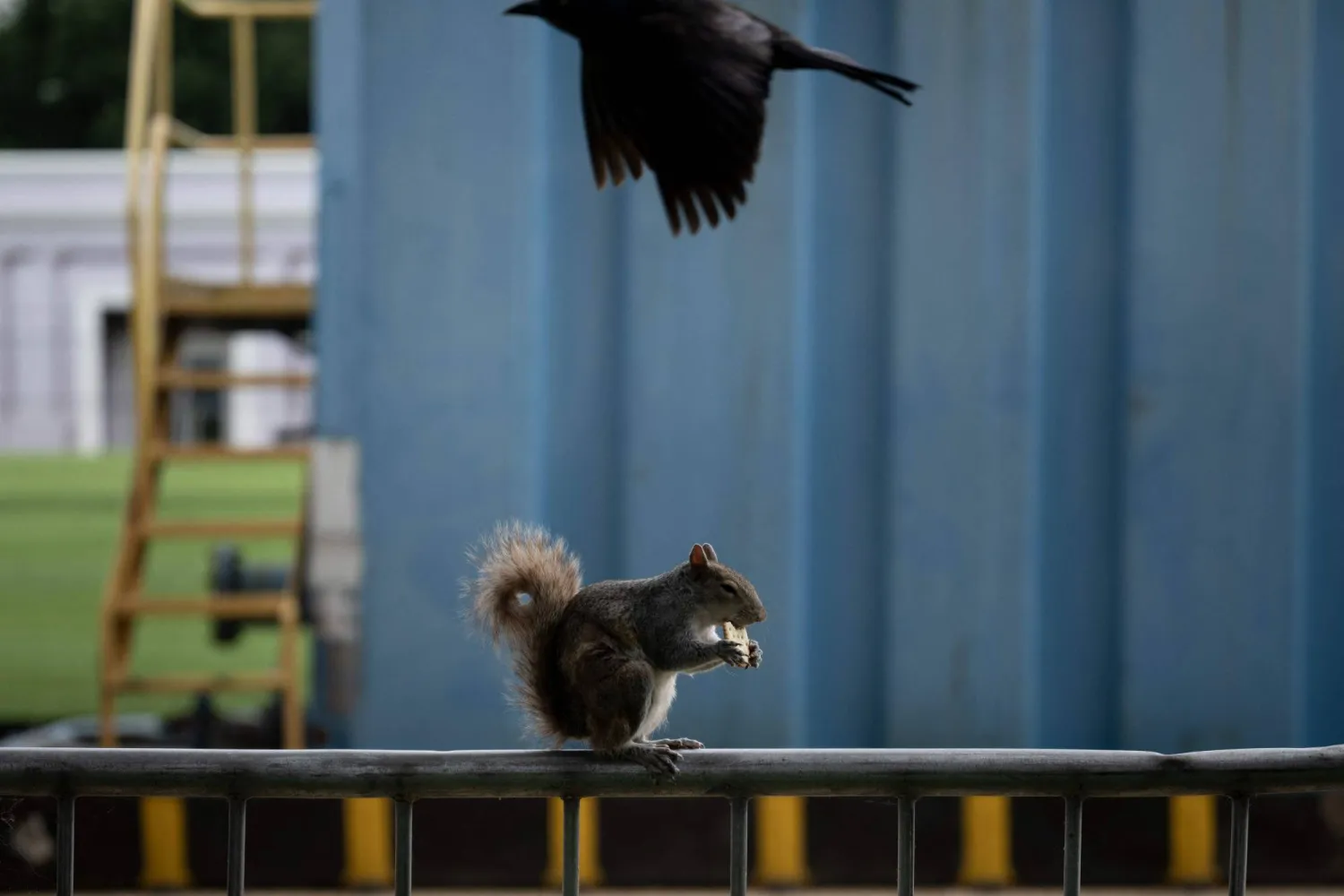
A squirrel eats on a barrier closing off the National Mall on June 8, 2026 in Washington, DC. (Photo by Brendan Smialowski / AFP)
TT

Woolly Mammoth Among Trove of Ancient DNA Found in Squirrel Poo

A squirrel eats on a barrier closing off the National Mall on June 8, 2026 in Washington, DC. (Photo by Brendan Smialowski / AFP)

A huge treasure trove of ancient DNA from animals including extinct woolly mammoths has been discovered in frozen squirrel feces in Canada's remote Yukon territory, scientists said Tuesday.

The DNA found deep inside sealed-off burrows is between 3,000 and 700,000 years old, offering a rare window into how life has changed over the millennia, AFP reported.

As well as DNA from woolly mammoths -- which the US company Colossal claims it is trying to "de-extinct" -- genetic material was also found from wolves, bison, horses, a cheetah and hundreds of plants.

Tyler Murchie, a palogenomics researcher at Canada's McMaster University and lead author of a new study, admitted that digging through squirrel poop might sound "less appealing" than discovering, say, a mammoth tusk.

However, the "spectacular" amount of information they uncovered suggests that feces is an overlooked way to see into our planet's distant past, he added.

The scientists had just been expecting to study the squirrel's microbiome before coming across the "really surprising biodiversity of organisms", Murchie said.

It turned out that arctic ground squirrels were ideal subjects for this research because of their "natural archivist behavior,” he explained.

The squirrels are only conscious for around four months a year, spending the rest of their life in hibernation.

So when they are awake, "they've got to get out there and eat as much as they can of everything," Murchie said.

The squirrels pack their burrows with nuts, seeds, leaves, bones, fur and anything else they can find.

But over time, rising permafrost permanently sealed off some of the burrows in the Yukon, creating a perfectly preserved time capsule.

Murchie said they even found a "super cute little guy" frozen in time.

"He just went to sleep one season, then he never woke up... it wasn't until some paleontologist came by investigating that they found him in there."

The scientists used the DNA to reconstruct 18 mitochondrial genomes, including for six woolly mammoths that lived in different eras.

This involves using computers to stitch together DNA fragments, like puzzle pieces, Murchie explained.

Colossal has declared its intention to resurrect the woolly mammoth, which went extinct around 4,000 years ago.

However, experts have expressed skepticism about the claim, saying the resulting animal would be more like an Asian elephant with some genetic tweaks to make it resemble a mammoth.

Murchie, who does not work for Colossal, said the genetic data they found would be made publicly available, so the company could use it.

"But they already have so much DNA to go off of -- whole genomes from different organisms -- so I'm sure ours is a drop in the bucket," he added.

The team behind the latest research, which was published in the journal Nature Communications, is working on another study describing what the DNA reveals about the woolly mammoth's evolution.

Murchie could not speak about that future research, other than to say it was "super cool.”

"I can't believe that we were able to get these insights from squirrel feces," he added.


EU Scientists: May Was World's Second-hottest on Record

FILE PHOTO: A drone view shows people using kayaks and paddle boards in the River Thames at Teddington Lock, London’s first official river bathing water site, as temperatures climb over the bank holiday weekend due to a heat dome spreading across the region, in London, Britain, May 24, 2026. REUTERS/Isabel Infantes/File Photo
TT

EU Scientists: May Was World's Second-hottest on Record

FILE PHOTO: A drone view shows people using kayaks and paddle boards in the River Thames at Teddington Lock, London’s first official river bathing water site, as temperatures climb over the bank holiday weekend due to a heat dome spreading across the region, in London, Britain, May 24, 2026. REUTERS/Isabel Infantes/File Photo

The world has just experienced the second-hottest May since records began, as climate change and the developing El Niño weather pattern conspired to push up average land and sea temperatures, the European Union's Copernicus Climate Change Service (C3S) said on Wednesday.

The hottest May on record was in 2024, in records going back to 1940, Reuters reported.

The average ⁠global temperature last ⁠month was 1.42 degrees Celsius above the average in 19th-century pre-industrial times.

Western Europe experienced one of the most severe heatwaves ever recorded so early in the year.

C3S says ⁠the extreme heat in Europe was in line with scientists' expectations of how climate change will affect the world's fastest-warming continent.

Parts of the Pacific Ocean recorded exceptionally high temperatures as it transitions towards El Nino conditions.

Extreme weather last month included fatal floods in China and Türkiye.

The El Niño ⁠weather ⁠pattern is expected to form in the coming months and to fuel extreme weather around the world.

El Niño naturally occurs every two to seven years, when weakening trade winds result in warmer waters in the eastern Pacific. The result tends to be higher global temperatures, and disrupted rainfall, meaning drought in some regions, heavy rains in others.


Encouraging Trial Results for AstraZeneca's New Weight-Loss Pill

The logo for AstraZeneca is seen outside its North America headquarters in Wilmington, Delaware, US, March 22, 2021. (Reuters)
TT

Encouraging Trial Results for AstraZeneca's New Weight-Loss Pill

The logo for AstraZeneca is seen outside its North America headquarters in Wilmington, Delaware, US, March 22, 2021. (Reuters)

A new pill developed by the British pharma firm AstraZeneca appears to help people lose a similar amount of weight to other GLP-1 oral drugs, trial results showed Monday.

If confirmed by further research, the pill could mark AstraZeneca's entrance into the massively lucrative weight-loss drug market currently dominated by Denmark's Novo Nordisk and American giant Eli Lilly.

The astronomical popularity of the appetite suppressing injectable drugs called GLP-1 agonists has kicked off a race to produce tablet versions that easier to take.

AstraZeneca's new pill, called elecoglipron, resulted in weight loss "comparable to that reported for other oral" GLP-1 drugs, according to phase 2 trial results published in the Lancet medical journal.

Side effects recorded during the randomized trial, which had 310 participants, were also similar to those seen for other GLP-1 pills, with nausea being the most common.

For overweight or obese adults without diabetes, the pill resulted in "average weight reductions of up to 10.5 percent at 26 weeks and 11.8 percent at 36 weeks in the highest-dose group," said Marie Spreckley of the University of Cambridge.

But the weight management researcher -- who was not involved in the study -- emphasized the phase 2 trial was not mainly designed to compare the pill to other anti-obesity drugs.

"Larger and longer phase 3 trials will therefore be needed to confirm the durability of these effects, establish longer-term safety and tolerability, and determine its place within the growing range of obesity and diabetes treatments," she explained.

AstraZeneca will face stiff competition -- Novo Nordisk and Eli Lilly have already developed pill versions of their hugely successful drugs.

The oral form of Eli Lilly's popular Mounjaro GLP-1 drug was approved in April in the United States, where it is sold under the brand name Foundayo.

The pill version of Novo Nordisk's blockbuster drug Wegovy is already available in the US and was given the green light by European Union health authorities last month.


Wild Black Bear in Japan Captured After Multi-Day Hunt Captures the Nation’s Attention

 Police officers with shields and sticks search for a bear at a residential area after a black bear was spotted in Utsunomiya, Tochigi Prefecture, Japan, June 9, 2026. (Reuters)
Police officers with shields and sticks search for a bear at a residential area after a black bear was spotted in Utsunomiya, Tochigi Prefecture, Japan, June 9, 2026. (Reuters)
TT

Wild Black Bear in Japan Captured After Multi-Day Hunt Captures the Nation’s Attention

 Police officers with shields and sticks search for a bear at a residential area after a black bear was spotted in Utsunomiya, Tochigi Prefecture, Japan, June 9, 2026. (Reuters)
Police officers with shields and sticks search for a bear at a residential area after a black bear was spotted in Utsunomiya, Tochigi Prefecture, Japan, June 9, 2026. (Reuters)

The Japanese city of Utsunomiya captured a wild black bear on Tuesday after a dramatic multi-day search that gripped the nation, as local schools closed and residents were urged to stay indoors. 

The city closed all 94 municipal primary and middle schools for a second straight day on Tuesday after its first-ever bear sighting on Saturday evening.  

Authorities decided to keep schools closed again on Wednesday due to a report of a possible second bear roaming the city, an official said. 

Bear attacks have spiked in Japan, including ‌in urban areas, prompting ‌the government to set up a task ‌force ⁠this year to reduce ⁠incidents. In fiscal 2025, the country reported a record 238 casualties, including 13 deaths, according to the environment ministry. 

With about 500,000 residents, Utsunomiya, in Tochigi Prefecture, is part of the Greater Tokyo Metropolitan region, about 100 km (60 miles) north of the capital. 

When the bear resurfaced in a residential area early on Tuesday afternoon, police cars and other vehicles involved ⁠in the search promptly blocked off the vicinity. ‌For more than an hour, police officers ‌milled about, with some holding long sticks and others metal shields, as some ‌national broadcasters aired live footage filmed from helicopters. 

The adult bear, which ‌was estimated to weigh about 100 kg (220 lbs), was eventually shot with a tranquilizer gun, loaded onto a cage on a truck and driven away. The city has yet to decide what to do with it, an ‌official said. 

Around 100 km to the northeast, Iwaki, in Fukushima Prefecture, also suspended classes at three ⁠schools on Tuesday in ⁠a neighborhood where a black bear was spotted a day earlier. 

Last week, a bear attack in Fukushima city left at least four people injured, with security footage in one incident showing the animal chasing a man and throwing him to the ground. 

Asiatic black bears are listed as a vulnerable species globally, but their numbers are estimated to have tripled in Japan since 2012, aided by a decline in hunting. 

Experts say climate change has reduced harvests of natural bear food like acorns and beechnuts, while the depopulation of rural areas and the proliferation of abandoned farmland have emboldened them to seek nourishment near human settlements.
