
World’s Largest Whale Graveyard Discovered by Chinese Sub

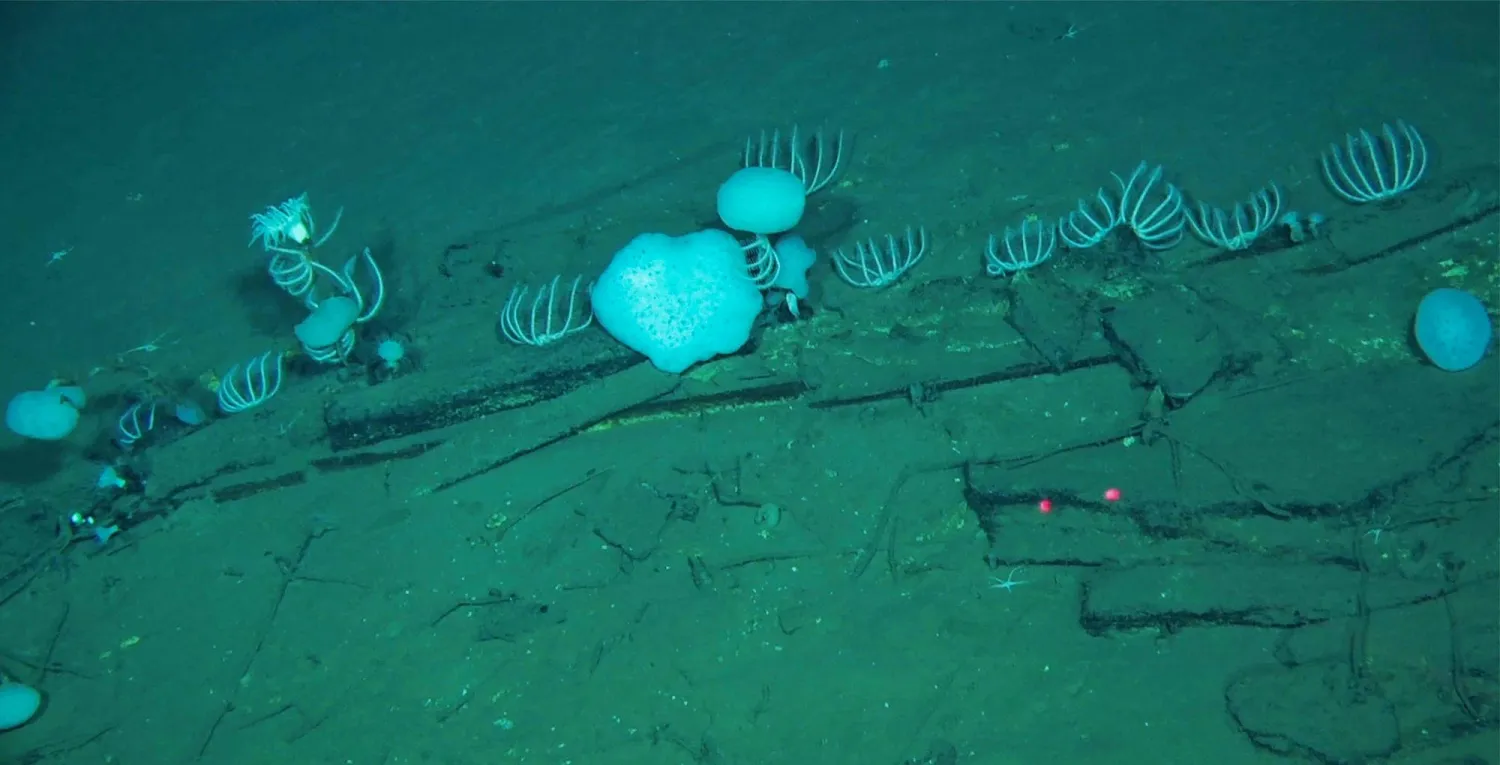
This handout photograph taken by Global TREnD, IDSSE, seven kilometers under the sea on the deep seafloor of the Diamantina Zone in the Indian Ocean in 2023 and released on June 10, 2026, shows whale bones at the world's biggest known whale graveyard discovered by the Chinese submersible Fendouzhe. (Handout / Global TREnD, IDSSE / AFP)
TT

World’s Largest Whale Graveyard Discovered by Chinese Sub

This handout photograph taken by Global TREnD, IDSSE, seven kilometers under the sea on the deep seafloor of the Diamantina Zone in the Indian Ocean in 2023 and released on June 10, 2026, shows whale bones at the world's biggest known whale graveyard discovered by the Chinese submersible Fendouzhe. (Handout / Global TREnD, IDSSE / AFP)

The world's largest whale graveyard has been discovered at the bottom of the Indian Ocean by Chinese scientists, who found that the vast expanse of both new and ancient carcasses supports huge communities of deep-sea life.

It is also the deepest and oldest known whale graveyard on Earth, according to research published in the journal Nature on Wednesday, with some fossils dating back 5.3 million years.

From inside a small submersible, the Chinese researchers saw many strange animals -- many believed to be new to science -- living off the whale carcasses.

A new, though extinct, species of whale was also identified among the nearly 500 skeletons found up to 7,000 meters deep along a 1,200 kilometer corridor of bones in the Indian Ocean west of Australia.

Lead study author Xiaotong Peng of the Chinese Academy of Sciences told AFP that the researchers were "astonished" when the scale of their discovery became clear.

It was known that when whales die and drop to the seafloor, their sunken bodies -- called "whale falls" -- provide a source of food to deep-sea creatures.

"But discovering a necropolis of this scale was completely unexpected: the size of distribution, the depth and the age range were far beyond anything we had imagined," Xiaotong Peng said.

The whales were believed to have died in such numbers in this particular area because it is a popular foraging habitat -- and has a V-shaped trench that funnels carcasses to the seafloor.

- 'Truly incredible experience' -

For the discovery, the Fendouzhe submersible carried out 32 dives in 2023 -- though what it found was only revealed in Nature on Wednesday.

The sub took up to three people on the dives, collecting the fossil samples using robotic arms.

Study co-author Peng Zhou said witnessing the whale graveyard "was a truly incredible experience".

"The vibrant ecosystems we saw offered a completely different perspective on this otherwise dark and cold ocean floor."

Among the animals they discovered living off the carcasses were jellyfish, brittle stars, bone-boring worms and mollusks called bivalves.

Most of the 485 fossils the scientists catalogued were from different species of beaked whales.

Extrapolating from the number of bones they found, the scientists estimated there could be more than 10 million carcasses across the area, which is called the Diamantina Zone.

The soft tissue and lipids inside that many carcasses "translates to roughly 6.7 million tons of sequestered carbon," Xiaotong Peng said.

This provides an immense source of sustenance for animals, similar to how hydrothermal vents create their own ecosystems on the ocean floor.

Some of the animals seen by the scientists also live in hydrothermal vents and cold seeps, suggesting whale carcasses could help connect these deep-sea communities.

While this is by far the largest whale graveyard yet found, fossils found during trawling suggest there could be others off South Africa, the Iberian peninsula and the Crozet islands, said the study.

- 'More blockbusters to come'? -

University of Hawaii oceanographer Craig Smith, who discovered the first whale fall in 1987 but was not involved in the new research, told AFP it was "extremely exciting".

"The vast number of fossil whale falls documented, including a new species of beaked whale, is truly amazing and is of major importance to understanding whale evolution and whale distributions over geologic time," he said.

Whale fall researcher Amy Baco-Taylor at Florida State University told AFP the "remarkable discovery" would "likely provide many new insights".

This includes for the animals living in these "chemosynthetic" communities, whose numbers had been thought to have been drastically reduced by human whaling, she added.

US paleontologist Stephen Godfrey compared the "truly unique discovery" to past major underwater finds, such as when scientists first identified hydrothermal vents teeming with life on the ocean floor in 1977.

He called for future submersible voyages to find more whale graveyards across the world.

This discovery "reminded me of a trailer for the first in a series of epic movies", Godfrey commented in a linked Nature paper.

"I hope that there will be many more of these blockbusters to come."


One Runner Gored in the Face at Spain's San Fermin Bull Run Festival

11 July 2026, Spain, Pamplona: The fifth bull run of the 2026 San Fermin Festival. Photo: Eduardo Sanz/EUROPA PRESS/dpa
TT

One Runner Gored in the Face at Spain's San Fermin Bull Run Festival

11 July 2026, Spain, Pamplona: The fifth bull run of the 2026 San Fermin Festival. Photo: Eduardo Sanz/EUROPA PRESS/dpa

A runner was gored in the face and many more were fortunate to not be seriously injured during a chaotic bull run at Spain’s San Fermin festival on Saturday.

The six bulls and accompanying steers charged through crowds of thrill-seekers who packed the narrow street course in Pamplona. The huge animals knocked down bodies to the cobblestones, and stumbling runners caused several pileups during the two-and-a-half-minute run from the pen to the bull ring where bullfighters will kill the bulls later in the day.

One runner was pierced by a horn in the face, while 12 more people needed medical treatment for an assortment of knocks, according to the University of Navarra Hospital.

A black bull broke away from the pack early in the 875-meter (957-yard) run and plowed into a group of people, smacking one full in the side of the face with a horn. It was not clear if that was the moment of the goring, The Associated Press reported.

Many runners appeared completely unaware when bulls were breathing down their necks and, instead of trying to gore them, just shoved them out of the way.

Saturday’s was the fifth morning run of the eight-day festival in northern Spain.

This year’s festival comes 100 years since the publication of Ernest Hemingway’s novel “The Sun Also Rises,” whose publication launched the San Fermin festival to international fame.

The last death at San Fermin's bull runs occurred in 2009, but gorings and broken bones are common, partly due to the large number of novice bull runners and foreign tourists who join the experienced locals.


Paris Landmarks Shutter Early as Quarter of France Swelters Under Heatwave

 A sign informs visitors that the Eiffel Tower will close at 16:00 CEST today due to extreme temperatures during a heatwave in Paris, France, July 11, 2026. (Reuters)
A sign informs visitors that the Eiffel Tower will close at 16:00 CEST today due to extreme temperatures during a heatwave in Paris, France, July 11, 2026. (Reuters)
TT

Paris Landmarks Shutter Early as Quarter of France Swelters Under Heatwave

 A sign informs visitors that the Eiffel Tower will close at 16:00 CEST today due to extreme temperatures during a heatwave in Paris, France, July 11, 2026. (Reuters)
A sign informs visitors that the Eiffel Tower will close at 16:00 CEST today due to extreme temperatures during a heatwave in Paris, France, July 11, 2026. (Reuters)

The Eiffel Tower and other Paris landmarks announced early closures over the weekend as a quarter of mainland France was under the highest heat alert level on Saturday in the third heatwave to hit the country since May.

The operator of the Eiffel Tower said the latticed-steel monument would "exceptionally close" early on Saturday and Sunday at 4 pm (1400 GMT), "due to the high temperatures forecast".

The 324-meter (1,063-foot) tower, which attracts seven million tourists a year, usually stays open past midnight during the high season.

Two of the French capital's most famous museums, the Louvre and the Musee d'Orsay, have taken similar measures.

The Louvre, the most visited museum in the world, said on Thursday it would close at 4 pm from Friday through to Monday.

The Musee D'Orsay announced it would also close early, "due to the extreme heat" at 5 pm from Saturday to Wednesday.

Twenty-four departments, home to 22.2 million people according to an AFP calculation, were under the maximum alert level issued by the national weather service Meteo-France on Saturday.

Another 59 departments of 96 in mainland France were under an orange heat warning, a step below the highest, as people flooded trains and highways at the start of a holiday weekend ahead of France's national public holiday on July 14.

Across France, many towns have called off their firework displays for Bastille Day due to increased fires and dry conditions.

Wildfires have scorched twice as much land in France so far this year as in the same period last year, an official said on Friday.

French President Emmanuel Macron called for vigilance on Saturday, warning nine out of 10 fires are due to human activity.

"A single second of inattention can put families at risk, endanger those who protect us and destroy our countryside," he wrote on X.

The European nation is facing its third heatwave since May, with a heatwave in June shattering records.

The country recorded more than 2,000 excess deaths during the June heatwave, and 300 during the high temperatures in late May, according to official figures.

The government has faced a barrage of criticism, accused of being "unprepared" for the extreme weather, the increasing frequency of which scientists have linked to man-made climate change.

High temperatures are expected to continue until Bastille Day, according to Meteo-France.


Dangerous Heatwave Is Building, Will Bring Oppressive Temperatures to Much of the US

Visitors use fans as as they wait to enter the Washington Monument, July 1, 2026, in Washington. (AP)
TT

Dangerous Heatwave Is Building, Will Bring Oppressive Temperatures to Much of the US

Visitors use fans as as they wait to enter the Washington Monument, July 1, 2026, in Washington. (AP)

A widespread and dangerous heatwave is building across the US, with triple-digit highs expected in the Southwest and Great Plains this weekend before spreading eastward under a dome of high pressure that meteorologists say could trap oppressive temperatures for a week or more.

Forecasters are advising people to stay hydrated and find places to cool off, warning of temperatures 15 to 25 degrees Fahrenheit (8 to 14 degrees Celsius) warmer than normal in many areas, including at night — especially bad for people's health because their bodies won't have a chance to recover. The heat dome is expected to affect as much as two-thirds of the continental United States.

“The heat doesn’t necessarily stop when it’s dark out,” said Josh Adam, a meteorologist with the National Weather Service in Bismarck, North Dakota, where temperatures will surpass 100 F (37 C) until Tuesday. That is a dramatic spike for a state where summer temperatures are typically in the 80s, he said.

The National Weather Service predicts that more than 90 US local temperature records will be tied or broken through Wednesday — with two-thirds of those being overnight heat records. Temperatures won’t drop below 80 F (27 C) at night in Fort Lauderdale, Florida; Miami; Tampa, Florida; Galveston, Texas; and Charleston, South Carolina, according to the forecast.

The current heat dome — formed when high pressure traps hot air while blocking cooling winds and rain — is one of the strongest to affect the Dakotas in 25 years, said Chad Merrill, a senior meteorologist with AccuWeather.

Forecasters expect record triple-digit highs this weekend in Nevada, Utah, Colorado, Wyoming, Idaho, Montana, North Dakota and South Dakota.

Nevada, a state accustomed to hot weather, is even hotter than normal, said Andrew Gorelow, a meteorologist with the National Weather Service in Las Vegas. The temperature in Las Vegas is expected to hit 111 F (48 C) on Saturday, Gorelow said.

Hydrating and finding cool spaces is critical, experts said.

They also warn the heat could spike fire risk to some parts of the country that already are dry, including the Rockies, where Merrill said dry thunderstorms could develop.

Climate change from the burning of coal, oil and natural gas is causing more intense and longer-lasting heatwaves that cover larger areas, scientists say.

This year's temperatures also are expected to be affected by El Nino, a natural warming of the equatorial Pacific that alters weather patterns and spikes temperatures across the globe.

The current El Nino — which formed last month and is too young to have affected this heatwave much — is expected to rank as among the most intense since the weather service began tracking them in 1950, experts said.

It has an 81% chance of becoming “very strong” — the top category — by fall, the US National Oceanic and Atmospheric Administration said Thursday.