
Scientists Warn of Record Heat, Threats to Climate Monitoring

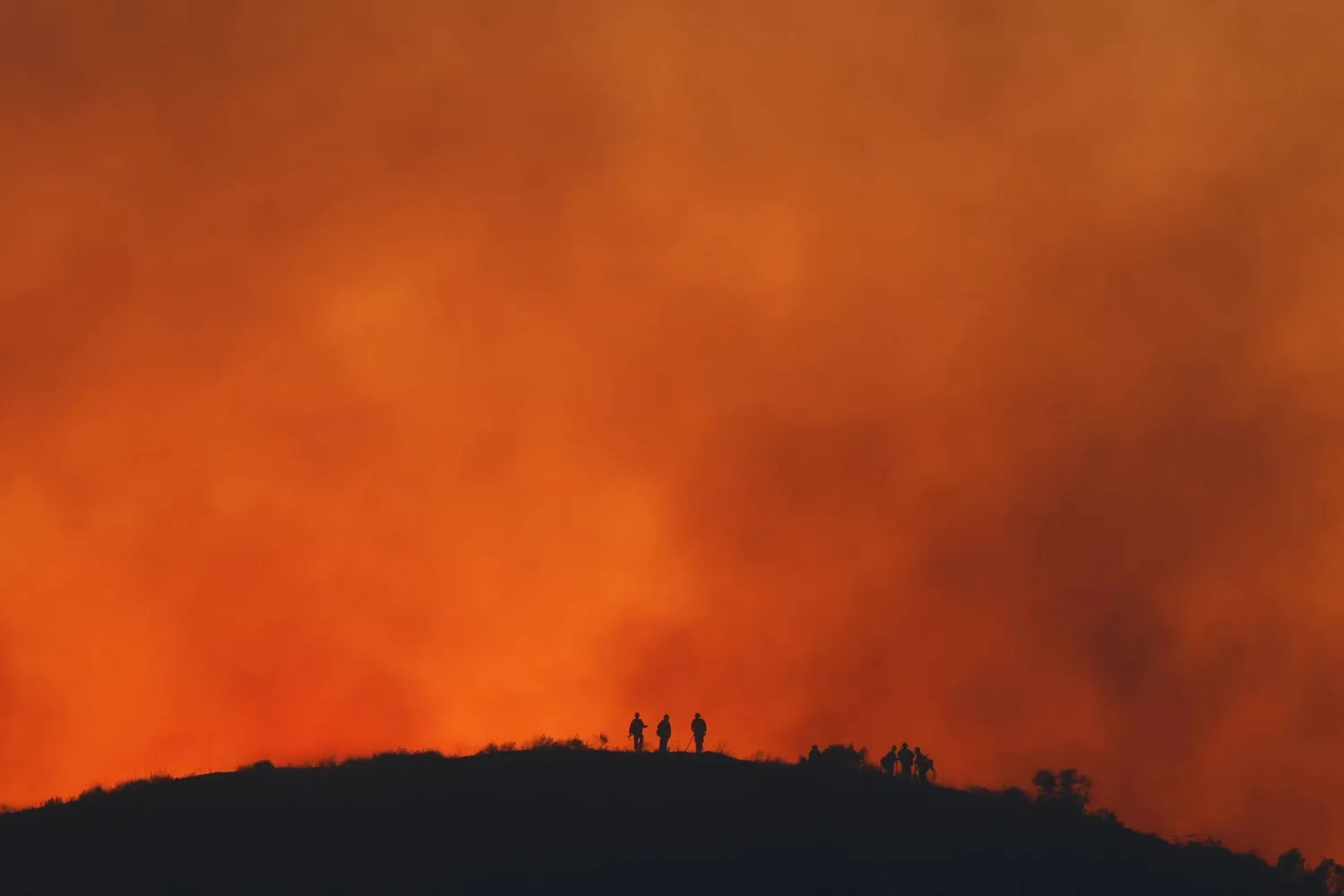
FILE - Firefighters are silhouetted amid an operation to control the Sandy Fire, May 19, 2026, in Simi Valley, Calif. (AP Photo/Caroline Brehman, File)
TT

Scientists Warn of Record Heat, Threats to Climate Monitoring

FILE - Firefighters are silhouetted amid an operation to control the Sandy Fire, May 19, 2026, in Simi Valley, Calif. (AP Photo/Caroline Brehman, File)

Planetary heating is intensifying and key climate indicators are deteriorating, top scientists said Thursday, warning that funding decisions affecting Earth observation systems in the United States and other countries threaten efforts to track global warming.

More than 70 scientists -- including contributors to the UN's Intergovernmental Panel on Climate Change (IPCC) -- raised the alarm over record human-induced warming and surging marine heatwaves in an annual study published between major IPCC assessments.

"These indicators represent an essential monitoring of the vitals of a patient exhibiting ever increasingly troubling symptoms," said Peter Thorne, a co-author and physical geography professor at Ireland's Maynooth University.

"They all rest upon a suite of global observation capabilities which are, for the first time in my lifetime, systematically either actively degrading or at risk," said Thorne, who is also deputy chair of the Global Climate Observing System (GCOS), a UN-backed Earth monitoring program.

Global temperatures reached about 1.39C above preindustrial levels in 2025, with nearly all of that warming -- 1.37C -- driven by human activities, according to the study published in the journal Earth System Science Data.

Human-induced warming will reach 1.5C in around 2030, the scientists warned, according to AFP.

Nations agreed under the 2015 Paris climate accord to limit warming to well below 2C -- and preferably 1.5C -- to avoid the worst consequences of climate change.

But the report found the world is accumulating heat at a rapid pace, worsening "Earth's energy imbalance" - the rate at which energy enters and leaves the planet.

"Without human influence, it should be close to zero, but it has been growing since the 1970s and is now at a record high, doubling in recent decades," said the study's lead author, Piers Forster, a physical climate change professor at the University of Leeds in Britain.

The high rate of warming is due to a combination of greenhouse gas emissions reaching an all-time high and the reduction of aerosol pollution, which has weakened a cooling effect as these particles reflect sunlight.

CO2 emissions, however, remain the main driver of global warming and are at a record high.

While scientists said emissions are slowing, the "carbon budget" -- the amount of CO2 that can still be emitted to keep warming under 1.5C -- could be exhausted in around three years.

"Given that greenhouse gas emissions are still on the rise, keeping global warming below this (1.5C) threshold now seems unachievable," said Aurelien Ribes, climate scientist at the French meteorological service.

The sea rose by around 23 cm between 1901 and 2025 -- and it is rising at a faster pace at 3.84 mm per year, due to melting land-based ice and through thermal expansion as the ocean warms.

The number of marine heatwave days -- a new indicator added to this year's report -- has more than tripled since 1991, reaching 65 on average in 2025.

Launched in 2023, the Indicators of Global Climate Change provides an annual update for policymakers on the state of the planet as climate change accelerates. The last IPCC assessment was finalized in 2023 and the next is due in 2028 or 2029.

The annual indicators report relies on around 40 global datasets which come from satellites and an array of land, sea and air instruments, including weather stations, ships, buoys and weather balloons.

But efforts to tackle climate change are increasingly overshadowed by wars in the Middle East and Ukraine, with governments facing a global energy crisis, budget constraints and a climate-sceptic President Donald Trump.

"Future monitoring of these indicators, such as ocean and satellite measurements of the Earth's energy imbalance, are threatened by geopolitical and public funding decisions," the report said.

It noted that funding for the UN's World Meteorological Organization has diminished while the GCOS "is also under threat.”

Several satellite programs are at risk, including in the United States.

The authors pointed to the recent decision by the Trump administration to remove hundreds of deep-sea instruments.

Such instruments are "incredibly critical" to understand how oceans absorb heat and how that affects weather patterns and ocean circulation, said Samantha Burgess, strategic lead for climate at the European Centre for Medium-Range Weather Forecasts (ECMWF).

"We really need these in-situ observations to continue monitoring the climate," she said.

The scientists also cited a decrease in on-site measurements in Africa, the west Pacific and South America.

Burgess said the plane that carries the atmospheric observing system in the UK was recently defunded.

"So it's not just one nation, unfortunately," she said.


The Indian Workers Training AI Robots to Take their Jobs

Indian housewife Nagireddy Sriramyachandra wears a smartphone on her head as she records her actions through motion capture while slicing mangoes at her home in Chennai. R.Satish BABU / AFP
TT

The Indian Workers Training AI Robots to Take their Jobs

Indian housewife Nagireddy Sriramyachandra wears a smartphone on her head as she records her actions through motion capture while slicing mangoes at her home in Chennai. R.Satish BABU / AFP

With a smartphone strapped to her head, Indian housewife Nagireddy Sriramyachandra films herself slicing mangoes to train AI-powered robots to take on household jobs in the future.

Earning just over two dollars for an hour of video, her mundane recordings are invaluable for global tech companies teaching machines how to move like humans in the real world, said AFP.

The 25-year-old is one of a growing army of thousands of AI system trainers in the world's most populous country.

"Who else will give you 250 rupees an hour just for doing housework?" said Sriramyachandra from her kitchen in Chennai in southern India's Tamil Nadu state.

"I may get a robot myself in the future," she added.

Artificial intelligence chatbots and image generators crunch reams of digital data, but building systems to navigate real-life environments is more challenging.

Developers think feeding first-person footage, called "egocentric data", into specialized AI models will help robots copy humans.

Some AI trainers work at home, others in factories or specialized studios -- using video glasses, head-mounted cameras and motion sensors.

"It blares 'hands not detected' when I'm not recording properly," said Sriramyachandra, who sends recordings via a special app to the AI data company Objectways.

The firm, which has offices in India and the United States, lists Fortune 500 multinationals as clients. It works with Amazon SageMaker, a platform for machine learning models.

- 'Better things' -

The humanoid robot market is booming, with investment bank Morgan Stanley predicting there could be over a billion in use by 2050, mostly for industrial and commercial purposes.

"Folding clothes, coffee making... cooking a very specific thing, sandwich making," Objectways head Ravi Shankar said, listing videos requested by clients.

"Some jobs are supposed to be taken over, so humans can go and do better things."

In India, the emerging field of spatial AI is providing new employment -- for now.

The 50-year-old CEO is US-based, but hires workers from Tamil Nadu, where he grew up, one of India's international technology hubs.

At a Karur textile factory, busy with workers attaching labels to caps and ironing cloth bags, AFP saw eight people wearing head cameras and smart glasses supplied by Objectways.

India has positioned itself as a global middleman for the creation, processing and annotation of AI data.

"It's likely that these data collection services will increase", said digital labor expert Aditi Surie, from the Indian Institute for Human Settlements in Bengaluru.

- Informal workers -

India is aggressively developing its AI industry, but its leaders are aware that, alongside the technology's much-hyped benefits, automation poses risks.

Government think-tank NITI Aayog said that most discussions around artificial intelligence and labor "focus on white-collar professionals and predict an almost certain loss of jobs in the segment" without urgent action.

"Little attention, if any, is paid to how AI can serve India's 490 million informal workers, the very people who form the backbone of our economy," it said in a report released ahead of a global AI summit in India this year.

The think-tank has examined how the technology could help or harm dozens of professions -- from cobblers to sewer cleaners, farmers to tea sellers.

For the last decade, 55-year-old Ponni has sat on a roadside in Bengaluru, the city known as India's Silicon Valley, making flower garlands.

She, too, has been paid to have a phone strapped to her forehead.

"The next generation... who might have to do work similar to mine -- they will face a problem," Ponni said.

- Always wearing a camera -

At an Objectways studio, AI system trainers film themselves performing household tasks in fake, fully furnished apartment rooms.

After several thousand hours of filming, the wallpaper is changed to provide clients with variety.

"Today I sit here, tomorrow I stand there," said engineering graduate Rani N., 21, on a break from filming herself, once again, folding a towel.

Each video lasts about four minutes, and she records around 90 a day -- on nearly every conceivable spot on the bed.

She says the job is "tolerable", but feels like she's always wearing a camera.

In other rooms, colleagues arranged pencil sharpeners, water bottles and crayons in patterns, recording with depth-sensor cameras.

Qanat Consulting Services in Andhra Pradesh, an Objectways subcontractor, supplies about a dozen larger data firms with recordings.

Some of its 2,000 contributors perform tasks with motion-sensor bands on their "wrists, hands and legs", CEO Thaslim Pattan said.

Manish Agarwal of Bengaluru-based Humyn Labs, not related to Objectways, records conversations as well as videos.

Contributors discuss assigned topics -- ranging from politics to entertainment -- for clients wanting to process speech patterns.

Agarwal denies that robots will steal jobs, believing that networks of humans and robots "will work together" one day, he said.

"A welder in India could be managing a welder-robot in Prague," he said.


World’s Largest Whale Graveyard Discovered by Chinese Sub

This handout photograph taken by Global TREnD, IDSSE, seven kilometers under the sea on the deep seafloor of the Diamantina Zone in the Indian Ocean in 2023 and released on June 10, 2026, shows whale bones at the world's biggest known whale graveyard discovered by the Chinese submersible Fendouzhe. (Handout / Global TREnD, IDSSE / AFP)
TT

World’s Largest Whale Graveyard Discovered by Chinese Sub

This handout photograph taken by Global TREnD, IDSSE, seven kilometers under the sea on the deep seafloor of the Diamantina Zone in the Indian Ocean in 2023 and released on June 10, 2026, shows whale bones at the world's biggest known whale graveyard discovered by the Chinese submersible Fendouzhe. (Handout / Global TREnD, IDSSE / AFP)

The world's largest whale graveyard has been discovered at the bottom of the Indian Ocean by Chinese scientists, who found that the vast expanse of both new and ancient carcasses supports huge communities of deep-sea life.

It is also the deepest and oldest known whale graveyard on Earth, according to research published in the journal Nature on Wednesday, with some fossils dating back 5.3 million years.

From inside a small submersible, the Chinese researchers saw many strange animals -- many believed to be new to science -- living off the whale carcasses.

A new, though extinct, species of whale was also identified among the nearly 500 skeletons found up to 7,000 meters deep along a 1,200 kilometer corridor of bones in the Indian Ocean west of Australia.

Lead study author Xiaotong Peng of the Chinese Academy of Sciences told AFP that the researchers were "astonished" when the scale of their discovery became clear.

It was known that when whales die and drop to the seafloor, their sunken bodies -- called "whale falls" -- provide a source of food to deep-sea creatures.

"But discovering a necropolis of this scale was completely unexpected: the size of distribution, the depth and the age range were far beyond anything we had imagined," Xiaotong Peng said.

The whales were believed to have died in such numbers in this particular area because it is a popular foraging habitat -- and has a V-shaped trench that funnels carcasses to the seafloor.

- 'Truly incredible experience' -

For the discovery, the Fendouzhe submersible carried out 32 dives in 2023 -- though what it found was only revealed in Nature on Wednesday.

The sub took up to three people on the dives, collecting the fossil samples using robotic arms.

Study co-author Peng Zhou said witnessing the whale graveyard "was a truly incredible experience".

"The vibrant ecosystems we saw offered a completely different perspective on this otherwise dark and cold ocean floor."

Among the animals they discovered living off the carcasses were jellyfish, brittle stars, bone-boring worms and mollusks called bivalves.

Most of the 485 fossils the scientists catalogued were from different species of beaked whales.

Extrapolating from the number of bones they found, the scientists estimated there could be more than 10 million carcasses across the area, which is called the Diamantina Zone.

The soft tissue and lipids inside that many carcasses "translates to roughly 6.7 million tons of sequestered carbon," Xiaotong Peng said.

This provides an immense source of sustenance for animals, similar to how hydrothermal vents create their own ecosystems on the ocean floor.

Some of the animals seen by the scientists also live in hydrothermal vents and cold seeps, suggesting whale carcasses could help connect these deep-sea communities.

While this is by far the largest whale graveyard yet found, fossils found during trawling suggest there could be others off South Africa, the Iberian peninsula and the Crozet islands, said the study.

- 'More blockbusters to come'? -

University of Hawaii oceanographer Craig Smith, who discovered the first whale fall in 1987 but was not involved in the new research, told AFP it was "extremely exciting".

"The vast number of fossil whale falls documented, including a new species of beaked whale, is truly amazing and is of major importance to understanding whale evolution and whale distributions over geologic time," he said.

Whale fall researcher Amy Baco-Taylor at Florida State University told AFP the "remarkable discovery" would "likely provide many new insights".

This includes for the animals living in these "chemosynthetic" communities, whose numbers had been thought to have been drastically reduced by human whaling, she added.

US paleontologist Stephen Godfrey compared the "truly unique discovery" to past major underwater finds, such as when scientists first identified hydrothermal vents teeming with life on the ocean floor in 1977.

He called for future submersible voyages to find more whale graveyards across the world.

This discovery "reminded me of a trailer for the first in a series of epic movies", Godfrey commented in a linked Nature paper.

"I hope that there will be many more of these blockbusters to come."


UK's Prince William Says AI Can Help to Tackle Homelessness

Prince William, Prince of Wales, attends the launch of the Global Humanitarian Memorial in London, Britain October 01, 2025. Chris Jackson/Pool via REUTERS
TT

UK's Prince William Says AI Can Help to Tackle Homelessness

Prince William, Prince of Wales, attends the launch of the Global Humanitarian Memorial in London, Britain October 01, 2025. Chris Jackson/Pool via REUTERS

Britain's Prince William said artificial intelligence was being harnessed to identify people at risk of homelessness, enabling early intervention to keep them in housing or reduce the time they spend on the streets or in temporary accommodation.

The prince told an audience at London Tech Week that it was an "unusual conversation" for a technology forum, but the types of data companies handled daily could give insights that made a real difference.

"I'm not sure you realise how much that data can be used to predict and see problems with potential homelessness before they arise," he said, Reuters reported.

Homelessness has long been an important cause for the prince, and three years ago he set up the "Homewards" project with the aim of making the problem "rare, brief and unrepeated".

The program launched its Homelessness Data Lab at Tech Week in partnership with LandAid and Salesforce, supported by Bloomberg, VodafoneThree, Accenture, NatWest Group and others.

The lab will analyse data to flag warning signs - such as a missed bill payment, a phone being cut off or a child absent from school - to intervene to reduce homelessness, a problem Homewards said affected more than 430,000 people in Britain.

The prince said the data could help identify much earlier when somebody was getting into difficulties, allowing intervention that could help them stay in their homes, jobs and communities.

"Prevention is better than cure," he said, appealing to other companies and organizations to join the 25 already working with the lab.

William was shown an "Economic Wellbeing Explorer" map that uses anonymized data from NatWest to pinpoint homelessness risks in Lambeth, London, one of the six locations Homewards works in.

"It's game-changing stuff," he told Tim Siret, an analyst at Smart Data Foundry, a subsidiary of the University of Edinburgh, which created the explorer.