


The Indian Workers Training AI Robots to Take their Jobs

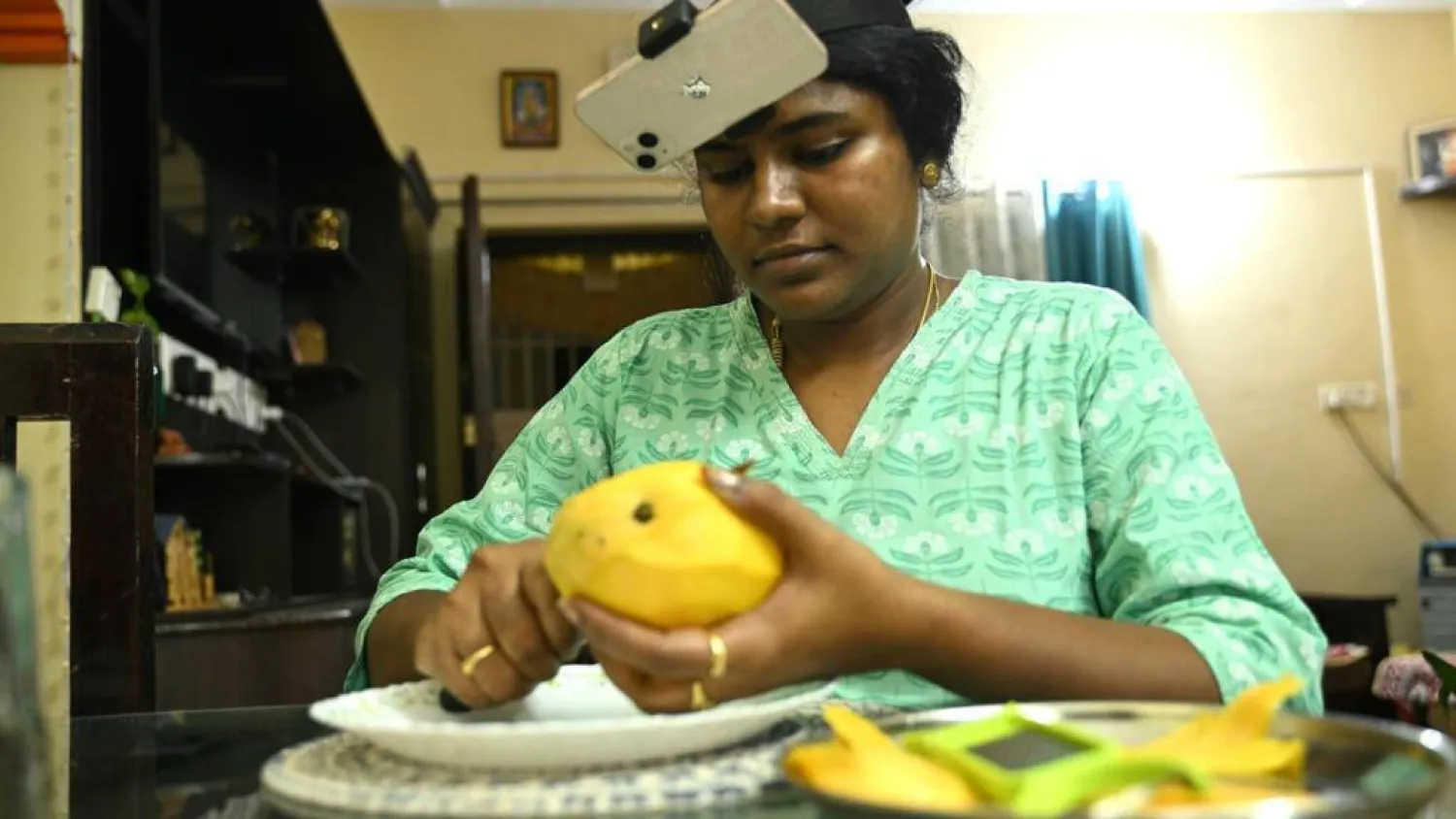
Indian housewife Nagireddy Sriramyachandra wears a smartphone on her head as she records her actions through motion capture while slicing mangoes at her home in Chennai. R.Satish BABU / AFP
TT

The Indian Workers Training AI Robots to Take their Jobs

Indian housewife Nagireddy Sriramyachandra wears a smartphone on her head as she records her actions through motion capture while slicing mangoes at her home in Chennai. R.Satish BABU / AFP

With a smartphone strapped to her head, Indian housewife Nagireddy Sriramyachandra films herself slicing mangoes to train AI-powered robots to take on household jobs in the future.

Earning just over two dollars for an hour of video, her mundane recordings are invaluable for global tech companies teaching machines how to move like humans in the real world, said AFP.

The 25-year-old is one of a growing army of thousands of AI system trainers in the world's most populous country.

"Who else will give you 250 rupees an hour just for doing housework?" said Sriramyachandra from her kitchen in Chennai in southern India's Tamil Nadu state.

"I may get a robot myself in the future," she added.

Artificial intelligence chatbots and image generators crunch reams of digital data, but building systems to navigate real-life environments is more challenging.

Developers think feeding first-person footage, called "egocentric data", into specialized AI models will help robots copy humans.

Some AI trainers work at home, others in factories or specialized studios -- using video glasses, head-mounted cameras and motion sensors.

"It blares 'hands not detected' when I'm not recording properly," said Sriramyachandra, who sends recordings via a special app to the AI data company Objectways.

The firm, which has offices in India and the United States, lists Fortune 500 multinationals as clients. It works with Amazon SageMaker, a platform for machine learning models.

- 'Better things' -

The humanoid robot market is booming, with investment bank Morgan Stanley predicting there could be over a billion in use by 2050, mostly for industrial and commercial purposes.

"Folding clothes, coffee making... cooking a very specific thing, sandwich making," Objectways head Ravi Shankar said, listing videos requested by clients.

"Some jobs are supposed to be taken over, so humans can go and do better things."

In India, the emerging field of spatial AI is providing new employment -- for now.

The 50-year-old CEO is US-based, but hires workers from Tamil Nadu, where he grew up, one of India's international technology hubs.

At a Karur textile factory, busy with workers attaching labels to caps and ironing cloth bags, AFP saw eight people wearing head cameras and smart glasses supplied by Objectways.

India has positioned itself as a global middleman for the creation, processing and annotation of AI data.

"It's likely that these data collection services will increase", said digital labor expert Aditi Surie, from the Indian Institute for Human Settlements in Bengaluru.

- Informal workers -

India is aggressively developing its AI industry, but its leaders are aware that, alongside the technology's much-hyped benefits, automation poses risks.

Government think-tank NITI Aayog said that most discussions around artificial intelligence and labor "focus on white-collar professionals and predict an almost certain loss of jobs in the segment" without urgent action.

"Little attention, if any, is paid to how AI can serve India's 490 million informal workers, the very people who form the backbone of our economy," it said in a report released ahead of a global AI summit in India this year.

The think-tank has examined how the technology could help or harm dozens of professions -- from cobblers to sewer cleaners, farmers to tea sellers.

For the last decade, 55-year-old Ponni has sat on a roadside in Bengaluru, the city known as India's Silicon Valley, making flower garlands.

She, too, has been paid to have a phone strapped to her forehead.

"The next generation... who might have to do work similar to mine -- they will face a problem," Ponni said.

- Always wearing a camera -

At an Objectways studio, AI system trainers film themselves performing household tasks in fake, fully furnished apartment rooms.

After several thousand hours of filming, the wallpaper is changed to provide clients with variety.

"Today I sit here, tomorrow I stand there," said engineering graduate Rani N., 21, on a break from filming herself, once again, folding a towel.

Each video lasts about four minutes, and she records around 90 a day -- on nearly every conceivable spot on the bed.

She says the job is "tolerable", but feels like she's always wearing a camera.

In other rooms, colleagues arranged pencil sharpeners, water bottles and crayons in patterns, recording with depth-sensor cameras.

Qanat Consulting Services in Andhra Pradesh, an Objectways subcontractor, supplies about a dozen larger data firms with recordings.

Some of its 2,000 contributors perform tasks with motion-sensor bands on their "wrists, hands and legs", CEO Thaslim Pattan said.

Manish Agarwal of Bengaluru-based Humyn Labs, not related to Objectways, records conversations as well as videos.

Contributors discuss assigned topics -- ranging from politics to entertainment -- for clients wanting to process speech patterns.

Agarwal denies that robots will steal jobs, believing that networks of humans and robots "will work together" one day, he said.

"A welder in India could be managing a welder-robot in Prague," he said.


Saudi Arabia Leads Global Coral Reef Efforts as ICRI Adopts Five Key Recommendations

Saudi Arabia Leads Global Coral Reef Efforts as ICRI Adopts Five Key Recommendations
TT

Saudi Arabia Leads Global Coral Reef Efforts as ICRI Adopts Five Key Recommendations

Saudi Arabia Leads Global Coral Reef Efforts as ICRI Adopts Five Key Recommendations

Saudi Arabia has enhanced its global leadership role in coral reef protection by chairing the 39th General Meeting of the International Coral Reef Initiative (ICRI), a step that paves the way for the Kingdom to host the first Global Coral Reef Summit in early November 2026.

The four-day meeting featured high-level dialogue sessions and scientific and policy discussions focused on developing an integrated practical framework that brings together science, policy, and sustainable financing, enhancing international coordination and tangible on-the-ground impact.

The meeting unanimously adopted five strategic recommendations proposed by Saudi Arabia. The recommendations focused on boosting the link between international commitments and actual implementation at the national level, developing supportive regulatory frameworks, unifying scientific references, and enabling sustainable financing, SPA reported.

The recommendations also endorsed the first Global Coral Reef Summit, which Saudi Arabia announced it would host during the Saudi House events at the World Economic Forum (WEF) Annual Meeting 2026 in Davos.

This reflects international consensus on the summit's importance and its pivotal role in supporting a Saudi-led effort to develop a comprehensive global framework that integrates science, policy, and sustainable financing while enabling countries to implement practical and actionable solutions to protect coral reefs.

The meeting also witnessed the acceptance of membership applications from four new countries: Somalia, Papua New Guinea, Vanuatu, and Trinidad and Tobago. In addition, the World Bank and the UN Global Fund for Coral Reefs joined the initiative, reflecting the expanding scope of international partnership and enhancing global momentum toward coral reef protection and sustainability. The total number of member states has now reached 48, accounting for some 84% of the world's coral reefs.


Russia Unblocks Roblox after Widespread Child Anger

People rest outside the Kremlin on a warm summer day in downtown Moscow, Russia, 05 June 2026. EPA/MAXIM SHIPENKOV
TT

Russia Unblocks Roblox after Widespread Child Anger

People rest outside the Kremlin on a warm summer day in downtown Moscow, Russia, 05 June 2026. EPA/MAXIM SHIPENKOV

Russia has lifted its ban on the popular gaming platform Roblox, after tens of thousands of children and parents sent letters complaining about the measure.

The platform -- which allows users to build their own games and share them with others -- was among Russia's most popular mobile games, tying third with TikTok in usage time among children in early 2025, according to Kaspersky Lab, a Moscow-based global cybersecurity firm.

In a statement published Wednesday, Russia's digital ministry said Roblox had successfully implemented measures to "protect children, including by launching a mechanism to restrict access to games by age group.”

"Roblox has also committed to continuing to combat the spread of undesirable content on the platform," the statement added.

Russia banned access to the US-owned platform last December, accusing it of distributing extremist materials and promoting "LGBT propaganda.”

A Roblox spokesperson told AFP at the time that the company was committed to safety and respected "local laws and regulations.”

Ekaterina Mizulina, the head of Russia's state-sponsored internet censorship watchdog, said in December she had received "63,000 emails" from disgruntled schoolchildren and parents commenting on the ban.

"This raises a question. Perhaps it's time to look for other ways to combat pedophiles and provocateurs who target children online?" she said.

Around 100 million people use Roblox daily, with under-13s accounting for around 40 percent of its 2024 users, according to the company.

Kremlin spokesman Dmitry Peskov said Thursday that Roblox's unblocking in Russia "shows that all services can return if they comply with the law,” in comments to the state TASS news agency.


Moose Put Down after Wandering Into Central Oslo

People and personell from the wildlife board mill around a dead moose that had strayed into Majorstuen,a inner city area in Oslo, Norway on, June 11, 2026. (Photo by Javad Parsa / NTB / AFP)
TT

Moose Put Down after Wandering Into Central Oslo

People and personell from the wildlife board mill around a dead moose that had strayed into Majorstuen,a inner city area in Oslo, Norway on, June 11, 2026. (Photo by Javad Parsa / NTB / AFP)

Norwegian police said Thursday that a moose that had wandered into downtown Oslo, drawing curious crowds, had been shot and killed.

Videos taken by witnesses and published by Norwegian media show the disoriented animal galloping through the streets of the Norwegian capital, weaving around cars and pedestrians.

"For animal welfare reasons, the moose was put down" by the wildlife authorities, AFP quoted the police as saying.

Although such incidents remain rare -- moose tend to avoid metropolitan areas -- this is the second such incident recorded in two days in Scandinavia.

On Tuesday, a young moose was put down in Sweden after it strayed into the streets of Stockholm.
