


Timmy, Germany's Humpback Whale, Likely Lived for Only 5 Days after Rescue Effort

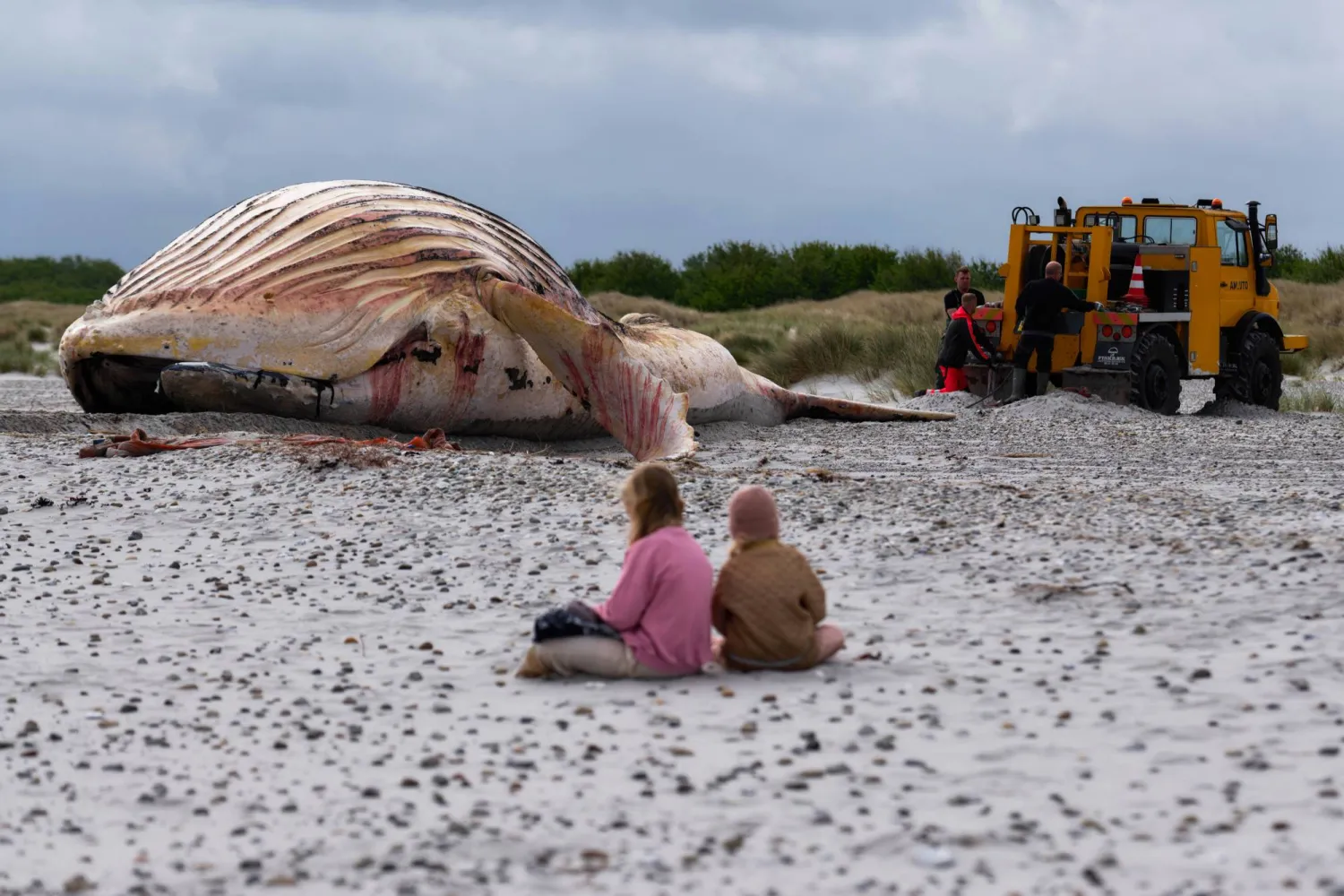
FILED - 30 May 2026, Denmark, Anholt: Two people sit in the sand near the carcass of "Timmy," a famous humpback whale washed ashore on the Danish island of Anholt. Photo: Marcus Golejewski/dpa
TT

Timmy, Germany's Humpback Whale, Likely Lived for Only 5 Days after Rescue Effort

FILED - 30 May 2026, Denmark, Anholt: Two people sit in the sand near the carcass of "Timmy," a famous humpback whale washed ashore on the Danish island of Anholt. Photo: Marcus Golejewski/dpa

The humpback whale that kept Germany spellbound for months likely lived for roughly five days after the final controversial rescue attempt failed to guide it back to its natural habitat in the Atlantic Ocean, officials said Friday.

The whale, nicknamed “Timmy” and “Hope” by German media, was found dead on May 14, stranded just off the small island of Anholt in the Kattegat, the broad strait between Denmark and Sweden that connects the Baltic Sea to the North Sea.

The discovery of the body ended months of a spectacular and contentious rescue effort that culminated May 2, when the mammal was transported toward the North Sea in a barge in the final rescue attempt.

Scientists, government officials, the public and a private initiative sparred over whether it was more humane to let the weakened and sick animal die on its own or continue the rescue efforts.

Data from a tracking transmitter attached to its dorsal fin shows that the whale’s death likely occurred on May 6 or 7, according to Till Backhaus, the environment minister for the state of Mecklenburg-Western Pomerania.

It had swum roughly 215 kilometers (134 miles) over the five days and was heading back toward the Baltic Sea, which is the wrong direction for it to reach the Atlantic Ocean.

The data shows that the whale likely drifted aimlessly after that — or the transmitter's signal was lost, Backhaus said Friday during a news conference.

Timmy was first spotted off the German coast on March 3, prompting a media frenzy that included push alerts and updated live blogs with the status of its health.

It’s not clear why it swam into the Baltic Sea, which it wasn’t suited to, although some experts said it may have lost its way while swimming after a shoal of herring or during migration, The Associated Press reported.

An autopsy of the carcass has not yet determined the cause of death, Backhaus said, though officials were able to figure out that “Timmy” was a female whale, after months of assumptions that it was male.

The minister said no serious injuries were discovered during the autopsy, as well as no indication of violence or any items that would have caused its death.

“Did it have any nets or other foreign objects on its body, in its mouth or on its body?” Backhaus said. "Nothing was found.”

Some of the remains will be turned into biodiesel in Denmark, according to German news agency dpa. Some of the bones will go to a Danish museum.



Hong Kong Seizes Haul of World Cup Fakes Worth $20 Million

 Hong Kong customs authorities showcase various types of fake goods they seized during a news conference at its headquarters in North Point, Hong Kong Thursday, June 11, 2026. (AP)
Hong Kong customs authorities showcase various types of fake goods they seized during a news conference at its headquarters in North Point, Hong Kong Thursday, June 11, 2026. (AP)
TT

Hong Kong Seizes Haul of World Cup Fakes Worth $20 Million

 Hong Kong customs authorities showcase various types of fake goods they seized during a news conference at its headquarters in North Point, Hong Kong Thursday, June 11, 2026. (AP)
Hong Kong customs authorities showcase various types of fake goods they seized during a news conference at its headquarters in North Point, Hong Kong Thursday, June 11, 2026. (AP)

Authorities in Hong Kong have seized suspected counterfeit World Cup items including football jerseys and balls with an estimated value of HK$156 million ($19.91 million), officials said.

The 2026 FIFA World Cup is running from ‌June 11 to ‌July 19, and ‌is ⁠being hosted jointly ⁠by the US, Canada and Mexico.

Wayne Chung, senior investigator at the city's Intellectual Property Investigation Bureau, told reporters on Thursday ⁠that 230,000 items had ‌been ‌seized.

Chung said the jerseys seized had ‌a close resemblance to ‌genuine football shirts.

"Many of the jerseys are uniforms of the participating countries. We noticed all ‌of these clothes are set to be exported ⁠to ⁠other countries, not for local market. At least 80% of them head to America," he said.

He said that this was due to high demand for jerseys during the World Cup, which got underway on Thursday.


First Leather Bag Made from T-Rex Cells Fails to Sell at Paris Auction

This photograph shows the first "T-Rex leather" bag on display ahead of its auction at the Hotel Drouot auction venue in Paris on June 9, 2026. (Photo by STEPHANE DE SAKUTIN / AFP)
TT

First Leather Bag Made from T-Rex Cells Fails to Sell at Paris Auction

This photograph shows the first "T-Rex leather" bag on display ahead of its auction at the Hotel Drouot auction venue in Paris on June 9, 2026. (Photo by STEPHANE DE SAKUTIN / AFP)

A leather bag made from Tyrannosaurus rex cells failed to sell on Thursday, the Paris auction house Drouot said, commenting that bids were well below expected.

Auctioneers Giquello had touted the "one-of-a-kind" piece to sell for more than $500,000 but bids barely broke the $150,000 mark, said the Drouot house where the sale took place.

Unveiled in the spring in Amsterdam, the bag was created from traces of collagen from the femur of a T-Rex found in the US state of Montana 25 years ago.

"In recent years, we've developed techniques -- biotechnologies that allow us to instruct a cell culture to produce, so to speak, genuine T-Rex skin in the laboratory," Iacopo Briano, a paleontology expert associated with the sale, recently told AFP.

He noted the material differs from vegan leather, which is mostly made from plastic.

"In this case, it's derived from a cell culture, so it's 100 percent skin. And at the same time, it comes from an animal that went extinct 67 million years ago!" he said.

With no precedent to go on, Alexandre Giquello, whose auction house is organizing the sale, explained they had to "come up with a price" that would reflect both the amount of investment required to create the bag and its rarity.

Giquello estimated the value at between 300,000 and 500,000 euros ($346,000 to $576,000).


Antarctic Peninsula Sees Record High June Temperatures

(FILES) This handout photograph released by The British Antarctic Survey on April 8, 2026, shows Emperor Penguins on Antarctica on November 13, 2010. (Photo by PETER BUCKTROUT / BRITISH ANTARCTIC SURVEY / AFP)
TT

Antarctic Peninsula Sees Record High June Temperatures

(FILES) This handout photograph released by The British Antarctic Survey on April 8, 2026, shows Emperor Penguins on Antarctica on November 13, 2010. (Photo by PETER BUCKTROUT / BRITISH ANTARCTIC SURVEY / AFP)

Temperatures in the Antarctic Peninsula have reached a record-breaking high of 15.4C for June, and ice is melting at abnormal rates during the current winter, climate scientists told AFP on Thursday.

Esperanza Base, an Argentine research station located in the north of the peninsula, recorded the unprecedented figure on June 6.

The previous highest temperature on record for that month -- 13.3C -- dates back to 1998. The current heat also significantly exceeds Esperanza's June average of -6.2C.

Such a figure is "very unusual for this time of year," Jose Luis Stella, a climatologist at Argentina's National Meteorological Service, told AFP.

Argentine bases Marambio and San Martin also recorded unequalled temperatures between June 5 and 6.

Marambio recorded 11.8C, surpassing a previous high of 9.2C and its June average of -10.7C.

San Martin meanwhile saw 9.4C compared to its previous 7.8C record and June average of -5.6C.

The northern Antarctic heatwave is not an isolated event, University of Groningen professor Raul Cordero told AFP.

"It confirms a trend," he said, warning that "these kinds of events will continue to occur with increasing frequency" if global warming is not derailed.

Thomas Caton Harrison, a polar climate scientist at the British Antarctic Survey, believes a combination of factors including climate change resulted in the current heat.

"There is credible evidence that climate change is playing a role, but the effect is complex in this region," he said.

"Because Antarctica sees such big swings in temperature, we have to collect lots of data over many years to build a picture of the underlying climate."

Both specialists agree that regional temperatures have been rising for years and are already showing visible effects.

"A surprising amount of precipitation has been falling as rain rather than snow," Caton Harrison said.

"This has implications for polar ecosystems such as penguin colonies," he said, adding that "it poses a challenge to my colleagues working on Antarctic bases because a lot of liquid rain has been falling and creating runoff and ice."

Esperanza Base has been recording above-zero temperatures daily for three consecutive weeks.

This trend has caused "large areas in the far north of the white continent to remain free of snow," according to Cordero, who called it "an unusual scene in the Antarctic landscape during winter."