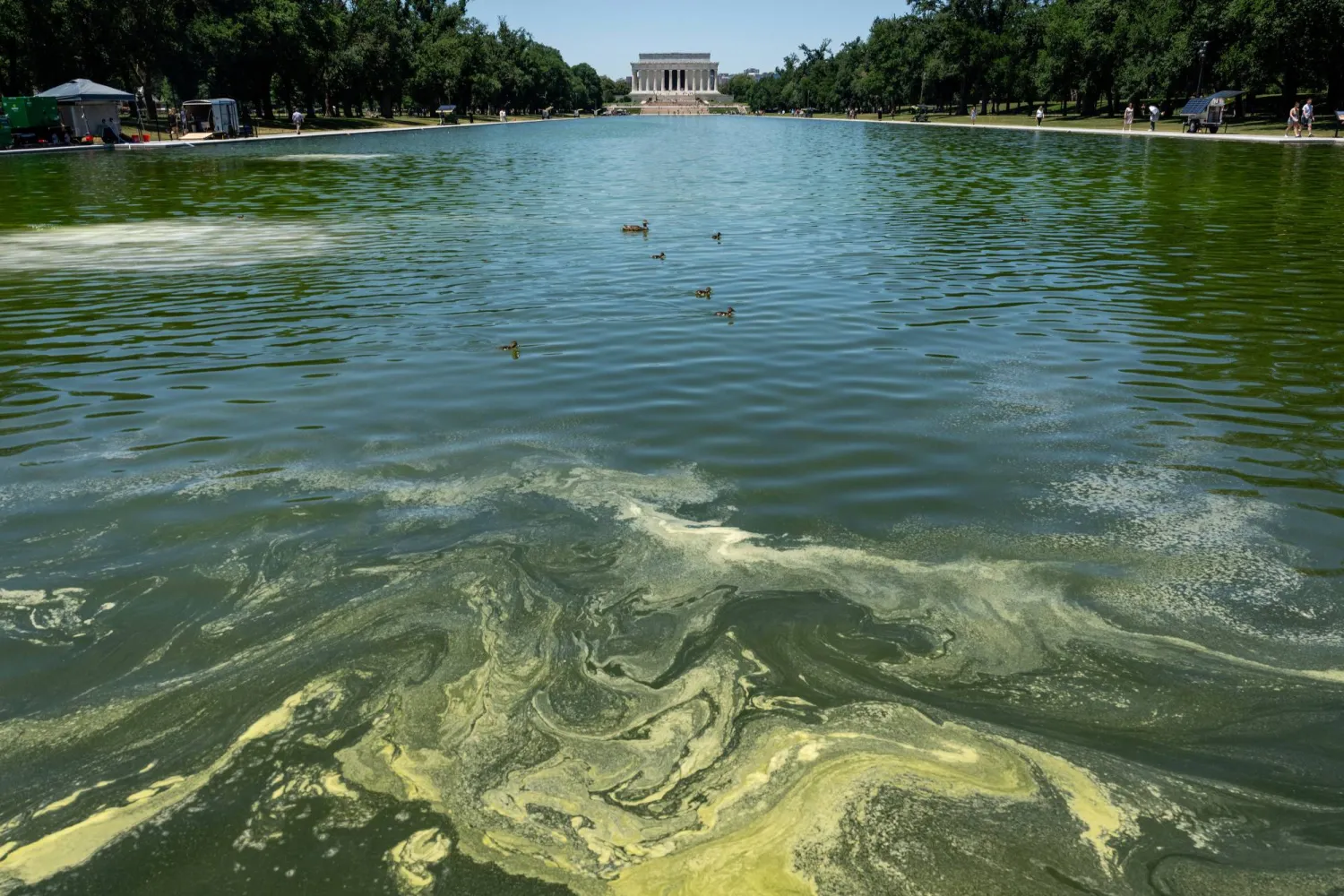
Crews Battle Algae Bloom in Washington's Newly Repainted Reflecting Pool

Ducks swim through algae in the Lincoln Memorial Reflecting Pool, after recent renovations following a directive from US President Donald Trump to paint it blue ahead of the 250th anniversary of US Independence, in Washington, D.C., US, June 16, 2026. REUTERS/Eric Lee
TT

Crews Battle Algae Bloom in Washington's Newly Repainted Reflecting Pool

Ducks swim through algae in the Lincoln Memorial Reflecting Pool, after recent renovations following a directive from US President Donald Trump to paint it blue ahead of the 250th anniversary of US Independence, in Washington, D.C., US, June 16, 2026. REUTERS/Eric Lee

Work crews poured hydrogen peroxide into the newly repainted Lincoln Memorial Reflecting Pool on Tuesday to combat an algae bloom, a little over a week after it was repainted as part of President Donald Trump's campaign to revamp some of Washington's major monuments.

National Park Service workers were seen emptying jugs labeled "12% hydrogen peroxide" into the visibly green water of the nearly century-old basin that stretches between the Lincoln Memorial and the Washington Monument on the National Mall.

A spokesperson for ⁠the Interior Department ⁠said the pool is being treated with "high-tech nanobubble ozone technology" that kills algae, pathogens including E. coli, and other contaminants. According to Reuters, the department said hydrogen peroxide is also being used, saying it's "a milder treatment than chlorine" that is used in spas and natural swimming pools.

Christopher ⁠Gobler, a professor at Stony Brook University in New York who has studied harmful algal blooms for more than 30 years, said hydrogen peroxide is a common short-term treatment for algae that is not likely to have major health effects on the ducks and geese that frequent the pool.

"It's most harmful to animals that are 100% in the water," Gobler said, adding the chemical can create low oxygen conditions that ⁠can ⁠be lethal to fish.

It might not be a long-term fix, though, he warned.

"There's always going to be a rebound of the algae," Gobler added. "Hopefully it works as a quick fix, but these algae do tend to rebound."

The reflecting pool was refilled with water starting on June 5 as part of a renovation project directed by Trump that involved draining, cleaning and resurfacing it. The bottom of the pool was repainted in a color Trump calls "American flag blue."


'Unstable' Tasmanian Devil Found after 15 Days on the Run

A Tasmanian devil named Nick is seen at the Conrad Prebys Australian Outback at the San Diego Zoo in San Diego, California May 31, 2016. Courtesy Ken Bohn/San Diego Zoo/Handout via Reuters
TT

'Unstable' Tasmanian Devil Found after 15 Days on the Run

A Tasmanian devil named Nick is seen at the Conrad Prebys Australian Outback at the San Diego Zoo in San Diego, California May 31, 2016. Courtesy Ken Bohn/San Diego Zoo/Handout via Reuters

A Tasmanian devil named Mary has been found in an "unstable condition" more than two weeks after escaping her enclosure, an Australian wildlife park said Wednesday.

Searchers tracked down the carnivorous marsupial the previous night in the bush, less than two kilometers (1.2 miles) from her home in the Paradise Country park on Queensland's Gold Coast.

"Upon finding her, Mary was in an unstable condition, and the team assessed and determined she required veterinary care and rushed her to a specialist veterinary hospital where they were able to stabilize her condition," AFP quoted the park as saying in a statement.

The two-year-old furry critter, described by keepers as extremely shy, was being kept in the hospital for diagnostic testing, it said.

A dozen wildlife experts backed by a sniffer dog and a thermal-imaging drone had searched for the Tasmanian devil after her widely publicized break-out on June 2, partly captured in CCTV images.

The wildlife park said it believed Mary made an "abnormally large leap" to embark on her 15-day adventure.

Tasmanian devils -- agile, mostly nocturnal animals that can roam for 16 kilometers (10 miles) in a single night -- have been extinct on the Australian mainland for more than 3,000 years.

They can live up to six years in the wild, with males weighing as much as 14 kilograms (30 pounds) and standing 30 centimeters (12 inches) tall at the shoulder, according to Tasmania's environment department.

Though widespread on the island state of Tasmania, they are listed as endangered and face a significant threat from a transmissible cancer known as Devil Facial Tumor Disease.


Stolen Felines Reunited with Owners After Vietnam Cat-Meat Bust

This handout picture taken on June 15, 2026 and released on June 16 by Humane World for Animals Vietnam shows people looking at cats seized by police at a facility in Ho Chi Minh City. (Handout / Humane World for Animals Vietnam / AFP)
TT

Stolen Felines Reunited with Owners After Vietnam Cat-Meat Bust

This handout picture taken on June 15, 2026 and released on June 16 by Humane World for Animals Vietnam shows people looking at cats seized by police at a facility in Ho Chi Minh City. (Handout / Humane World for Animals Vietnam / AFP)

More than 40 abducted cats have been reunited with owners after Vietnam police busted a feline theft ring and rescued 400 pets destined to be slaughtered for food, an animal rights group said Tuesday.

Nine people were arrested last week in connection with the "criminal group specializing in stealing and collecting cats", according to the official newspaper of the Ho Chi Minh City police.

Authorities clawed back more than 400 live cats and 80 dead ones preserved on ice, the newspaper said. They seized another 21 cats from a separate facility.

Consumption of dogs and cats is legal in Vietnam, where many restaurants openly advertise the meat -- however vendors are required to obtain certificates showing the origin of the animals.

Police said they swooped on the gang after responding to rampant pet thefts in Ho Chin Minh City, and the suspects confessed to luring and trapping the cats over three years across southern Vietnam.

At least 40 of the pinched pets have been reunited with their owners, Humane World for Animals said in a Tuesday statement, praising police for "decisive action that has saved the lives of so many animals".

However, it said around 100 of the rescued cats "later perished due to what they have endured".

"While efforts are continuing to reunite stolen cats with their families, our main concern is for the cats who remain at the police station as evidence during the prosecution," Humane World for Animal's Karanvir Kukreja said, according to the statement.

He said the organization had donated food and was arranging the delivery of fans to keep the pets from overheating.

Ho Chi Minh City police did not immediately respond to AFP's request for comment.


Brazilian Amazon Waters Recover after Two Years of Drought

FILE - People maneuver by boat through the low water levels of a tributary that connects with the Amazon River, in Isla de la Fantasia, on the outskirts of Leticia, Colombia, Oct. 20, 2024. (AP Photo/Ivan Valencia, File)
TT

Brazilian Amazon Waters Recover after Two Years of Drought

FILE - People maneuver by boat through the low water levels of a tributary that connects with the Amazon River, in Isla de la Fantasia, on the outskirts of Leticia, Colombia, Oct. 20, 2024. (AP Photo/Ivan Valencia, File)

Water levels in the Brazilian Amazon recovered in 2025 following two consecutive years of severe drought, but long-term prospects remain "concerning," a monitoring network said in a report published Tuesday.

Brazil holds about 12 percent of the planet's freshwater, nearly two-thirds of which is found in the Amazon region.

The Amazon recorded water levels 2.6 percent above its historical average in 2025 due to increased rainfall compared to the previous year, according to MapBiomas, a network of organizations that tracks changes in land cover and use.

Despite the rebound, the network warned the situation "remains concerning" as severe weather events become increasingly common, AFP reported.

"Extreme weather events are becoming increasingly frequent, and there are signs of instability in the hydrological regime, driven by both climate change and changes in land use," said Bruno Ferreira of the MapBiomas Amazon team.

Brazil's vast territory includes several different biomes, including forests, wetlands and grasslands.

The report noted Brazil's Pantanal -- the wetland region south of the Amazon Basin -- ended 2025 with water levels 56 percent below its historical average.

Although conditions improved compared to 2024 -- a year that saw the region's most severe drought in decades -- the wetlands region remained the country's most stressed ecosystem.

The arrival of El Nino, a natural climate occurrence that warms surface temperatures in the central and eastern equatorial Pacific Ocean, typically causes droughts in parts of the Amazon and threatens to worsen the situation.

The climate phenomenon began last week and could become one of the most intense on record by the end of the year, according to the US National Oceanic and Atmospheric Administration.