


Scientists Make New Discovery about Northern Ireland’s Giant’s Causeway

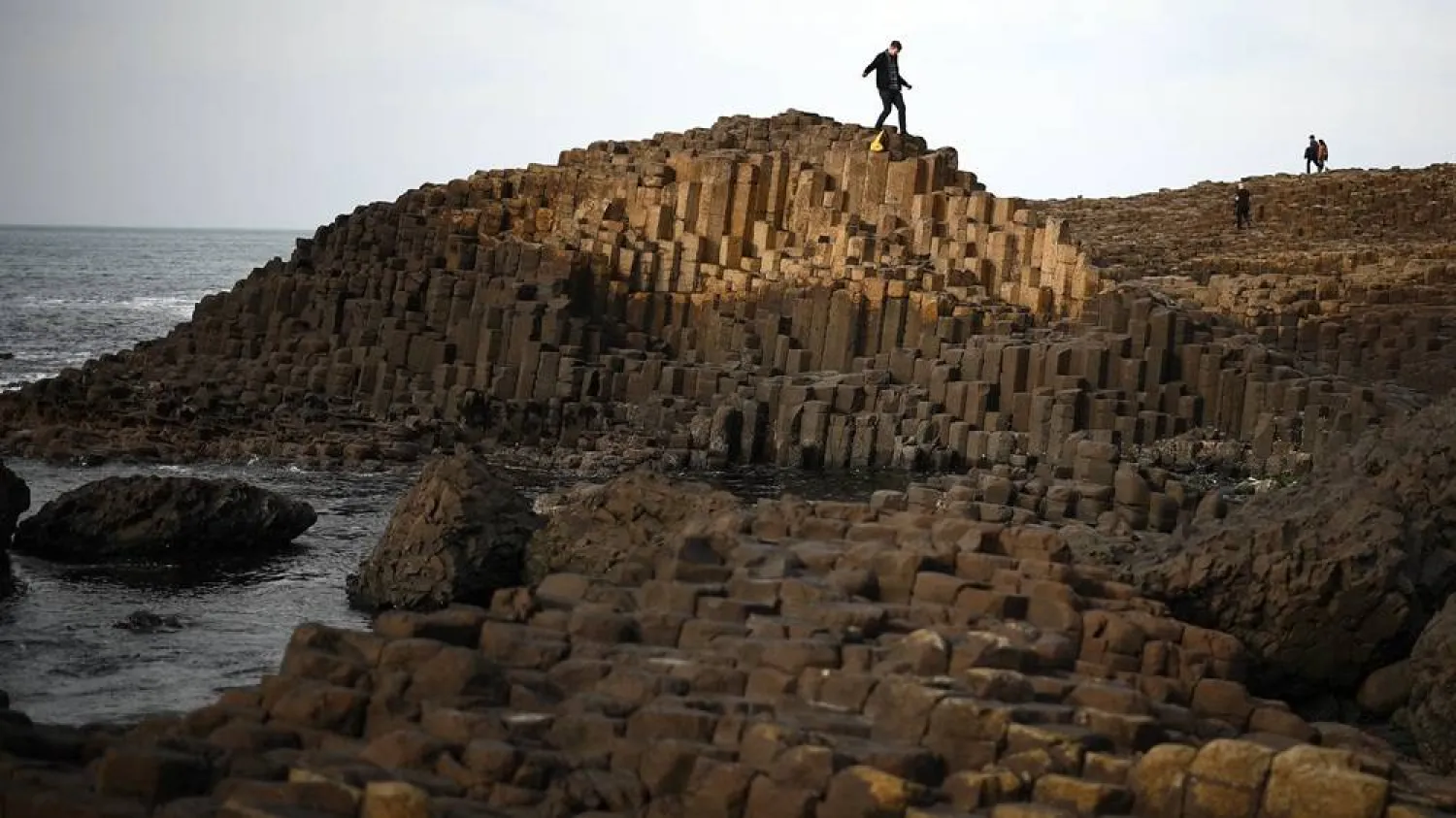
People explore the basalt columns of the Giant’s Causeway on Northern Ireland’s north coast on March 20, 2025. (AFP via Getty Images)
TT

Scientists Make New Discovery about Northern Ireland’s Giant’s Causeway

People explore the basalt columns of the Giant’s Causeway on Northern Ireland’s north coast on March 20, 2025. (AFP via Getty Images)

The geological timeline for Northern Ireland's iconic Giant’s Causeway has been dramatically revised following new scientific research, according to The Independent.

New findings indicate that the volcanic activity responsible for the distinctive 40,000 basalt columns occurred over a significantly condensed period.

Scientists now believe the region's volcanic events, including those forming the Causeway, transpired in just 5.5 million years – a staggering eight million years less than earlier estimations.

Dr. Simon Tapster, geochronologist at the British Geological Survey (BGS), said: “Fundamentally, what we’ve done is by piecing together this tapestry of volcanic rocks all across the North Atlantic, but focusing on Northern Ireland, we have been able to reassess a major globally impacting volcanic event.”

“In doing that, and in reassessing the timescales, we have shown that actually it occurred in a much shorter duration,” he added.

The Giant’s Causeway’s distinctive landscape was formed during intense volcanic activity which forced molten rock up through cracks in the earth. Thick lava flows then cooled, contracted and cracked, creating about 40,000 basalt columns.

Tapster said the cutting-edge research by the Geological Survey of Northern Ireland (GSNI) and the BGS, has reconstructed a new timeline for volcanic activity across Northern Ireland.

It has allowed researchers to place the volcanic activity that led to the formation of the Giant’s Causeway within a much more precise global context for the first time.

The research has significantly updated the understanding of when specific volcanic events happened in Northern Ireland.

As a result, scientists can more confidently connect those events to activity and landmarks elsewhere, including Scotland.

It also connects the processes that caused the development of the Giant’s Causeway to a globally significant volcanic event seen in rocks as far away as Greenland about 60 million years ago.

The first lava flows of Northern Ireland’s Antrim Plateau previously were thought to have occurred millions of years before the Staffa basalts and the formation of Fingal’s Cave, but they can now be connected much more definitively as part of the same volcanic activity.

Researchers said it is the same for the Giant’s Causeway with formations on Rum, the Mourne Mountains, and magmatism in Skye.

Tapster said: “By looking at the timescales and the high resolution timeline, we’re able to match it up with various other locations, particularly in the Inner Hebrides in Scotland, the volcanics of Mull, Rum, the Isle of Skye, and taking a bigger view, looking at Greenland and the Faroe Islands.”

The research is part of a wider initiative at the British Geological Survey to improve the understanding of the UK’s geology through better quantifying geological time in the rocks.



‘Pokemon Airport’ Opens to Help Japanese Quake-Hit Region

A "Pikachu" balloon is displayed at the Noto Airport in Wajima City, Ishikawa Prefecture on July 7, 2026. (JIJI / AFP)
TT

‘Pokemon Airport’ Opens to Help Japanese Quake-Hit Region

A "Pikachu" balloon is displayed at the Noto Airport in Wajima City, Ishikawa Prefecture on July 7, 2026. (JIJI / AFP)

An airport in a remote Japanese region hit by a deadly earthquake in 2024 was given a new look on Tuesday, temporarily nicknamed after the Pokemon universe, and its lobby adorned with a floating Pikachu on a plane-shaped balloon.

The Noto Peninsula has faced a decline in tourists since the powerful 7.5-magnitude quake on New Year's Day two years ago that claimed over 700 lives.

On Tuesday, a life-size Pikachu mascot dressed as a pilot joined officials for a ribbon-cutting ceremony to officially nickname the local facility "Noto Satoyama Pokemon With You Airport" and welcome visitors.

More than 100 Pokemon characters are displayed across the airport, including the lobby wall.

The name will be used for three years, according to the Pokemon With You Foundation.

Public broadcaster NHK reported in February that the number of visitors who stay overnight in the region remains at just over 30 percent of pre-quake levels.


Europe May Face ‘More Deadly Weeks’ as New Heatwave Builds, WHO Warns

A worker drinks water from a plastic bottle at a construction site in Bordeaux, southwestern France on June 22, 2026, as France experiences a ferocious heatwave. (AFP)
TT

Europe May Face ‘More Deadly Weeks’ as New Heatwave Builds, WHO Warns

A worker drinks water from a plastic bottle at a construction site in Bordeaux, southwestern France on June 22, 2026, as France experiences a ferocious heatwave. (AFP)

The World Health ‌Organization warned on Tuesday that Europe could face “more deadly weeks” ahead, with another intense heatwave forming over the Atlantic.

Temperatures in Portugal and southern Spain are expected to climb to 43 degrees Celsius (109 degrees Fahrenheit) in the coming days.

WHO Regional Director for Europe Hans Kluge held an emergency call on Monday with representatives from 41 countries in the region, ‌the European ‌Commission and civil society groups to ‌discuss ⁠lessons from the ⁠recent heatwave and preparations for the next one.

Kluge said in a statement that countries with heat-health action plans in place responded more quickly and better protected their populations during the June heatwave.

However, he said that less ⁠than half of WHO's European member states ‌had such a ‌plan in place.

Experts have said the June ‌20-28 heatwave was the most severe recorded in ‌Europe, causing disruption to power generation, damaging infrastructure and overwhelming healthcare systems.

The extreme heat was almost certainly driven by climate change, scientists said.

France, the ‌Netherlands and Belgium recorded 3,700 excess deaths, with authorities warning that the numbers ⁠are preliminary ⁠and could rise.

Temperatures hit 40 degrees Celsius in parts of Europe during the heatwave.

Kluge said care home residents, homeless people and socially isolated older adults were still not being reached consistently across Europe.

"The work now is on two fronts: fixing what failed in recent weeks before the next heatwave hits and building the kind of health systems that don’t just respond to extreme heat but are ready for it," Kluge said.


Prince Harry to Discover Outcome of UK Tabloids Case

FILE PHOTO: Britain's Prince Harry departs after attending court for his appeal against the rejection of his legal challenge to the British government's decision to take away his police protection when he is in Britain, outside the High Court in London, Britain, April 8, 2025. REUTERS/Maja Smiejkowska/File Photo
TT

Prince Harry to Discover Outcome of UK Tabloids Case

FILE PHOTO: Britain's Prince Harry departs after attending court for his appeal against the rejection of his legal challenge to the British government's decision to take away his police protection when he is in Britain, outside the High Court in London, Britain, April 8, 2025. REUTERS/Maja Smiejkowska/File Photo

Prince Harry was in Britain on Tuesday as a court was set to rule in his case against the Daily Mail's publisher for alleged unlawful information gathering.

A judge at London's High Court was due to publish a written decision at 2:00 pm (1300 GMT), following an 11-week trial earlier this year in Harry's claim against Associated Newspapers.

The prince gave emotional testimony during the proceedings, in which several high-profile figures, including pop star Elton John and actor Elizabeth Hurley, accused the tabloid publisher of invading their privacy.

Harry's lawyers have said the claimants are seeking "substantial" damages for their claims, which relate to articles dating from 1993 to 2018.

It is the third, and set to be final, case brought by the Duke of Sussex in his acrimonious legal battle with British tabloids, which has further strained relations with the royal family.

Harry, 41 - the youngest son of King Charles III - has also been involved in other legal spats, including over his police protection in Britain following his dramatic departure from frontline royal duties six years ago.

The prince, now living in California, arrived in Britain on Monday for a five-day visit expected to go ahead mostly without his wife and children after the family was refused police protection.

The trip, to mark the one-year countdown to next year's Invictus Games for wounded veterans, which Harry founded, was meant to be his first family trip back to the UK in four years.

But a source close to the Duke of Sussex told AFP that Harry's wife Meghan, son Archie and daughter Lilibet would not accompany him on the London leg of the trip after the family was refused security.

Arrangements for the rest of the trip were still under consideration, the source said, leaving it unclear whether the whole family would visit but stay outside the capital.

Contradictory statements about plans to stay at Buckingham Palace while in London added to the prince's headaches.

Just ahead of Harry's arrival, Buckingham Palace contradicted the duke's team to say that he would not be staying at the palace after missing a deadline to accept the accommodation offer.

Harry's spokesman said it was "disappointing" the offer to be hosted by his father had been "withdrawn at the last moment", in a statement sent to AFP.

- Security woes -

It was unclear whether the prince would meet his father during the trip. He is last understood to have met Charles, who is being treated for an undisclosed form of cancer, at the monarch's London residence Clarence House in September 2025.

Harry and Meghan left Britain for North America in 2020 amid a bitter feud with his family, which worsened as Harry published his tell-all memoir "Spare".

The prince has since said he wishes to reconcile with his father, but the confusion over where Harry was going to stay in London suggest relations remain difficult.

According to his spokesperson, Harry had to make "alternative security arrangements" for the trip after publicly funded protection was refused, contributing to the delay in accepting Buckingham Palace's accommodation offer.

"It is therefore unclear why, having formally accepted the accommodation offer, it has now been withdrawn at the last moment," the spokesman said.

Beyond logistical complications, the palace believed the legal judgement expected Tuesday had complicated matters as it could compromise the king's constitutional position, the PA news agency reported.

Last year, Harry said he felt unable to bring his family to Britain after losing a court case to have his security restored during visits home.

Harry has long blamed the media for the death of his mother Princess Diana, who was killed in a Paris car crash in 1997 while trying to shake off the paparazzi.

"He understands how that protection can fail and how catastrophic, therefore, those results can be," Simon Morgan, a former bodyguard for the royal family, told AFP on Monday.