

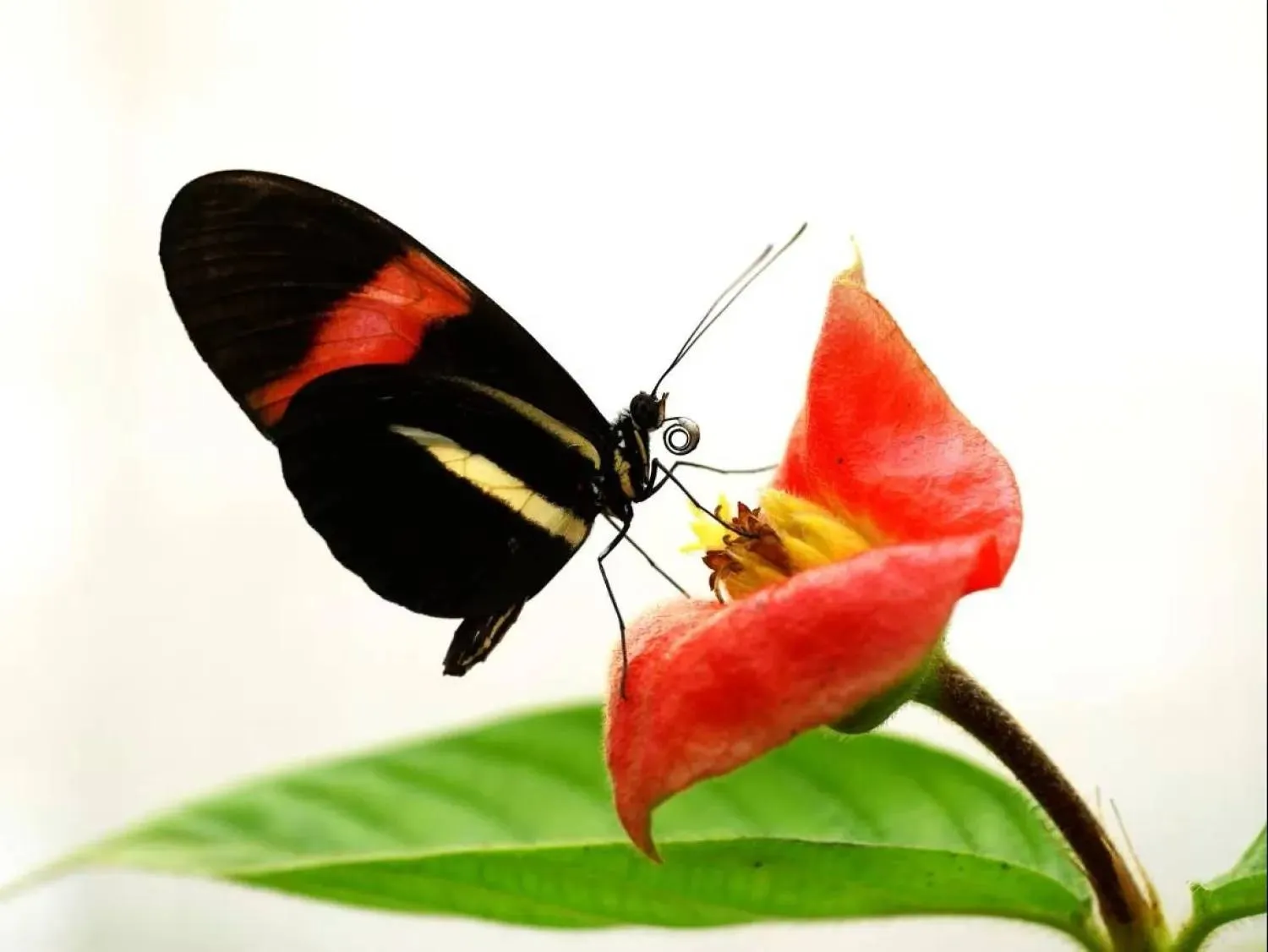

Why Do Some Tropical Butterflies Live 25 Times Longer Than Their Relatives?

A Heliconius melpomene butterfly feeds on pollen. (Nature Communications)
TT

Why Do Some Tropical Butterflies Live 25 Times Longer Than Their Relatives?

A Heliconius melpomene butterfly feeds on pollen. (Nature Communications)

Most butterflies have short lifespans, fluttering between colorful flowers for a few weeks before dying, but a few rare exceptions have stumped scientists. Now, some long-lived tropical butterfly species are shedding light on the secrets of longevity.

Butterflies belonging to the Heliconius genus, which inhabit the tropical rainforests of South and Central America, have lifespans that vary wildly. The Dione juno butterfly lives for 14 days after reaching adulthood, while Heliconius hewitsoni lives for 348 days — nearly 25 times longer.

Other Heliconius species also have impressively lengthy lives, enduring between 106 to 277 days, according to a study on the phenomenon published Tuesday in the journal Nature Communications.

Some scientists have speculated that Heliconius’ extended adulthood is due to the insects consuming an enhanced diet, rather than relying purely on carbohydrates like other butterflies.

But the exact reasons behind this unexpected longevity have been unclear, which is what inspired Dr. Jessica Foley, the study’s lead author and a postdoctoral scholar at Tufts University’s Jean Mayer USDA Human Nutrition Research Center on Aging in Boston, to take an in-depth look at the intriguing butterfly genus.

“We see vast differences in lifespan across the animal kingdom — adult mayflies famously live only for a day, whereas some whales and sharks can live for hundreds of years,” Foley wrote in an email.

“I’m interested in the evolutionary basis of these kinds of lifespan differences because they might hold insights relevant for healthy ageing in humans,” she added.

Foley and her colleagues discovered that while nutrition has its part to play, some Heliconius have also evolved an anti-aging mechanism the researchers are still unraveling — and how it could be a model for understanding human longevity.

The new research shows that Heliconius can be a potential model insect group for studying increased longevity, including adaptations that could slow aging and have potential applicability to humans, said Dr. Jaret C Daniels, curator and interim associate director for the McGuire Center for Lepidoptera and Biodiversity at the Florida Museum of Natural History. Daniels was not involved in the study.

“This study reinforces the utility of many insect groups and important model organisms for various fields of research,” Daniels said in an email.

“Since many insects are often overlooked or underappreciated by humans, studies like this can help change that perspective,” Daniels added.



Indonesia Rescues Six Orangutans from Fires in a Week

This handout picture taken on September 8, 2026 and released on September 10, 2026 by Indonesia's Ministry of Forestry and Yayasan Inisiasi Alam Rehabilitasi Indonesia (YIARI) shows a young orangutan during a rescue operation for the primates caught up in wildfires in Pemangkat village in West Kalimantan province. (Photo by Muffidz Ma'sum / Yayasan Inisiasi Alam Rehabilitasi Indonesia (YIARI) / AFP)
TT

Indonesia Rescues Six Orangutans from Fires in a Week

This handout picture taken on September 8, 2026 and released on September 10, 2026 by Indonesia's Ministry of Forestry and Yayasan Inisiasi Alam Rehabilitasi Indonesia (YIARI) shows a young orangutan during a rescue operation for the primates caught up in wildfires in Pemangkat village in West Kalimantan province. (Photo by Muffidz Ma'sum / Yayasan Inisiasi Alam Rehabilitasi Indonesia (YIARI) / AFP)

Six orangutans including two nursing infants have been rescued from fires raging on Borneo island in the past week, Indonesian authorities and rescuers said Thursday, bringing the total to 15 in a month.

The apes were saved from plantations in deep rural West Kalimantan province, on the Indonesian part of the island, where they got stuck after fires cut off access to their forest home, according to the forestry ministry and the YIARI wildlife rehabilitation foundation.

A large fire was burning just 200 meters (656 feet) from where the group of critically endangered primates were found, the ministry and YIARI said in a joint statement.

"This situation left the orangutans without a safe route back to their habitat; they could only move from one plantation to another," AFP quoted the statement as saying.

"In addition to facing the threat of flames and smoke, the orangutans' movement among plantations also has the potential to increase interactions and conflict with (human) communities."

Four orangutans were rescued on Friday, with the help of residents and plantation workers, followed by another mother-infant pair on Tuesday.

Rescuers had to anaesthetize the animals to minimize stress and the risk of injury. All six were taken to YIARI's rehabilitation center in the town of Ketapang.

Orangutans are endemic to Borneo and Sumatra islands -- two of the places hardest hit by wildfires that have destroyed vast swathes of land and spewed putrid haze that has spread as far as Malaysia and Singapore.

The Indonesian government said more than 202,000 hectares of land burnt countrywide between January and July. Figures for August have yet to be released.

The Nusantara Atlas project has put the number at closer to 300,000 hectares, and on Thursday gave an estimate of 895,657 hectares, which includes August.

Last week the European Union's Copernicus Atmosphere Monitoring Service said the haze emitted by the fires was the worst for any month of August in 24 years.

Indonesia's dry season typically runs from July to October, made worse this year by a strong episode of the El Nino weather phenomenon.

Wildfires emit dangerous levels of PM2.5 particles so small they can enter deep into the lungs and even the bloodstream, with potentially dire consequences for health.

According to Greenpeace estimates using government data, some 35 million people in Indonesia are exposed to toxic haze.

Some 43,000 firefighters were deployed to combat the blazes, national disaster mitigation agency spokesman Berton Panjaitan told reporters in Jakarta on Thursday.

He said a Japanese navy ship had arrived in West Kalimantan with three helicopters to aid water bombing efforts.


Mount Fuji Ends Hiking Season with Landslide, Two Rescues

Vehicles buried by mud and debris after a landslide swept into the parking lot at Fifth Station of Mount Fuji's Fujinomiya Trail. Shizuoka Prefecture/AFP
TT

Mount Fuji Ends Hiking Season with Landslide, Two Rescues

Vehicles buried by mud and debris after a landslide swept into the parking lot at Fifth Station of Mount Fuji's Fujinomiya Trail. Shizuoka Prefecture/AFP

A landslide struck a car park on Japan's Mount Fuji, with the final day of the volcano's summer climbing season on Thursday marred by downpours and dense mist.

Three vehicles belonging to people working on the mountain were partially buried Wednesday, as powerful gusts and torrential rain battered the popular hiking destination, a local official told AFP.

No injuries were reported in the incident, which occurred in a parking lot at one of the 3,776-meter (12,388-foot) volcano's four main access gates, said Hisayuki Motohashi, a road maintenance official for the Shizuoka regional government.

Separately, Shizuoka police said on Thursday they had been called to help rescue two hikers.

A man who appeared to be in his 30s or 40s was found collapsed near the summit Wednesday while another man who appeared to be in his 60s was found fallen on a trail the same day, according to a local police official, who spoke on condition of anonymity.

She did not provide details about the condition of both individuals.

The local Shizuoka government and official mountain guides posted video clips and photos from the mountain Thursday morning, showing access roads and gravel trails covered with dense mist and rain.

Mount Fuji attracts more than 200,000 hikers every year during its official opening period from July through September.

Local police rescue dozens of people and report a few deaths every year.

In recent years, communities around the popular mountain have tightened access rules to Mount Fuji to ease severe overtourism problems.

They have also tried to stop poorly equipped climbers from summitting and mandating that visitors spend at least one night at one of the huts on the trails.

On Tuesday, hundreds of Asian Games athletes in Japan were briefly evacuated from their accommodation as record rainfall lashed host city Nagoya.


Iceland to Propose Whaling Ban, Leaving Norway and Japan Isolated

FILE PHOTO: Workers cut up a finwhale at a port in Reykjavik June 18, 2013. REUTERS/Sigtryggur Johannsson/File Photo
TT

Iceland to Propose Whaling Ban, Leaving Norway and Japan Isolated

FILE PHOTO: Workers cut up a finwhale at a port in Reykjavik June 18, 2013. REUTERS/Sigtryggur Johannsson/File Photo

Iceland's government will submit a bill in February to ban whaling, a move that would leave Norway and Japan as the only two countries in the world to continue commercial whaling.

Whaling in Iceland has sparked years of protests from animal welfare campaigners and Hollywood celebrities.

The bill will include "a permanent ban on whaling," the government, which has a majority in parliament, said on its website late on Wednesday.

In this year's hunting season, which runs from June to around the end of ⁠September, 80 fin ⁠whales were caught as of September 9, according to Humane World for Animals, an animal welfare group that tracks the catches.

The quota allows 150 fin whales to be killed this year, Reuters reported.

"There is considerable political and public support for this bill ⁠to ban commercial whaling, and compelling ethical, veterinary, legal and conservation reasons to hope it succeeds," said Wendy Higgins, a Humane World for Animals spokeswoman.

Fin whales, the primary target of Iceland's whaling industry, are classified by the International Union for Conservation of Nature as vulnerable.

In 2024, Iceland's interim government issued a five-year license to its sole remaining whaling company.

Only Iceland, Norway and Japan have conducted commercial whaling in recent years, ⁠according ⁠to the International Whaling Commission's catch list.

Norway resumed commercial whaling in 1993 and Iceland in 2006, despite an international moratorium that took effect in 1986 to protect whale populations.

Japan withdrew from the International Whaling Commission in 2019 and resumed commercial whaling in its territorial waters and exclusive economic zone.

The moratorium allows indigenous peoples in certain parts of the world, such as Greenland and Alaska, to hunt whales because whale products play a vital role in their nutritional and cultural lives.