


At Least 117 Dead Dogs Found in 'Horrific Scene' at California 'No-kill' Shelter

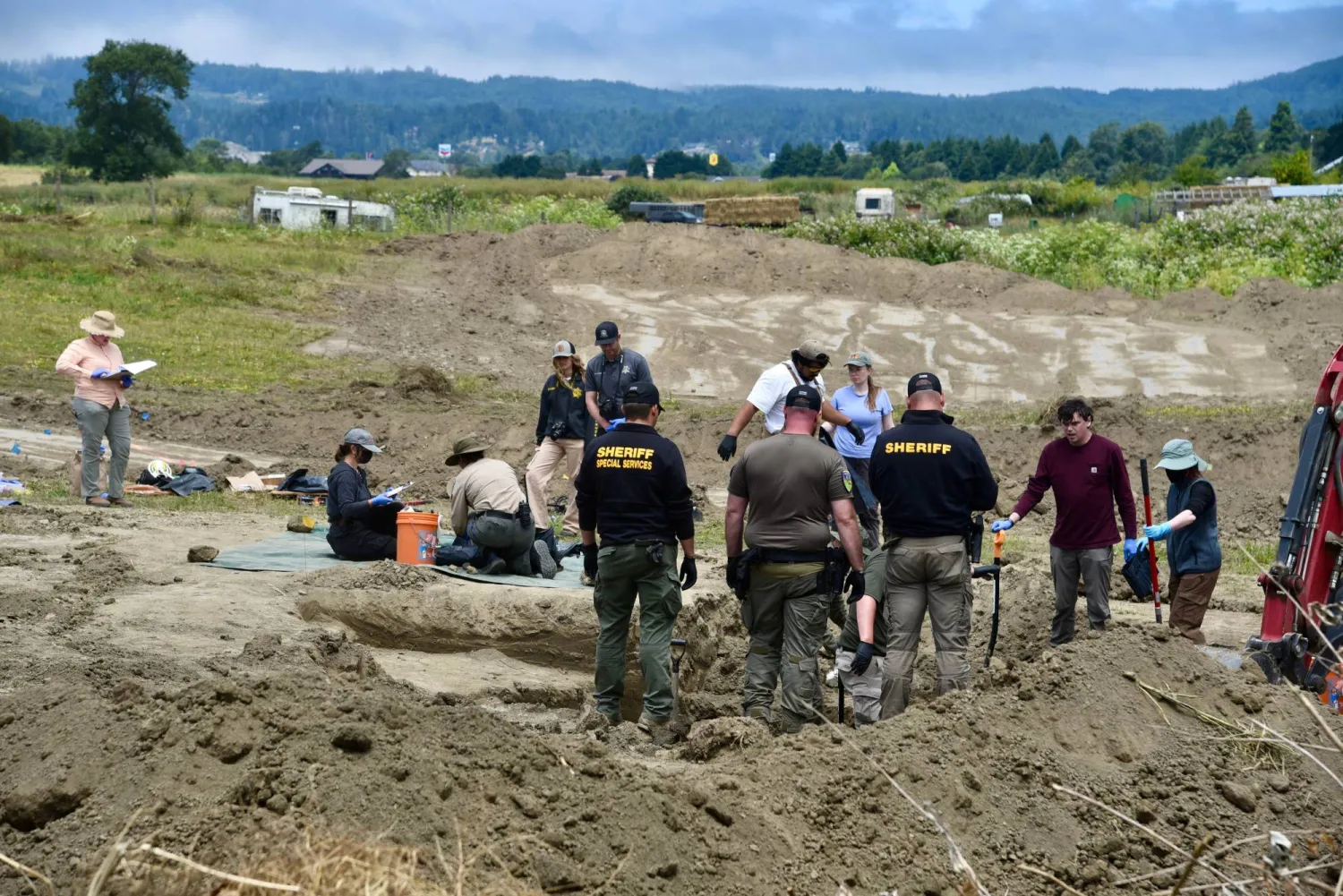
Investigators from the Humboldt County Sheriff's Office search the grounds of Miranda's Rescue Animal Sanctuary in Fortuna, Calif., June 24, 2026, where the remains of at least 117 dogs were found. (Ryan Burns/Lost Coast Outpost via P)
TT

At Least 117 Dead Dogs Found in 'Horrific Scene' at California 'No-kill' Shelter

Investigators from the Humboldt County Sheriff's Office search the grounds of Miranda's Rescue Animal Sanctuary in Fortuna, Calif., June 24, 2026, where the remains of at least 117 dogs were found. (Ryan Burns/Lost Coast Outpost via P)

The remains of at least 117 dogs were found on the grounds of a California “no-kill” animal shelter, many of them with gunshot wounds, authorities said.

The Humboldt County Sheriff’s Office said Friday that it also discovered 21 canine skulls, hundreds of bones and other remains during searches at Miranda’s Rescue Animal Sanctuary, a 50-acre (20-hectare) facility in Fortuna, California.

Investigators combing the site on Thursday located an area in a barn where they believe dogs were likely killed, the sheriff’s office said. More than 600 dog collars were found nearby, The Associated Press quoted the office as saying.

Sheriff William Honsal called it a “horrific scene.” No charges have been filed.

A message seeking comment was left for the shelter’s founder, Shannon Miranda.

In a statement posted to the shelter’s website on June 18, Miranda said that recent media coverage and online commentary “have presented an incomplete and, in some cases, inaccurate picture of our work.”

“At Miranda’s Rescue, our mission is to save as many animals as we safely can—always balancing compassion for animals with our responsibility to protect families, children, other pets, and the public,” Miranda wrote.

The sheriff’s office said it started investigating the shelter after receiving “credible information” in April “regarding allegations of felony animal abuse, animal cruelty, fraud, and conspiracy.”

Miranda’s Rescue collects fees from shelter transfers, as well as donations that it says helps cover the costs of food, housing, veterinary care, medications, facility expenses and staffing.

An affidavit from an earlier search of the property said that the sheriff’s office was tipped off by a pair of animal advocates, one of whom owns property adjoining the shelter and used trail cameras to monitor activity near an alleged burial site.

The advocates later went onto shelter property and dug up dog remains, the affidavit said.

“This investigation is just getting started,” Honsal said in a statement. “There is a tremendous amount of data to process, witnesses to interview, and evidence to examine.”

Investigators using ground-penetrating radar found 117 intact remains in various stages of decomposition buried in an open field, the sheriff’s office said.

They X-rayed 70 of the remains on site and found evidence of bullet fragments in many of them. The cause of death for many of those animals appeared to be gunshot wounds, the sheriff’s office said.

Investigators also found additional remains in advanced stages of decomposition, the sheriff’s office said.

The sheriff’s office said hundreds of dogs were transferred or turned over to Miranda’s Rescue by private citizens and animal shelters.

In his statement, Miranda said, “Miranda’s Rescue is a no-kill rescue. We do not euthanize animals simply to make space.”

However, Miranda wrote, “there are rare circumstances in which euthanasia may be necessary — when an animal is suffering from a terminal condition or when it poses a serious, ongoing danger to people or other animals.”

“In those situations, we make the most humane and responsible decision we can, always with public safety and animal welfare in mind.”



Military Shows to be Featured at Saudi International Falcons and Hunting Exhibition 2026

The exhibition will welcome visitors daily from 2 p.m. to 11 p.m. - SPA
TT

Military Shows to be Featured at Saudi International Falcons and Hunting Exhibition 2026

The exhibition will welcome visitors daily from 2 p.m. to 11 p.m. - SPA

The Saudi International Falcons and Hunting Exhibition 2026, scheduled for October 1 to 10 in Malham, north of Riyadh, will feature military shows presented by the Ministry of Interior among the accompanying events, adding a new element to the program.

The exhibition will allow visitors to watch the military shows at 4:30 p.m. and 7 p.m., while the band will perform at 6 p.m. and 8 p.m., SPA reported.

This year's exhibition will offer a wide range of experiences, including "Falconer of the Future," safari, mountain climbing, fishing, shooting, horseback and camel riding, auctions, and workshops, providing families, youth, and enthusiasts with a variety of options during their visit.

The exhibition will welcome visitors daily from 2 p.m. to 11 p.m.


Italy's Catania Airport Reopens as Etna Threat Downgraded

Visitors climb Mount Etna as smoke rises from its volcano in Catania, on the Mediterranean island of Sicily, on September 28, 2026. (Photo by Roman PILIPEY / AFP)
TT

Italy's Catania Airport Reopens as Etna Threat Downgraded

Visitors climb Mount Etna as smoke rises from its volcano in Catania, on the Mediterranean island of Sicily, on September 28, 2026. (Photo by Roman PILIPEY / AFP)

Italy's Catania airport resumed flights on Tuesday after briefly halting operations due to renewed volcanic activity from nearby Mount Etna and adverse weather conditions, in the latest stop-and-go disruption to air traffic.

According to Reuters, Operator SAC said ⁠flights to and ⁠from the airport had resumed with immediate effect after the volcanic alert level was lowered from red to ⁠orange.

The hub had previously suspended operations until 1300 GMT on Tuesday, only hours after ending a three-day shutdown on Monday evening.

The Sicilian airport, Italy's fifth-busiest by passenger traffic, is often disrupted by volcanic ⁠ash ⁠interference from Mount Etna, Europe's highest and most active volcano.

The latest shutdown affected thousands of passengers and placed significant pressure on other Sicilian airports, as airlines diverted flights away from Catania.


Scientists: Rising Seas Threaten Spread of Marine Invaders

An aerial view of fishermen returning from sea at the traditional fishing port in Banda Aceh, Indonesia, 29 September 2026. EPA/HOTLI SIMANJUNTAK
TT

Scientists: Rising Seas Threaten Spread of Marine Invaders

An aerial view of fishermen returning from sea at the traditional fishing port in Banda Aceh, Indonesia, 29 September 2026. EPA/HOTLI SIMANJUNTAK

Sea-level rise driven by climate change could help invasive marine species spread into newly flooded coastal areas, threatening biodiversity and some economic activities, researchers warned in a study published Monday.

The findings in Nature Ecology & Evolution highlight the links between the climate and biodiversity crises, with global warming altering ecosystems and creating new opportunities for non-native species to thrive.

That could "potentially expose ecosystems and human activities that have not previously been affected by these species," said study co-author Xuan Liu of Beijing Normal University.

The researchers modelled the potential future spread of 122 established non-native marine animals, including fish, crustaceans, molluscs and sea stars, under different climate and sea-level scenarios.

Climate change causes sea levels to rise through thermal expansion -- ocean water increases in volume as it warms -- and the melting of glaciers and ice sheets.

Global sea levels are projected to rise by about 20 centimeters (eight inches) by 2050 and 56 cm by 2100 under a scenario of moderate growth in greenhouse gas emissions.

That would see around 360,000 square kilometers (139,000 square miles) of coastal land flooded by mid-century, rising to 550,000 square kilometers by the end of the century.

More than two-thirds of the newly flooded coastal land -- roughly 290,000 to 470,000 square kilometers -- could become suitable for the marine non-native animals studied, particularly around estuaries at mid-latitudes, AFP quoted the authors as saying.

The risk is concentrated in regions including the eastern United States, Gulf of Mexico, North Sea, Gulf of Guinea, Arabian Gulf, northern Bay of Bengal, southeastern China and northern Australia.

Several species examined are already established in Europe, including the Pacific oyster, Atlantic blue crab and the veined rapa whelk, a predatory sea snail.

"Estuaries are particularly at risk because they are directly connected to the ocean and are also major hubs of human activity," Liu said.

Such areas could provide stepping stones for marine invaders moving further inland as the sea advances, the study said.

The findings come as governments prepare for two UN-backed international summits on the twin biodiversity and climate crises: COP17 in October and COP31 in November.

A global assessment by the UN's expert scientific panel on biodiversity, IPBES, estimated that economic costs from biological invasions exceeded $423 billion in 2019.