


'My Dream is Broken': Japan Visa Rules Push Out Foreign Residents

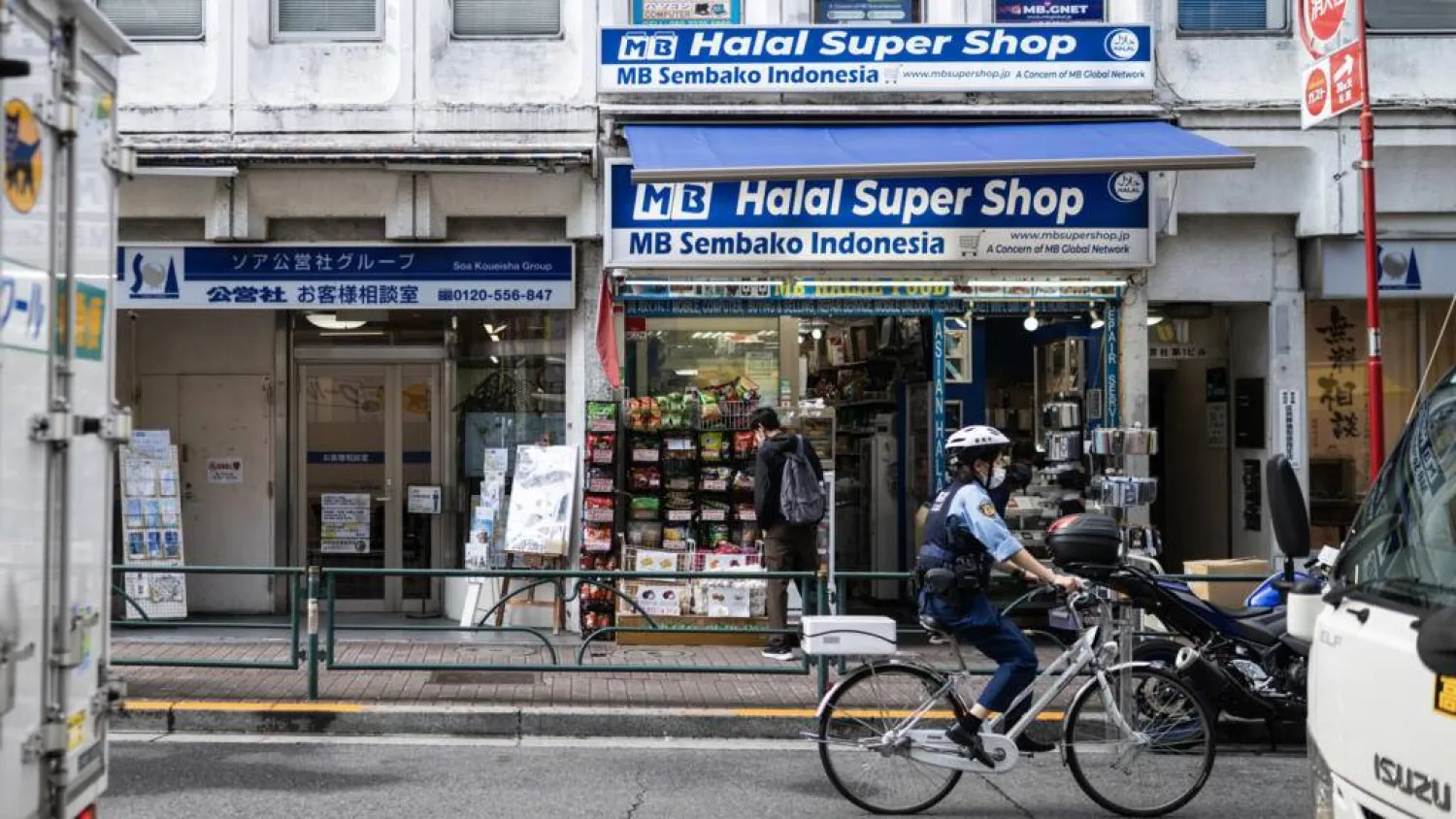
A police officer bikes past a convenience store in the Okubo–Shin area in Tokyo, a neighborhood known for its large immigrant communities. Andrew CABALLERO-REYNOLDS / AFP
TT

'My Dream is Broken': Japan Visa Rules Push Out Foreign Residents

A police officer bikes past a convenience store in the Okubo–Shin area in Tokyo, a neighborhood known for its large immigrant communities. Andrew CABALLERO-REYNOLDS / AFP

In a tiny Tokyo restaurant filled with the smell of Nepalese dumplings, Budhathoki Samjhana surveys the business she built from scratch but may now have to give up as Japan tightens visa rules.

Even though Japan has a rapidly ageing population and is suffering labor shortages in many sectors, opposition to immigration is growing and the new rules for business manager visas were introduced by the ruling Liberal Democratic Party in late 2025.

Nepalese national Budhathoki, who spent a decade away from her young daughter to create a new life for them in Tokyo, faces expulsion from the country because she may not be able to meet the specifications.

"I always wanted to become a bridge between Japan and Nepal... but my dream is broken," the 38-year-old told AFP from the capital's Okubo district, where her restaurant is nestled alongside Vietnamese cafes, Indian curry houses and Korean barbecue joints.

The stricter rules come as some residents complain of overtourism and soaring land prices in part due to foreign investment, prompting a push by Japanese Prime Minister Sanae Takaichi for tighter regulations on foreign nationals.

Her government announced last month a sharp increase in visa fees for some tourists for the first time in nearly 50 years, hiking the cost for single and multiple entry permits five-fold.

And while business manager visa holders have a three-year grace period to meet the new conditions, some thriving businesses -- including many popular eateries in Okubo -- fear they won't manage.

"The biggest problem is the increase in capital requirement to 30 million yen ($185,000) from 5 million ($30,000)," said Budhathoki, leafing through receipts as the scent of freshly cooked Nepalese momos wafts in from the kitchen.

"It's impossible".

Budhathoki came to Japan as a student in 2016 and saved for years to open her first restaurant in 2023.

After opening her third eatery in January, she finally brought her 14-year-old daughter from Nepal following a decade of separation and she is now enrolled in a Japanese school.

"Now, I'm very worried not about myself but about my daughter... What did I do to her?" she said.

"My heart pounds when I think about the next visa renewal."

- 'Zero illegal' residents -

Indian restaurant owner Manish Kumar, who has lived in Japan for three decades, has already been told his business manager visa won't be renewed, in spite of the grace period.

He doesn't know exactly why but visa experts say immigration officials have become more rigorous, demanding more documentation including tax receipts and social insurance premiums.

"My children only speak Japanese... and we're told to go back to India," Kumar tearfully explained at a gathering about the visa issue last month.

More than 67,800 people have signed a petition calling for the suspension of the new rules.

"What happened to him was shocking," petition organizer Taro Tsurugashima said of Kumar, who ran a restaurant in Saitama, near Tokyo, for 18 years.

"He is one of my friends, and he is a trusted member of a business community", Tsurugashima told AFP.

The tightening of regulations comes after the justice ministry in May last year announced a "zero illegal foreign residents" plan to address public concern.

Super-ageing Japan has one of the world's lowest birth rates, and increasing immigration could help reverse its falling population.

But foreigners were a major issue in last year's upper house election which saw the sharp rise of the "Japanese-first" Sanseito party, which describes immigration as a "silent invasion".

Since taking office in October, Takaichi has pledged stricter screening.

The business manager visa, meant to attract entrepreneurs, had become an easy route for would-be immigrants without real business plans, said Kazuki Yuda, an administrative affairs advisor.

The visa's popularity surged, with around 46,000 holders by mid-2025 -- up 70 percent from 2020. About half were Chinese nationals, according to government data.

"We also started to see unscrupulous real estate agents telling people that they could secure a visa simply by purchasing property in Japan," he said.

Daisuke Komori, another advisor on administrative affairs, told AFP that he had declined potential clients, "many of whom were Chinese", seeking to move chiefly for their children's education or to leave China.

However Yuda and Komori both warned that the tougher measures were impacting "small restaurant owners" and "young entrepreneurs", as well as the system's abusers.

At an April parliament session, Justice Minister Hiroshi Hiraguchi said he had no plan to review the rules, but his ministry intends "to respond based on individual circumstances".

Among other new requirements, a business manager visa holder must employ a Japanese national or long-term resident.

But with the shrinking population, "there's not enough Japanese workers", a 30-year-old Bangladeshi man who runs a trading business in Tokyo told AFP.

Under these circumstances, "who will apply for a job at a company whose manager's status is unstable with a visa that has to be renewed every year?"



Military Shows to be Featured at Saudi International Falcons and Hunting Exhibition 2026

The exhibition will welcome visitors daily from 2 p.m. to 11 p.m. - SPA
TT

Military Shows to be Featured at Saudi International Falcons and Hunting Exhibition 2026

The exhibition will welcome visitors daily from 2 p.m. to 11 p.m. - SPA

The Saudi International Falcons and Hunting Exhibition 2026, scheduled for October 1 to 10 in Malham, north of Riyadh, will feature military shows presented by the Ministry of Interior among the accompanying events, adding a new element to the program.

The exhibition will allow visitors to watch the military shows at 4:30 p.m. and 7 p.m., while the band will perform at 6 p.m. and 8 p.m., SPA reported.

This year's exhibition will offer a wide range of experiences, including "Falconer of the Future," safari, mountain climbing, fishing, shooting, horseback and camel riding, auctions, and workshops, providing families, youth, and enthusiasts with a variety of options during their visit.

The exhibition will welcome visitors daily from 2 p.m. to 11 p.m.


Italy's Catania Airport Reopens as Etna Threat Downgraded

Visitors climb Mount Etna as smoke rises from its volcano in Catania, on the Mediterranean island of Sicily, on September 28, 2026. (Photo by Roman PILIPEY / AFP)
TT

Italy's Catania Airport Reopens as Etna Threat Downgraded

Visitors climb Mount Etna as smoke rises from its volcano in Catania, on the Mediterranean island of Sicily, on September 28, 2026. (Photo by Roman PILIPEY / AFP)

Italy's Catania airport resumed flights on Tuesday after briefly halting operations due to renewed volcanic activity from nearby Mount Etna and adverse weather conditions, in the latest stop-and-go disruption to air traffic.

According to Reuters, Operator SAC said ⁠flights to and ⁠from the airport had resumed with immediate effect after the volcanic alert level was lowered from red to ⁠orange.

The hub had previously suspended operations until 1300 GMT on Tuesday, only hours after ending a three-day shutdown on Monday evening.

The Sicilian airport, Italy's fifth-busiest by passenger traffic, is often disrupted by volcanic ⁠ash ⁠interference from Mount Etna, Europe's highest and most active volcano.

The latest shutdown affected thousands of passengers and placed significant pressure on other Sicilian airports, as airlines diverted flights away from Catania.


Scientists: Rising Seas Threaten Spread of Marine Invaders

An aerial view of fishermen returning from sea at the traditional fishing port in Banda Aceh, Indonesia, 29 September 2026. EPA/HOTLI SIMANJUNTAK
TT

Scientists: Rising Seas Threaten Spread of Marine Invaders

An aerial view of fishermen returning from sea at the traditional fishing port in Banda Aceh, Indonesia, 29 September 2026. EPA/HOTLI SIMANJUNTAK

Sea-level rise driven by climate change could help invasive marine species spread into newly flooded coastal areas, threatening biodiversity and some economic activities, researchers warned in a study published Monday.

The findings in Nature Ecology & Evolution highlight the links between the climate and biodiversity crises, with global warming altering ecosystems and creating new opportunities for non-native species to thrive.

That could "potentially expose ecosystems and human activities that have not previously been affected by these species," said study co-author Xuan Liu of Beijing Normal University.

The researchers modelled the potential future spread of 122 established non-native marine animals, including fish, crustaceans, molluscs and sea stars, under different climate and sea-level scenarios.

Climate change causes sea levels to rise through thermal expansion -- ocean water increases in volume as it warms -- and the melting of glaciers and ice sheets.

Global sea levels are projected to rise by about 20 centimeters (eight inches) by 2050 and 56 cm by 2100 under a scenario of moderate growth in greenhouse gas emissions.

That would see around 360,000 square kilometers (139,000 square miles) of coastal land flooded by mid-century, rising to 550,000 square kilometers by the end of the century.

More than two-thirds of the newly flooded coastal land -- roughly 290,000 to 470,000 square kilometers -- could become suitable for the marine non-native animals studied, particularly around estuaries at mid-latitudes, AFP quoted the authors as saying.

The risk is concentrated in regions including the eastern United States, Gulf of Mexico, North Sea, Gulf of Guinea, Arabian Gulf, northern Bay of Bengal, southeastern China and northern Australia.

Several species examined are already established in Europe, including the Pacific oyster, Atlantic blue crab and the veined rapa whelk, a predatory sea snail.

"Estuaries are particularly at risk because they are directly connected to the ocean and are also major hubs of human activity," Liu said.

Such areas could provide stepping stones for marine invaders moving further inland as the sea advances, the study said.

The findings come as governments prepare for two UN-backed international summits on the twin biodiversity and climate crises: COP17 in October and COP31 in November.

A global assessment by the UN's expert scientific panel on biodiversity, IPBES, estimated that economic costs from biological invasions exceeded $423 billion in 2019.