Australia Welcomes Draft UNESCO Decision to Keep Great Barrier Reef Off Danger List

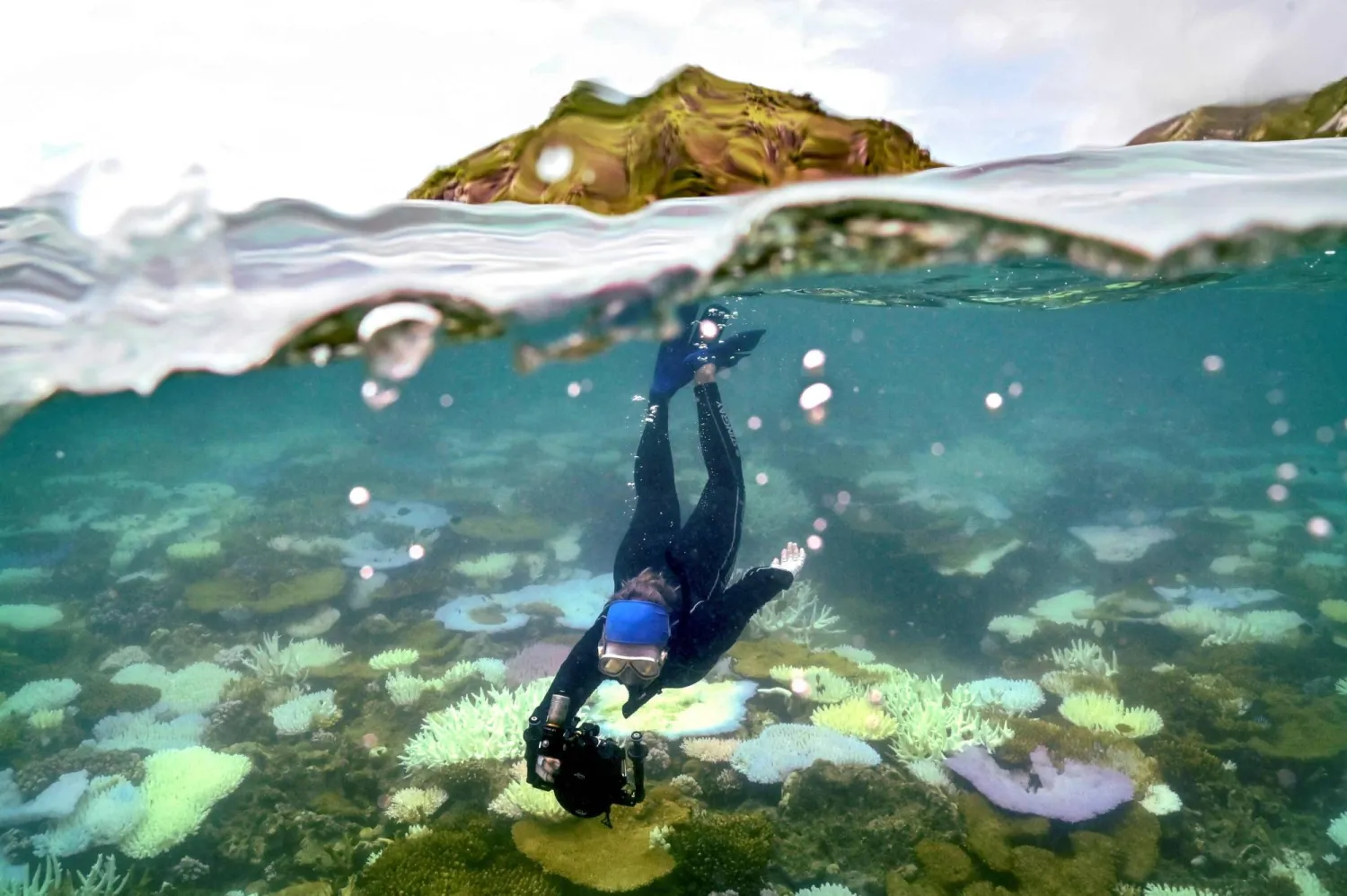
(FILES) In this underwater photo taken on April 5, 2024, marine biologist Anne Hoggett snorkels to inspect and record bleached and dead coral around Lizard Island on the Great Barrier Reef, located 270 kilometres (167 miles) north of the city of Cairns. (Photo by DAVID GRAY / AFP)
TT

Australia Welcomes Draft UNESCO Decision to Keep Great Barrier Reef Off Danger List

(FILES) In this underwater photo taken on April 5, 2024, marine biologist Anne Hoggett snorkels to inspect and record bleached and dead coral around Lizard Island on the Great Barrier Reef, located 270 kilometres (167 miles) north of the city of Cairns. (Photo by DAVID GRAY / AFP)

Australia welcomed a draft UNESCO decision not to list the Great Barrier Reef as an endangered site, its assistant tourism minister said on Saturday, despite ongoing struggles of the world's biggest coral reef ecosystem with coral bleaching.

The reef, which has suffered several mass coral bleaching events in recent years, is not currently on the United Nations Educational, Scientific and Cultural Organization (UNESCO) list of world heritage sites that are in danger, although UN scientists have previously ⁠recommended that it ⁠should be added.

Australia's government has lobbied for years to keep the reef - which contributes more than A$9.0 billion ($6.25 billion) to the economy annually - off the list, as it could damage tourism at the site, which receives more than ⁠2 million visitors each year.

Assistant Tourism Minister Nita Green said the decision overnight by the UNESCO World Heritage Centre "recognizes Australia's continued efforts to protect and manage this important icon,” Reuters reported.

"Australia welcomes UNESCO's decision to not list the reef as endangered, and recognize all of the work that's been going into protecting the reef," Green said in televised remarks from the capital Canberra.

The reef, home to 400 ⁠types ⁠of coral and 1,500 species of fish, stretches for some 2,400 km (1,500 miles) off the coast of the northern state of Queensland.

Since 2016, it has experienced five summers of mass coral bleaching, when large sections of the reef turn white due to heat stress, putting them at greater risk of death. Climate change is a primary driver of rising sea temperatures which cause coral bleaching, according to the Queensland government.


New Species of Ghost Shark May Have Been Found in Costa Rica

This image shows a partial view of the newly discovered Costa Rican ghost shark (Rhinochimaera costaricana) at the Museum of Zoology of the University of Costa Rica's Center for Research in Biodiversity and Tropical Ecology in San Jose, Costa Rica, on July 3, 2026. (Photo by Ezequiel BECERRA / AFP)
TT

New Species of Ghost Shark May Have Been Found in Costa Rica

This image shows a partial view of the newly discovered Costa Rican ghost shark (Rhinochimaera costaricana) at the Museum of Zoology of the University of Costa Rica's Center for Research in Biodiversity and Tropical Ecology in San Jose, Costa Rica, on July 3, 2026. (Photo by Ezequiel BECERRA / AFP)

Costa Rican scientists may have discovered a new species of ghost shark in Pacific waters near Cabo Blanco and Cano Island.

The latest discovery has a "shorter" snout, a "darker coloration pattern" and a "much longer spine on its dorsal fin," according to Arturo Angulo Sibaja, a biology professor at the University of Costa Rica.

The discovery marks the only such species "known for the Central American coast," Sibaja said, adding genetic analysis indicates the new species has "no reproductive contact" with other ghost sharks.

But earlier specimens collected "near Peru and Chile are very similar to the species" from Costa Rica, so scientists are still comparing the specimens before finalizing the conclusion, AFP quoted him as saying.

Three species of ghost shark -- a type of fish that is related to sharks -- have been discovered elsewhere, in waters off South Africa, Taiwan, Australia, Japan and in the Atlantic between Greenland and Brazil.

Ghost sharks belong to a group of cartilaginous fish called Rinochimaera that is related to sharks but genetically diverged from them nearly 400 million years ago.

Sibaja said it's "most likely" the new species "has broader distribution along the (Pacific) coast of Central and South America."


Trump's Massive July 4 Firework Show Raises Health Alarms

LYNWOOD, CALIFORNIA - JULY 03: People watch fireworks explode during the annual Independence Day Celebration in the predominantly Latino community of Lynwood on July 3, 2026 in Lynwood, California. Mario Tama/Getty Images/AFP
TT

Trump's Massive July 4 Firework Show Raises Health Alarms

LYNWOOD, CALIFORNIA - JULY 03: People watch fireworks explode during the annual Independence Day Celebration in the predominantly Latino community of Lynwood on July 3, 2026 in Lynwood, California. Mario Tama/Getty Images/AFP

An "unforgettable" tribute to America, or a health hazard that will terrorize animals and pollute the environment?

That's the question as Washington prepares to break the record for the world's largest fireworks display on the United States' 250th birthday on Saturday.

The Trump administration's "Freedom250" project has hired Pennsylvania-based Pyrotecnico to launch more than 850,000 fireworks shells across 10 sites around the Lincoln Memorial and Potomac River, starting at 10:30 pm and lasting 40 minutes.

That is around 40,000 more than the current Guinness World Record, set in Bocaue, Philippines in 2016, and roughly 50 times more than Washington's usual annual show.

"Freedom250" has billed it as the "unforgettable" capstone for a day of performances, flyovers and acrobatics displays at the National Mall, claiming it will bring hundreds of thousands of visitors and calling it a generational event.

They haven't however disclosed the bill for the affair and did not respond to a request seeking the sum.

- 'Frightening' numbers -

"Fireworks are a tried-and-true American tradition," Jodi Dague, Pyrotecnico's director of marketing, told AFP. "They bring back childhood memories and allow families to create new ones. It's a reason to gather and celebrate."

Not everyone is convinced.

"First let me say, I like fireworks -- I think they're fun," Russell Dickerson, a professor of atmospheric chemistry at the University of Maryland told AFP, but said the number in question was "frightening."

"In my professional opinion, it's probably ill-advised to try to set off 850,000 fireworks... on a hot, stagnant, already polluted day. I'm not going down to the Mall and I certainly would not bring my grandchildren there."

The biggest concern is fine particulate matter, he explained -- particles 2.5 micrometers or smaller that can penetrate deep into the lungs, enter the bloodstream and even cross the blood-brain barrier.

The EPA's 24-hour standard caps exposure at 35 micrograms per cubic meter. After a fireworks show, "it dissipates substantially in a few hours, but in those few hours, people are going to be exposed to huge amounts," Dickerson said, adding that the smoke could cut visibility to a few hundred yards.

Making matters worse is a heat wave gripping the East Coast, with firework smoke and pollution liable to last longer without rain to clear it, and hot weather itself increasing background levels of pollution as the power grid strains under increased demand for cooling and as vehicles emit more.

"The amount of pollution that we produce is apocalyptic during this one particular day," Glory Dolphin Hammes, CEO of IQAir's North American division, told AFP.

Data compiled by the Swiss-based company from public and private sources showed that hourly PM2.5 in Washington peaked at 11 pm on July Fourth, last year at 133 micrograms per cubic meter. The Air Quality Index peaked at 208, levels more commonly associated with South Asian cities.

Epidemiologically, PM2.5 spikes are linked to a rise in emergency room visits, Hammes said, with longer-term impacts on heart and lung health from chronic exposure. Beyond particulate matter, fireworks contain trace metals that produce their bright colors, and burning fireworks releases harmful volatile organic compounds.

- Sounds of freedom -

Fireworks are also traumatizing for pets, particularly dogs, which tremble and even bolt from their homes in fear.

Adrian Aceves, a physician living in downtown Washington, said he'd be staying in with his five-year-old mutt Rosy, "trying to distract her with treats and toys, and I will medicate her."

Then there's wildlife: a recent European study found Arctic migratory geese flew away from their sleeping sites in response to New Year's Eve fireworks and never returned.

And a 2016 US government study found perchlorate, an oxidizing agent used in fireworks, had made its way into groundwater and surface water around Mount Rushmore National Memorial, which holds annual July 4 shows.

But Erica Walker, an assistant professor of epidemiology at Brown University School of Public Health, said the harms of fireworks need to be weighed against the joy they bring, drawing a distinction between ongoing sources of noise and pollution and those confined to a single day.

"As an American who has ancestors here who descended from slavery, Independence Day for me is incredibly relevant," she said. "I think for me those are the sounds of independence... it's also the sound of freedom, without trying to sound all corny."


‘Once-in-a-Generation’ Expedition Launched to Survey Shipwrecks of Two Polar Heroes

Ship trapped in ice during an expedition to the Antarctic. (Getty Images)
TT

‘Once-in-a-Generation’ Expedition Launched to Survey Shipwrecks of Two Polar Heroes

Ship trapped in ice during an expedition to the Antarctic. (Getty Images)

A “once-in-a-generation” expedition will be launched this month to survey the last ships of legendary polar explorers Sir Ernest Shackleton and Captain Robert Falcon Scott.

The ships Quest and Terra Nova are the last link to Shackleton and Scott, who competed to reach the South Pole in the early 1900s before each died during an expedition, according to The Independent.

Now, The Woods Hole Oceanographic Institution (WHOI) and the Royal Canadian Geographical Society (RCGS) will conduct the first comprehensive visual survey of both Quest and Terra Nova to produce digital twins of the wrecks.

Their expedition on research vessel will map the shipwrecks and debris fields around their hulls using a combination of high-definition 5.2K video cameras and advanced Canadian “Voyis” photogrammetric technology.

Quest is the ship of Irish-born British explorer Shackleton, who died in 1922.

Its wreck was discovered in 2024, sitting on its keel under 390m (1,280ft) of frigid water off the coast of Labrador in Canada, 62 years after it went missing.

Shackleton’s death aboard the ship in 1922 marked the end of what historians call the “heroic age” of Antarctic exploration.

"The discovery of Quest in 2024 was only the beginning," said John Geiger, expedition leader and chief of the RCGS.

Terra Nova, Scott’s final ship, was first discovered by the Schmidt Ocean Institute in 2012.
Scott and his entire party had frozen to death on their return journey.

The vessel had sunk off the coast of Greenland in 1943 and was located using modern echo sounders.