
Anissa Helou’s New Book of Recipes from Lebanon Spotlights Villages Scarred by War

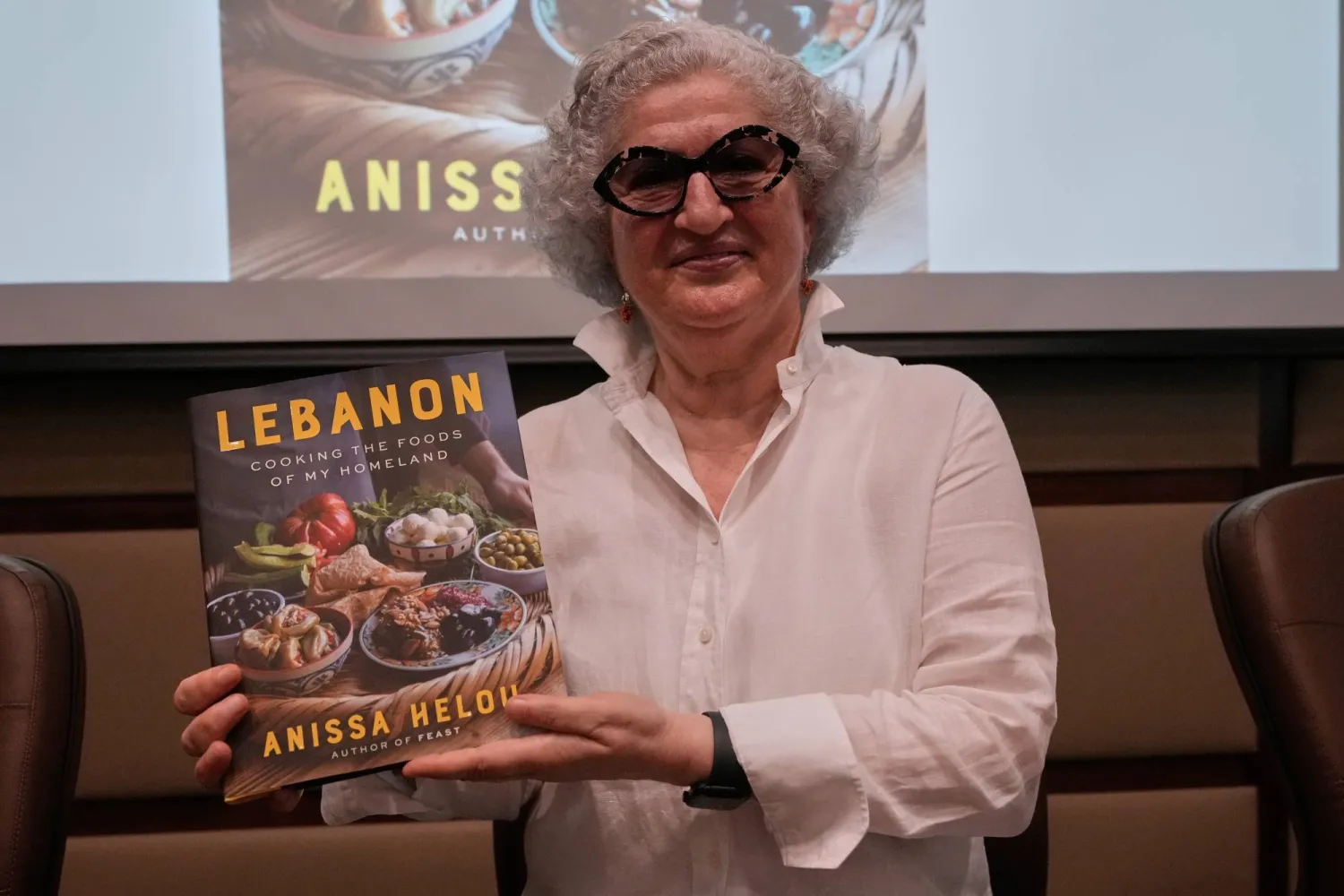
Anissa Helou, 74, one of the Middle East's most acclaimed cooks and food writers, holds her new book during a ceremony at the Lebanese Ministry of Tourism, in Beirut, Lebanon, Tuesday, June 23, 2026. (AP Photo/Hussein Malla)
TT

Anissa Helou’s New Book of Recipes from Lebanon Spotlights Villages Scarred by War

Anissa Helou, 74, one of the Middle East's most acclaimed cooks and food writers, holds her new book during a ceremony at the Lebanese Ministry of Tourism, in Beirut, Lebanon, Tuesday, June 23, 2026. (AP Photo/Hussein Malla)

Before becoming one of the Middle East’s most acclaimed cooks and food writers, Anissa Helou had no intention of either path. She entered the world of cooking and writing almost by accident when she was in her late 30s.

Now 74, Helou has a wide following in the region and elsewhere and has released nearly a dozen books since the 1990s about food in the Middle East and beyond. Last month she received Britain’s prestigious Guild of Food Writers Lifetime Achievement Award.

The daughter of a Lebanese mother and a Syrian father, Helou was born into a Christian family and grew up watching her mother, grandmother and paternal aunt cooking. It opened her eyes to the food traditions of the two countries, both widely known in the region for their varied and flavorful cuisine.

“I was always fascinated by the kitchen, by their movements (and) by how they put things together, by the chopping,” Helou said about her mentors. “I love being in the kitchen with them and of course I loved eating.”

Helou’s latest book, “Lebanon: Cooking the Foods of My Homeland,” was officially released in late June in Beirut in a ceremony at Lebanon's Tourism Ministry attended by scores of people including food critics and restaurant owners.

The book, which comes as the country has been battered by two wars in the past three years between Israel and Hezbollah, includes a section about food in some of the southern Lebanese villages that have suffered the worst destruction, The Associated Press reported.

During her repeated visits there, most recently in October 2023, she found residents had their own regional variations of traditional cuisine. They include mujadara, a dish mainly consisting of lentils that is often cooked with rice, but in southern Lebanon is more likely to be made with bulgur.

“I discovered more, like, variations and added dishes, rather than something that was a complete revelation,” Helou said.

She has picked walnuts from a tree growing along the giant wall separating southern Lebanon from northern Israel and met residents who have lost their homes and businesses in the Hezbollah-Israel conflict.

Helou recalled Moussa Ibrahim from the southern village of Dibbine, which has been the site of intense clashes between Israeli troops and Hezbollah fighters.

Fighting there in 2024 caused Ibrahim to lose his business producing mouneh: vegetables, fruits, grains and dairy preserved with traditional Lebanese techniques including sun-drying, salting, pickling or submerging in olive oil.

Representing the Middle East and Muslims through recipes Helou, who has traveled the world to sample food, said she loves Korean and Japanese in addition to Middle Eastern cuisine.

“Lebanese, Iranian and Moroccan are among the greatest cuisines,” Helou said earlier this month in her late mother's apartment in the Mount Lebanon town of Ballouneh.

“Lebanese cuisine is kind of a little bit more sophisticated, a lot fresher, more vibrant” compared with some other Middle East food, Helou said as she prepared a traditional Lebanese lamb confit called awarma.

Asked for the home of the region’s best food, Helou did not hesitate to move outside Lebanon and name Syria’s largest city, Aleppo.

Famed for its centuries-old covered market, which was badly damaged during Syria’s civil war beginning in March 2011, Aleppo is known for varied and elaborate cuisine with influences from Persia, North Africa and Armenia.

“I think that Aleppo is undoubtedly the gastronomic capital of the Middle East, regardless of me being Syrian,” she said.

Global anti-Islamic sentiments rose dramatically after ISIS took large parts of Syria and Iraq and declared a so-called caliphate in 2014, launching deadly attacks in the region and the world.

Helou responded with a book of about 300 recipes of dishes from Muslim countries.

“I was thinking, one way of presenting Islam and Muslim people positively could be through their foods,” she said.

Starting late in the world of cooking Helou, who left Lebanon at the age of 21, holds citizenship in Lebanon, Syria and the United Kingdom and has spent much of her time in Britain and Italy. She still regularly visits Lebanon, cooking and asking people how they make specific dishes.

Helou refused to cook for years while she was a young woman and told her partner at the time not to expect her to make meals.

“I didn’t want to be domesticated. I was like a feminist and so I didn’t cook for a very long time,” she said.

One day a friend prepared a meal at their home and Helou saw the happiness it gave her partner, prompting her to think she should start cooking.

Her decision to become a food writer came in 1992 when a discussion with a group of Lebanese living abroad gave Helou the idea of filling a gap in Lebanese cookbooks with a collection of her mother's recipes. As it happened, there was a publisher looking for someone to write such a book.

“That’s how I started, by sheer coincidence,” Helou said.


NCW, NEOM Celebrate First Striped Hyena Birth

Striped hyenas play an important ecological role by feeding on carcasses and carrion - SPA
TT

NCW, NEOM Celebrate First Striped Hyena Birth

Striped hyenas play an important ecological role by feeding on carcasses and carrion - SPA

The National Center for Wildlife (NCW), in collaboration with NEOM, has documented the first birth of a striped hyena following the reintroduction of two breeding pairs into NEOM Nature Reserve. The birth is a positive indication of the hyenas’ successful adaptation to the reserve and their ability to reproduce in the wild.

According to a press release issued by the NCW, the birth marks another milestone in NCW’s wildlife breeding and reintroduction programs, which include dedicated efforts for predator species aimed at restoring their natural roles within ecosystems.

Prior to the release, two pairs of striped hyenas were selected and underwent a rehabilitation program at one of NCW’s wildlife care facilities, SPA reported.

The program included veterinary examinations, health monitoring, and preparation for their transition into the wild. A specialized NCW team also conducted a field assessment of the reintroduction site to verify its readiness and ecological suitability for the hyenas.

NCW CEO Dr. Mohammed Qurban said: "This is the first striped hyena birth following their reintroduction, and it marks an important milestone in the center’s wildlife breeding and reintroduction programs.”

He emphasized that reintroducing species into their natural habitats represents an advanced stage in establishing populations capable of surviving and reproducing in the wild and restoring their ecological roles.

Striped hyenas play an important ecological role by feeding on carcasses and carrion. Their populations have declined in parts of their natural range due to several threats, particularly hunting and poisoning.


Chile-led Team Maps Antarctic Plant Genome in Step Towards Climate-resilient Crops

FILE PHOTO: A frozen section of the Ross Sea at the Scott Base in Antarctica on November 12, 2016. REUTERS/Mark Ralston/Pool/File Photo
TT

Chile-led Team Maps Antarctic Plant Genome in Step Towards Climate-resilient Crops

FILE PHOTO: A frozen section of the Ross Sea at the Scott Base in Antarctica on November 12, 2016. REUTERS/Mark Ralston/Pool/File Photo

A team led by Chilean researchers has produced the most complete genetic map yet of one of only two flowering plants that grow naturally in Antarctica, potentially helping the development of crops resistant to extreme weather.

Colobanthus quitensis has long attracted scientific interest because it can survive the freezing temperatures, lack of water and high levels of ultraviolet radiation in Antarctica, one of the planet's coldest and driest environments.

As record heat and extensive drought have increased the urgency of ⁠debate in many ⁠parts of the world over how to adapt agriculture, the scientists said they are now equipped to start assessing whether the plant's traits could be transferred to agricultural crops through gene-editing techniques.

The study, published in Oxford University Press journal "Genome Biology and Evolution," ⁠assembled all 40 chromosome-scale scaffolds that make up the plant's genetic blueprint under a project known as Polarix.

"We were able to sequence and assemble the entire genome," said Eduardo Castro, an associate researcher at Chile's Cape Horn International Center and lead author of the study alongside Claudio Meneses of Chile's Pontifical Catholic University.

"The idea is not to create transgenic plants. The idea is to edit the genome of a plant with ⁠nutritional ⁠value," Reuters quoted Castro as saying.

Identifying individual genes is easier once a genome has been mapped, but it can still take time. When that has been done, Castro said that scientists could need between five and 10 years to develop commercial applications.

A team in California supported the Chilean scientists, who said their work built on previous efforts by the Korea Polar Research Institute. That work produced only a partial version of the genome and was not published.


Stubborn Vulture Reportedly Plucked from Plane's Wing before Greece Flight

A vulture flies over the Iraty mountains, southwestern France on July 2, 2026. (Photo by Gaizka IROZ / AFP)
TT

Stubborn Vulture Reportedly Plucked from Plane's Wing before Greece Flight

A vulture flies over the Iraty mountains, southwestern France on July 2, 2026. (Photo by Gaizka IROZ / AFP)

A vulture who refused to budge had to be removed from the wing of a flight awaiting takeoff on the Greek island of Crete, in order to avoid potential damage to the plane, a local newspaper reported Monday.

The Patris daily said the incident occurred late Sunday at the island's Iraklio airport, when the fire service was called in to remove the large scavenger.

It pictured the bird tucked inside a jacket held by a firefighter. The report did not specify where the flight was headed.

Birds are routinely sucked into aircraft engines, occasionally causing serious accidents.

Last week, the US National Transportation Safety Board said bird remains had been found in the engine of a Ryanair plane that saw a blade break off on July 10, shattering a cabin window and partially sucking a passenger outside.

Four suspected bird strikes to the plane's engine had been reported by flight crews in the 12 months preceding the accident, but no damage was found in subsequent maintenance, the report said.