


When 'That Disease' Became Mine

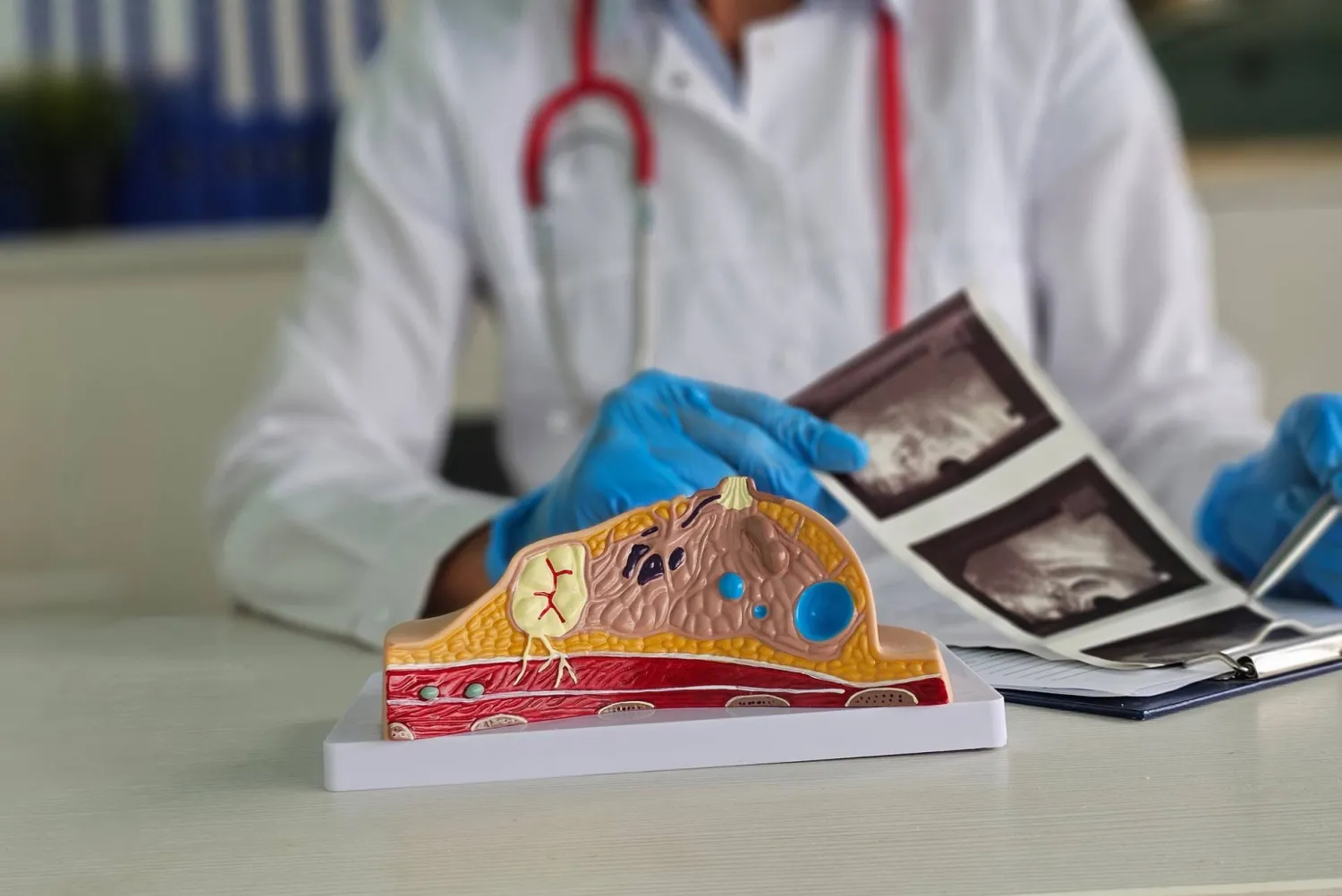
A breast radiologist reviews ultrasound images and examination results. (Shutterstock)
TT

When 'That Disease' Became Mine

A breast radiologist reviews ultrasound images and examination results. (Shutterstock)

No one prepares you for that moment. For that phone call. For the instant you feel the life you have built, with care, patience, and love, beginning to collapse. “I’m sorry... we found cancer cells.” How? Why?

All I could see were the faces of my two daughters. Had I failed them? Would I still be here to watch them grow? Would I still get to be their mother? No one prepares you for the fear that follows those words.

How could this happen? No one in my family has ever had breast cancer. I never skipped my annual checkups. In fact, I had undergone my routine mammogram just one month earlier. It showed nothing. No warning signs. No reason to worry.

So how? How? How? Then time seemed to stop.

A procession of faces flashed before me: my husband, my parents, my siblings, my family, my friends, my colleagues. One question overwhelmed every other thought: How was I going to tell them?

And then came the hardest question of all. How was I going to tell my daughters?

In that moment, I felt I had somehow let everyone down.

My own body, one I had spent years caring for, had betrayed me. It had pulled me into unfamiliar territory, a place I never imagined I would have to enter. I exercise with almost obsessive discipline. I pay close attention to what I eat. I rarely get sick. Even COVID somehow passed me by. So how had this happened?

Once the initial shock began to fade, another part of me took over: the journalist. Instead of asking only, Why me? I began asking the questions I have spent my career asking.

What do the facts say?

What do the numbers tell us?

What are the treatment options?

What are the chances of recovery?

The answers surprised me. Nearly 90 percent of women diagnosed with breast cancer have no inherited genetic mutation linked to the disease and no family history of it. That reality challenges one of the most common assumptions many of us carry: that breast cancer is primarily hereditary. It also made me question the countless medical forms we fill out, where family history often feels like the defining measure of our risk.

I learned something else I wish someone had told me years ago: an annual mammogram may not detect a tumor in its earliest stages, while an MRI can sometimes reveal what other imaging cannot. I knew none of this. I wish I had.

By the grace of God, and because my cancer was caught early, I found myself facing a disease with a clear treatment plan and an excellent prognosis.

What I am going through is deeply personal, and something I would never wish on anyone. My first instinct was to keep it private. I thought that if I didn’t talk about it, perhaps I could pretend that the long road of treatment ahead wasn’t real. Perhaps silence would make it easier.

Instead, the opposite happened. The more I learned, the more I felt a responsibility to speak. I realized that staying silent would not change my reality. But it might deny another woman information that could change hers.

That is why I decided to write. Not because I am asking for sympathy. Not because I am seeking pity. I have been overwhelmed by the love, kindness, and support I have received, and I am deeply grateful for every message, every prayer, and every hand that has reached out to help me.

I am writing because I now understand that my story is not unusual. Thousands of women are living this same experience, quietly, and often alone.

Today, I find myself searching for women who have walked this path before me so I can learn from them. At the same time, I am choosing to make my own journey public in the hope that it may help someone else.

Perhaps another woman, somewhere far away, will read these words before finally scheduling the screening she has postponed for months. Perhaps she will ask for a second opinion. Perhaps she will insist on an MRI after a normal mammogram if something still doesn’t feel right.

Or perhaps she will simply find comfort in seeing me continue to write, continue to work, continue to appear on television, living my life while navigating treatment. I am not afraid of what lies ahead. Treatment will be difficult. There will be hard days. I know that.

But I also know this: I can endure pain. I will fight with everything I have, with my strength, my spirit, my body, and every ounce of determination I possess. I will fight for my daughters. For my husband. For my parents, my siblings, and my family. For my friends, who have become family in this life far from home.

I will fight. Perhaps it will defeat me. Perhaps I will defeat it. But I will never surrender.

To every woman who has fought, or is still fighting, this battle: I stand with you. I may grow tired. I may cry. I may have moments when I feel overwhelmed.

But I will never stop living. I will never stop loving. I will never stop finding joy. And I will never stop doing the work that gives my life purpose.

Breast cancer is now part of my story. But it will not be the ending of it. And I refuse to let it define who I am. I also hope to challenge a mindset that still exists in many of our communities: a fear so deep that people hesitate to even say the word *cancer* aloud, as though speaking its name somehow gives it power.

I believe the opposite is true. Naming it is the first step toward confronting it. Talking about it is the first step toward awareness. Awareness is the first step toward saving lives.

My name is Rana Abtar. I have breast cancer. It is part of my story. It is not my identity. And it will never define the life I choose to live. Because if this disease has entered my life, then I intend to confront it with the one thing it can never understand: A relentless love of life.



Paris Landmarks Shutter Early as Quarter of France Swelters Under Heatwave

 A sign informs visitors that the Eiffel Tower will close at 16:00 CEST today due to extreme temperatures during a heatwave in Paris, France, July 11, 2026. (Reuters)
A sign informs visitors that the Eiffel Tower will close at 16:00 CEST today due to extreme temperatures during a heatwave in Paris, France, July 11, 2026. (Reuters)
TT

Paris Landmarks Shutter Early as Quarter of France Swelters Under Heatwave

 A sign informs visitors that the Eiffel Tower will close at 16:00 CEST today due to extreme temperatures during a heatwave in Paris, France, July 11, 2026. (Reuters)
A sign informs visitors that the Eiffel Tower will close at 16:00 CEST today due to extreme temperatures during a heatwave in Paris, France, July 11, 2026. (Reuters)

The Eiffel Tower and other Paris landmarks announced early closures over the weekend as a quarter of mainland France was under the highest heat alert level on Saturday in the third heatwave to hit the country since May.

The operator of the Eiffel Tower said the latticed-steel monument would "exceptionally close" early on Saturday and Sunday at 4 pm (1400 GMT), "due to the high temperatures forecast".

The 324-meter (1,063-foot) tower, which attracts seven million tourists a year, usually stays open past midnight during the high season.

Two of the French capital's most famous museums, the Louvre and the Musee d'Orsay, have taken similar measures.

The Louvre, the most visited museum in the world, said on Thursday it would close at 4 pm from Friday through to Monday.

The Musee D'Orsay announced it would also close early, "due to the extreme heat" at 5 pm from Saturday to Wednesday.

Twenty-four departments, home to 22.2 million people according to an AFP calculation, were under the maximum alert level issued by the national weather service Meteo-France on Saturday.

Another 59 departments of 96 in mainland France were under an orange heat warning, a step below the highest, as people flooded trains and highways at the start of a holiday weekend ahead of France's national public holiday on July 14.

Across France, many towns have called off their firework displays for Bastille Day due to increased fires and dry conditions.

Wildfires have scorched twice as much land in France so far this year as in the same period last year, an official said on Friday.

French President Emmanuel Macron called for vigilance on Saturday, warning nine out of 10 fires are due to human activity.

"A single second of inattention can put families at risk, endanger those who protect us and destroy our countryside," he wrote on X.

The European nation is facing its third heatwave since May, with a heatwave in June shattering records.

The country recorded more than 2,000 excess deaths during the June heatwave, and 300 during the high temperatures in late May, according to official figures.

The government has faced a barrage of criticism, accused of being "unprepared" for the extreme weather, the increasing frequency of which scientists have linked to man-made climate change.

High temperatures are expected to continue until Bastille Day, according to Meteo-France.


Dangerous Heatwave Is Building, Will Bring Oppressive Temperatures to Much of the US

Visitors use fans as as they wait to enter the Washington Monument, July 1, 2026, in Washington. (AP)
TT

Dangerous Heatwave Is Building, Will Bring Oppressive Temperatures to Much of the US

Visitors use fans as as they wait to enter the Washington Monument, July 1, 2026, in Washington. (AP)

A widespread and dangerous heatwave is building across the US, with triple-digit highs expected in the Southwest and Great Plains this weekend before spreading eastward under a dome of high pressure that meteorologists say could trap oppressive temperatures for a week or more.

Forecasters are advising people to stay hydrated and find places to cool off, warning of temperatures 15 to 25 degrees Fahrenheit (8 to 14 degrees Celsius) warmer than normal in many areas, including at night — especially bad for people's health because their bodies won't have a chance to recover. The heat dome is expected to affect as much as two-thirds of the continental United States.

“The heat doesn’t necessarily stop when it’s dark out,” said Josh Adam, a meteorologist with the National Weather Service in Bismarck, North Dakota, where temperatures will surpass 100 F (37 C) until Tuesday. That is a dramatic spike for a state where summer temperatures are typically in the 80s, he said.

The National Weather Service predicts that more than 90 US local temperature records will be tied or broken through Wednesday — with two-thirds of those being overnight heat records. Temperatures won’t drop below 80 F (27 C) at night in Fort Lauderdale, Florida; Miami; Tampa, Florida; Galveston, Texas; and Charleston, South Carolina, according to the forecast.

The current heat dome — formed when high pressure traps hot air while blocking cooling winds and rain — is one of the strongest to affect the Dakotas in 25 years, said Chad Merrill, a senior meteorologist with AccuWeather.

Forecasters expect record triple-digit highs this weekend in Nevada, Utah, Colorado, Wyoming, Idaho, Montana, North Dakota and South Dakota.

Nevada, a state accustomed to hot weather, is even hotter than normal, said Andrew Gorelow, a meteorologist with the National Weather Service in Las Vegas. The temperature in Las Vegas is expected to hit 111 F (48 C) on Saturday, Gorelow said.

Hydrating and finding cool spaces is critical, experts said.

They also warn the heat could spike fire risk to some parts of the country that already are dry, including the Rockies, where Merrill said dry thunderstorms could develop.

Climate change from the burning of coal, oil and natural gas is causing more intense and longer-lasting heatwaves that cover larger areas, scientists say.

This year's temperatures also are expected to be affected by El Nino, a natural warming of the equatorial Pacific that alters weather patterns and spikes temperatures across the globe.

The current El Nino — which formed last month and is too young to have affected this heatwave much — is expected to rank as among the most intense since the weather service began tracking them in 1950, experts said.

It has an 81% chance of becoming “very strong” — the top category — by fall, the US National Oceanic and Atmospheric Administration said Thursday.


Charles Hosted Prince Harry and Family for First Time in Years as They Try to Repair a Family Rift

Britain's Prince Harry speaks at the National Exhibition Centre (NEC), the primary venue for the 2027 Invictus Games, as it marks one year until the event, in Marston Green, near Birmingham, Britain, July 10, 2026. (Aaron Chown/Pool via Reuters)
TT

Charles Hosted Prince Harry and Family for First Time in Years as They Try to Repair a Family Rift

Britain's Prince Harry speaks at the National Exhibition Centre (NEC), the primary venue for the 2027 Invictus Games, as it marks one year until the event, in Marston Green, near Birmingham, Britain, July 10, 2026. (Aaron Chown/Pool via Reuters)

King Charles III hosted Prince Harry and met with his family for the first time in years Friday as they try to repair a rift that has persisted since his youngest son and wife quit royal life and moved to America six years ago.

Harry, Meghan and their two children, Prince Archie and Princess Lilibet, met with the king and Queen Camilla at Highgrove House, a country estate west of London, Buckingham Palace confirmed.

The Duke of Sussex had arrived Monday in his homeland for a number of charity events that were overshadowed by speculation of whether he would meet with his father.

British tabloids and news broadcasts were filled with speculation about whether Meghan, Duchess of Sussex, would accompany him and, more importantly, whether they would bring their two children so they can finally get to know Grandpa Charles.

However, the monarch’s schedule is often years in the making, with events penciled in long before they take place. An opportunity to hold such a meeting would have been fleeting, particularly because the children would need to return to school in the fall and because they live in California.

The wish to seize the moment fueled tensions between Harry and royal officials earlier this week. That was highlighted by embarrassing scenes when royal officials first invited Harry to stay at Buckingham Palace, then rescinded the offer after the prince didn’t accept it in a timely manner.

Harry’s visit also coincided with him losing his final lawsuit in his quest to tame the British tabloids. A judge ruled that he failed to prove his privacy invasion claims against the publisher of the Daily Mail.

His legal battles have been a source of friction with his family, however. Harry has said he wants to reconcile with his 77-year-old father, who is being treated for an undisclosed form of cancer.

Harry and Charles met briefly for a cup of tea in September during a short visit in London, the first time they’d seen each other in well over a year.

But the prince has also wanted his children to see the monarch, whom they first met during celebrations for the late Queen Elizabeth II’s Platinum Jubilee in 2022.

The royal children, Archie, 7, and Lilibet, 5, are now old enough to remember meeting their grandfather, and will certainly hope for pictures with the king, though the event was deemed private and no images will be publicly released.

Tensions within the House of Windsor have heightened ever since Harry and Meghan gave up their royal duties and moved to California to pursue lucrative media deals, free from the pressures of royal life in London.

They reached a new low after Harry published an explosive memoir that included unflattering depictions of the royal family and damning allegations of a toxic relationship between the monarchy and the press.

Harry’s description of royals leaking information about other family members in exchange for positive coverage of themselves is just one of the tawdry allegations in his book, “Spare.” The prince was especially scathing about Camilla, accusing her of feeding private conversations to the media as she sought to rehabilitate her image after her longtime affair with Charles when he was heir to the throne.

After losing a court battle over his security issue last year, Harry said he hoped to rebuild relations with his family, even as he suggested that the royals had sought to prevent him from receiving police protection to punish him for walking away from royal duties.

“I would love reconciliation with my family. There’s no point in continuing to fight anymore,” Harry told the BBC. “I don’t know how much longer my father has.”

The visit Friday is a step toward mending those fences.