


A Journey Through 28 Letters: Riyadh Exhibition Traces Story of Arabic from Ancient Inscriptions to Modern Technology

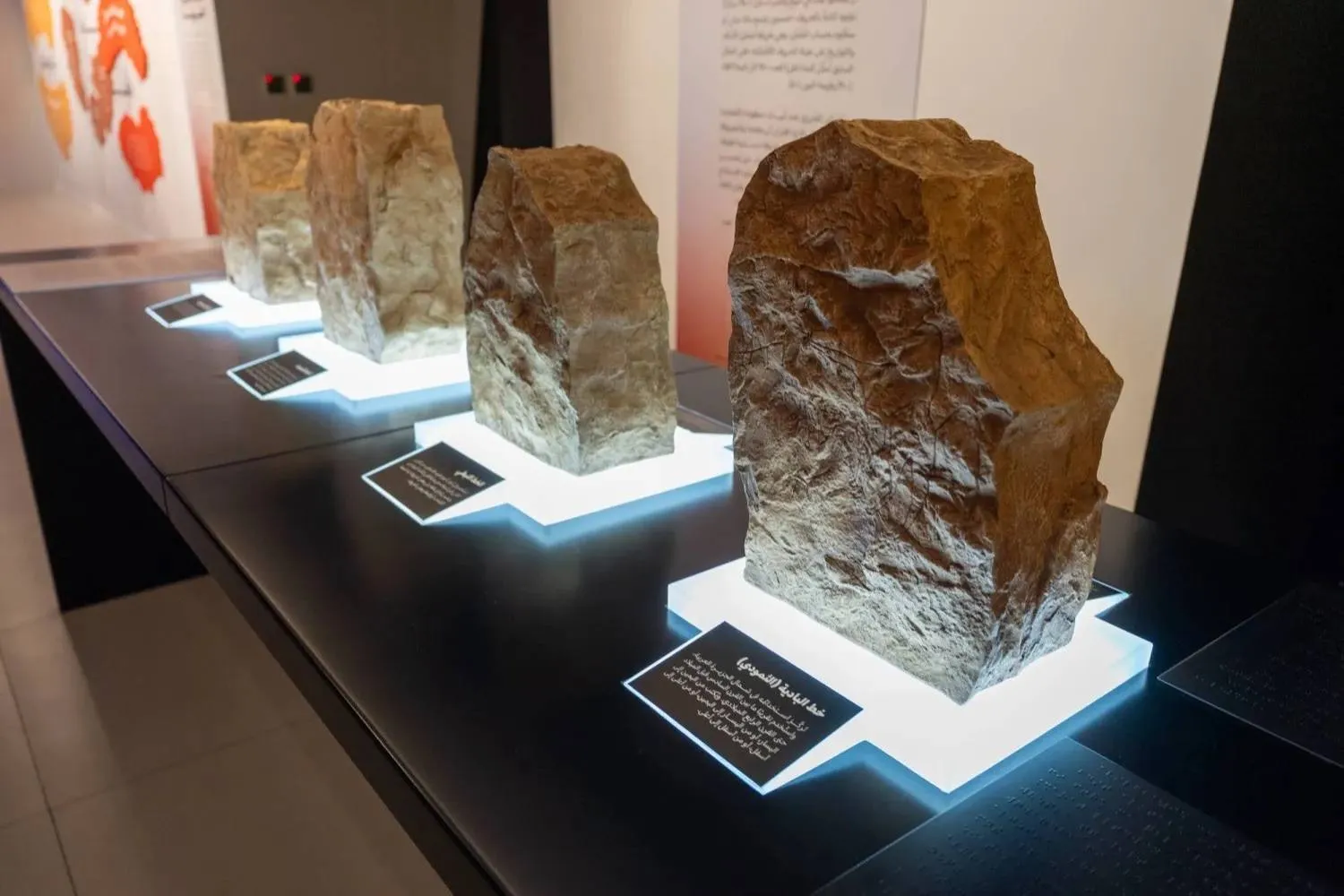
The exhibition features authentic rock specimens engraved with examples of ancient scripts (Academy). 
TT

A Journey Through 28 Letters: Riyadh Exhibition Traces Story of Arabic from Ancient Inscriptions to Modern Technology

The exhibition features authentic rock specimens engraved with examples of ancient scripts (Academy). 

A historical and intellectual journey awaits visitors to “Arabic Language: Twenty-Eight Letters of Light,” an exhibition in Riyadh that tells the story of one of humanity’s oldest languages.

Through its galleries and interactive displays, the exhibition brings the story of the “language of ḍād” out of books and dictionaries into an innovative, technology-driven experience.

The exhibition has opened at the headquarters of the King Salman Global Academy for Arabic Language in Riyadh. Aimed at academics, researchers, teachers, students, and Arabic-language enthusiasts, it offers visitors a creative and contemporary way to explore the language.

Its interactive stations allow visitors to explore a range of linguistic topics, engage with modern educational platforms, and participate in specialized training sessions designed to enhance Arabic learners’ skills, improve teaching methods, and present Arabic as a dynamic language capable of keeping pace with advances in knowledge.

The exhibition also serves as a cultural landmark in Riyadh, reinforcing the status of Arabic while supporting the goals of Saudi Vision 2030 in the cultural, tourism, and heritage sectors. Technology-based exhibits trace the language’s history, authenticity, and standing among the world’s languages, highlighting its beauty, richness, and uniqueness.

One section explores the history of languages in the Arabian Peninsula, explaining how scholars have classified the world’s languages into major families and how different linguistic approaches have produced varying classifications. It outlines how many linguists place Arabic within the Hamito-Semitic language family, specifically among the Southwest Semitic languages, which include both Northern and Southern Arabic and the languages of the Arabian Peninsula.

Semitic languages share common characteristics in their sounds, vocabulary, morphology, and grammar. Many scholars believe Arabic is the closest surviving Semitic language to the ancient Proto-Semitic tongue. As spoken and written forms gradually diverged, writing systems emerged across the Arabian Peninsula, enabling people to record languages that differed from their spoken dialects.

Among the exhibits are authentic rock specimens bearing ancient inscriptions, including Thamudic and Nabataean scripts, preserved over centuries in rocks and valley walls as enduring evidence of the evolution of writing and language across Arabia.

Another section traces the evolution of writing itself. Early civilizations wrote on stone, copper, wood, clay tablets, tree materials, camel shoulder blades and ribs, and leather. The exhibition explains how the Sumerians introduced the sharpened stylus in the early fourth millennium BC, using pointed wooden implements to inscribe soft clay tablets that were later dried in the sun. The stylus’s wedge-shaped impression gave rise to what became known as cuneiform writing.

Writing instruments continued to evolve, with different pens developed for specialized purposes. During the Umayyad period, the calligraphers Khalid ibn Abi al-Hayyaj and Qutbah al-Muharrir gained prominence, while the Abbasid era saw the rise of Ibn Muqlah, regarded as the master of Arabic calligraphy, and his student Ibn al-Bawwab.

Over the centuries, Arab scholars developed detailed rules for holding and cutting pens and produced books devoted to writing instruments. Papermaking flourished during the Abbasid era, and Muslims were the first to introduce paper to Spain, paving the way for its spread across Europe.

The exhibition also serves as an advanced knowledge platform, presenting Arabic in its cultural and scientific contexts while showcasing Saudi Arabia’s efforts to support the language, develop Arabic-language education, strengthen its presence in academic and scientific circles, and promote it globally. Through its interactive environment, visitors gain a deeper appreciation of Arabic’s long history, its evolution through the centuries, and its contributions to thought, science, and the arts.

Ali Al-Ahmad, a doctoral researcher in philology, stressed that the exhibition succeeds in transforming the history and development of Arabic “from the dry theoretical setting of lecture halls and dissertations into a living, interactive space that engages the senses.”

“For us as researchers,” he said, “the exhibition offers a different experience by integrating modern technology to tell the remarkable story of our language. Visitors almost feel that Arabic is a living organism, constantly evolving and responding to the changes in its environment.”

Seeing the roots of words, patterns of derivation, and semantic development presented through visual and interactive technological platforms, he added, “compresses years of traditional learning. The exhibition bridges the gap between the digital generation and the authenticity of the Arabic script, offering tangible proof that Arabic is fully capable of leading today’s knowledge landscape, not merely keeping pace with it.”



When 'That Disease' Became Mine

A breast radiologist reviews ultrasound images and examination results. (Shutterstock)
TT

When 'That Disease' Became Mine

A breast radiologist reviews ultrasound images and examination results. (Shutterstock)

No one prepares you for that moment. For that phone call. For the instant you feel the life you have built, with care, patience, and love, beginning to collapse. “I’m sorry... we found cancer cells.” How? Why?

All I could see were the faces of my two daughters. Had I failed them? Would I still be here to watch them grow? Would I still get to be their mother? No one prepares you for the fear that follows those words.

How could this happen? No one in my family has ever had breast cancer. I never skipped my annual checkups. In fact, I had undergone my routine mammogram just one month earlier. It showed nothing. No warning signs. No reason to worry.

So how? How? How? Then time seemed to stop.

A procession of faces flashed before me: my husband, my parents, my siblings, my family, my friends, my colleagues. One question overwhelmed every other thought: How was I going to tell them?

And then came the hardest question of all. How was I going to tell my daughters?

In that moment, I felt I had somehow let everyone down.

My own body, one I had spent years caring for, had betrayed me. It had pulled me into unfamiliar territory, a place I never imagined I would have to enter. I exercise with almost obsessive discipline. I pay close attention to what I eat. I rarely get sick. Even COVID somehow passed me by. So how had this happened?

Once the initial shock began to fade, another part of me took over: the journalist. Instead of asking only, Why me? I began asking the questions I have spent my career asking.

What do the facts say?

What do the numbers tell us?

What are the treatment options?

What are the chances of recovery?

The answers surprised me. Nearly 90 percent of women diagnosed with breast cancer have no inherited genetic mutation linked to the disease and no family history of it. That reality challenges one of the most common assumptions many of us carry: that breast cancer is primarily hereditary. It also made me question the countless medical forms we fill out, where family history often feels like the defining measure of our risk.

I learned something else I wish someone had told me years ago: an annual mammogram may not detect a tumor in its earliest stages, while an MRI can sometimes reveal what other imaging cannot. I knew none of this. I wish I had.

By the grace of God, and because my cancer was caught early, I found myself facing a disease with a clear treatment plan and an excellent prognosis.

What I am going through is deeply personal, and something I would never wish on anyone. My first instinct was to keep it private. I thought that if I didn’t talk about it, perhaps I could pretend that the long road of treatment ahead wasn’t real. Perhaps silence would make it easier.

Instead, the opposite happened. The more I learned, the more I felt a responsibility to speak. I realized that staying silent would not change my reality. But it might deny another woman information that could change hers.

That is why I decided to write. Not because I am asking for sympathy. Not because I am seeking pity. I have been overwhelmed by the love, kindness, and support I have received, and I am deeply grateful for every message, every prayer, and every hand that has reached out to help me.

I am writing because I now understand that my story is not unusual. Thousands of women are living this same experience, quietly, and often alone.

Today, I find myself searching for women who have walked this path before me so I can learn from them. At the same time, I am choosing to make my own journey public in the hope that it may help someone else.

Perhaps another woman, somewhere far away, will read these words before finally scheduling the screening she has postponed for months. Perhaps she will ask for a second opinion. Perhaps she will insist on an MRI after a normal mammogram if something still doesn’t feel right.

Or perhaps she will simply find comfort in seeing me continue to write, continue to work, continue to appear on television, living my life while navigating treatment. I am not afraid of what lies ahead. Treatment will be difficult. There will be hard days. I know that.

But I also know this: I can endure pain. I will fight with everything I have, with my strength, my spirit, my body, and every ounce of determination I possess. I will fight for my daughters. For my husband. For my parents, my siblings, and my family. For my friends, who have become family in this life far from home.

I will fight. Perhaps it will defeat me. Perhaps I will defeat it. But I will never surrender.

To every woman who has fought, or is still fighting, this battle: I stand with you. I may grow tired. I may cry. I may have moments when I feel overwhelmed.

But I will never stop living. I will never stop loving. I will never stop finding joy. And I will never stop doing the work that gives my life purpose.

Breast cancer is now part of my story. But it will not be the ending of it. And I refuse to let it define who I am. I also hope to challenge a mindset that still exists in many of our communities: a fear so deep that people hesitate to even say the word *cancer* aloud, as though speaking its name somehow gives it power.

I believe the opposite is true. Naming it is the first step toward confronting it. Talking about it is the first step toward awareness. Awareness is the first step toward saving lives.

My name is Rana Abtar. I have breast cancer. It is part of my story. It is not my identity. And it will never define the life I choose to live. Because if this disease has entered my life, then I intend to confront it with the one thing it can never understand: A relentless love of life.


Thousands Evacuated from Homes in Southwest France as Wildfire Burns

This photograph shows a wildfire burning in the Aspres region seen from Millas, in the Pyrenees-Orientales department, southern France on July 5, 2026. (AFP)
TT

Thousands Evacuated from Homes in Southwest France as Wildfire Burns

This photograph shows a wildfire burning in the Aspres region seen from Millas, in the Pyrenees-Orientales department, southern France on July 5, 2026. (AFP)

‌A wildfire burning out of control in southwestern France has forced the evacuation of 10,000 people from two dozen small towns and villages near the Spanish border and officials said strong winds on Monday would further fan the blaze.

The fire has scorched some 4,600 hectares in the foothills of the French Pyrenees, local prefect Pierre Regnault de la Mothe said in a post on X.

"This morning ‌conditions are ‌deteriorating again," Interior Minister Laurent Nunez ‌warned ⁠on French TV ⁠station TF1. "Today the battle resumes."

Early summer heatwaves in France and across western Europe in May and June have scorched vast areas of land, making them particularly vulnerable to wildfires this year.

The Trevillach blaze is burning in the vicinity of the third stage ⁠of the Tour de France. Local ‌authorities have closed ‌the leg to the public to allow emergency services easy ‌access to the area. Although the race will ‌proceed, the motorcade of team vehicles that follows will now be kept to a minimum.

On the Spanish side of the border, the fire ravaged 2,200 hectares — 97% ‌of them in the protected natural area of Les Gavarres — but Catalan authorities ⁠said ⁠late on Saturday that it was stable and would be completely extinguished during the week.

Police have arrested an employee of a company contracted by Catalonia's regional government who is suspected of having sparked the wildfire by using an angle grinder at the side of a road.

South of Catalonia, in the eastern Castellon province, 500 people were evacuated after a wildfire entered the Sierra de Espadan national park, home to a significant cork oak forest.


Oldest Quasars Ever Discovered Add to ‘Perplexing’ Space Mystery

Multiple images of a distant quasar are visible in this undated combined view from NASA’s Chandra X-ray Observatory and the Hubble Space Telescope. (Reuters/NASA handout via Reuters)
TT

Oldest Quasars Ever Discovered Add to ‘Perplexing’ Space Mystery

Multiple images of a distant quasar are visible in this undated combined view from NASA’s Chandra X-ray Observatory and the Hubble Space Telescope. (Reuters/NASA handout via Reuters)

The Euclid space telescope has spotted the oldest quasars -- the brightest objects in the universe -- ever discovered, deepening a cosmic mystery that has been puzzling scientists.

Quasars are powered by supermassive black holes at the heart of early galaxies gobbling up surrounding matter in a colossal feeding frenzy that can shine trillions of times brighter than the Sun.

Because they are so incredibly bright -- and looking deep into space also means looking back in time -- scientists have been hunting for ancient quasars to learn more about the little-understood infancy of the universe.

In a study published on Monday, an international team of astronomers announced they had discovered 31 quasars, including the two oldest observed yet, using the European Space Agency's Euclid telescope, which is at a stable hovering spot around 1.5 million kilometers from Earth.

The light from the oldest pair comes from when the universe was roughly 670 million years old, just five percent of its current age of 13.8 billion years.

This beats the team's previous record for oldest -- and therefore most distant -- quasar announced in 2021 by around 20 million years.

Previous quasar hunts were mostly carried out with ground-based telescopes, but the launch of Euclid in 2023 "has transformed this field," Daming Yang, the lead author of the study in Astronomy & Astrophysics, told AFP.

In just two years, Euclid has doubled the number of ancient quasars known to science, added Yang, a PhD student at Leiden University in the Netherlands.

- Cosmic quandary -

The newly discovered quasars date back to what is known as the epoch of reionization. This when the first stars and galaxies began to form, bringing an end to the cosmic dark ages.

"We can use quasars as a lighthouse to study the gas between us and them, so that we can trace how the universe was reionized through this cosmic history," Daming Yang said.

The quasars are also the latest example of a problem that has been increasingly baffling scientists.

As more powerful telescopes allow us to see further back in time, galaxies and other cosmic objects have turned out to be far bigger than had been thought possible at such an early age.

"Every step further back in time makes the puzzle more perplexing," study co-author Joseph Hennawi said in a statement about the newly discovered quasars.

"These monsters -- weighing billions of times the mass of our Sun -- somehow already existed when the universe was in its infancy," he said.

"We don't yet have a good understanding of how they grew so massive, so fast."

Hoping to find an answer, the scientists are searching for even older quasars.

The far-seeing James Webb space telescope also recently observed the newly announced quasars, Daming said, and the team will soon begin sifting through the data it collected.

The team eventually hope to stitch together "a quasar chronicle of the first billion years," Hennawi said.