Europe May Face ‘More Deadly Weeks’ as New Heatwave Builds, WHO Warns

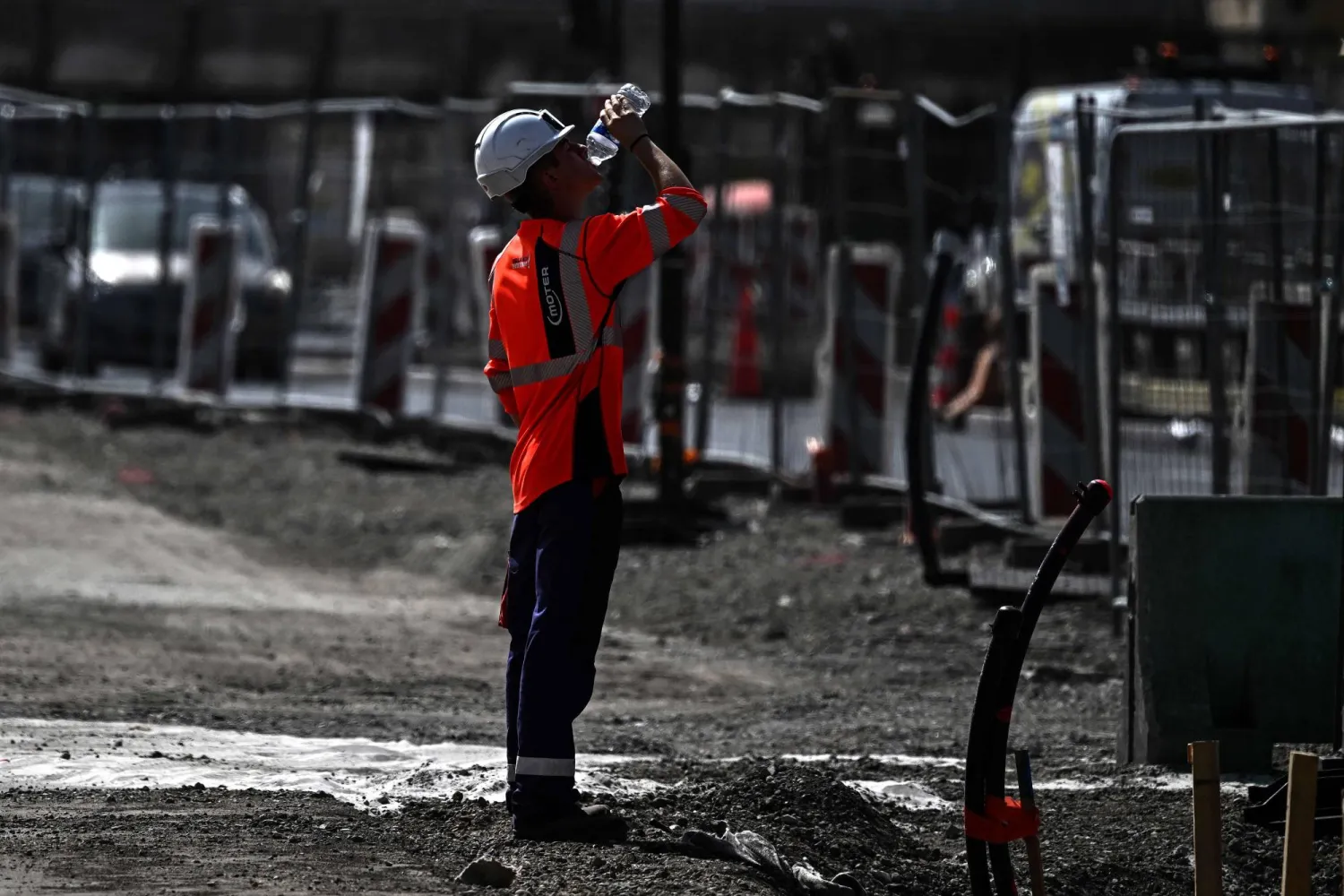
A worker drinks water from a plastic bottle at a construction site in Bordeaux, southwestern France on June 22, 2026, as France experiences a ferocious heatwave. (AFP)
TT

Europe May Face ‘More Deadly Weeks’ as New Heatwave Builds, WHO Warns

A worker drinks water from a plastic bottle at a construction site in Bordeaux, southwestern France on June 22, 2026, as France experiences a ferocious heatwave. (AFP)

The World Health ‌Organization warned on Tuesday that Europe could face “more deadly weeks” ahead, with another intense heatwave forming over the Atlantic.

Temperatures in Portugal and southern Spain are expected to climb to 43 degrees Celsius (109 degrees Fahrenheit) in the coming days.

WHO Regional Director for Europe Hans Kluge held an emergency call on Monday with representatives from 41 countries in the region, ‌the European ‌Commission and civil society groups to ‌discuss ⁠lessons from the ⁠recent heatwave and preparations for the next one.

Kluge said in a statement that countries with heat-health action plans in place responded more quickly and better protected their populations during the June heatwave.

However, he said that less ⁠than half of WHO's European member states ‌had such a ‌plan in place.

Experts have said the June ‌20-28 heatwave was the most severe recorded in ‌Europe, causing disruption to power generation, damaging infrastructure and overwhelming healthcare systems.

The extreme heat was almost certainly driven by climate change, scientists said.

France, the ‌Netherlands and Belgium recorded 3,700 excess deaths, with authorities warning that the numbers ⁠are preliminary ⁠and could rise.

Temperatures hit 40 degrees Celsius in parts of Europe during the heatwave.

Kluge said care home residents, homeless people and socially isolated older adults were still not being reached consistently across Europe.

"The work now is on two fronts: fixing what failed in recent weeks before the next heatwave hits and building the kind of health systems that don’t just respond to extreme heat but are ready for it," Kluge said.


‘Pokemon Airport’ Opens to Help Japanese Quake-Hit Region

A "Pikachu" balloon is displayed at the Noto Airport in Wajima City, Ishikawa Prefecture on July 7, 2026. (JIJI / AFP)
TT

‘Pokemon Airport’ Opens to Help Japanese Quake-Hit Region

A "Pikachu" balloon is displayed at the Noto Airport in Wajima City, Ishikawa Prefecture on July 7, 2026. (JIJI / AFP)

An airport in a remote Japanese region hit by a deadly earthquake in 2024 was given a new look on Tuesday, temporarily nicknamed after the Pokemon universe, and its lobby adorned with a floating Pikachu on a plane-shaped balloon.

The Noto Peninsula has faced a decline in tourists since the powerful 7.5-magnitude quake on New Year's Day two years ago that claimed over 700 lives.

On Tuesday, a life-size Pikachu mascot dressed as a pilot joined officials for a ribbon-cutting ceremony to officially nickname the local facility "Noto Satoyama Pokemon With You Airport" and welcome visitors.

More than 100 Pokemon characters are displayed across the airport, including the lobby wall.

The name will be used for three years, according to the Pokemon With You Foundation.

Public broadcaster NHK reported in February that the number of visitors who stay overnight in the region remains at just over 30 percent of pre-quake levels.


Prince Harry to Discover Outcome of UK Tabloids Case

FILE PHOTO: Britain's Prince Harry departs after attending court for his appeal against the rejection of his legal challenge to the British government's decision to take away his police protection when he is in Britain, outside the High Court in London, Britain, April 8, 2025. REUTERS/Maja Smiejkowska/File Photo
TT

Prince Harry to Discover Outcome of UK Tabloids Case

FILE PHOTO: Britain's Prince Harry departs after attending court for his appeal against the rejection of his legal challenge to the British government's decision to take away his police protection when he is in Britain, outside the High Court in London, Britain, April 8, 2025. REUTERS/Maja Smiejkowska/File Photo

Prince Harry was in Britain on Tuesday as a court was set to rule in his case against the Daily Mail's publisher for alleged unlawful information gathering.

A judge at London's High Court was due to publish a written decision at 2:00 pm (1300 GMT), following an 11-week trial earlier this year in Harry's claim against Associated Newspapers.

The prince gave emotional testimony during the proceedings, in which several high-profile figures, including pop star Elton John and actor Elizabeth Hurley, accused the tabloid publisher of invading their privacy.

Harry's lawyers have said the claimants are seeking "substantial" damages for their claims, which relate to articles dating from 1993 to 2018.

It is the third, and set to be final, case brought by the Duke of Sussex in his acrimonious legal battle with British tabloids, which has further strained relations with the royal family.

Harry, 41 - the youngest son of King Charles III - has also been involved in other legal spats, including over his police protection in Britain following his dramatic departure from frontline royal duties six years ago.

The prince, now living in California, arrived in Britain on Monday for a five-day visit expected to go ahead mostly without his wife and children after the family was refused police protection.

The trip, to mark the one-year countdown to next year's Invictus Games for wounded veterans, which Harry founded, was meant to be his first family trip back to the UK in four years.

But a source close to the Duke of Sussex told AFP that Harry's wife Meghan, son Archie and daughter Lilibet would not accompany him on the London leg of the trip after the family was refused security.

Arrangements for the rest of the trip were still under consideration, the source said, leaving it unclear whether the whole family would visit but stay outside the capital.

Contradictory statements about plans to stay at Buckingham Palace while in London added to the prince's headaches.

Just ahead of Harry's arrival, Buckingham Palace contradicted the duke's team to say that he would not be staying at the palace after missing a deadline to accept the accommodation offer.

Harry's spokesman said it was "disappointing" the offer to be hosted by his father had been "withdrawn at the last moment", in a statement sent to AFP.

- Security woes -

It was unclear whether the prince would meet his father during the trip. He is last understood to have met Charles, who is being treated for an undisclosed form of cancer, at the monarch's London residence Clarence House in September 2025.

Harry and Meghan left Britain for North America in 2020 amid a bitter feud with his family, which worsened as Harry published his tell-all memoir "Spare".

The prince has since said he wishes to reconcile with his father, but the confusion over where Harry was going to stay in London suggest relations remain difficult.

According to his spokesperson, Harry had to make "alternative security arrangements" for the trip after publicly funded protection was refused, contributing to the delay in accepting Buckingham Palace's accommodation offer.

"It is therefore unclear why, having formally accepted the accommodation offer, it has now been withdrawn at the last moment," the spokesman said.

Beyond logistical complications, the palace believed the legal judgement expected Tuesday had complicated matters as it could compromise the king's constitutional position, the PA news agency reported.

Last year, Harry said he felt unable to bring his family to Britain after losing a court case to have his security restored during visits home.

Harry has long blamed the media for the death of his mother Princess Diana, who was killed in a Paris car crash in 1997 while trying to shake off the paparazzi.

"He understands how that protection can fail and how catastrophic, therefore, those results can be," Simon Morgan, a former bodyguard for the royal family, told AFP on Monday.


A Journey Through 28 Letters: Riyadh Exhibition Traces Story of Arabic from Ancient Inscriptions to Modern Technology

The exhibition features authentic rock specimens engraved with examples of ancient scripts (Academy). 
TT

A Journey Through 28 Letters: Riyadh Exhibition Traces Story of Arabic from Ancient Inscriptions to Modern Technology

The exhibition features authentic rock specimens engraved with examples of ancient scripts (Academy). 

A historical and intellectual journey awaits visitors to “Arabic Language: Twenty-Eight Letters of Light,” an exhibition in Riyadh that tells the story of one of humanity’s oldest languages.

Through its galleries and interactive displays, the exhibition brings the story of the “language of ḍād” out of books and dictionaries into an innovative, technology-driven experience.

The exhibition has opened at the headquarters of the King Salman Global Academy for Arabic Language in Riyadh. Aimed at academics, researchers, teachers, students, and Arabic-language enthusiasts, it offers visitors a creative and contemporary way to explore the language.

Its interactive stations allow visitors to explore a range of linguistic topics, engage with modern educational platforms, and participate in specialized training sessions designed to enhance Arabic learners’ skills, improve teaching methods, and present Arabic as a dynamic language capable of keeping pace with advances in knowledge.

The exhibition also serves as a cultural landmark in Riyadh, reinforcing the status of Arabic while supporting the goals of Saudi Vision 2030 in the cultural, tourism, and heritage sectors. Technology-based exhibits trace the language’s history, authenticity, and standing among the world’s languages, highlighting its beauty, richness, and uniqueness.

One section explores the history of languages in the Arabian Peninsula, explaining how scholars have classified the world’s languages into major families and how different linguistic approaches have produced varying classifications. It outlines how many linguists place Arabic within the Hamito-Semitic language family, specifically among the Southwest Semitic languages, which include both Northern and Southern Arabic and the languages of the Arabian Peninsula.

Semitic languages share common characteristics in their sounds, vocabulary, morphology, and grammar. Many scholars believe Arabic is the closest surviving Semitic language to the ancient Proto-Semitic tongue. As spoken and written forms gradually diverged, writing systems emerged across the Arabian Peninsula, enabling people to record languages that differed from their spoken dialects.

Among the exhibits are authentic rock specimens bearing ancient inscriptions, including Thamudic and Nabataean scripts, preserved over centuries in rocks and valley walls as enduring evidence of the evolution of writing and language across Arabia.

Another section traces the evolution of writing itself. Early civilizations wrote on stone, copper, wood, clay tablets, tree materials, camel shoulder blades and ribs, and leather. The exhibition explains how the Sumerians introduced the sharpened stylus in the early fourth millennium BC, using pointed wooden implements to inscribe soft clay tablets that were later dried in the sun. The stylus’s wedge-shaped impression gave rise to what became known as cuneiform writing.

Writing instruments continued to evolve, with different pens developed for specialized purposes. During the Umayyad period, the calligraphers Khalid ibn Abi al-Hayyaj and Qutbah al-Muharrir gained prominence, while the Abbasid era saw the rise of Ibn Muqlah, regarded as the master of Arabic calligraphy, and his student Ibn al-Bawwab.

Over the centuries, Arab scholars developed detailed rules for holding and cutting pens and produced books devoted to writing instruments. Papermaking flourished during the Abbasid era, and Muslims were the first to introduce paper to Spain, paving the way for its spread across Europe.

The exhibition also serves as an advanced knowledge platform, presenting Arabic in its cultural and scientific contexts while showcasing Saudi Arabia’s efforts to support the language, develop Arabic-language education, strengthen its presence in academic and scientific circles, and promote it globally. Through its interactive environment, visitors gain a deeper appreciation of Arabic’s long history, its evolution through the centuries, and its contributions to thought, science, and the arts.

Ali Al-Ahmad, a doctoral researcher in philology, stressed that the exhibition succeeds in transforming the history and development of Arabic “from the dry theoretical setting of lecture halls and dissertations into a living, interactive space that engages the senses.”

“For us as researchers,” he said, “the exhibition offers a different experience by integrating modern technology to tell the remarkable story of our language. Visitors almost feel that Arabic is a living organism, constantly evolving and responding to the changes in its environment.”

Seeing the roots of words, patterns of derivation, and semantic development presented through visual and interactive technological platforms, he added, “compresses years of traditional learning. The exhibition bridges the gap between the digital generation and the authenticity of the Arabic script, offering tangible proof that Arabic is fully capable of leading today’s knowledge landscape, not merely keeping pace with it.”