


Drones, AI and White Paint: Europe Races to Protect Infrastructure from Heat

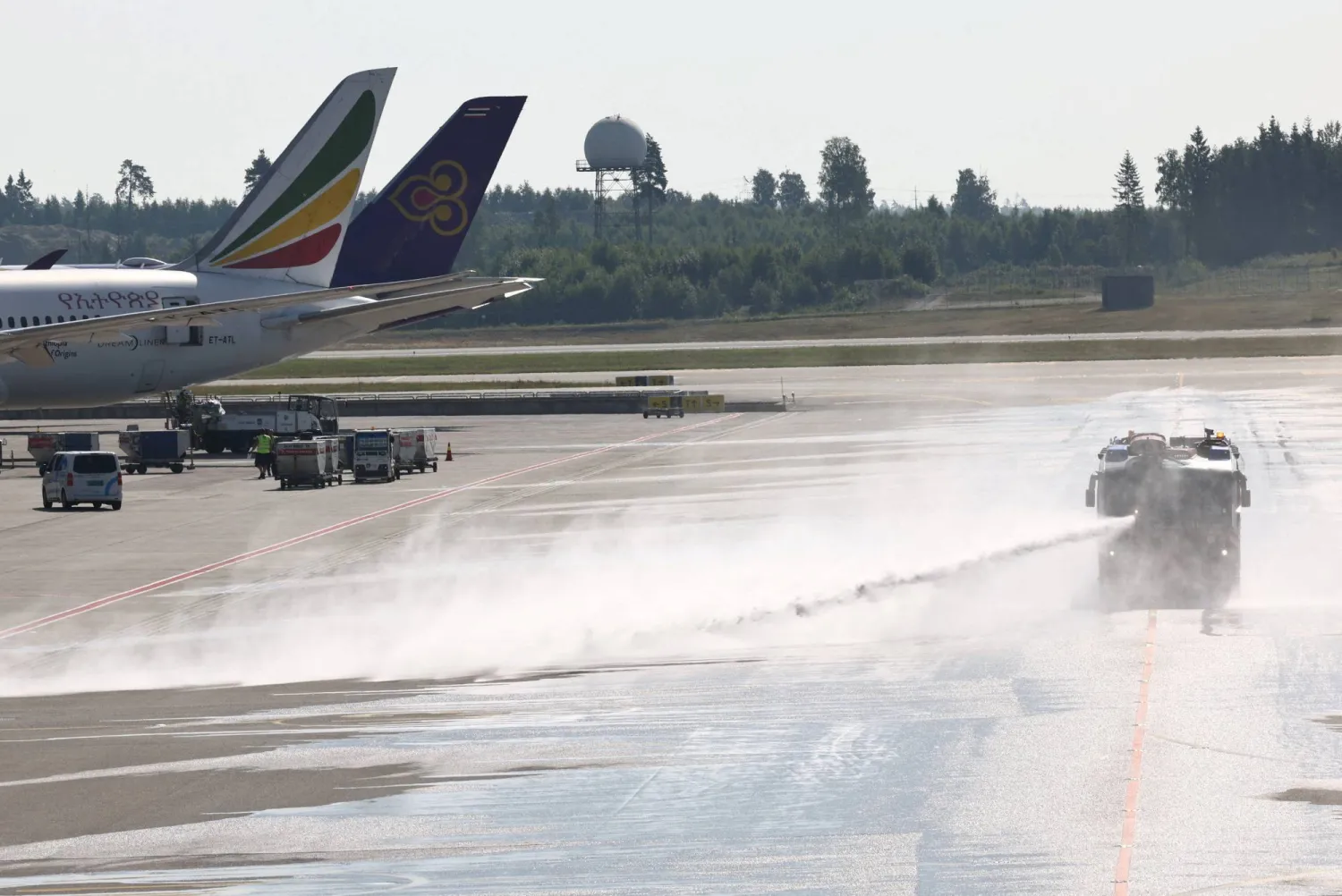
A vehicle from Oslo Airport’s fire rescue services sprays water onto the runway at the airport, to combat heat, in Oslo, Norway, July 15, 2026. REUTERS/Tom Little
TT

Drones, AI and White Paint: Europe Races to Protect Infrastructure from Heat

A vehicle from Oslo Airport’s fire rescue services sprays water onto the runway at the airport, to combat heat, in Oslo, Norway, July 15, 2026. REUTERS/Tom Little

As Europe's railways buckle under record heat, roads melt and power grids strain, countries are turning to an array of fixes for ageing infrastructure, from drones inspecting tracks and AI-powered sensors to a surprisingly simple tool: white paint.

At Norway's Oslo airport on Wednesday, with temperatures set to hit 30 degrees Celsius (86 degrees Fahrenheit), 10 C above normal for the time of year, workers doused the tarmac with water to keep it cool.

It's a marked shift in a country more used to coping with the cold that reflects how Europe is having to adapt to rising temperatures that are stoking wildfires, causing thousands of excess deaths and putting infrastructure under growing pressure.

"In Norway, the asphalt must withstand both extreme cold and fairly warm temperatures," said Jørn Arvid Remark, operating engineer at Norwegian state-owned airport operator Avinor, adding the airport was testing a new heat-resistant asphalt.

The fire brigade sprays around 9,000 liters of water on key parts of the runway, which can get damaged at high temperatures as it softens under the weight of aircraft, Reuters reported.

Europe's roads and railways, many built decades ago, are increasingly struggling to cope.

Temperatures across Western Europe on Wednesday were 5.5 C above the average for July ⁠15, according to the ⁠Reuters Climate Monitor.

"Our infrastructure is in no way prepared for the extreme weather events that we're going to see," said Chris Dodwell, co-head of sustainability center at Impax Asset Management, adding heatwaves, once rare, were becoming regular events.

A 2025 report by leading central banks estimated that severe weather events, including heatwaves, droughts and floods, could cut euro zone GDP by as much as 4.7% by 2030.

Europe's railways have felt the impact acutely.

An EU report in April found that more than 70% of rail managers were seeing growing disruption from extreme weather. Between 2015 and 2024 weather-related interruptions amounted to the equivalent of one to three years of railway service across the region.

Heat can cause tracks to expand, and points, ⁠signals and power to fail. However, extreme weather triggered by high temperatures can be even more disruptive.

"The most critical issue for rail networks is not the heat itself, but the thunderstorms, strong winds and landslides that often follow heatwaves," said Oliviero Baccelli, a professor at Milan's Bocconi University.

"Italy has already experienced significant disruptions to its railway network, particularly on Alpine routes, as a result of climate-related events."

Northern European countries such as Britain face particular challenges because much of their rail infrastructure was designed for a narrower temperature range than networks in southern Europe.

John Lawrence, chair of the IET Railway Technical Network, said many rail components and systems were "in essence frozen in time".

He added it would be a huge cost to heat-proof entire networks, though operators were exploring more stable sleeper designs and technologies such as AI and drones to "speed up the amount of track that can be inspected and monitored".

Britain's Network Rail has pledged to invest  £2.6 billion ($3.5 billion)  between 2024 and 2029 to help its network withstand increasingly extreme weather.

Not all solutions are hugely expensive, however, with some operators using traditional methods to reflect heat. Stockholm's transport authority spent about 100,000 Swedish crowns ($10,300) painting ⁠sections of metro track white in ⁠May and June to reduce the risk of track buckling.

Martin Wilson, engineering director at French rail equipment manufacturer Alstom, said Europe could learn lessons from transport systems such as the Riyadh Metro and Dubai tram, designed to operate in temperatures above 50C (122F).

"Today's heatwaves are often more intense, more frequent and longer-lasting," he said.

"Rising temperatures are increasingly challenging rail systems across Europe."

Roads face similar pressures.

Engineers say northern European highways were built primarily to withstand damage from freeze-thaw cycles, while southern countries such as Spain use asphalt blends better suited to prolonged summer heat.

Finding the right balance is becoming harder as countries contend with both colder winters and hotter summers.

"They may have to adjust their approach," said José Pablo Sáez Villar of the Spanish Civil Engineers Association, referring to planners and road builders in northern Europe.

Paris transport operator RATP has created a heatwave contingency unit and is preparing a climate adaptation plan by the end of the year.

In Norway, officials say warmer, wetter weather is changing how new infrastructure is designed.

"Roads are going to be made more robust," said Grethe Vikane, head of social development and climate at the Norwegian Public Roads Administration.

"So they can withstand both the challenges already being experienced and the consequences of expected climate change."



French Family Rescued After 16 Hours Adrift Off Thai Island

A ship that ferries passengers and vehicles during a 22-hour journey between Bangkok and the southern Thai island of Koh Samui, sails along the Chao Praya River in Bangkok on August 12, 2026. (Photo by ANTHONY WALLACE / AFP)
TT

French Family Rescued After 16 Hours Adrift Off Thai Island

A ship that ferries passengers and vehicles during a 22-hour journey between Bangkok and the southern Thai island of Koh Samui, sails along the Chao Praya River in Bangkok on August 12, 2026. (Photo by ANTHONY WALLACE / AFP)

A French family spent more than 16 hours floating at sea after their jet ski capsized off Thailand's Koh Samui island before being rescued, a local official told AFP on Saturday.

The 50-year-old father and his two sons, aged five and seven, were taken to hospital for checks after their overnight ordeal but were discharged shortly afterwards, local government official Amorn Chomchoey said.

"We found them exhausted after swallowing a lot of seawater," he told AFP.

"They were pale, especially the boys."

The father had rented a jet ski from a local operator on Koh Samui, a popular resort island in the Gulf of Thailand, at around 5:00 pm on Thursday.

The operator became concerned when the family failed to return at the agreed time and alerted local rescuers and provincial authorities, Amorn said.

They were found at around 10:00 am on Friday.

Investigators are looking into why the jet ski capsized after operating just over 15 minutes, Amorn's secretary, who also works as a translator, told AFP.

The father told officials he was an experienced jet ski driver, the secretary said.

But the jet ski operator told local media that the family appeared to have travelled outside the agreed area specified in the rental contract.

Footage of the rescue shared by the Koh Samui district office showed the jet ski almost completely capsized, with only its triangular front section visible above the water.

One of the boys was sitting on top of the jet ski while his father floated nearby, both of them wearing life jackets.

One rescuer can be heard shouting, "calm down" and "they survived," and later helped the boy onto another boat and provided the family with water.

The family remained in Thailand and continued their holiday, officials said.

Koh Samui is one of Thailand's most popular islands for families, thanks to its calm seas and wide range of resorts, attracting millions of visitors each year.


Lions and Tigers Begin Long-awaited Rescue from Notorious Argentine Zoo

Members of the Four Paws animal welfare organization carry a tiger to a crate for its transfer from a shuttered zoo to a sanctuary in South Africa, in Lujan, Argentina, Friday, Aug. 14, 2026. (AP Photo/Natacha Pisarenko)
TT

Lions and Tigers Begin Long-awaited Rescue from Notorious Argentine Zoo

Members of the Four Paws animal welfare organization carry a tiger to a crate for its transfer from a shuttered zoo to a sanctuary in South Africa, in Lujan, Argentina, Friday, Aug. 14, 2026. (AP Photo/Natacha Pisarenko)

Thirty lions and tigers that were kept alive — barely — for years in cramped concrete cages at a shuttered Argentine zoo began entering jumbo-size transport crates Friday as they embarked on ambitious journeys to wildlife sanctuaries halfway across the world in South Africa and the United States.

The cats are being rescued from the former Luján Zoo, about 70 kilometers (43 miles) northwest of Argentina's capital of Buenos Aires, after years of uncertainty over their fate.

Four Paws, the international animal-welfare organization overseeing the transfer, described it as one of the largest relocations of captive big cats in the world.

“We are putting everything into making this go as smoothly as possible so we can celebrate that 30 lives have improved because of this effort,” said Luciana D’Abramo, program director for Four Paws.

Once loaded into their crates and placed aboard cargo and passenger jets, nine tigers and six lions will be flown to Lionsrock, a Four Paws sanctuary in South Africa that houses more than 80 big cats across natural enclosures sprawling 60 hectares (148 acres).

The Wild Animal Sanctuary in Colorado, a vast refuge on the grasslands northeast of Denver where rescued lions, tigers and other animals roam expansive habitats.

But getting there is no easy feat: The big cats bound for Colorado will fly through Chile, while the others will travel to Johannesburg via Frankfurt or Amsterdam before a four-hour drive to Lionsrock.

The Four Paws handlers trained many of the lions and tigers to enter the crates voluntarily. But some of the big cats required sedation, including two tigers that veterinarians hoisted in canvas slings Friday and carried by hand to their transport crates, The Associated Press reported.

Argentine authorities shut down the Lujan Zoo — famous for letting visitors handle and pose for pictures with tigers and lions — over safety and animal welfare concerns in 2020.

D’Abramo said about 200 big cats were living there when it closed. Only 112 remained when Four Paws first arrived in 2023 seeking a solution.

By the time the organization was allowed to take over the site two years later, that number had fallen to 62. Some of the captive animals can barely walk because of obesity, muscle loss or poor nutrition. Others suffer from dental and kidney disease, complications from declawing and injuries that never healed properly.

“That alone shows the level of overcrowding and the conditions in which these animals have endured,” D’Abramo said.

The organization retrained longtime zoo employees in modern animal-welfare practices and began improving the cats’ diets and medical care. This transfer leaves more than 20 lions and tigers at Luján while Four Paws searches for their long-term homes.


Spain Investigates Likely Shooting of Endangered 'Grandmother' Orca

A handout photo shows marks on the dorsal fin of an elderly Iberian orca known as "Toñi," in the Strait of Gibraltar, Spain, August 11, 2026. WeWhale & Iberian Orca Guardians/Handout via REUTERS
TT

Spain Investigates Likely Shooting of Endangered 'Grandmother' Orca

A handout photo shows marks on the dorsal fin of an elderly Iberian orca known as "Toñi," in the Strait of Gibraltar, Spain, August 11, 2026. WeWhale & Iberian Orca Guardians/Handout via REUTERS

Spain's Environment Ministry has ordered an investigation into the likely shooting of a rare Iberian orca that was filmed swimming with wounds to its dorsal fin, Deputy Prime Minister Sara Aagesen said on Friday.

"The oldest orca in the Strait of Gibraltar has appeared with marks compatible with pellets" fired from a shotgun this week, she wrote in a post on Bluesky, announcing the investigation. "It is a vulnerable species and any harm to them is a serious ⁠crime."

The WeWhale Association ⁠and Iberian Orca Guardians said earlier they had documented multiple new wounds across the dorsal fin of Toñi, the oldest known Iberian orca, during their field operations.

"Seeing Toñi, “La Abuela” (the grandmother) like this is devastating," said Janek Andre, head of ⁠the two conservation groups. "If someone has deliberately fired a shotgun at her, this is not only an act of extreme cruelty against an individual animal. It is an attack on one of the last remaining members of a critically endangered population."

The Iberian orca subpopulation counts fewer than 40 animals, Reuters quoted the groups as saying.

Referring to a series of boat rammings by orca pods off the coasts of ⁠Spain ⁠and Portugal in recent years, Andre said: "Whatever someone’s opinion about those interactions may be, shooting at these animals can never be an acceptable response. These orcas need protection, not retaliation."

Scientists have yet to reach a consensus on the reasons for this relatively recent boat-ramming behavior. Although known as killer whales, orcas are part of the dolphin family. They can measure up to 8 meters (26 feet) and weigh up to 6 metric tons (13,200 pounds) as adults.