


What Living in One of the World's Hottest Towns Feels Like

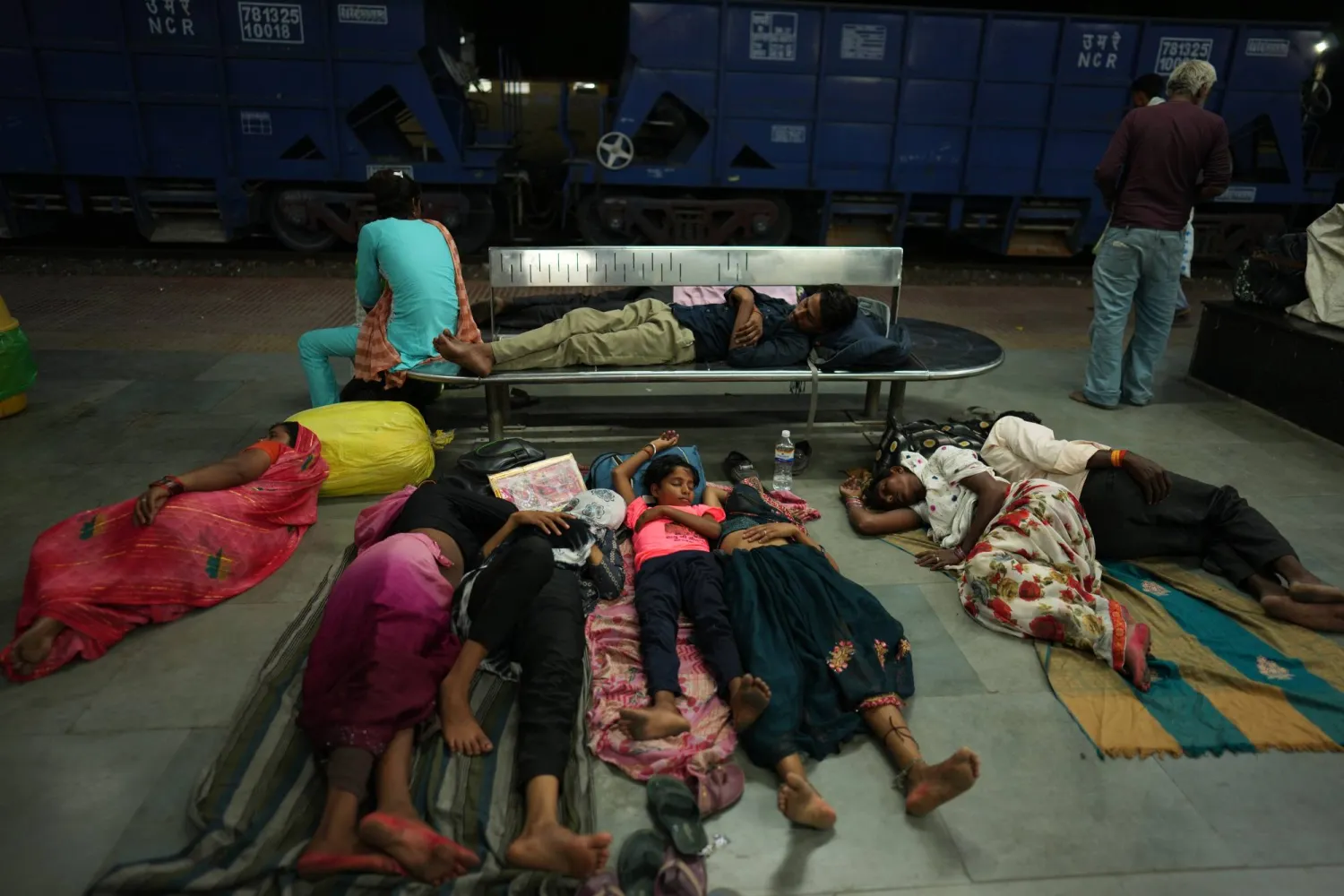
Residents sleep on the platform of a railway station to escape the heat in Banda, northern Indian state of Utter Pradesh, Saturday, June 20 , 2026. (AP Photo/Rajesh Kumar Singh)
TT

What Living in One of the World's Hottest Towns Feels Like

Residents sleep on the platform of a railway station to escape the heat in Banda, northern Indian state of Utter Pradesh, Saturday, June 20 , 2026. (AP Photo/Rajesh Kumar Singh)

Heat at all hours, even in the middle of the night. Long stretches without electricity, meaning some homes can't even use basic fans. And a constant search for relief, like being hosed down with water or sleeping outside.

For many residents of Banda, a town in northern India that has recorded some of the country's highest temperatures, just getting through each day is a challenge.

Global warming, caused mostly by the burning of fuels like gas, oil and coal, is making heat waves across India more frequent and intense. Uttar Pradesh, the state Banda is in, is among those most vulnerable to extreme heat. In 2023, at least 119 people died over several days during a severe heat wave in parts of the state.

In May, temperatures reached 48.2 Celsius (118.8 Fahrenheit), one of multiple times this year that the town recorded the country’s highest temperature for the day. Banda was also the hottest spot on Earth seven times this year, most of them in April, according to climatologist and weather historian Maximiliano Herrera, who tracks global weather extremes. Since then, temperatures have dropped some but are still stifling, particularly as seasonal rains increase humidity.

In June, an Associated Press team went to Banda to report on how people try to cope with the heat throughout the day.

Morning: Heat makes market workers’ jobs tougher Munni Devi and her four sons begin work loading and unloading vegetables when most of the town is asleep.

It’s only 4 a.m., but the temperature is already 30 C (86 F). Workers at Banda's vegetable market are busy unloading tomatoes, jackfruits and other vegetables and transferring them to smaller vehicles for delivery to neighborhood shops.

Devi, 70, says the heat is becoming more intense every year, and this year has been especially bad. The work is physically demanding in any weather. During a heat wave, it can be brutal. But Devi says she and her sons can’t afford to miss a day.

“Everyone feels the heat, but because of our circumstances, we have to bear it,” she says.

At the market, young men wheel carts through narrow lanes. Women sort vegetables on the streets. Devi says many buyers arrive early, hoping to finish shopping before temperatures soar.

Devi and her sons work from early morning until lunch, then return home to recuperate.
She says unreliable power to her home means there is little respite even there. Devi’s grandchildren get sprayed down every day with a water hose to get some relief.

“If there is no power, even the ceiling fans don’t work. Sometimes there is no power for hours,” she says.

Afternoon: Animal lover tries to protect birds from heat impacts As the afternoon sun bakes Banda’s streets, residents who can afford to stay inside do so. But some vegetable sellers and auto rickshaw drivers stay outdoors in hopes of attracting a little more business.

Meanwhile, 70-year-old animal lover Shobharam Kashyap is busy making wooden birdhouses at a workshop in his home.

Kashyap says he and other volunteers have installed over 15,000 birdhouses across the town to give birds respite from an increasingly harsh environment.

Kashyap’s brightly painted birdhouses — many of which are painted green as he says birds seem to prefer that color — have been mounted on trees and walls across Banda.

He has also placed clay water bowls in and near his home to give birds a place for a dip or drink.

Kashyap says he is continuing traditional practices of caring for other animals.

“Our culture has long encouraged feeding birds. Women visiting temples traditionally offer rice. Neither the priest nor the deity consumes it — the birds do,” he says.

Evening: As heat increases, so do hospital admissions Hotter days have brought more patients to the hospital in Banda, one of the bigger medical centers in this region. Those with heat maladies, ranging from fainting to heatstroke, tend to come in the afternoon and evening, filling the corridors and wards.

Patients sit shoulder-to-shoulder on benches. Relatives fan family members with sheets of paper. Hospital staff move between beds carrying intravenous fluids.

Dr. Abhishek Pranayami, the hospital's head doctor, says the hospital sees a surge of patients every summer, "and the number of patients is increasing every year.”

He says they are treating large numbers of people suffering from dehydration, diarrhea, vomiting and abdominal pain — illnesses that become more common as temperatures rise. Some patients recover within days. Others take longer.

“Pressure is quite high on us and the staff,” he says.

Night: Sleeping outdoors or in a rail station to seek a break from heat Even after sunset, Banda remains hot.

When young boys play a game of cricket, they keep their water bottles cool by wrapping them in torn clothes.

At the town’s railway station, families sometimes gather late into the night, hoping the open platforms and occasional breeze will be more comfortable than cramped homes that have absorbed heat all day.

On one such night, dozens are sleeping in the station to avoid the heat. In one spot, several children and adults sleep on blankets spread out on the stone platform with parked train cars a few feet away. Some use bags as pillows. A pile of flip-flops sits inches from their bare feet. Another man stretches out on a bench, with his head on a backpack.

Nearby, several men and women are trying to sleep on blankets near the ticket kiosks, despite the bright lights. Dogs lie between some of the people on the ground, also trying to get relief.

Laborers whose homes are too small and hot to sleep in are sleeping on blankets outside the railway station's entrance, trying their best to get some rest in the hot night. Regardless of the noise of vehicles and passengers entering and leaving the station, laborers and residents are lying on towels and sometimes right on the gravel as the relatively open, breezy roads and pavements near the railway station give them the best chance for some shut-eye.

For parents with little children, the hot night is too uncomfortable for sleep, so they wait in the station, huddled around a smartphone.

The struggle for relief and rest has become a defining feature of summer in cities like Banda.

“Climate change is shifting the average,” says Abhiyant Tiwari, climate and health expert at New Delhi-based NRDC India. “While Banda has always been known for hot summers, what is changing right now is the intensity, the duration and the number of people exposed to dangerous heat conditions.”

High nighttime temperatures are especially worrying because they prevent people from recovering physically from the day’s heat, he says.

The top government official in Banda says authorities have responded by opening cooling centers, distributing hundreds of thousands of oral rehydration kits and monitoring hospitals during heat warnings.

Amit Aasery, the district magistrate of Banda, says officials are studying groundwater levels, soil moisture and vegetation loss while working to improve water supplies and public awareness.

But he says there is only so much they can do.

“What is happening here is a global phenomenon,” he says. “It is because of climate change. We are the recipient of this.”



Prince Harry, Wife Meghan Arrive in the UK as They Make a Fresh Start in Britain

Britain’s Prince Harry and his wife, Meghan. (AP)
TT

Prince Harry, Wife Meghan Arrive in the UK as They Make a Fresh Start in Britain

Britain’s Prince Harry and his wife, Meghan. (AP)

Prince Harry and his wife Meghan arrived in the United Kingdom on Wednesday, as they make a fresh start in Britain after six years in the United States, UK media reported.

The news comes less than a week after the couple surprised fans and critics alike with plans to return to Britain. The return was reported by media outlets including the BBC and Sky News, with the Daily Telegraph reporting their plane landed at Birmingham International Airport around noon.

Flight tracking websites showed a private charter flight from Van Nuys, California, arrived at the airport at 11:56 a.m.

The couple’s children, Prince Archie, 7, and Princess Lilibet, 5, have already enrolled at British schools and will start classes in September. The family plans to live at a private, nonroyal residence outside of London, but haven’t said exactly where that will be.

Harry and Meghan gave up their royal duties and moved to California more than six years ago to earn their living through lucrative contracts with Netflix and Spotify.

Relations with the rest of the royal family quickly soured as the couple said palace staff had been insensitive to Meghan’s mental health and leveled charges of racism and media manipulation at members of the royal family.

Harry recently expressed an interest in reconciliation so he could spend more time with his father, King Charles III, who is being treated for an undisclosed form of cancer. But relations with his brother, Prince William, who is heir to the throne, remain tense.


Social Media Use on the Rise Among Australian Under-16s After Ban

The TikTok logo is displayed on signage outside TikTok social media app company offices in Culver City, California on September 30, 2025. (AFP)
TT

Social Media Use on the Rise Among Australian Under-16s After Ban

The TikTok logo is displayed on signage outside TikTok social media app company offices in Culver City, California on September 30, 2025. (AFP)

Australian under-16s are increasing their use of social media apps, such as Instagram and TikTok, despite a world-leading ban, data provided by a parental control software company showed Wednesday.

Australia implemented legislation barring children from social media platforms in December, with the UK, France and others following suit.

Youngsters' use of social media fell across the board when the legal restrictions were first implemented, data from parental control app Qustodio showed.

But since then their social media activity has climbed -- even approaching pre-ban levels for some apps.

The use of apps TikTok, Instagram and Snapchat among 10–12-year-olds and 13- to 15-year-olds was on the rise, data from parental control app Qustodio showed.

In the case of video-sharing site TikTok, 25.9 percent of 13-15 year-olds are still using the app -- just over a percentage point lower than before the ban came into force.

And use among 10–12-year-olds was just 0.06 percentage points below where it was before the ban.

"They could be accessing these platforms with VPNs, or obfuscating their ages," Yasmin London, Global Online Safety Expert for Qustodio, said.

"But it could really be as simple as they're just accessing these apps because the restrictions aren't working."

The data also showed children increasingly turning to messaging platform WhatsApp, which is not affected by the ban.

Qustodio said the data was gathered by analyzing anonymized monthly social media app usage among Australian children and showed the percentages of kids that had used the app for more than five consecutive minutes at least once in a given month.

Australian officials have said the ban is designed to protect children from online bullying and "predatory algorithms".

A team of Australia-based researchers in a peer-reviewed study published in June found little evidence to suggest teenagers have turned away from social media as a consequence, however.

New Zealand's government also this week said it would introduce legislation that could see firms like Meta fined up to 10 percent of their global revenue if they fail to comply.


Drought-Hit Danube Gives Way to Fossil Hunt in Bulgaria

This photograph taken on August 21, 2026, shows unidentified remains found in the dried-out Danube riverbed near the village of Ryahovo, during an organized fossil hunt after a record low water level revealed mammoth bones there at the end of July. (AFP)
TT

Drought-Hit Danube Gives Way to Fossil Hunt in Bulgaria

This photograph taken on August 21, 2026, shows unidentified remains found in the dried-out Danube riverbed near the village of Ryahovo, during an organized fossil hunt after a record low water level revealed mammoth bones there at the end of July. (AFP)

Volunteers scanned the dried-up bank of the Danube in northern Bulgaria, close to where receding waters laid bare mammoth bones last month, hoping to find more fossilized fragments exposed by Europe's parching drought.

"I've found a tooth!" exclaimed Aleksandar Denkov, a 30-year-old amateur photographer, holding up a yellowish fragment protruding from the sand.

Denkov last week joined some 20 other volunteers, many hoping to find more mammoth fossils during the search organized by the regional history museum of the nearby city of Ruse, around 250 km (155 miles) northeast of Sofia.

Though their hopes were not fulfilled, the group found remains of a mammal -- "probably an aurochs or a European bison," according to the museum -- a horse jawbone in a subfossil state and a cluster of fossilized oysters dating back around 60 to 65 million years.

Europe's drought, exacerbated by human-induced climate change according to experts, has seen major rivers slow to a trickle, causing serious problems for cargo shippers and nuclear plants normally cooled by river water.

But the low waters have also revealed remains and historical artefacts not seen for decades -- or even millennia.

Finds in recent weeks along the Danube, Europe's second-longest river, have included World War II shipwrecks in Austria and Serbia and the remains of two German soldiers and a motorbike in the middle of Budapest.

- 'Close to history' -

Ruse Regional History Museum curator Krasimir Kirov said the museum decided to organize the field day "to teach people how to recognize different finds, show them what they might uncover, and give them safety tips."

"After the mammoth was discovered, I started getting dozens of calls from people telling me about what they'd found," he told AFP.

Last month, a resident of the village of Ryahovo -- some 30 kilometers from Ruse -- spotted by chance what museum specialists then identified as a mammoth jaw bone, fragments of tusks, part of a shoulder blade and a femur.

Announced on social media, the initiative to gather near Ryahovo for a guided search quickly sparked keen interest, with requests already pouring in for the next outing, according to Kirov.

The search began with a few instructions: the volunteers must advance in a line and, if someone spots something, raise a hand so that the whole group stops.

Above all, they must not touch any metal objects, which could be ammunition or explosives.

But the walk had barely begun when the line broke apart: enthusiasm won out over discipline.

"It's a very rare opportunity to feel this close to history," Ekaterina Yordanova, a 34-year-old psychologist, told AFP.

"Seeing the Danube in this state is worrying, but it also gives us the chance to discover new things."

Vladimir Tsvyatkov, a 44-year-old business owner, said he, his wife and their two children mainly came "for the adventure".

Having grown up on the banks of the river, he said he had "never seen the Danube so dried up."

- WWII remnants -

Further upstream in Bulgaria, the low Danube levels have also allowed archaeologists to document the foundations of a bridge, more than two km long, inaugurated under Emperor Constantine I in 328.

And elsewhere along the Danube, World War II weaponry and other remnants have been found.

In central Austria, two wrecks of German warships are protruding from the water.

Damaged in fighting with American tanks in 1945, they were later sunk by their own crews, according to local media.

In Serbia, near Prahovo, the receding river has likewise exposed wrecks of German warships, which were among dozens sunk by their own side in 1944 in an attempt to slow the Soviet Red Army's advance along Europe's second-longest river.

And in Budapest, a motorbike and the remains of two German soldiers were found, according to the German War Graves Commission.

The findings come as vast tracts of many of Europe's largest rivers have fallen to levels never recorded before in the month of July, according to data from European climate observatory Copernicus.