


India Successfully Launches 1st Private Orbital Rocket

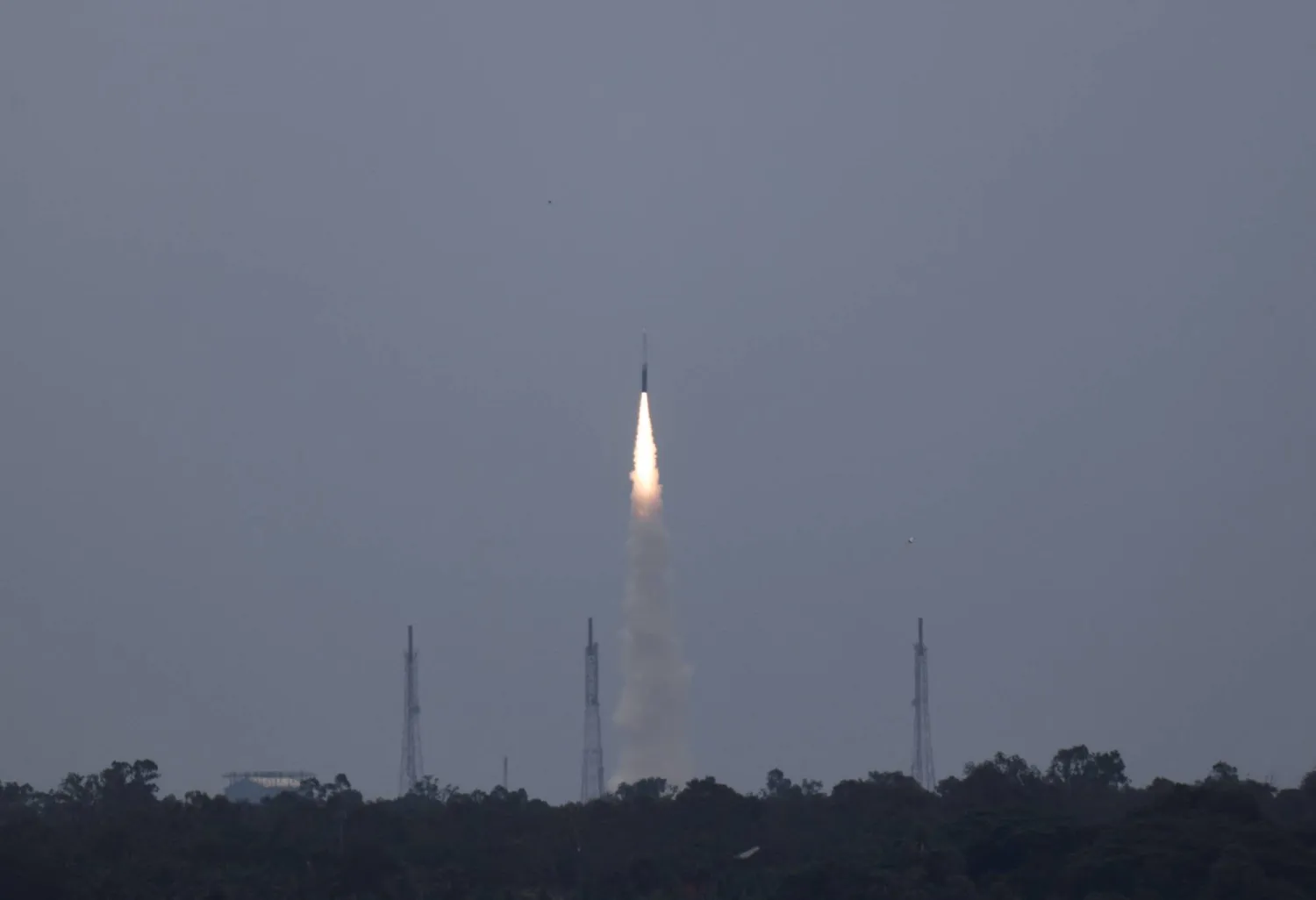
Indian space startup Skyroot Aerospace launched its Vikram-1 rocket, marking the first attempt by an Indian private company to place a satellite in orbit, from the Satish Dhawan Space Center in Sriharikota, Andhra Pradesh, India, July 18, 2026. REUTERS/Priyanshu Singh
TT

India Successfully Launches 1st Private Orbital Rocket

Indian space startup Skyroot Aerospace launched its Vikram-1 rocket, marking the first attempt by an Indian private company to place a satellite in orbit, from the Satish Dhawan Space Center in Sriharikota, Andhra Pradesh, India, July 18, 2026. REUTERS/Priyanshu Singh

India's first privately built orbital rocket took its maiden flight on Saturday, its company said, marking a significant step for the South Asian giant as it eyes a bigger slice of the global space economy.

The Vikram-1 rocket, built by Skyroot Aerospace and designed to carry small satellites into low-Earth orbit, took off from the Satish Dhawan Space Center in Sriharikota amid loud cheers.

"Hello space, we have arrived!" Skyroot Aerospace said in a post on X.

"Vikram-1's Test Flight-1 has completed its mission. The first ever Indian private sector launch has been successfully completed."

Vikram-1 is about as tall as a seven-story building and capable of carrying payloads weighing up to 350 kilograms (771 pounds).

Pawan Goenka, chairman of the government's Indian National Space Promotion and Authorisation Center, said the achievement went "way beyond expectation for the very first orbital launch ever taken by an Indian private company".

Prime Minister Narendra Modi hailed the endeavor as "a defining moment in India's space journey".

"The growing participation of our private sector is opening new frontiers and accelerating innovation," AFP quoted Modi as saying.

"This achievement will encourage countless youngsters to dream bigger and innovate fearlessly."

The rocket is carrying a diverse range of payloads, including a lab-grown diamond and robotic arms capable of removing space debris.

A miniature 18-karat gold rocket that has mini sculptures of Indian physicists Vikram Sarabhai, CV Raman and former Indian president and noted aerospace engineer APJ Abdul Kalam is also aboard the vehicle.

India's space ambitions, built on decades of investment by the Indian Space Research Organization (ISRO), have gathered pace in recent years.

The country's space economy -- valued at around $8.4 billion -- has rapidly expanded since the sector opened up to private players in 2020, and is now home to more than 400 space startups.

"India's space ambitions soar to new heights!" Foreign Minister S. Jaishankar said after the successful launch.

In August 2023, India became only the fourth country to successfully land an unmanned spacecraft on the Moon, after Russia, the United States and China.

Former ISRO chairman K. Sivan hailed the work done by space startups, adding that the country was witnessing the "fruits of the seeds sown" when it opened up the sector to private players.

"With Skyroot especially, the rocket is one of the most challenging and complex technologies in the space system... It is going to motivate many people," he told AFP.

Sivan added that "there is no doubt" the launch will have a global impact.

"If an Indian startup can make one of the most challenging things in the space industry, then it gives a huge boost to India's reputation globally."




Climate Change Hits Trout and Salmon in UK’s Prized Chalk Streams

This photo taken on August 25, 2026 shows Bob Wellard, director of the Piscatorials Society, fly-fishing in the Candover Brook, a chalk stream tributary of the River Itchen, near Winchester, Hampshire, southern England. (AFP)
TT

Climate Change Hits Trout and Salmon in UK’s Prized Chalk Streams

This photo taken on August 25, 2026 shows Bob Wellard, director of the Piscatorials Society, fly-fishing in the Candover Brook, a chalk stream tributary of the River Itchen, near Winchester, Hampshire, southern England. (AFP)

A fly fisherman cast his line into the crystal-clear waters of the Itchen, a chalk stream in Hampshire in southern England, home to salmon and trout hit by climate change.

A summer of record-breaking temperatures and drought is threatening the ecological balance of rare chalk streams -- rivers formed on chalk beds that are largely unique to England -- and the fish that depend on them.

Wading through a branch of the Itchen near Winchester, Robert Wellard, director of fisheries at the Piscatorial Society and a recreational angler, dipped a thermometer into the clear water, drawing a reading of 17C.

"We should be more around 12 or 13 degrees" in August, said Kathryn Boler, manager of the Freshwater Programme for the Hampshire and Isle of Wight Wildlife Trust.

Chalk streams, which are fed naturally by underground springs filtered through porous chalk bedrock, are known for their clear, cool and mineral-rich waters where fish such as brown trout and salmon thrive.

Out of 200 rivers of this type recorded in the world, 85 percent are found in England, according to the Wildlife Trust, which looks after the UK's nature reserves.

These unique habitats have been at the forefront of climate change for years, with this summer's successive heatwaves and bone-dry conditions warming the water, depleting groundwater reserves and reducing river flows.

"This year it's been unique in the sense that we have had them (heatwaves) pretty much back-to-back. And so that puts a huge amount of stress on the natural environment," said Wellard.

During heatwaves, "we've seen water temperatures... creeping up well above their normal temperature range," said Wellard, noting that water temperatures this summer reached levels which start affecting wild fish.

Several angling clubs -- which primarily practice catch-and-release fishing -- have temporarily limited activity to reduce the stress on the fish.

- 'Trapped' -

In water temperatures above 19C, salmon and trout experience "extra stress on their bodies", said Boler, as it reduces the oxygen available in the water and increases the physiological needs of fish.

The Itchen chalked up a high of 21.7C in July, according to figures by the Environment Agency (EA), an arm's-length government body which deals with environmental protection in England.

Falling river flows in drought conditions also expose the fish to predators.

For Atlantic salmon, which come to chalk streams to spawn and are already classified as endangered, the situation is particularly concerning.

"With the lower flow, salmon are effectively more trapped, and more susceptible to predation from things like harbor seals and cormorants," explained Paul Vignaux, who heads a local association for landowners and anglers in the Itchen.

In 2022, only 180 salmon came to spawn in the Itchen. Preliminary figures for last year counted 250 individuals -- 32 percent of the threshold considered necessary for the species' conservation, Vignaux noted.

This summer was also difficult for young freshwater salmon, the Environment Agency said in its July salmon count of the Itchen and another nearby chalk stream the Test, with their "abundance and size ... far lower than usual".

According to an EA model, the average temperature of rivers where brown trout live in England is expected to exceed the tolerable limit "at most sites by 2070".

The critical threshold for salmon is expected to be exceeded in half of their habitats by 2080.

Scientists say that climate change is increasing the frequency and intensity of heatwaves, drought and other extreme weather conditions.

Combined with river pollution, chalk streams are facing the perfect storm as declining water flows also cause pollutants to become more concentrated.

In July, wastewater treatment company Southern Water admitted discharging pollutants in 2023 into the Test.

Scientists, environmentalists and anglers are calling for agencies to restore rivers to a more natural state, reduce water extraction and plant trees to improve shade.

"It's really essential that as much water as possible stays in the rivers," said Boler.


Riyadh Launches ‘Digital District’ to Bolster Status as Global Hub for Talent, Innovation

The initiative aims to strengthen Riyadh’s position as a global hub for technology talent and digital creativity. (SPA)
TT

Riyadh Launches ‘Digital District’ to Bolster Status as Global Hub for Talent, Innovation

The initiative aims to strengthen Riyadh’s position as a global hub for technology talent and digital creativity. (SPA)

The Royal Commission for Riyadh City (RCRC) announced Thursday the launch of the “Riyadh Digital District,” a strategic initiative designed to attract global technology talent, foster entrepreneurship and build a knowledge-based economy driven by digital leadership and technological innovation.

The initiative aims to strengthen Riyadh’s position as a global hub for technology talent and digital creativity and place it among the world’s top 10 technology districts, in line with Saudi Vision 2030.

Ibrahim bin Muhammad Al-Sultan, Minister of State, Cabinet member and CEO of the RCRC, said the initiative would help establish Riyadh as a global destination for technology companies, talent and digital entrepreneurship.

Al-Sultan expressed his gratitude to Custodian of the Two Holy Mosques King Salman bin Abdulaziz and Prince Mohammed bin Salman, Crown Prince and Prime Minister, for their support of the commission’s projects.

“This step reflects the leadership’s commitment to advancing the capital toward global leadership in promising future sectors,” he said, adding that it supports Vision 2030 goals of building a diversified and prosperous economy based on digital leadership and technological innovation.

The district will focus on attracting companies and specialized talent in six key fields: Artificial Intelligence and Big Data, Cybersecurity, Computing and Cloud Services, the Internet of Things (IoT), Blockchain Technologies, and Robotics and Unmanned Aerial Systems. These sectors account for the majority of global investments in technology innovation companies, highlighting their pivotal role in driving future growth and technological advancement.

Overseen by the RCRC, the Digital District is conceived as an integrated digital business ecosystem within Riyadh, bringing together technology companies, talent and investment.

It will provide a supportive technical and regulatory environment for global and regional technology companies and startups seeking to establish operations in Riyadh and expand across the Middle East and North Africa.

Companies will have access to dedicated spaces near technology firms and communities, as well as opportunities to collaborate with government agencies and the private sector.

The initiative also seeks to develop digital skills, attract investment and create sustainable jobs by helping companies build technology teams and expand their Riyadh operations.

Regular meetings and open events will bring together founders, engineers, researchers and investors to foster an active technology community.


Riyadh Hosts UNESCO Global Forum on AI Ethics with Participation from 194 Countries

Riyadh Hosts UNESCO Global Forum on AI Ethics with Participation from 194 Countries
TT

Riyadh Hosts UNESCO Global Forum on AI Ethics with Participation from 194 Countries

Riyadh Hosts UNESCO Global Forum on AI Ethics with Participation from 194 Countries

Riyadh will host the fourth edition of the UNESCO Global Forum on the Ethics of Artificial Intelligence (GFEAI 2026) from September 14 to 17, bringing together a broad international community representing 194 countries. The forum will convene decision-makers, experts, academics, and representatives of international organizations, as well as public- and private-sector leaders from around the world.

GFEAI 2026 is organized by the Saudi Data and AI Authority (SDAIA) in partnership with UNESCO, and in cooperation with the International Center for AI Research and Ethics (ICAIRE), the Saudi Press Agency said on Friday.

GFEAI is one of the international platforms focused on AI ethics. The 2026 edition aims to strengthen global dialogue on responsible AI governance, facilitate the exchange of expertise and best practices, and explore ways to harness AI technologies to support sustainable development and promote societal prosperity.

Over four days, GFEAI 2026 is set to address key topics including AI ethics and governance, capacity building, responsible innovation and international policies, through high-level sessions and specialized workshops, bringing together experts and policymakers from around the world.

The Kingdom of Saudi Arabia’s hosting of GFEAI 2026 reflects its continued efforts to support the principles of AI ethics and strengthen AI governance at both the national and international levels, support multilateral cooperation in developing frameworks for the responsible and trustworthy use of emerging technologies, align with the objectives of Saudi Vision 2030, and strengthen the Kingdom’s contribution to shaping the future of AI globally.