


US Cancels Automatic Protections for Imperiled Animals as Critics Warn of Extinctions

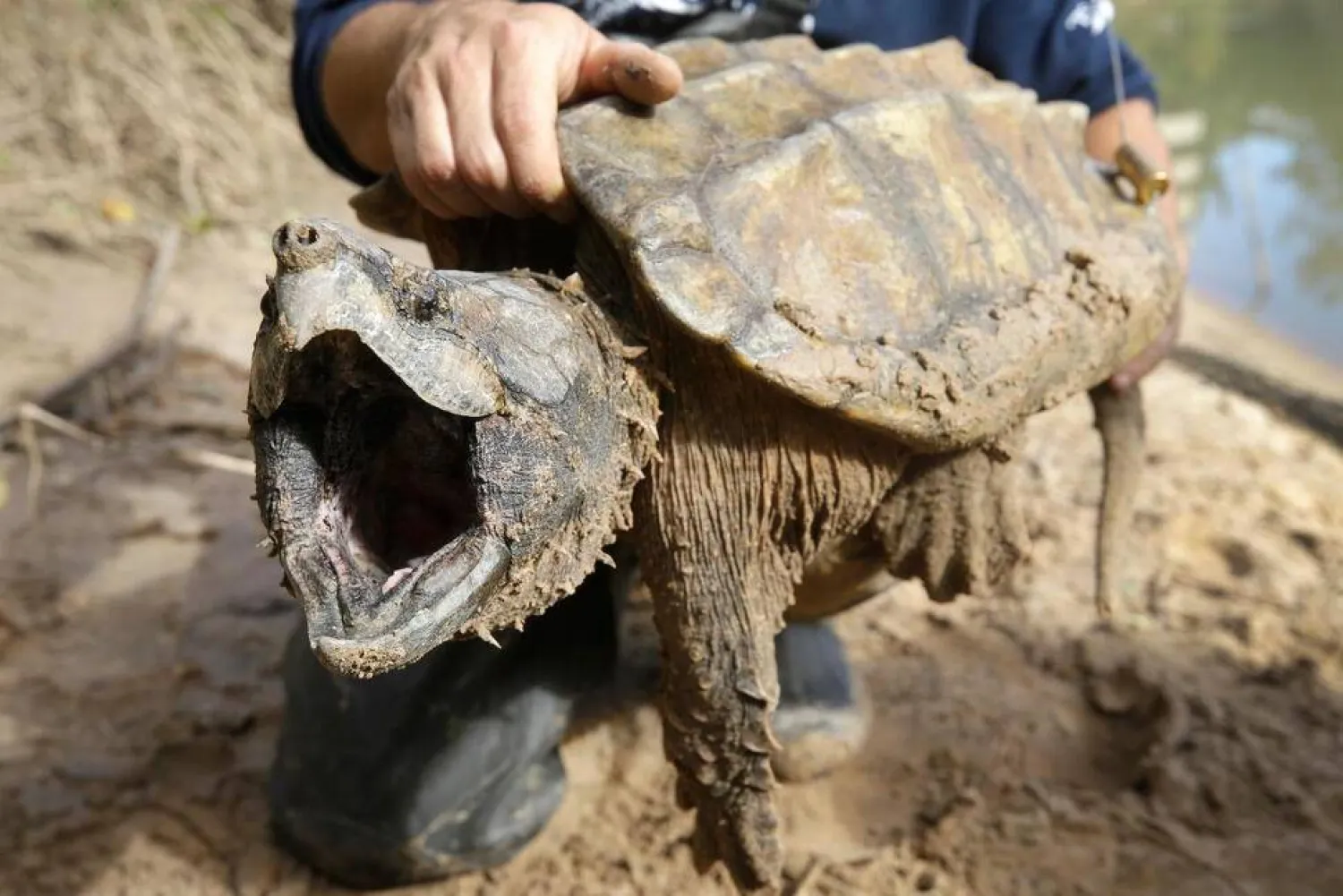
FILE - A male alligator snapping turtle is held after being trapped by the Turtle Survival Alliance-North American Freshwater Turtle Research Group, Nov. 24, 2018, as part of the process of tagging turtles. (Melissa Phillip/Houston Chronicle via AP, File)
TT

US Cancels Automatic Protections for Imperiled Animals as Critics Warn of Extinctions

FILE - A male alligator snapping turtle is held after being trapped by the Turtle Survival Alliance-North American Freshwater Turtle Research Group, Nov. 24, 2018, as part of the process of tagging turtles. (Melissa Phillip/Houston Chronicle via AP, File)

The US Interior Department on Friday canceled a rule meant to protect plants and animals that are determined to be threatened with extinction, the latest step by President Donald Trump’s administration to dismantle key provisions of the landmark Endangered Species Act at the behest of industry.

Instead of receiving automatic protections, imperiled species will need individualized protection plans once they are added to the threatened species list. That's a potentially lengthy process in which companies could seek exemptions for oil and gas drilling, mining and other development where those species live.

Opponents said it would make it harder to save wildlife that’s awaiting federal protections and in danger of disappearing, such as monarch butterflies and alligator snapping turtles.

Interior Secretary Doug Burgum said in a statement that the Endangered Species Act had been used for too long “to stop almost any new project in America, driving up costs for families, weakening our competitiveness, and undermining our national security.”

“Success should be measured by species recovery and delisting, not by adding more species to the list,” Burgum added.

A second change finalized Friday requires officials to analyze economic impacts when deciding whether habitat is critical to a species’ survival. Critics say it gives corporations an opportunity to put their thumb on the scale so that officials will allow development in those areas.

“If you're exempting certain industries that cause habitat destruction, in many instances you'll be exempting the main threat to those species,” said Noah Greenwald with the environmental group Center for Biological Diversity.

Officials made similar changes during Trump’s first term but they were reversed under former Democratic President Joe Biden.

The rules that gave what some consider “blanket protections” to threatened species were first adopted for wildlife in 1975 and for plants in 1977.

Two groups, the Rocky Mountain Elk Foundation and the Property and Environment Research Center, sued the Biden administration in 2024 after officials restored the blanket protections rule. They argued the rule unfairly imposed the same restrictions on landowners when a species' status improves from endangered, which is more dire, to threatened.

That removed incentives for landowners to participate in species recovery, said Jonathan Wood, vice president at the Montana-based research center.

Wood said the Trump administration's approach allows officials to “better reward progress and encourage proactive conservation.”

There have been no species added to the endangered or threatened lists in Trump’s second term. By comparison, more than 20 species were added in Trump’s first term, and about 60 during Biden’s presidency, The Associated Press reported.

About 30 species are currently proposed to be listed as threatened. Besides monarchs and alligator snapping turtles, they include California spotted owls and various snakes, fish, clams and insects.

Changes to government policies for endangered plants and wildlife have come faster and extended further in Trump's second term than in his first.

The administration in March exempted oil and gas drilling in the Gulf of Mexico from the Endangered Species Act after Defense Secretary Pete Hegseth said environmentalists’ lawsuits threatened to hobble domestic energy supplies as the US wages war against Iran.

Last week, Interior officials sharply narrowed the definition of what constitutes “harm” to a species. The change would allow development on critical wildlife habitat so long as the animals themselves are not immediately killed or injured.

This week officials sharply reduced the amount of critical habitat in the US Rocky Mountains designated for Canada lynx, forest dwelling wildcats that are threatened by climate change and other pressures.

Also this week, Burgum said in a visit to Montana that the US Fish and Wildlife Service would turn over more management authority for grizzly bears to states where the bruins live. That's been a longstanding priority for the Republican governors of Wyoming, Idaho and Montana.

The Endangered Species Act is credited with bringing back iconic animals including the bald eagle and American alligator from the brink of extinction.

Burgum noted Friday that 97% of the species that have been given protections still have them. That’s a frustration for Republican lawmakers who say species should be taken off the endangered and threatened lists more quickly once they’ve recovered.



Flight Attendants and Pilots Have Highest Risk of Dying from Radiation-Linked Cancers, Study Says

American Airlines flight 718, the first US Boeing 737 MAX commercial flight since regulators lifted a 20-month grounding in November, lands at LaGuardia airport in New York, US, December 29, 2020. (Reuters)
TT

Flight Attendants and Pilots Have Highest Risk of Dying from Radiation-Linked Cancers, Study Says

American Airlines flight 718, the first US Boeing 737 MAX commercial flight since regulators lifted a 20-month grounding in November, lands at LaGuardia airport in New York, US, December 29, 2020. (Reuters)

Flight attendants and pilots are at the highest risk of dying from radiation-related cancers — even more than people who work with radioactive materials, according to a new study.

Cosmic radiation comes from space. Only a small amount reaches the Earth's surface, but exposure is greater for people flying at high altitudes.

There’s been limited evidence from small studies suggesting that the exposure translates to higher cancer death rates among people who fly often, particularly pilots and flight attendants. The new study “brings important new evidence to bear on this question,” two Australian radiation experts who weren't involved in the research wrote in an accompanying commentary.

The latest study, published Monday by JAMA Internal Medicine, used national data from more than 12 million death certificates that included information about occupations. The authors looked at death rates from cancers that are tied to radiation exposures, including leukemia, lymphoma, multiple myeloma, and cancers of the skin, breast, thyroid, prostate and central nervous system.

Among more than 500 occupations, flight attendants had the highest percentage of deaths from radiation-related cancers, and pilots were second, the researchers found. For those two occupations, the odds of dying were unusually high for each type of radiation-related cancer.

Neither group showed higher-than-normal death rates from cancers that aren't tied to radiation exposure, noted the commentary writers, Catherine Olsen and Ken Karipidis. That fact “supports the hypothesis that occupational radiation exposure, rather than lifestyle or socioeconomic factors, underlies the observed excess,” they wrote.

The researchers found that flight attendants had about 50% higher odds of dying from a radiation-related cancer than the general working population, and pilots had about 36% higher odds.

In terms of absolute risk, about 6.9% of flight attendant deaths were from these cancers — roughly 1 in 14. Among pilots, it was 6.7%. For the general working population, it was 5%, said the study's first author, Dr. Vishal Patel of Harvard Medical School.

The authors acknowledged some limitations in their study. They do not know how much exposure each flight attendant and pilot got in the air or from other sources. It's also possible occupations were misclassified on some death certificates.

They also could not account for another possible contributor specific to the professions: Cancer risk can be worsened by frequent disruption of the body’s internal clock, which can be affected by jet lag, crossing time zones and irregular work schedules.

The Federal Aviation Administration has acknowledged that aircrews are exposed to ionizing radiation, but the government does not set federal dose limits or require monitoring, the authors noted.

“You can't manage an exposure you've decided not to measure,” Patel said in an email.

Sara Nelson, who leads a union representing 55,000 flight attendants, said the report reinforces that radiation exposure needs to be taken seriously, as the union has suggested for years.

“The risk is known, but crew are not educated or informed. And, no one is taking responsibility,” said Nelson, president of the Association of Flight Attendants-CWA.

Annual skin examinations may be warranted for all people working on high-altitude flights, and women in those jobs may want to get mammograms earlier or more frequently, Olsen and Karipidis wrote. Doctors who care for pilots and flight attendants also should have a “heightened index of suspicion” for cancer when evaluating these patients, they said.


Misk Foundation and UN Youth Office Announce Establishment of Global Network for Youth

The network is the first platform of its kind established by Misk  - SPA
The network is the first platform of its kind established by Misk - SPA
TT

Misk Foundation and UN Youth Office Announce Establishment of Global Network for Youth

The network is the first platform of its kind established by Misk  - SPA
The network is the first platform of its kind established by Misk - SPA

The Mohammed bin Salman Foundation (Misk), in collaboration with the United Nations Youth Office, announced on Tuesday the establishment of the Global Network for Youth, a new international network connecting independent global organizations working to serve youth with leadership and policymaking pathways at the global level.

The announcement was made during the convening of the AFS Youth Assembly in Geneva, coinciding with International Youth Day.
The Global Network for Youth will be officially launched during the United Nations General Assembly in New York in September 2026, SPA reported.

The network is the first platform of its kind established by Misk in collaboration with the UN Youth Office, building on a partnership between the two dating back to 2018.

It brings together independent youth-focused organizations from different regions and provides tailored pathways enabling young people to participate in global policymaking and decision-making.

The network operates around four pillars: strengthening young people's capacities in public policy and advocacy; creating clear pathways to UN platforms and global forums; amplifying diverse youth voices and those of underrepresented groups; and equipping member organizations with tools, data, and shared knowledge.


Cat Missing For 10 Years Returns Home on Owner's 30th Birthday

Charlie's owners described her as a “bit fiery”. (Lucy Roberston)
TT

Cat Missing For 10 Years Returns Home on Owner's 30th Birthday

Charlie's owners described her as a “bit fiery”. (Lucy Roberston)

A 13-year-old tabby cat that went missing 10 years ago has found her way back home.

Her owners Lucy and Hannah Robertson were “heartbroken” in April 2016 when Charlie, then three-years-old, disappeared.

As an outdoor cat, Charlie would spend her days roaming the streets but one day, after recently moving to a new area, she never returned home.

The family spent months looking, never finding any leads.

But last month, the “impossible” happened on Lucy's 30th birthday, they received a call from the vet saying Charlie had been found.

Hannah, 37, moved from Newbridge to Abercarn, in Caerphilly county, a few miles away, 10 years ago.

Within three days, Charlie, whom she described as a “bit fiery,” had vanished.

“We did have one or two tip-offs... we tried to find her, but we kept missing her,” Hannah said. “We never lost hope. But sadly, we just couldn't find her,” she told BBC Radio Wales Drive.

Lucy said that, despite having asked around, as well as posting on Facebook, there was no sign of Charlie.

“It was heartbreaking. We were scared that she had been knocked over or that she wasn't around anymore,” she said.

But on 29 July, Hannah was left “gobsmacked” after receiving a call from a veterinary practice in Abercarn saying Charlie had been found.

A person living nearby had found Charlie living in bushes, feeding the supposed stray for weeks before taking her to the vets, who called Hannah from the number found on the microchip.

The vet was also “really shocked” to find out the cat had been missing for a decade, Hannah said.

The friendly tabby was in great health, her fur was fine and she did not look “disheveled.”

“She's been on an adventure,” Hannah said, and that she guessed “we'll never know” what happened to Charlie.

Lucy said their beloved pet had recognized them “straight away,” describing it as “lovely, because we didn't expect that.”

“She doesn't look much different at all, she looks exactly the same as the old photos we have of her,” she said.

Lucy said that it “is a bit of a work in progress” getting her used to living with their other pets, “but we're definitely getting there.”

However, Charlie had been loving the “food and attention,” Lucy said and was just as friendly as she was 10 years ago.

She had also been enjoying the “attention”, Lucy said. “Right now I feel like she knows she's a bit of a celebrity.”
