


Ski Enthusiasts Flock to Sub-Saharan Africa and a Snowy Mountain Resort in Lesotho

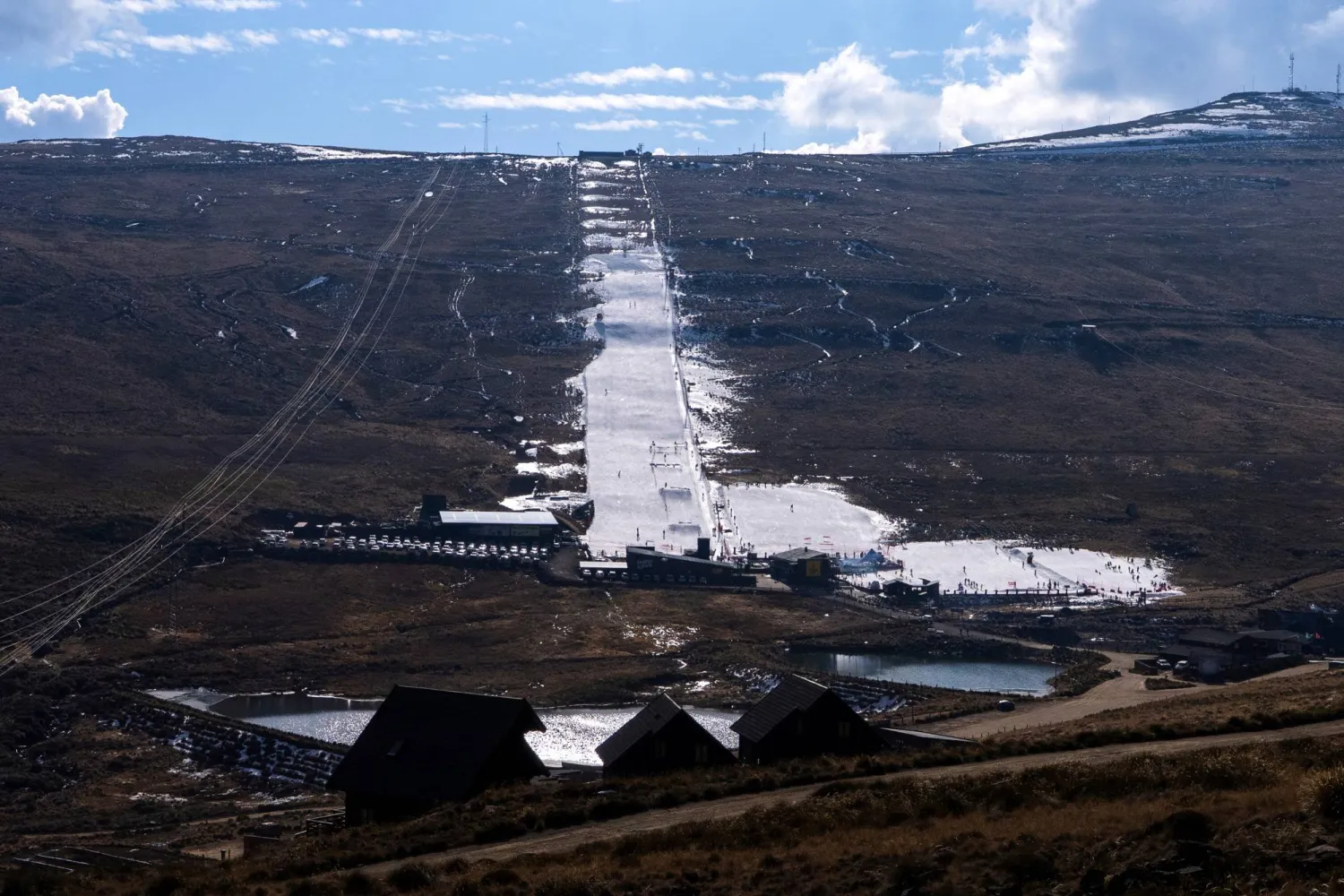
 Afriski Mountain Resort is seen in Maluti, Lesotho, Saturday, July 11, 2026. (AP)
Afriski Mountain Resort is seen in Maluti, Lesotho, Saturday, July 11, 2026. (AP)
TT

Ski Enthusiasts Flock to Sub-Saharan Africa and a Snowy Mountain Resort in Lesotho

 Afriski Mountain Resort is seen in Maluti, Lesotho, Saturday, July 11, 2026. (AP)
Afriski Mountain Resort is seen in Maluti, Lesotho, Saturday, July 11, 2026. (AP)

One may not expect thousands to flock each winter to Lesotho but for many ski enthusiasts from across southern Africa, the small, landlocked mountain kingdom has become the go-to place in recent years.

Lesotho's high elevation and mountainous terrain combine to make it the coldest country on the continent, with temperatures in the highlands typically plunging to minus 8 degrees Celsius (about 18 degrees Fahrenheit) between June and August.

The Afriski Mountain Resort, some 3,200 meters (10,499 feet) above sea level, nestled in the northern Maluti Mountains, is Lesotho's single fully operational ski resort and the only one in sub-Saharan Africa.

The majestic snow-covered landscape is ideal for skiing, and both seasoned and new visitors enjoy the slopes that are spread over 17 hectares (42 acres) surrounding the resort — about the size of 24 standard football pitches. The resort opened 25 years ago, a short bus or car ride from the nearest major town of Butha-Buthe, about 80 kilometers (50 miles) away.

Last year, tourism contributed about 7% to Lesotho's annual GDP of some $2.6 billion. For its part, Afriski provides a chunk of needed cash in a country cited by the World Bank as one of the poorest in the world and its artificial snow machines ensure it stays open throughout the Southern Hemisphere’s winter.

US President Donald Trump may have joked in 2025 about Lesotho being a country that “nobody has ever heard of” but just a year earlier, the kingdom, bordered on all sides by South Africa and with a population of 2.3 million, celebrated 200 years of the founding of the Basotho nation and 58 years of independence from British rule.

Located in its entirety at and over 1,000 meters (3,280 feet) above sea level, Lesotho sees a lot of snow and skiing is growing in popularity here from a rare sport previously mainly associated with North America and the European Alps.

Most people drive into Lesotho from neighboring South Africa, but international visitors can also fly in to the airport in Maseru, the country's capital.

Afriski's CEO, Theo Ferreira, says almost 70% of the visitors come from South Africa; the rest are mostly from Lesotho or elsewhere in southern Africa. The resort now has 227 full-time and seasonal employees, nearly all Lesotho nationals, with about 30 South Africans, working mainly as skiing instructors, he said.
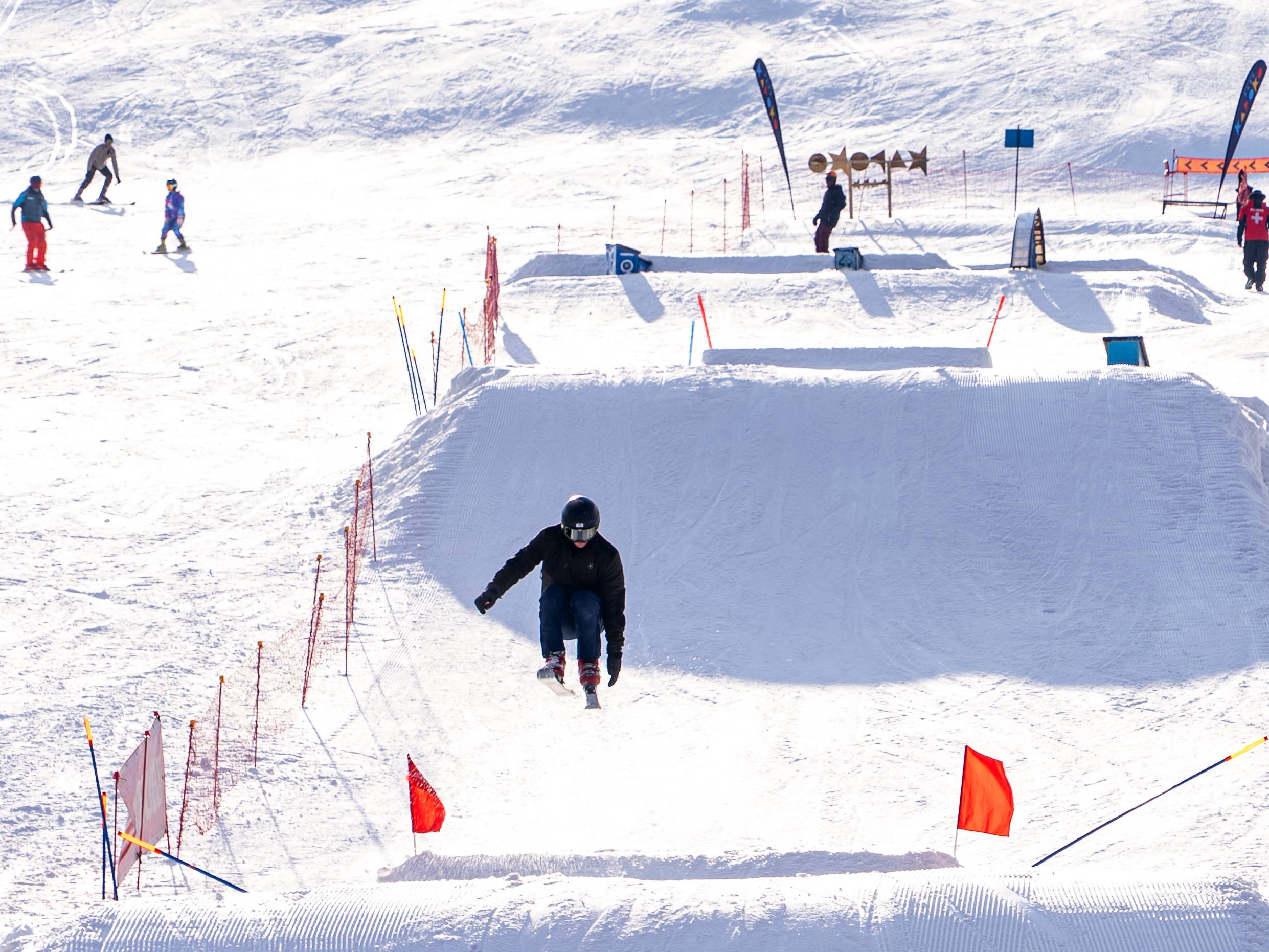
A skier descends through the snow at Afriski Mountain Resort in Maluti, Lesotho, Saturday, July 11, 2026. (AP)

While the resort has rooms for 420 overnight guests, the nearby Butha-Buthe and Mohlokong towns can offer extra accommodations in peak season. The busiest day so far this year saw over 1,400 visitors while in 2025, the record was over 1,600 day visitors and those staying overnight or longer, Ferreira said.

Because unreliable weather patterns can make natural snow scarce, the resort relies on artificial snow to make skiing possible all winter long.

The resort has played role in helping ski tourism emerge as another attraction in southern Africa, known for its wildlife and scenic coastlines along the Indian and Atlantic Oceans.

For many visitors, Afriski is where they had their first ski lessons, braving falls and dusting themselves off before having another try, and another — until making that first, full glide down without falling.

Janko Smits, a student from Cape Town, South Africa, describes it as "an amazing slope to learn on.”

“At the start it was a little discouraging because you fall, and you fall hard,” he said. “But the people here, they gave me one lesson and after an hour, honestly, I felt confident.”

“When you think of the African continent, you don't think of snow. You think about ... the sun and the Sahara (Desert),” said Thato Ramaphoko, a first-timer at the resort from Pretoria, South Africa’s capital. "But that you can actually go to all that and also come here and it also snows at the same time, it is just mind-blowing, so I just had to see it for myself."

Visitors at Afriski can also sample a taste of Lesotho in the form of traditional sausage rolls and Maluti Lager, the country's proudly home-brewed beer.

As for a souvenir to take home, try the colorful Basotho blanket, which comes in vibrant colors and patterns that also pop up in local garments and are creatively integrated into various skiing jackets and gear.



New Space Object ‘Black Hole Star’ Discovered by Astronomers

 The James Webb Space Telescope, which spotted the new astronomical object called a "black hole star". (NASA TV/AFP file)
The James Webb Space Telescope, which spotted the new astronomical object called a "black hole star". (NASA TV/AFP file)
TT

New Space Object ‘Black Hole Star’ Discovered by Astronomers

 The James Webb Space Telescope, which spotted the new astronomical object called a "black hole star". (NASA TV/AFP file)
The James Webb Space Telescope, which spotted the new astronomical object called a "black hole star". (NASA TV/AFP file)

Astronomers announced Wednesday they had discovered a new type of astronomical object called a "black hole star", potentially solving a mystery involving strange red dots spotted in the early universe.

The object looks like a star the size of our solar system, but produces 100 billion times more energy than any star -- a mighty blast of power closer to what is produced by a black hole.

The black hole star, which dates from 660 million years after the Big Bang, was spotted by a US-led team of astronomers using the James Webb Space Telescope, according to a study published in the journal Nature.

Since history's most powerful telescope went online in 2022, it has been spotting many extremely bright cosmic objects dubbed "little red dots" in the early universe that have baffled scientists.

"What exactly these objects are has been one of the most debated topics of the JWST era," lead study author Rohan Naidu of Hawaii University said in a statement.

The team had been trying to find clues for a different mystery: why JWST keeps finding bright galaxies in the universe's infancy, when it was thought to have been too early for them to have become so huge.

But while looking through the images, they spotted a little red dot.

- 'Pure black hole star light' -

"When we see something very red in the universe, we often assume that it is surrounded by dust, like soot or ash," said Robert Simcoe, a study co-author from the Massachusetts Institute of Technology.

"The same way that the wildfire smoke from Canada recently made the sky in Boston look bright red, astronomical objects can also appear redder than their intrinsic color when you see them through a veil of dust," he added.

However, when the team sifted through their data, they found that at certain wavelengths, the object's light simply disappeared.

To their surprise, this suggested that it is not dust making this object appear red -- it is hydrogen gas.

This explained the object's color, but not how it could be pumping out so much energy.

"You can't be powering this by nuclear fusion, which is the energy source that sits at the heart of all the stars," Naidu explained.

Using modelling simulations, they determined the most likely scenario was that the object is powered by a central black hole surrounded by a cocoon of gas that makes it resemble a star.

The team named the object MoM-BH*-1. The BH and asterix is for black hole star -- and the number one suggests they believe there are more out there.

"Every little red dot is consistent with being a black hole star," Naidu said.

"What is special about MoM-BH*-1 is, the black hole star is essentially completely outshining its surrounding host galaxy, such that we're seeing pure black hole star light."


Britain’s Andy Green Sets Another Speed Record, This Time in a Hydrogen-Powered Car

 The JCB Hydromax sits on the Bonneville Salt Flats in Wendover, Utah, where Andy Green aims to drive it to a land speed record for cars powered by hydrogen internal combustion engines, Monday, Aug. 10, 2026. (AP)
The JCB Hydromax sits on the Bonneville Salt Flats in Wendover, Utah, where Andy Green aims to drive it to a land speed record for cars powered by hydrogen internal combustion engines, Monday, Aug. 10, 2026. (AP)
TT

Britain’s Andy Green Sets Another Speed Record, This Time in a Hydrogen-Powered Car

 The JCB Hydromax sits on the Bonneville Salt Flats in Wendover, Utah, where Andy Green aims to drive it to a land speed record for cars powered by hydrogen internal combustion engines, Monday, Aug. 10, 2026. (AP)
The JCB Hydromax sits on the Bonneville Salt Flats in Wendover, Utah, where Andy Green aims to drive it to a land speed record for cars powered by hydrogen internal combustion engines, Monday, Aug. 10, 2026. (AP)

The only person to break the sound barrier in a car earned another world record Tuesday in a show of force for hydrogen power.

British driver Andy Green reached 406.320 mph (653.908 kph) in a car powered by two hydrogen internal combustion engines with a combined 1,600 horsepower, setting the record for that vehicle category, according to the Fédération Internationale de l’Automobile, the international governing body of motor sports.

The 64-year-old retired Royal Air Force pilot rocketed across the crystalline crust at Utah’s famous Bonneville Salt Flats in a 32-foot (9.75-meter) car engineered by British construction equipment manufacturer JCB. The engines, adapted from those used in the company’s heavy machinery, mix pressurized hydrogen gas with air and ignite it to create bursts of power.

“It’s magic to be able to showcase this technology and to showcase how good the engineering is on the best racing surface in the world, Bonneville Salt Flats,” Green told The Associated Press after the run.

To be clear, Tuesday’s feat didn’t come close to approaching the overall land-speed record, which Green set with jet power in 1997. That year, he climbed into the Thrust SSC, a black needle sandwiched between two cartoonishly large jet engines, and hit 763.035 mph (1,227.985 kph), breaking the sound barrier and achieving a feat no one has come close to matching. His runs in Nevada’s Black Rock Desert produced sonic booms that shook the nearby town of Gerlach.

In 2006, Green also set the land-speed record for a diesel-powered car — 350.092 mph (563.4 kph) — at the Bonneville Salt Flats. He returned there Tuesday with the goal of beating that mark using hydrogen power, which he has called the “fuel of the future.”

In targeting his diesel speed, Green easily topped the previous hydrogen combustion world record of 185.5 mph (298.5 kph). He had a 10-mile (16-kilometer) straightaway to build speed. A few dozen JCB staff members and reporters watched from a distance through cameras and binoculars.

Green said the cockpit of the car he used on Tuesday was “probably a little hotter” than in the jet-powered vehicle from 1997, with temperatures routinely above 122 degrees Fahrenheit (50 degrees Celsius).

“But I have been training four months for that, both training in the gym and actually just getting used to it with hot baths,” he said.

A remnant of a prehistoric lake bed, the Bonneville Salt Flats are about 100 miles (160 kilometers) west of Salt Lake City and sit atop a shallow aquifer that cools the tires. The low-friction surface and dry desert air are conducive to speed and have beckoned drivers since the first race there in 1914.

“It looks like snow, and it behaves a bit like packed snow — it is surprisingly slippery,” Green said.

Green was no stranger to speed when he took his first racing job. He had been flying supersonic military jets when he spotted a 1994 British newspaper ad seeking a high-speed driver to break the sound barrier.

Green did not approach supersonic speeds on Tuesday, but JCB engineers hope his feat with hydrogen power will shake up the clean-energy industry.

The company's chairman has argued that hydrogen can better handle the demands of heavy industries than electric power.

Hydrogen is only as clean as its source, and the vast majority is currently produced from fossil fuels. JCB signed a deal to buy green hydrogen, which is created using renewable energy but makes up a tiny fraction of global hydrogen production.

The concept and development of such technology has been around for decades, but has had a resurgence over the past several years, said Greg Keoleian, a professor of sustainable systems at the University of Michigan and co-director of the school’s MI Hydrogen initiative.

Many major automakers have already developed hydrogen internal combustion engines or hydrogen fuel cell technology, but the higher cost of hydrogen production compared with gas and diesel is a barrier to wider usage, Keoleian said.

“It represents an important energy carrier for decarbonizing areas of the economy,” he said. “As far as its deployment, it’s influenced heavily by the cost.”

An emerging focus, he said, is extracting hydrogen from natural deposits instead of separating it from water, a prospect that could significantly reduce costs.


Rising Kenyan Lakes Push Crocodiles Closer to Homes

A crocodile perches on the roof of what was the conference hall of a tourist lodge now completely inundated in the rising waters of the Lake Bogoria in Marigat sub-county, Baringo county on July 27, 2026. (AFP)
TT

Rising Kenyan Lakes Push Crocodiles Closer to Homes

A crocodile perches on the roof of what was the conference hall of a tourist lodge now completely inundated in the rising waters of the Lake Bogoria in Marigat sub-county, Baringo county on July 27, 2026. (AFP)

A crocodile basks in the sunshine on the roof of a submerged conference hall at a holiday resort in central Kenya, in a visible sign of how rising lake waters are endangering thousands of families and local businesses.

Lake Baringo and other lakes in Kenya's Rift Valley have risen to levels not seen in at least half a century, with scientists attributing the surge to extreme rainfall linked to climate change.

Tens of thousands of people have been displaced to higher ground, according to official data, yet many victims say the lakes keep following them.

In 2011, when the lake recorded its first significant surge, Mary Milka Tiren, 40, lost her husband after a hippo attacked him on his way home from his job at a popular tourist resort, which is now completely submerged.

A decade later, her nine-year-old son spent three months in hospital after a crocodile attack, leaving a scar on his right arm.

"It wanted to rip off his whole arm from the shoulder... but he was rescued by his peers after a long struggle," Tiren said.

"We've seen a rise in crocodile attacks not because there are more crocodiles, but because the lake is now close to the homesteads," Kenya Wildlife Service (KWS) senior warden Jackson Komen told AFP.

"We also have hippo attacks because when the lake expanded, the (riverbank) riparian ecosystem -- where we used to have pasture -- was lost."

- 'Ecological disaster' -

An AFP analysis of Copernicus Sentinel and NASA Landsat satellite imagery shows Lake Baringo's surface area has expanded by 70 percent since 2010, from about 138 square kilometers (53 square miles) to 234 square kilometers.

Neighbouring Lake Bogoria, which is notable for its high sodium levels, has also grown by 21 percent over the same period, increasing from 34 to 41 square kilometers.

As the waters of the two lakes -- one freshwater and the other alkaline -- rise, the distance between them has narrowed.

"If the two lakes mix, then the fish, crocodiles and hippos may not survive... we may have an ecological disaster that we don't know how to deal with," said Komen.

Lake Baringo provides vital drinking and irrigation waters, and supports a thriving fishing industry.

"It may trigger a complete change... I don't know whether human beings will still be able to live here," Komen said.

The distance between the two lakes is now estimated to be about 10 kilometers (six miles).

Scientist Mathew Herrnegger, of Austria's University of Natural Resources and Life Sciences, said "the overflow is already happening".

"Satellite altimetry shows that the lake level of Bogoria is high enough that it overflows towards Baringo," he said.

But how much water will reach Baringo and what impact it will have is unclear, he added.

- Tourism decline -

The expansion of the two lakes has also dealt a major blow to tourism.

"We lost 80 percent of our community wildlife conservancies," Komen said, with giraffes, ostriches, warthogs and impalas all moved to safety.

AFP saw at least four holiday resorts engulfed by Lake Baringo's waters, another stranded and abandoned on an island.

At Lake Bogoria, known for its flamingoes and hot springs, rising waters have driven away a significant number of the birds and submerged some of the springs.

Michael Baimet, the director at the local disaster department, said tourism earnings had dropped from roughly $1 million annually to $200,000.

Google reviews show visitors complaining about dwindling flamingos at Lake Bogoria and impassable roads caused by rising water levels.

- 'Risky' -

Schools have not been spared the devastation.

Official records show roughly 12 institutions around Lakes Baringo and Bogoria have been affected, some completely submerged.

About 240 students and staff at Kokwa Island Primary and Junior School in Marigat must now cross crocodile-infested Lake Baringo, with the lone ferry's multiple trips cutting into learning time.

Most exposed is the girls' dormitory, inches from the lapping waves.

"It is too risky for the girls who board as hippos and crocodiles come into the school at night," said one school official.

"We've been forced to employ two security officers to keep the students safe."

The school fears El Nino rains expected in October could engulf the dormitory.

Families on the same island know they have to relocate as the waters advance, but finances remain a major issue.

Faith Mpayei, 40, has moved the fence around her once two-acre (0.8-hectare) farm twice since 2016, when she said the lake began advancing rapidly.

Her fence now lies submerged, while the water stands nearly a third of the way up her house.

"It has reduced me to zero," said the mother-of-five.

"We are helpless... I am here just for the time being, I have to relocate... there's nothing left to do here."
