


Whales at Risk, Hungry Pelicans: Marine Heat Wave Hits California

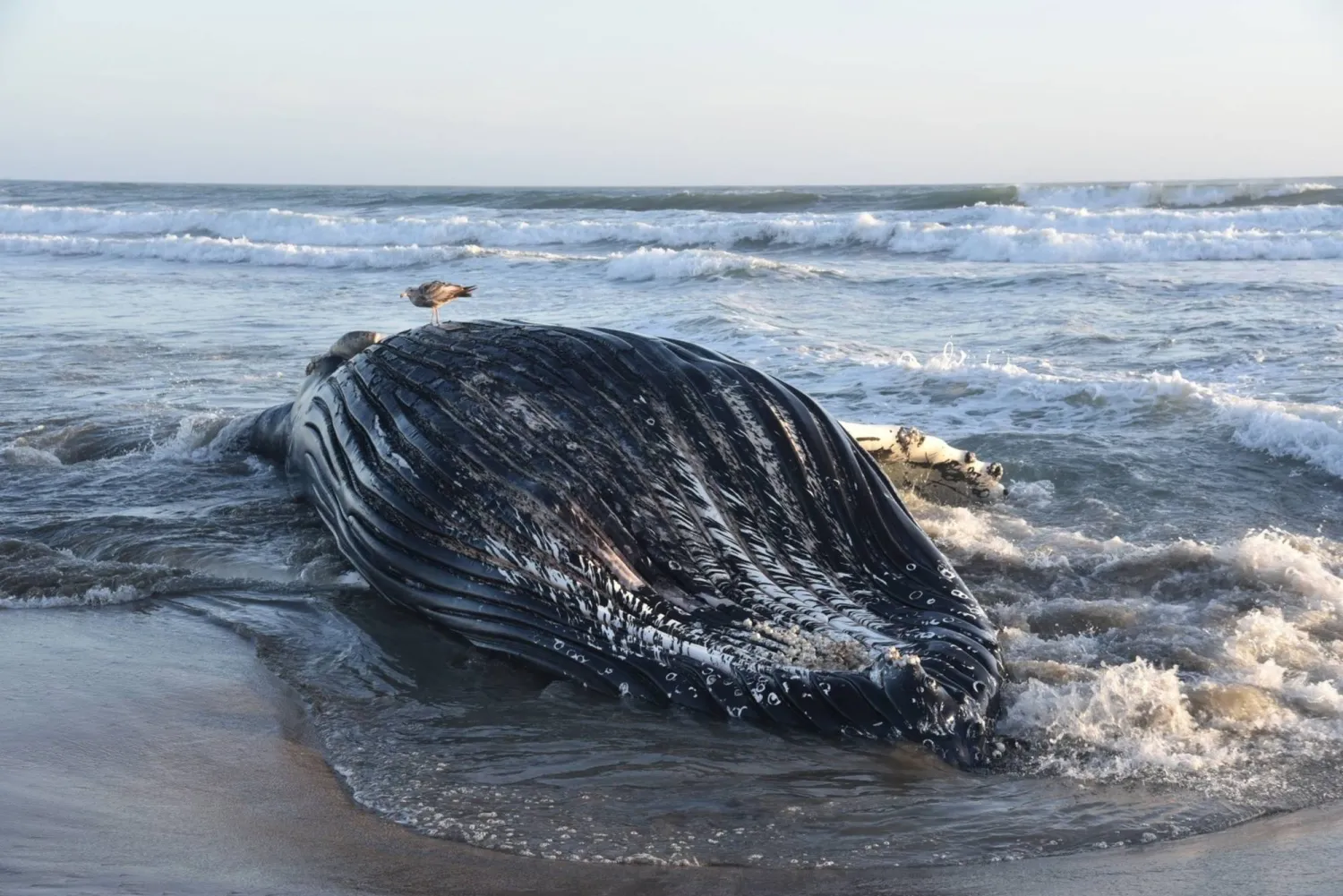
This handout picture provided by the Marine Mammal Stranding Network at UC Santa Cruz shows a juvenile humpback whale that washed ashore after dying from domoic acid poisoning, on Sunset Beach near Watsonville, in the Monterey Bay, California, on June 5, 2026. (Photo by Handout / Marine Mammal Stranding Network, UC Santa Cruz / AFP)
TT

Whales at Risk, Hungry Pelicans: Marine Heat Wave Hits California

This handout picture provided by the Marine Mammal Stranding Network at UC Santa Cruz shows a juvenile humpback whale that washed ashore after dying from domoic acid poisoning, on Sunset Beach near Watsonville, in the Monterey Bay, California, on June 5, 2026. (Photo by Handout / Marine Mammal Stranding Network, UC Santa Cruz / AFP)

On a boat off the coast of California, Sara Lesser gazes wistfully at dozens of dolphins playing in the vessel's wake. This summer, extreme heat is making such a scene increasingly rare.

On daily tourist boat trips, "the number of whales and dolphins we're seeing is less than we would on a normal year," Lesser, a 39-year-old naturalist at the Aquarium of the Pacific in Long Beach, told AFP.

The warming of the ocean surface is forcing anchovies and sardines -- which the mammals eat -- to seek cooler waters, either at deeper levels or farther north.

Dolphins and whales "are going to follow their food, and so we're seeing less sightings," Lesser explained.

The educator aims to raise awareness among visitors about the plight of the animals, as fewer whale sightings is just a harbinger of larger negative changes to come to the marine ecosystem.

Surface water temperatures along the California coast are now three to four degrees C above normal, according to the US National Oceanic and Atmospheric Administration (NOAA).

The current heat wave has been ongoing for "about six months," said Andrew Leising, a research oceanographer at NOAA.

What makes it more worrying is that it coincides with the return of El Nino, the weather pattern that warms surface temperatures in the central and eastern equatorial Pacific Ocean -- and periodically disrupts global climate.

This year, scientists are predicting that El Nino could rank among the largest ever recorded.

- Sea lions at risk -

"Chances are this El Nino is going to be stronger than the 2015-2016 one," Leising said, noting that a decade ago, the oceanic heat wave was devastating for the Golden State.

At that time, conditions were much the same as they are now: El Nino aggravated a heat wave that had begun in 2014.

Ocean waters became so hot that thousands of birds died because they could not reliably get fish on the surface. The carcasses of malnourished sea lions and whales washed up on beaches.

In recent months, dozens of pelicans and cormorants were found dead near San Diego.
Leising fears the sea lions -- one of California's signature animals -- could soon suffer.

When temperatures rise, the females abandon their pups to hunt for food, he explained.

Heat also fuels toxic algae blooms containing domoic acid, which contaminate the anchovy and sardine populations. This makes the sea lions sick, and eventually they could wash up dead.

In Monterey Bay, south of San Francisco, harmful algae are so prevalent that two humpback whales were found dead ashore in early June.

Elliott Hazen, an adjunct professor in the ecology and evolutionary biology department at the University of California, Santa Cruz, says that hasn't happened in a decade.

"These are such large predators, it just highlights how much domoic acid there has to be in the ecosystem for it to affect them," Hazen told AFP.

- Great white sharks near shore -

The marine heat wave is also pushing great white sharks nearer to the shore -- a rare sight.
During the whale watching sail from the Aquarium of the Pacific, a shark briefly surfaced, its fin visible.

"It's not common for us to see them," said Lesser, the aquarium guide. "But younger sharks like to be in warmer waters, and so we're seeing sharks closer to shore."

That has frayed nerves more than once in the area.

This week, a Malibu resident posted a video of a white shark swimming just a few yards (meters) from children, who were totally unaware of its presence.

This past spring, swimming was banned three times at Huntington Beach due to sharks deemed to be aggressive.

All these anomalies could become more and more regular -- California has seen marine heat waves every year since 2019.

"We know that climate change is adding more fuel to the fire," Hazen said.

"If we have these marine heat waves over and over again, and we lose the ability to sustain the ecosystem the way we have in the past, we're going to lose some of the fish species that we rely on for food. So that's the big concern."



Hoor Al Qasimi Becomes 1st Arab Woman to Lead Venice Biennale Art Show

Emirati curator Hoor Al Qasimi (Venice Biennale)
TT

Hoor Al Qasimi Becomes 1st Arab Woman to Lead Venice Biennale Art Show

Emirati curator Hoor Al Qasimi (Venice Biennale)

Emirati curator Hoor Al Qasimi has been named as the first Arab and the seventh woman to lead the Venice Biennale contemporary art exhibition, scheduled for 2028.

Al Qasimi leads the Sharjah Art Foundation, which she founded in 2009 to promote contemporary art and foster cultural exchange in the emirate, and has run the Sharjah Biennial since 2003. She curated the UAE’s pavilion at Venice in 2015.

The influential contemporary art magazine ArtReview ranked her No. 1 on its 2024 Power 100 list of the contemporary art world’s most influential figures, highlighting her support for artists beyond the Western mainstream.

The curator’s role is to present an organizing theme for the 62nd International Art Exhibition and choose artists for the main curated show, which runs alongside national pavilions that often take cues from the curator’s vision.

“The International Art Exhibition of La Biennale di Venezia has been an important platform for many of us around the world,’’ said Al Qasimi, who visited her first Venice Biennale in 2005.

“For me, La Biennale continues to be a critical space to engage with the work of influential artists and curators,” she added on Thursday.

Biennale President Pietrangelo Buttafuoco, who recommended Al Qasimi’s appointment, said her work combines “a profound attentiveness to deep-rooted memory and its legacies, an open perspective on the intricate complexities of the present, and a rare ability to listen to places and their people.”

The 61st Biennale contemporary art show curated by the late Koyo Kouoh closed on Sunday.


‘American Doctor’ Documentary Puts Spotlight on Gaza Health Workers

Doctors Feroze Sidhwa and Thaer Ahmad and filmmaker Poh Si Teng of the documentary film ‘American Doctor’ pose for a portrait in London, Britain, November 20, 2026. REUTERS/Kevin Coombs
TT

‘American Doctor’ Documentary Puts Spotlight on Gaza Health Workers

Doctors Feroze Sidhwa and Thaer Ahmad and filmmaker Poh Si Teng of the documentary film ‘American Doctor’ pose for a portrait in London, Britain, November 20, 2026. REUTERS/Kevin Coombs

Filmmaker Poh Si Teng went “all chips in” to reveal the harsh realities of Gaza’s hospitals in her feature debut “American Doctor.”

A former New York Times journalist and Al Jazeera documentary commissioner, Malaysian American Teng left her role at a major studio, used up her savings and fundraised to direct her first feature-length documentary.

The film follows three US doctors, Jewish American orthopedic surgeon Dr. Mark Perlmutter, Zoroastrian trauma surgeon Dr. Feroze Sidhwa and Palestinian American emergency physician Dr. Thaer Ahmad, who volunteer to provide care for Palestinians in Gaza.

Shot by local filmmakers and medics on the ground, it takes viewers inside the overwhelmed operating rooms and hospitals hit by Israeli strikes, depicting the extreme conditions, shortages and difficult decisions the trio and their Palestinian colleagues face.

“A lot of my well-meaning friends told me, ‘if you make this film, know that you’re sabotaging your own commercial film career’,” Teng told Reuters.

“And I thought to myself, ‘look, as a taxpayer, I’m paying for what is happening in Palestine, so if I’m going to be sabotaging my career, then, okay, all ⁠chips in, let’s go. Maybe this is the last feature, so be it’.”

Teng’s team agreed early on to make the film – shot between Christmas 2024 and Christmas 2025 – at record speed to release it before the US midterm elections.

Looking for an entry point that would resonate with audiences and allow her to examine America’s role in the Gaza war, Teng reasoned that “everybody’s got a doctor and has been to OR and ER at some point in their lives.”

“The title was always meant to be like a decoy. It was always meant to be a Trojan horse, especially in the United States, where people were so afraid to talk about Palestine and Gaza. I was, like, ‘let’s give it the most non-controversial title’,” she said.

“People came to watch ‘American Doctor’, quite a substantial chunk of the audience didn’t know what it was, and then when they watched it, they were exposed to what’s happening in Palestine.”

From Khan Younis to Washington

The film shows Sidhwa and Perlmutter working in the surgery department of Nasser Hospital in ⁠Khan Younis, which serves half of Gaza’s 2 million people, and follows Ahmad’s efforts to gain permission to re-enter Gaza.

They also engage in advocacy work, talking to journalists, addressing conventions and travelling to Washington, DC, to meet politicians.

Trying to convince lawmakers to support medical humanitarian aid was not a role they had been eager to take on, said Ahmad, but they felt it was necessary.

“They are casting votes that directly lead to bombs being dropped on our colleagues in Palestine, so it’s essential that they understand how deeply involved they are and that ⁠they need to be held accountable,” he said.

Israel’s campaign in Gaza has strained the decades-long bipartisan support for the country in the US.

Israel’s military has struck the Nasser Hospital complex at least seven times since the start of the Gaza war, according to hospital officials.

Surgeon Rezik Abushira, who is featured in “American Doctor,” was killed in an Israeli airstrike on Nasser Hospital two weeks ⁠ago.

Israel’s military said it targeted a senior Hamas commander and accused the militants of using the hospital complex to plan attacks, which the group denied.

Hospitals are protected sites under international law. Both attacking hospitals and their use for military purposes are typically considered breaches of the law.

Israel’s assault on Gaza has killed more than 74,000 ⁠Palestinians since 2023, caused a hunger crisis, internally displaced Gaza’s entire population and led to assessments of genocide from scholars and United Nations inquiries.

Israel has said its actions were in self-defense after Hamas-led militants killed 1,200 people and took more than 250 hostages in an attack on Israel in October 2023.

The Academy announced earlier this week that “American Doctor,” currently showing in cinemas in Britain and Ireland, was eligible for Oscar consideration.


Tourists Enjoy Brilliant Autumn Colors in Kyoto

Tourists dressed in kimonos pose for photos near autumn leaves next to the Nanzen-ji Buddhist temple in Kyoto on November 25, 2026. (Photo by Andrew CABALLERO-REYNOLDS / AFP)
TT

Tourists Enjoy Brilliant Autumn Colors in Kyoto

Tourists dressed in kimonos pose for photos near autumn leaves next to the Nanzen-ji Buddhist temple in Kyoto on November 25, 2026. (Photo by Andrew CABALLERO-REYNOLDS / AFP)

Visitors from Japan and overseas marveled at the brilliant reds and yellows of Kyoto's autumn foliage season, as it transformed the city's temples, gardens and mountains with a blaze of color.

The ancient Japanese capital is known for its cherry blossoms in spring, but autumn is another peak tourism season, particularly for local visitors keen to enjoy the centuries-old tradition of viewing vibrant fall foliage.

"The autumn leaves themselves are beautiful," Rie Segawa, 34-year-old visitor from Osaka, told AFP, adding that the colors make her "feel calm".

"Seeing them turn red makes me happy to see the seasons changing," she said.

Anthony Piglioni from France said he'd heard so much about the famous cherry blossom season but "the colors are just as beautiful as in the spring".

"It's incredible... the colors, the landscapes... very zen, very relaxing," the 37-year-old told AFP.

Kyoto has a long-standing tradition of appreciating autumn foliage.

During the Heian period between the late eighth century and the late 12th century, when the city was Japan's capital, looking at autumn leaves was an important seasonal pastime among the aristocracy, much like cherry blossom viewing in spring.

The aristocracy would visit the mountains and compose poems celebrating the beauty of the autumn colors.

Over time, trees such as Japanese maples were planted in aristocratic residences, temples and gardens across Kyoto.

Scientists say climate change is delaying famed autumn foliage season in Japan, pushing back the peak display of red and yellow leaves, although this year was within the normal range for Kyoto.