UN Lists South Sudan Antelope Route as Heritage in Danger

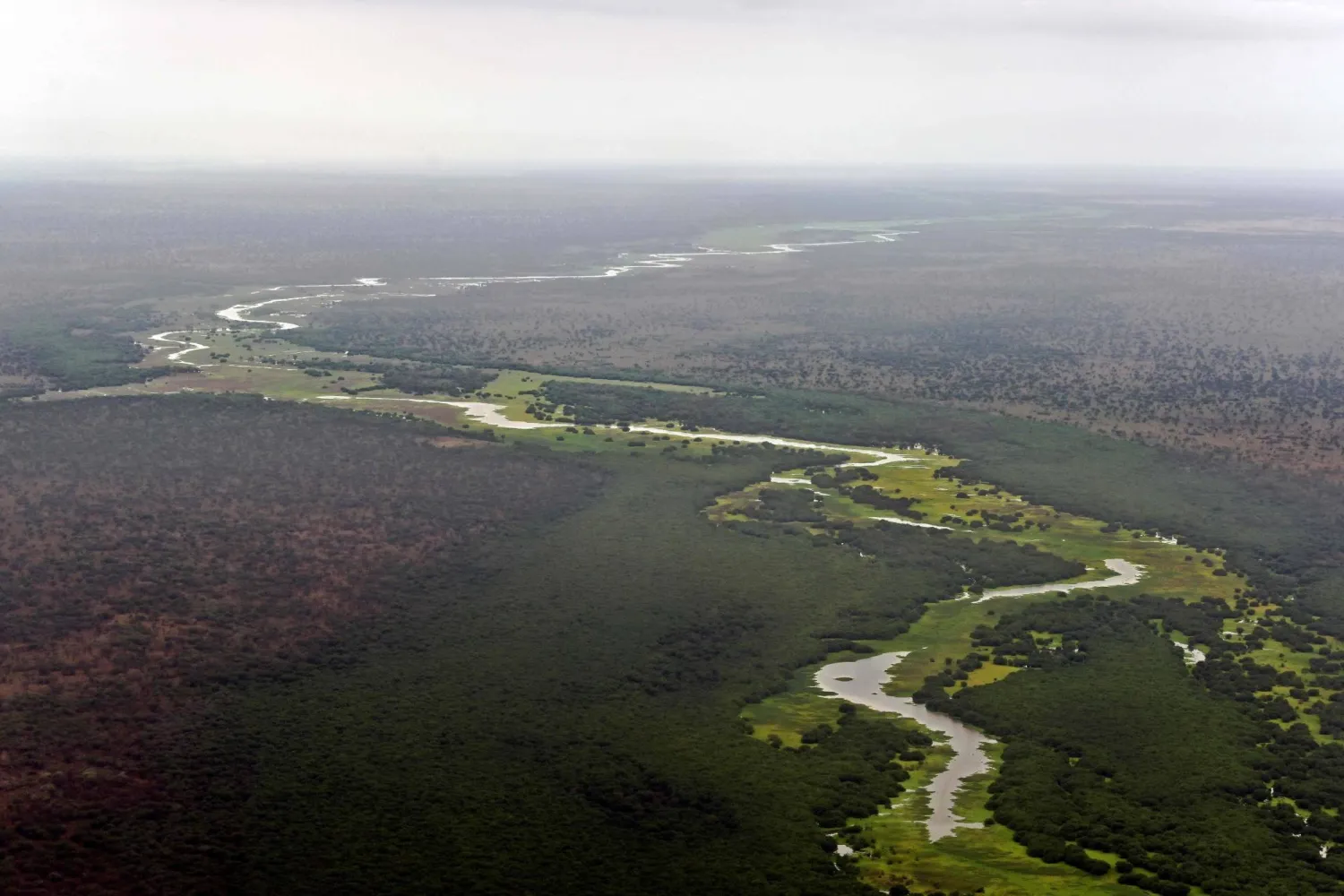
An aerial view of the Pibor river flowing across the landscape between Boma and Badingilo national parks on February 4, 2020. (AFP)
TT

UN Lists South Sudan Antelope Route as Heritage in Danger

An aerial view of the Pibor river flowing across the landscape between Boma and Badingilo national parks on February 4, 2020. (AFP)

The United Nations has fast-tracked a vast antelope migration path in South Sudan onto its list of World Heritage in Danger, in the young nation's first such listing.

The United Nations Educational, Scientific and Cultural Organization (UNESCO) added the so-called Boma-Badingilo migratory landscape to its list on Sunday.

The grassland and woodland savannahs that cover some 37,500 square kilometers -- an area larger than Belgium -- are viewed as under threat from both war and climate change.

One million animals -- including antelopes and gazelles -- migrate through the vast wilderness located between the White Nile and the Ethiopian border every year, leaving scars on the grasslands that are visible from the sky.

South Sudan has been the scene of a series of deadly conflicts since gaining its independence in 2011.

"The Boma-Badingilo migratory landscape is home to one of the greatest wildlife migrations on Earth and stands as a powerful symbol of our country's resilience, beauty and potential," Tourism Minister Denay Jock Chagor told AFP.

Its listing "as South Sudan's first UNESCO World Heritage Site is a proud and historic moment for our nation", he added.

Paulino Warnyang, a representative of communities living in the area, said it honored "not only the animals and the land, but also the people whose lives, traditions and cultures have always been connected to them".

Making the UNESCO heritage list often sparks a lucrative tourism drive and can unlock funding for the preservation of sites that can face threats including pollution, war and negligence.


NCW, NEOM Celebrate First Striped Hyena Birth

Striped hyenas play an important ecological role by feeding on carcasses and carrion - SPA
TT

NCW, NEOM Celebrate First Striped Hyena Birth

Striped hyenas play an important ecological role by feeding on carcasses and carrion - SPA

The National Center for Wildlife (NCW), in collaboration with NEOM, has documented the first birth of a striped hyena following the reintroduction of two breeding pairs into NEOM Nature Reserve. The birth is a positive indication of the hyenas’ successful adaptation to the reserve and their ability to reproduce in the wild.

According to a press release issued by the NCW, the birth marks another milestone in NCW’s wildlife breeding and reintroduction programs, which include dedicated efforts for predator species aimed at restoring their natural roles within ecosystems.

Prior to the release, two pairs of striped hyenas were selected and underwent a rehabilitation program at one of NCW’s wildlife care facilities, SPA reported.

The program included veterinary examinations, health monitoring, and preparation for their transition into the wild. A specialized NCW team also conducted a field assessment of the reintroduction site to verify its readiness and ecological suitability for the hyenas.

NCW CEO Dr. Mohammed Qurban said: "This is the first striped hyena birth following their reintroduction, and it marks an important milestone in the center’s wildlife breeding and reintroduction programs.”

He emphasized that reintroducing species into their natural habitats represents an advanced stage in establishing populations capable of surviving and reproducing in the wild and restoring their ecological roles.

Striped hyenas play an important ecological role by feeding on carcasses and carrion. Their populations have declined in parts of their natural range due to several threats, particularly hunting and poisoning.


Chile-led Team Maps Antarctic Plant Genome in Step Towards Climate-resilient Crops

FILE PHOTO: A frozen section of the Ross Sea at the Scott Base in Antarctica on November 12, 2016. REUTERS/Mark Ralston/Pool/File Photo
TT

Chile-led Team Maps Antarctic Plant Genome in Step Towards Climate-resilient Crops

FILE PHOTO: A frozen section of the Ross Sea at the Scott Base in Antarctica on November 12, 2016. REUTERS/Mark Ralston/Pool/File Photo

A team led by Chilean researchers has produced the most complete genetic map yet of one of only two flowering plants that grow naturally in Antarctica, potentially helping the development of crops resistant to extreme weather.

Colobanthus quitensis has long attracted scientific interest because it can survive the freezing temperatures, lack of water and high levels of ultraviolet radiation in Antarctica, one of the planet's coldest and driest environments.

As record heat and extensive drought have increased the urgency of ⁠debate in many ⁠parts of the world over how to adapt agriculture, the scientists said they are now equipped to start assessing whether the plant's traits could be transferred to agricultural crops through gene-editing techniques.

The study, published in Oxford University Press journal "Genome Biology and Evolution," ⁠assembled all 40 chromosome-scale scaffolds that make up the plant's genetic blueprint under a project known as Polarix.

"We were able to sequence and assemble the entire genome," said Eduardo Castro, an associate researcher at Chile's Cape Horn International Center and lead author of the study alongside Claudio Meneses of Chile's Pontifical Catholic University.

"The idea is not to create transgenic plants. The idea is to edit the genome of a plant with ⁠nutritional ⁠value," Reuters quoted Castro as saying.

Identifying individual genes is easier once a genome has been mapped, but it can still take time. When that has been done, Castro said that scientists could need between five and 10 years to develop commercial applications.

A team in California supported the Chilean scientists, who said their work built on previous efforts by the Korea Polar Research Institute. That work produced only a partial version of the genome and was not published.


Stubborn Vulture Reportedly Plucked from Plane's Wing before Greece Flight

A vulture flies over the Iraty mountains, southwestern France on July 2, 2026. (Photo by Gaizka IROZ / AFP)
TT

Stubborn Vulture Reportedly Plucked from Plane's Wing before Greece Flight

A vulture flies over the Iraty mountains, southwestern France on July 2, 2026. (Photo by Gaizka IROZ / AFP)

A vulture who refused to budge had to be removed from the wing of a flight awaiting takeoff on the Greek island of Crete, in order to avoid potential damage to the plane, a local newspaper reported Monday.

The Patris daily said the incident occurred late Sunday at the island's Iraklio airport, when the fire service was called in to remove the large scavenger.

It pictured the bird tucked inside a jacket held by a firefighter. The report did not specify where the flight was headed.

Birds are routinely sucked into aircraft engines, occasionally causing serious accidents.

Last week, the US National Transportation Safety Board said bird remains had been found in the engine of a Ryanair plane that saw a blade break off on July 10, shattering a cabin window and partially sucking a passenger outside.

Four suspected bird strikes to the plane's engine had been reported by flight crews in the 12 months preceding the accident, but no damage was found in subsequent maintenance, the report said.