


Strange Discovery on Mars Surprises Scientists

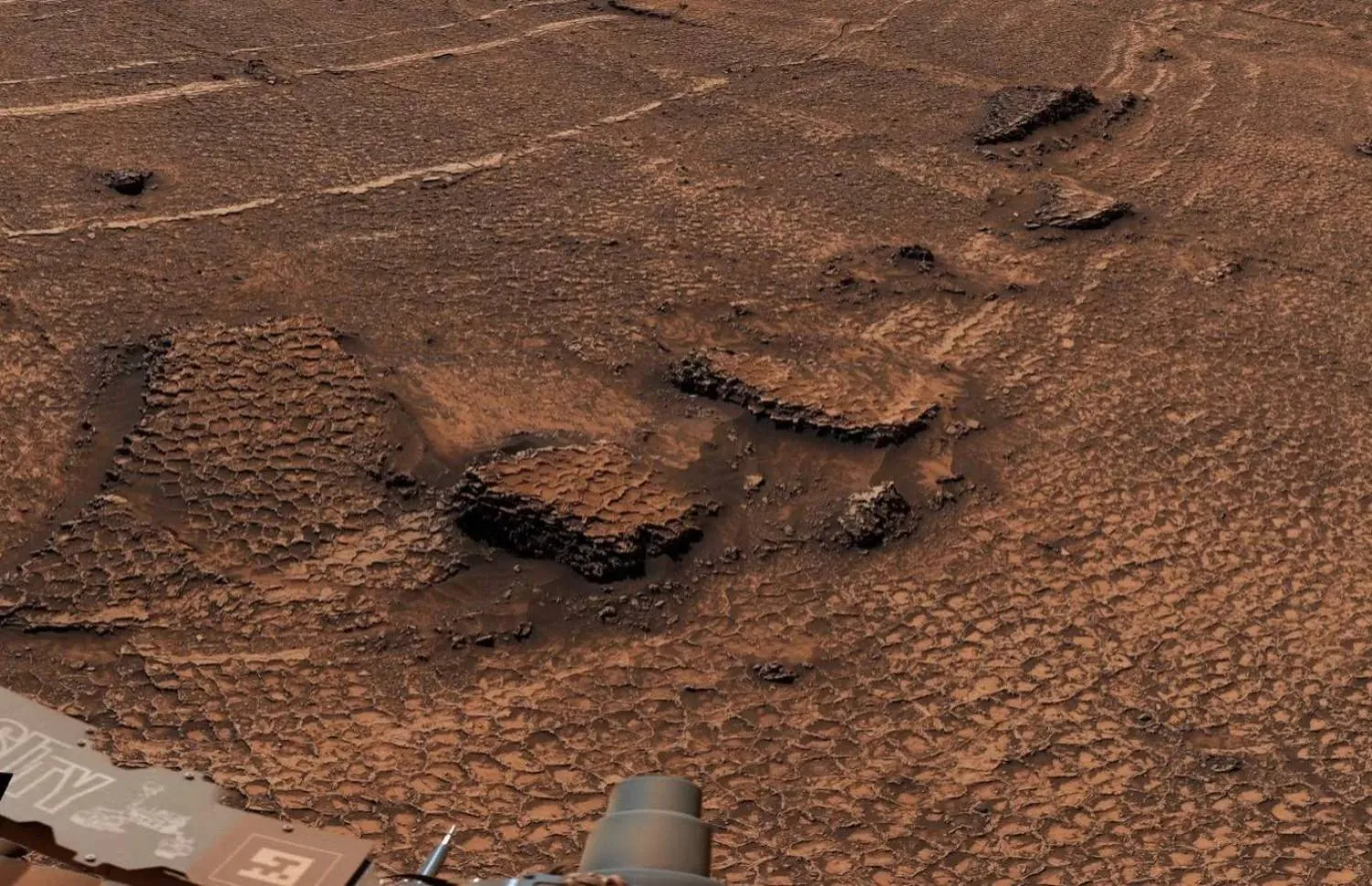
NASA’s Curiosity rover made a curious discovery on the Martian surface in June (NASA/JPL-Caltech/MSSS) 
TT

Strange Discovery on Mars Surprises Scientists

NASA’s Curiosity rover made a curious discovery on the Martian surface in June (NASA/JPL-Caltech/MSSS) 

NASA’s Curiosity rover just made a strange discovery. The vehicle stumbled upon honeycomb-like patterns of polygons on the surface of the Martian valley known as “Valle Grande” last month, according to The Independent.

The Curiosity rover has been exploring the Red Planet for nearly 12 years.

While this is not the first time the mission has seen the polygonal shapes, scientists have never seen so many of the features in one place before. They also still do not know how they formed - though they hope to determine the cause.

“We have seen a lot of fascinating landscapes through Curiosity’s eyes, but this sea of polygons took our breath away,” Curiosity mission project scientist Ashwin Vasavada, of the agency’s Jet Propulsion Laboratory in South California, said in a statement. “We measured their shapes and chemistry carefully and are hopeful there are clues in the data as to how these features formed.”

The polygons are between 1.3-3 inches in diameter and wrap around the sides of a nearby hill nicknamed “Miraflores.”

Some of the polygons spotted in the past were clearly formed as cracks in ancient mud.

Researchers previously said these were signals of the Red Planet’s past seasonal cycles - and potential signs for how life began there.

“This is the first tangible evidence we’ve seen that the ancient climate of Mars had such regular, Earth-like wet-dry cycles,” William Rapin, of France’s Institut de Recherche en Astrophysique et Planétologie, said in a statement in 2023. “But even more important is that wet-dry cycles are helpful – maybe even required – for the molecular evolution that could lead to life.”

That said, a variety of processes can contribute to honeycomb textures, according to the laboratory. Another potential explanation is that water was squeezed out of the sediment when the surface was buried.

This is not the first discovery from Curiosity that’s surprised project mission researchers.

Curiosity has found evidence that ancient Mars was able to support microbial life, but it’s also found sulfur crystals and shiny meteorites.

The rover landed on Mars in August 2012. Since 2014, it’s been climbing the three-mile-tall Mount Sharp, which was covered with lakes and streams billions of years ago.


Prince Harry and Meghan to Move Back to Britain

FILE PHOTO: Britain's Prince Harry and Meghan, the Duke and Duchess of Sussex, arrive at Rushcutters Bay following a sail on Sydney Harbour with veterans from the Invictus Australia community, in Sydney, Australia, April 17, 2026. REUTERS/Hollie Adams/File Photo
TT

Prince Harry and Meghan to Move Back to Britain

FILE PHOTO: Britain's Prince Harry and Meghan, the Duke and Duchess of Sussex, arrive at Rushcutters Bay following a sail on Sydney Harbour with veterans from the Invictus Australia community, in Sydney, Australia, April 17, 2026. REUTERS/Hollie Adams/File Photo

Prince Harry and his wife Meghan plan to move back to Britain this month, six years after they stepped down from their royal duties and relocated to the US, a source close to the couple said.

The surprise move comes after the couple spent recent years repeatedly criticizing the royal family and lambasting the British press, saying the tabloids had made their lives hell and they wanted to carve out independent roles for themselves.

The couple, known as the Duke and Duchess of Sussex, were moving with Prince Archie, 7, and Princess Lilibet, 5, from California to Britain for an extended period and the children would begin school there in September, the person close to them said, confirming details that were reported in the media.

King Charles, who welcomed having his youngest son and his family closer, found out about the move on Sunday, British media reports said. Harry and Meghan will not live in a royal residence and will remain non-working royals as agreed with the late Queen Elizabeth when they left in March 2020.

Harry's spokesperson and Buckingham Palace declined to comment, according to Reuters.

Harry married Meghan Markle in a ceremony at ⁠Windsor Castle in 2018, ⁠and it was hoped his union with the former actor would reinvigorate the historic institution for a new generation.

But it was not long before cracks in their relationship with the rest of the royal family began to emerge. Two years later in March 2020, they announced they would step down from official duties and move to the US, saying they wanted to move away from the intense press scrutiny they faced in Britain.

They settled in the wealthy seaside enclave of Montecito, near Santa Barbara, California, with media reports putting the 2020 purchase price of their 16-bedroom home at $14.7 million.

In the following years, Harry, now 41, and Meghan, 45, repeatedly criticized the royal family and the monarchy in ⁠TV interviews, a Netflix documentary series and, most notably, in Harry's memoir "Spare.”

During a 2021 interview the couple gave to Oprah Winfrey, Meghan, whose mother is Black, said an unnamed member of the family had asked how dark their son Archie’s skin might be. Heir-to-the-throne Prince William, Harry's elder brother, responded by denying that Britain’s royals were racist.

Harry had some particularly barbed comments for his father, Charles, and Prince William, leading to a total breakdown in their relationship.

Harry was also angry the British government changed his security arrangements and said the lack of automatic police protection meant he was unable to bring his children to Britain.

But relations with the king appeared to be thawing in September, and father and son met briefly for the first time in 20 months. Charles was diagnosed with an unspecified type of cancer in 2024. He announced on television last December that he had responded "exceptionally well" to treatment.

Last month, Harry, Meghan and their children visited Britain, and Charles saw his grandchildren for the first time since 2022.

However, while the king welcomed the chance to see more ⁠of the Sussexes, he only became aware ⁠of the couple's plans to return to Britain on Sunday.

While Harry and the king's relationship might have improved, he is still barely on speaking terms with his brother.

British minister Lucy Powell, talking to the BBC on Thursday, said it was good news, adding that she hoped "the reconciliation with the family continues because I think that's good for the country ... to send out that signal.”

Harry and Meghan embarked on several media ventures from their California home, signing multi-million-dollar deals with Spotify for a podcast series and with Netflix for programming including a lifestyle show hosted by Meghan.

The projects produced mixed results. Harry's tell-all book was a bestseller, but their podcast deal ended and Meghan's Netflix show was not renewed for a third season.

In recent months Meghan has published an increasing number of photographs on her Instagram account, showing Harry and their children and their US life, often taken from behind the children to hide their faces.

"I think they didn't achieve the superstar status they wanted," said Dominic Patten, executive editor of Hollywood publication Deadline.com.

They did, however, keep the public interested in their story in a town full of big-name celebrities, Patten said.

"He and Meghan have kept that flame aflutter," Patten said. "If you look at how quickly Hollywood careers can burn out, on that level, by that metric, they've been successful."


Australia Races to Shield Little Penguins from H5N1 Bird Flu

This handout photo taken on August 13, 2024 and released by Phillip Island Nature Parks on August 20, 2026 shows tourists watching the "Penguin Parade" at Phillip Island Nature Parks in Victoria. (Photo by Handout / Phillip Island Nature Parks / AFP)
TT

Australia Races to Shield Little Penguins from H5N1 Bird Flu

This handout photo taken on August 13, 2024 and released by Phillip Island Nature Parks on August 20, 2026 shows tourists watching the "Penguin Parade" at Phillip Island Nature Parks in Victoria. (Photo by Handout / Phillip Island Nature Parks / AFP)

Australian wildlife workers have launched an unprecedented effort to vaccinate wild populations of little penguins against the highly contagious H5N1 avian influenza.

Hundreds of thousands of tourists a year flock to viewing areas and boardwalks to watch the diminutive sea birds waddle ashore and along the beach in the evenings on the eastern coast's Phillip Island.

The stars of this "penguin parade" are from a wild colony on the island, numbering up to 40,000 seabirds at the height of the breeding season in the southern hemisphere's spring and summer.

It is the world's biggest single colony of little penguins, which have a life span of about six years with habitats in southern Australia -- mostly Tasmania -- and New Zealand.

Also known as fairy penguins, they are the tiniest species of the semi-aquatic sea birds, barely reaching knee height and weighing about the same as a standard bag of sugar.

Now, like the rest of Australia's wild bird population, they face the threat of H5N1, which breached the continental landmass for the first time in June and has since started to spread in local wildlife.

The virus was detected this month in a Phillip Island penguin that had died, the first infection in the colony by a pathogen that has caused severe disease and death in birds worldwide.

In response, wildlife teams started to vaccinate birds in the colony this week, said James Todd, chief biodiversity officer for the state of Victoria in which the island lies.

"This is unprecedented. There has been no vaccination of this scale in a wild population anywhere in the world," Todd said.

The H5N1 vaccination program, which also covers a popular little penguin population at a breakwater in the Melbourne beach suburb of St Kilda, is a challenge, he said.

"Trying to vaccinate wild populations is almost impossible, partly because you need two doses of the vaccine," Todd told AFP.

But wildlife experts are very familiar with the little penguins' burrows at Phillip Island and St Kilda, he said.

The birds, in turn, are accustomed to floodlights for the "penguin parade" tourist attraction, as well as being periodically handled by veterinarian scientists for monitoring of their health.

Vaccination teams aim to inoculate about 5,000 little penguins closest to the visitor areas, the state official said, in a program that is likely to last weeks and months, not days.

Ideally, the H5N1 vaccine should be administered in two doses with a gap of three-to-four weeks, Todd said.

"Given that we're in a bit of a state of urgency here, experts have said that it's okay to even think about you know one to two weeks," he said, though a final decision had yet to be taken.

Vaccination teams can pick up the penguins from their burrows and may try to corral some as they come ashore on the beach, using microchips to track those that have been given a shot, Todd said.

"They're wild animals -- they'll squawk and try to, you know, peck you, and do all that sort of stuff -- but as I said, the team down there are very used to handling these animals," he explained.

"If you and I were doing it, we'd probably drop the thing straight away."


Fastest-known Star Zooms Under Milky Way Black Hole's Influence

Black holes are extremely dense objects with such strong gravity that light cannot escape them (Reuters)
TT

Fastest-known Star Zooms Under Milky Way Black Hole's Influence

Black holes are extremely dense objects with such strong gravity that light cannot escape them (Reuters)

Scientists have detected the fastest-known star, a stellar speedster that is zooming around the supermassive black hole residing at the center of our galaxy and might hold the key to measuring the spin of this celestial beast for the first time.

The star, around 50% more massive and five times brighter than our sun, travels at speeds up to about 56 million miles (90 million km) per hour as it orbits the Milky Way's central black hole — named Sagittarius A*, or Sgr A*. That is more than 8% the speed of light. No other star in our galaxy or elsewhere has ever been clocked at that speed.

The star, named S301, is traveling in a highly elliptical path around Sgr A*, taking about 8.7 years to complete an orbit. Its closest approach to the black hole is about 11.5 times Earth's orbital distance from the sun, a metric called an astronomical unit. That means the star's nearest pass is somewhat more than the planet Saturn's ⁠orbital distance from ⁠the sun. But at its farthest, S301 is about 1,360 astronomical units from Sgr A*, Reuters reported.

Black holes are extraordinarily dense objects with gravity so strong that not even light can escape. Sgr A* possesses about 4 million times the sun's mass and is located about 26,000 light-years from Earth. A light-year is the distance light travels in a year, 5.9 trillion miles (9.5 trillion km).

While Sgr A* presently is in a quiescent state, its gravitational pull is considerable — meaning it could gulp down stars or other material straying too close. But the researchers said S301 should remain safe from the black hole's wrath.

"Its orbit will not decay ⁠anytime soon. So the orientation of the orbit will change, but it is not in danger of being swallowed," said astrophysicist Stefan Gillessen of the Max Planck Institute for Extraterrestrial Physics in Germany, one of the leaders of the research published on Wednesday in the journal Nature.

No other star is known to orbit as close to Sgr A* as this one. So how did S301 end up with this crazy orbit?

Gillessen said it appears that S301 originally was part of a two-star system called a binary, gravitationally bound to a stellar partner. But the two stars at some point ventured too close to the black hole while traveling through space, and the subsequent three-way gravitational interaction wreaked havoc.

"One star shoots out from the center of the Milky Way traveling at high speed and even leaving the galaxy. The other star is stuck forever on an orbit close to the black hole. That is S301," Gillessen said.

The researchers observed S301 using the ⁠European Southern Observatory's Chile-based Very Large ⁠Telescope Interferometer. The continuing influence that Sgr A* exerts on S301 during its orbit may enable scientists to better understand the black hole, including possibly measuring its spin.

"Currently, there is very little that we know about the rotation of Sgr A*," said study co-author Felix Mang, a doctoral student at the Max Planck Institute for Extraterrestrial Physics.

Black holes are believed to rotate, so much so that they twist the very fabric of space and time around them. But confirming this spin is difficult because black holes do not emit or reflect light, rendering them invisible.

"We only can see their rotation by seeing the effect on the space around them," Gillessen said.

The researchers said that the motion of S301 remains sensitive to Sgr A*.

"The star during its orbit comes so close to Sgr A* that it actually will feel the spin of Sgr A*," Gillessen said.

"It is not a wobble — like in back and forth — but rather the star gets pushed onto a slightly different orbit each time it passes the black hole. That means that by observing that change in orbit for another good decade, we should be able to directly determine the spin of the black hole. Such a measurement is unheard of, so far," Gillessen added.
