


Tourists Chase High-Octane Thrill in China’s Trending Biker Capital

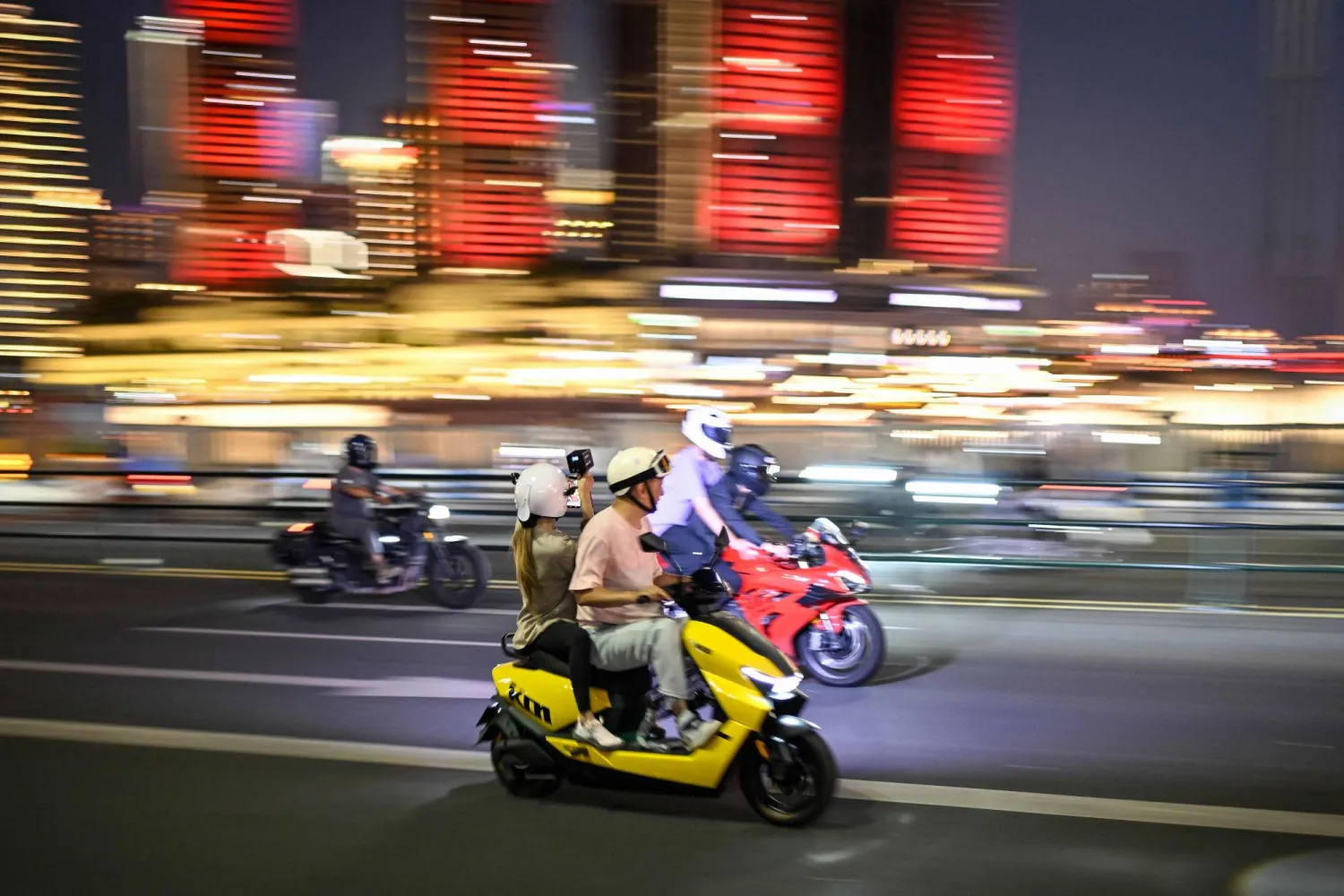
This picture taken on July 20, 2026 shows a woman sitting on the back seat of a motorcycle using mobile phone and lighting equipment to take pictures and videos in Chongqing, southwestern China. (AFP)
TT

Tourists Chase High-Octane Thrill in China’s Trending Biker Capital

This picture taken on July 20, 2026 shows a woman sitting on the back seat of a motorcycle using mobile phone and lighting equipment to take pictures and videos in Chongqing, southwestern China. (AFP)

The roar of engines fills the night air in China's Chongqing city as tourists awkwardly clamber onto gleaming motorbikes and cling to muscular drivers to star in personalized videos.

Teams of sellers hawk their filming services to passersby, many of whom have been drawn to the city and its cyberpunk image by motorbiking videos on social media shot against the neon-lit nightscape.

"I flew from Shanghai to Chongqing this morning, and the first priority is this shoot," 30-year-old Liu Changqing told AFP, dressed in one of the heavy motorcycle jackets rented to customers, despite the sweltering heat.

"They even have make-up artists to help you," she said as she mounted a crimson superbike, wrapped her arms around her driver and sped off with a videographer in pursuit.

While many Chinese cities have restricted motorcycling, Chongqing has embraced it and become a biker's paradise.

What began with local riders snapping each other to post online exploded last year as tourism to the mega-city of 23 million spiked.

Videos using a hashtag related to the trend have racked up a cumulative 1.3 billion views on Douyin -- China's version of TikTok -- helping to elevate Chongqing's motorcycle culture to national prominence and even gaining recognition overseas.

- Manufacturing hub -

"There is a local saying that if you put a camera at an intersection in Chongqing, every 30 seconds you'll see a motorcycle pass by," said Zhang Yuanming, a 29-year-old motorbike enthusiast and instructor.

Zhang attributes biking's popularity in the city to the prevalence of manufacturers, the rugged terrain, and bad traffic.

Chongqing has been an industry hub since 1979, when state-owned military equipment manufacturer Jialing began producing civilian motorcycles in the city.

Motorbikes quickly became popular, and the city now accounts for more than a third of China's total motorbike production.

While many Chinese cities are dominated by electric scooters, which face fewer regulations, Chongqing has remained open to petrol-powered two-wheelers.

Zhang, who teaches students to race at a track on the outskirts of the city, hopes tourism will further burnish the city's biker reputation.

"When (tourists) take photos and videos, they may come to like motorbikes and learn to ride, then buy a bike," he said.

Zhang has also seen increased interest from students since March, when local brand ZXMoto made headlines by becoming the first Chinese manufacturer to win a race in the prestigious WorldSSP class in Portugal.

"It's pushing young people to get in touch with motorcycles," he said.

- Roaring business -

For the local bikers offering videos for tourists, Chongqing's motorcycle prowess is a business opportunity.

The packages of choreographed photos and videos -- in which customers are swept off their feet by dashing riders and cruise past the city's landmarks in slow motion -- cost upwards of 200 yuan ($30).

"We used to just make short videos of ourselves. Later other people saw that we looked pretty handsome so they started wanting to sit on the back," 26-year-old rider Li Yan told AFP, explaining how he now earns up to 1,000 yuan a night from customers.

Li's team has grown to seven members working together to advertise online and to passersby, drive the bikes, and edit the footage, with each rider attracting around six to 12 customers a night.

Domestic interest has cooled from the craze's peak last year, but foreign tourists -- who now make up around a third of customers each evening -- are helping fill the gap as the news spreads overseas.

"I saw it was a 'must do' in Chongqing," said Alex Schodorowska, a tourist visiting from Britain, who saw the trend on Instagram.

"There's nowhere with a view like this, with all the lights," the 29-year-old told AFP as she waited her turn for a ride.

"I don't think many places could have the same effect for video."


Indonesia Intensifies Aerial Firefighting as Forest Fires Scorch Multiple Provinces

In this aerial photo released by Indonesia's National Disaster Mitigation Agency (BNPB) on Friday, Aug. 21, 2026, smoke billows as a wildfire rages through a peatland forest in Bulungan, North Kalimantan, Indonesia. (BNPB via AP)
TT

Indonesia Intensifies Aerial Firefighting as Forest Fires Scorch Multiple Provinces

In this aerial photo released by Indonesia's National Disaster Mitigation Agency (BNPB) on Friday, Aug. 21, 2026, smoke billows as a wildfire rages through a peatland forest in Bulungan, North Kalimantan, Indonesia. (BNPB via AP)

Indonesia on Monday intensified ground and aerial firefighting operations as huge blazes in central and western parts of the country scorched thousands of hectares of forests and peatland, created a choking haze that blanketed cities and crossed borders.

Indonesian authorities have been battling fires driven by an intensifying El Nino pattern and a prolonged dry season, generating dense smoke that crossed into Malaysia and Brunei, according to Indonesia’s National Disaster Management Agency, or BNPB.

The BNPB said Monday that fires remain active in several regions, while large-scale suppression efforts continue in fire-prone provinces including West, Central and South Kalimantan on Borneo island and in Riau, South Sumatra and Jambi on Sumatra island. The fires are part of a broader surge in wildfire activity across Indonesia this year.

After visiting areas devastated by forest and peatland fires in Central Kalimantan on Saturday, Indonesian President Prabowo Subianto flew to fire-affected Riau province on Sumatra island, where more than 11,500 hectares (28,400 acres) have burned, to encourage authorities to get the haze cloud under control.

Prabowo vowed the government would continue supporting firefighting operations, including through the deployment of additional water-bombing helicopters and oxygen supplies for firefighters. According to The Associated Press, he urged authorities to “thoroughly document and report the work being carried out by firefighting teams” directly to him.

The Transportation Ministry said it has authorized the use of 35 foreign-registered aircraft to support wildfire response operations, including water-bombing missions and aerial patrols.

The ministry said the aircraft can be rapidly redeployed to disaster-hit areas as conditions change, while complying with Indonesian aviation safety regulations.

The Environment Ministry satellite data on Monday showed South Sumatra recorded the highest number of hot spots nationwide with 1,429, followed by West Kalimantan with 1,226 and Central Kalimantan with 811. East Kalimantan logged 576 hot spots, ahead of Riau with 503, while West Papua and Jambi recorded 468 and 458 hot spots, respectively.

Forestry Ministry data indicated that nearly 94,000 hectares (232,000 acres) burned in July alone.

Drought, strong winds and dry vegetation have complicated efforts to contain the fires, BNPB said in a statement on Monday. Some hot spots remained inaccessible to more than 10,700 ground firefighters who were deployed as of Sunday, prompting local officials to request additional water-bombing support and firefighting vehicles.

Cloud-seeding resumed over Kalimantan on Monday, with 30 helicopters for water-bombing and aerial patrol missions, and another 22 helicopters covering Sumatra.

Fires are a regular problem during dry season in Indonesia, a vast archipelago nation of more than 17,000 islands, and often strain relations with neighbors.

Plantation owners and traditional farmers often start fires to clear land for farming. It triggers hazardous haze that reduces visibility, disrupts land and air transportation and threatens public health, sometimes affecting neighboring countries in Southeast Asia.

Meanwhile, Malaysia has suffered severe smoke from the fires, with its eastern state of Sarawak among the hardest hit, prompting the closure of nearly 600 schools and affecting about 200,000 students, the Sarawak government said.


New Zealand’s PM Proposes Banning Children from Using Social Media

 New Zealand's Prime Minister Christopher Luxon speaks to media during a visit to aircraft manufacturing company "NZ Aero" with Thailand's Prime Minister Anutin Charnvirakul (not pictured) in Auckland on August 21, 2026. (AFP)
New Zealand's Prime Minister Christopher Luxon speaks to media during a visit to aircraft manufacturing company "NZ Aero" with Thailand's Prime Minister Anutin Charnvirakul (not pictured) in Auckland on August 21, 2026. (AFP)
TT

New Zealand’s PM Proposes Banning Children from Using Social Media

 New Zealand's Prime Minister Christopher Luxon speaks to media during a visit to aircraft manufacturing company "NZ Aero" with Thailand's Prime Minister Anutin Charnvirakul (not pictured) in Auckland on August 21, 2026. (AFP)
New Zealand's Prime Minister Christopher Luxon speaks to media during a visit to aircraft manufacturing company "NZ Aero" with Thailand's Prime Minister Anutin Charnvirakul (not pictured) in Auckland on August 21, 2026. (AFP)

New Zealand's Prime Minister Christopher Luxon has unveiled a proposed law banning children younger than 16 from using social media platforms, citing what he said Monday was “harm being done to a generation” of young people.

However, the bill hasn't yet attracted enough support to pass into law because two of the three parties in Luxon's coalition government will vote against it. Passage would require support from opposition lawmakers, who have yet to decide how they would vote.

There also wasn't enough time for lawmakers to hold a vote on the proposal before Parliament dissolved on Oct. 1 ahead of November’s election, Luxon said. Bills are required to pass three rounds of voting, usually over a period of months, before they become law.

Proposal comes after other countries enact age bans If reelected, Luxon is seeking to make his government the latest worldwide to enact age restrictions for social media platforms after dozens of countries have either introduced or are mulling such measures.

He said 2025 research showed a third of New Zealand teenagers spent at least five hours a day on social media.

“Social media is exposing them to harmful content, addictive technology and pressures they are not equipped to deal with and it’s affecting their family life, mental health, sleep, and education,” Luxon said.

The proposal would require social media platforms including Instagram, TikTok, Snapchat and Facebook, to “take reasonable steps” to check users were older than 16, according to material supplied by Luxon's party Monday. This could include “existing account information, facial age estimation, digital ID services and formal ID,” the material said.

Excluded from the proposed law are messaging platforms such as WhatsApp, online gaming platforms like Roblox and AI apps with productivity uses, including ChatGPT, Gemini and Copilot.

No penalties are proposed for parents or children, but tech firms could be fined up to 10% of their global revenue for failing to meet their obligations. Platforms regularly used by children would be required to assess and report on the risks their networks posed, Luxon said.

Prospect of a ban has divided New Zealand's government Luxon's government has mulled such a law since Australia's world-first social media ban for under 16-year-olds took effect in December 2025. However, it's been vehemently opposed by the other two parties that make up the government along with Luxon's center-right group National — libertarian ACT and populist NZ First.

Both minor parties repeated Monday their plans to vote against the law. Lawmakers from the largest opposition party, center-left Labour, haven't decided if they'd vote for it, leader Chris Hipkins said Monday.

Since Australia's law came into force, countries including Canada, Brazil and Indonesia have enacted bans too, while many other countries are studying or developing laws. Child safety advocates and some parents have welcomed age restrictions, while privacy groups say the rules can be cheated and that forcing users to supply identification raises privacy concerns.

In January, a month after Australia's ban was enacted, social media platforms told an Australian regulator they had revoked access to about 4.7 million accounts identified as belonging to children.

Luxon's government enacted a ban in 2024 on the use of cellphones during the school day for students of all ages.


Australia’s Wild Macadamias... a Rare Gene to Cope with Climate, Illnesses

Australia’s wild macadamias (Shutterstock)
TT

Australia’s Wild Macadamias... a Rare Gene to Cope with Climate, Illnesses

Australia’s wild macadamias (Shutterstock)

While grown in huge numbers commercially, macadamias are a vulnerable crop. A group of wild Australian nut hunters is seeking to change that, according to The Guardian.

Ian McConachie has always been partial to a macadamia nut. As a boy in Brisbane in the 1940s he used to climb fences to steal them from people’s back yards. “We’d put them in a little hole in the concrete under the house and hit them with a hammer.”

Now 90, he has spent much of his life devoted to the nut, including developing a tree that has raised $2 million in royalties for the Macadamia Conservation Trust, which seeks to preserve this scrappy rainforest plant.

Today macadamias are a $2 billion global industry, grown in industrial quantities in subtropical climates in Hawaii, the Americas, Africa and Asia. But there was a time when Aboriginal people traded them for rum and tobacco with the white settlers here on this country.

“It is the world’s finest nut,” McConachie said. “It is an Australian icon and our only native plant that has become a commercial food.”

A couple of kilometers from here lives Macadamia integrifolia, which genetic testing has shown is the genesis tree of 70% of macadamia trees grown commercially around the world.

There are three other species: M tetraphylla is also grown commercially, while M ternifolia and M jansenii are almost inedible, wild and rare.

Macadamias have been cultivated commercially since the 1920s, starting in Hawaii.

Australia didn’t start commercial production until the 1960s. Only two to three generations out of the wild is “terribly young in the world of horticulture”, McConachie said. “So we simply don’t know what the potential of the wild macadamia tree is.”

All four macadamia species are native to a tiny patch of Australian subtropical rainforest in south-east Queensland and northern NSW.

“Which is pretty much where everyone wants to live,” said Denise Bond, executive director of Wild Macadamia Conservation. “They [the trees] like expensive real estate, which makes them incredibly endangered because we’ve got so little rainforest left.”

Wild trees may hold the key to the next generation of climate- and disease-resilient nuts.

McConachie said for commercial macadamia farming, “one of the very few things Australia has got going for it is the wild trees and their genetic potential.”

But more than 80% of the habitat that these trees evolved in over 120 million years is reduced to remnant now.

One of the macadamia species, M jansenii, is seriously endangered, so rare “a bushfire could totally wipe them out,” McConachie said.

Their locations are kept secret to protect them. While the nuts are too bitter to eat, “it could be a major tool in terms of climate change because it is so hardy.” The other three species are listed as threatened or vulnerable.

McConachie has spent decades walking the remnant rainforests not far from where he lives, to find and document wild macadamias in situ. In August, he and fellow macadamia conservationist Russell Bennet took The Guardian on one of their hunts.

Bennet, a Kabi Kabi man, custodian and elder, who is driving, is known for his ability to spot them. “It’s some genetic ability handed down through the ancestors, I reckon,” he said.

First Nations Australians, though, have received vanishingly little financial benefit from the nut’s global popularity.

When he finds a new undocumented tree, Bennet said: “it’s almost like finding gold. You can go through a lot of rainforest and not see one.”

Except in September, when they flower and put on a show. The rest of the year, their dark leaves retreat into the rainforest, easily overlooked.

In 1981, McConachie and his wife, Jan, bought a rundown dairy farm near Wolvi. He flirted with other trees, mangoes, lychees, stone fruit, but quickly came back to his great love.

After an extensive selection trial, he found a particularly hardy and accommodating tree, named it MCTI and secured planter breeding rights.

“It has sold about a million and a half trees,” he said, “and raised about $2 million in royalties.”

All of that has been donated to Wild Macadamia Conservation.

“We’re probably all a bit eccentric,” he said of the group, “but we’re passionate about the need to conserve the wild genetics.”
