AI-assisted Staging Draws Boos at the Richard Wagner Festival in Germany

 Richard Wagner Festival Hall on the day of the opening of the Bayreuth Festival, in Bayreuth, Germany July 25, 2026. (Reuters)
Richard Wagner Festival Hall on the day of the opening of the Bayreuth Festival, in Bayreuth, Germany July 25, 2026. (Reuters)
TT

AI-assisted Staging Draws Boos at the Richard Wagner Festival in Germany

 Richard Wagner Festival Hall on the day of the opening of the Bayreuth Festival, in Bayreuth, Germany July 25, 2026. (Reuters)
Richard Wagner Festival Hall on the day of the opening of the Bayreuth Festival, in Bayreuth, Germany July 25, 2026. (Reuters)

An experiment with artificial intelligence at the annual Richard Wagner festival in the southeastern German town of Bayreuth drew boos from the audience after producing a staging that appeared to leave some spectators confused.

Curator Marcus Lobbes and his team were greeted with boos and whistles as they took to the stage at the end of Saturday evening's performance of “Götterdämmerung,” German news agency dpa reported. However, there was warm applause for the singers and musicians, and particularly for conductor Christian Thielemann.

Festival organizers said ahead of the performance that it would be the first time AI took part on stage at the event, “not as a character, but as an image-generating force.”

They said that singers would be “the fixed point within a visually seething cosmos of light, texture, history, and association, amidst projections that erupt, constantly shift, and merge into one another.”

The AI-assisted projections included scenes from previous performances of Wagner's “Ring” cycle and historical themes, and drew from images pre-selected by Lobbes, the director of the Academy for Theater and Digitality in Dortmund, and his team.

The collage that the technology projected on stage puzzled the audience, dpa reported, with images including former German Chancellor Helmut Kohl, the towers of the World Trade Center after the Sept. 11, 2001, attacks, and a special postage stamp marking German reunification in 1990.

The festival website said that “every performance will be unique — because the images and associations never stand still.” Two more performances are scheduled.


Buckingham Palace Hits Back at Claims in Princess Diana Book

Britain's King Charles III attends The King's Foundation's Harmony in Food and Farming Summit, at the Foundation's headquarters at Dumfries House near Cumnock, Ayrshire, Scotland on September 16, 2026. (Photo by Jonathan Brady / POOL / AFP)
TT

Buckingham Palace Hits Back at Claims in Princess Diana Book

Britain's King Charles III attends The King's Foundation's Harmony in Food and Farming Summit, at the Foundation's headquarters at Dumfries House near Cumnock, Ayrshire, Scotland on September 16, 2026. (Photo by Jonathan Brady / POOL / AFP)

Buckingham Palace has hit back at claims by the late Princess Diana's brother that King Charles III acted insensitively following her death in a car crash almost 30 years ago.

The palace issued an unusually strong statement after Charles Spencer claimed in his new memoir that the then-prince, Diana's former husband, said "rest assured, we'll forget her soon enough" days after she died in 1997.

"While we do not comment on books as a matter of principle," a palace spokesperson said late Wednesday, according to AFP.

"His Majesty is mindful that the pain of fraternal grief can cloud reason, affect judgment and color memory in ways others do not recognize, even many years after such a loss."

"Swan Song: Diana, My Sister" is due to be published next week.

In the book, serialized in the Daily Mail, Spencer claims that Charles subjected him to a "stream of anger" after he insisted Diana would not have wanted her sons, princes William and Harry, then aged 15 and 12, to walk in her funeral procession.

"He unleashed down the phone what I have always taken to be his pent-up contempt for Diana, and his horror that the world was so bowled over by her death. 'Rest assured', he hissed, 'we'll forget her soon enough!'," Spencer writes.

Diana, who was extremely popular in the UK, died in Paris at the age of 36 after the car she was travelling in crashed as it tried to get away from paparazzi photographers.

Her death sparked an outpouring of grief in Britain and led to accusations that the monarchy failed to show the appropriate empathy.

UK media likened the language in the palace's statement to the late Queen Elizabeth II's response in 2021 to claims of racism in the royal family from Harry and his wife Meghan.

The queen said that "some recollections may vary".


Indonesia Cash-for-photos Scheme Turns Animal Hunters Into Protectors

This picture taken on September 2, 2026 shows wildlife observer and former poacher Octavius using a mobile phone equipped with a telephoto lens to take pictures of wildlife in a forest near Labian village in Kapuas Hulu, West Kalimantan. (Photo by BAY ISMOYO / AFP)
TT

Indonesia Cash-for-photos Scheme Turns Animal Hunters Into Protectors

This picture taken on September 2, 2026 shows wildlife observer and former poacher Octavius using a mobile phone equipped with a telephoto lens to take pictures of wildlife in a forest near Labian village in Kapuas Hulu, West Kalimantan. (Photo by BAY ISMOYO / AFP)

Indonesian villager Octavius wades through the forest in rubber boots and tattered joggers, ears pricked, eyes peeled, a telephoto lens on his phone primed to capture orangutans, monkeys or birds.

The daily photo hunt earns Octavius and hundreds of others in Borneo cash as part of a conservation program seeking to make animals worth more alive than dead.

Locals on the island have long made money from hunting wild songbirds and selling them, mainly to domestic customers.

The KehatiKu project aims to break that cycle by paying individuals in nine participating villages in West Kalimantan province for photos or recordings of animals instead.

Payments range from 5,000 rupiah (about $0.30) for observing a common bird, to 130,000 rupiah for an endangered orangutan -- the top prize.

The most successful observers earn up to 10 million rupiah a month -- equivalent to about $570, several times an average farmworker's income.

The extra cash "really helps, especially to pay for my children's college", said 50-year-old Octavius, who like many Indonesians uses a single name.

The program, run by environmental consultancy Borneo Futures, began two years ago and produces data on wildlife distribution and population changes.

Most participants are small-scale farmers of rice, cacao, durian and the stimulant kratom.
Early signs suggest the scheme is working.

"People have started to realize that where previously they caught one bird and it was worth 50,000 rupiah, now they just need to take a photo, send it to us, and they can receive a payment of 5,000 to 10,000 rupiah," Borneo Futures Indonesia director Nardiyono told AFP.

"If they take just five photos, they (may) earn 50,000 rupiah, and the bird is still in their environment, still observable, and still able to reproduce, so the potential income from observing birds is far greater than from hunting birds."

That shifting logic has prompted two participating villages to voluntarily introduce hunting bans since the project started, added Nardiyono.

The program is funded by philanthropic foundations and has received about $300,000 to date, according to Borneo Futures.

Half has gone towards development, including a mobile app for uploading animal sightings and an AI system that helps humans verify observations.

So far, users have submitted over 350,000 observations, about half of which have been validated and paid for.

Invalid entries might include multiple observations of the same animal, or a species that is not on the program's list.

In September, Octavius and dozens of others gathered at the tiny office in Labian village -- population 683 -- for their monthly payments.

His share was four million rupiah, or nearly $230.

"This is a side-job; it doesn't interfere" with farming, he told AFP as he showed off a patch where he grows kratom and cacao.

"Sometimes when we're working, when everyone is gathered to collect kratom leaves, we hear birds calling, so we go over, observe them -- if we can take a photo, we take a photo; if not, we just make a sound recording."

The program's model is "likely better for both environmental and social impacts than an unincentivized, top-down conservation project design," said researcher Paul Ferraro of the US-based Johns Hopkins University.

The main challenge will be maintaining funding, he added.

"People may revert to their prior behavioral patterns because the incentive payments are insufficient when the enthusiasm has waned," said Ferraro, an expert in human behavior and public policy.

For now, Borneo Futures has funding secured through 2028, and two more villages will join next month.

It pays for observations of 73 species, including birds, monkeys, wild cats and deer.

Antonia Uneng says she never has to venture too far from her home in Sungai Ajung, a village of fewer than 400 people, for observations.

She bought her first fridge with her earnings, as well as a karaoke machine, complete with flashing lights and two microphones, that occupies pride of place in her living room.

The project has given women in the village a sense of independence, said the 36-year-old part-time nursing assistant, whose husband works abroad.

"I have my own income... so I am not dependent on my husband."

Imelda, a farmer in Labian, goes into the forest daily with friends to record bird sounds and, if they are lucky, orangutans.

"It makes us healthier, walking in the forest," said the 72-year-old.

In the past, some in the community considered wild boar and deer pests for damaging their gardens and crops, she said.

But now, "we really, really want to protect them".


Humpback Whale Apparently Grieves Stillborn Calf in Rare Footage

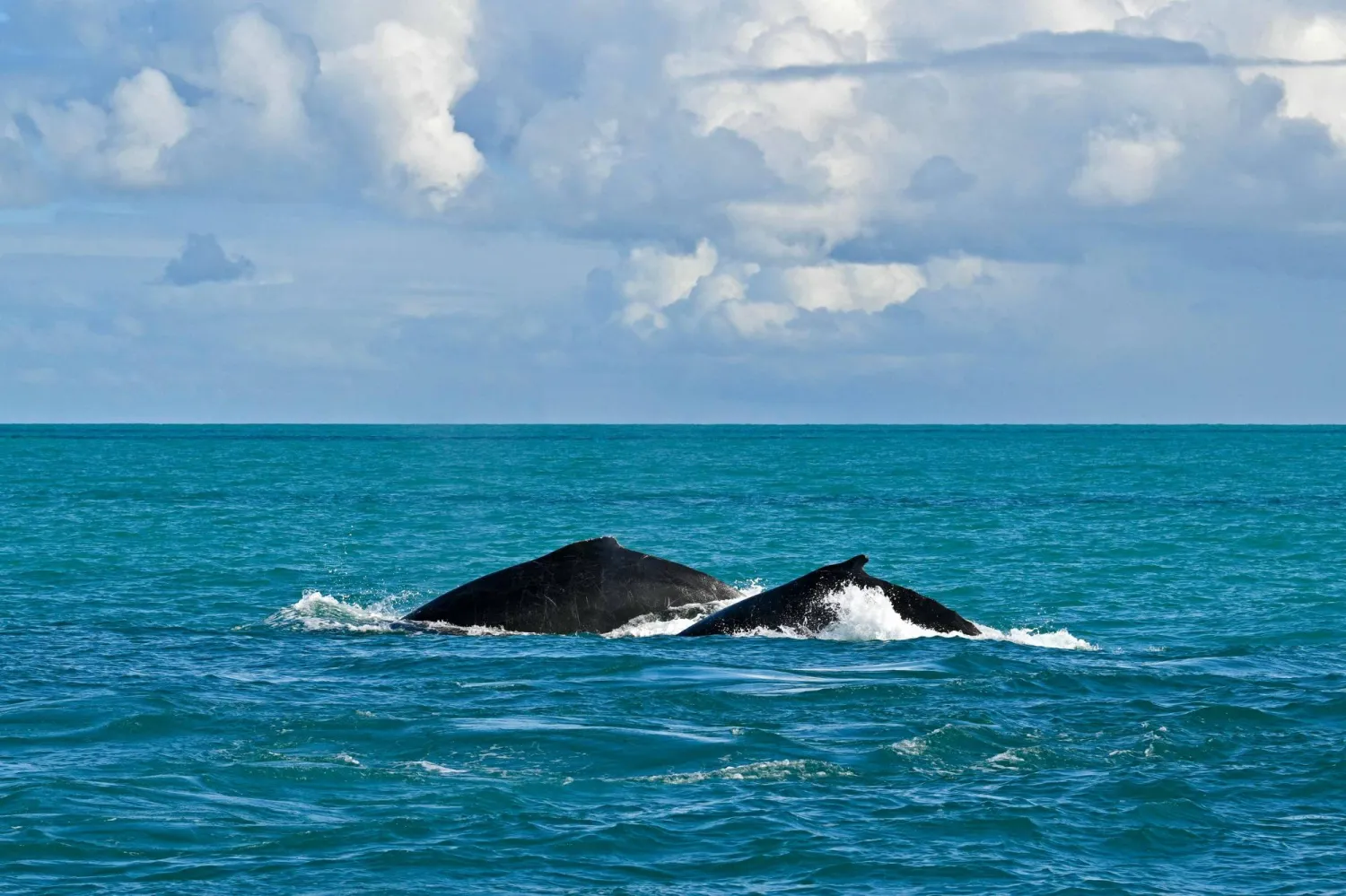
Humpback whales (Megaptera novaeangliae) swim in the Abrolhos Archipelago, Bahia State, Brazil on August 18, 2026. (Photo by Evaristo Sa / AFP)
TT

Humpback Whale Apparently Grieves Stillborn Calf in Rare Footage

Humpback whales (Megaptera novaeangliae) swim in the Abrolhos Archipelago, Bahia State, Brazil on August 18, 2026. (Photo by Evaristo Sa / AFP)

A female humpback whale has been documented apparently grieving a stillborn calf in new research released Thursday offering rare insights into the complex emotions of the sea-dwelling mammals.

The footage, taken off Australia's Gold Coast last year, shows a female humpback whale staying close to the dead calf as it lies motionless on the sea floor.

Accompanied by a companion, the whale holds eye contact with the animal, touching it with its head and fin.

"At first sight, I thought it was just two whales resting on the surface, but their behavior was unusual," said Andrew Mulville from Sea World Foundation, who witnessed the heart-wrenching moment.

"It was definitely not what I was expecting to see out at sea that day."

Researchers said the whale had stayed with the deceased animal for "several hours and possibly even days".

"It's really sad," Olaf Meynecke of Griffith University's Whales and Climate Research Program told AFP.

"It's pretty heartbreaking to watch this female making continuous contact with the deceased calf."

A number of other deceased whale calves were observed in the area at the time, the researchers said.

The whale did not try and bring the calf to the surface, suggesting "she might have been aware that it was dead shortly after giving birth", they said.

Researchers said the whale's actions "may represent a form of grief-related behavior in humpback whales".

Meynecke said his research spoke to the "strong bond" between mother and calf and the emotional stages that "socially complex" mammals go through following the deaths of their offspring or companions.

Whales are far from the first non-human mammals to have been observed engaging in complex grieving rituals, he said.

"We're seeing this from elephants and apes and cases like that that are also extremely heartbreaking," Meynecke said.

"But on land we witness this more often, whereas at sea it's really rare to document something like this."