


Mountain Flower From China Joins the World’s Carnivorous Plant Club

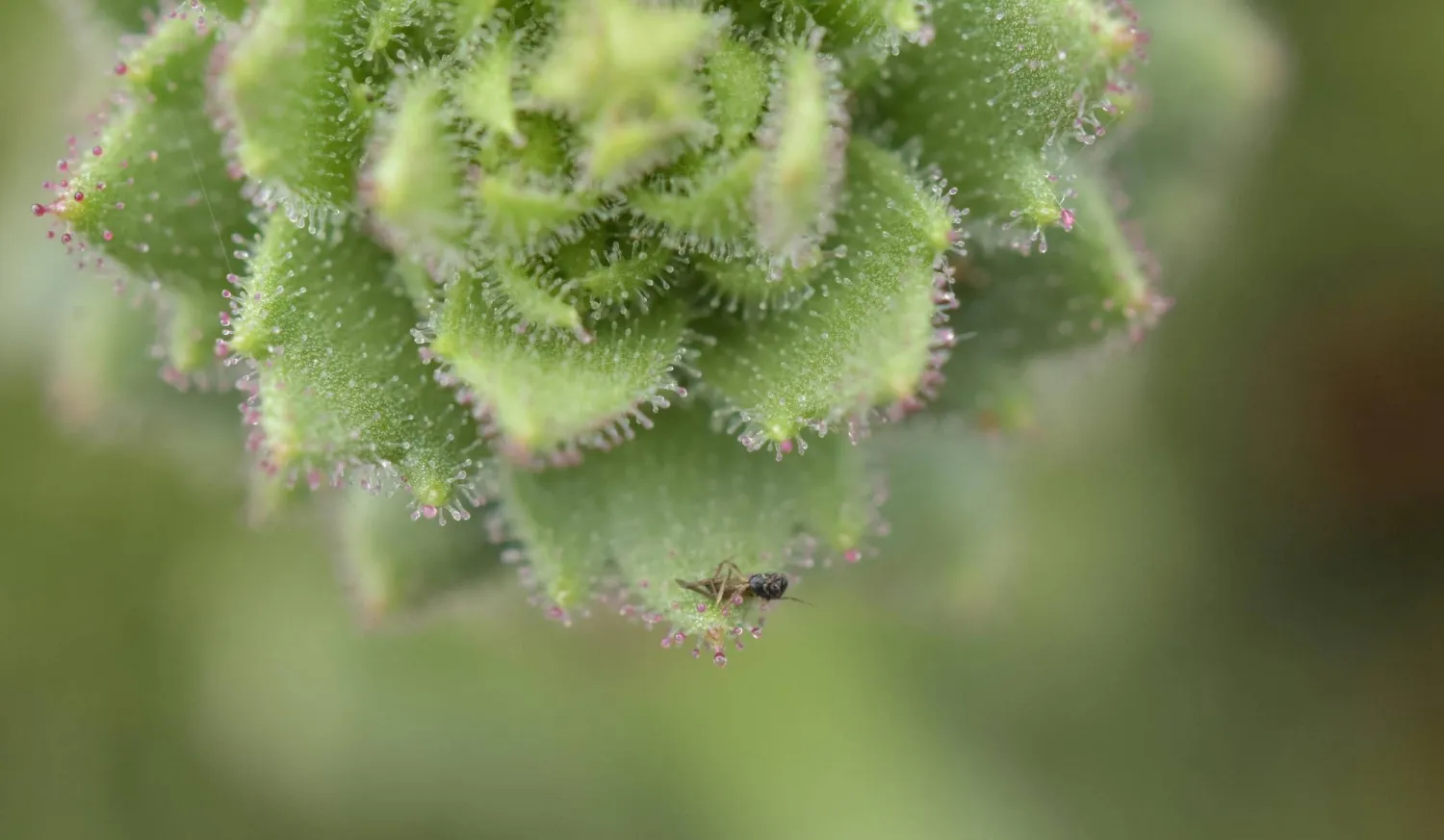
Sticky glandular hairs on the plant species Saxifraga candelabrum are shown trapping insect prey, in this handout picture taken on September 25, 2024, at Wufeng Mountain, Shangri-La, Yunnan, China, released August 4, 2026. (Xian-Han Huang/Handout via Reuters)
TT

Mountain Flower From China Joins the World’s Carnivorous Plant Club

Sticky glandular hairs on the plant species Saxifraga candelabrum are shown trapping insect prey, in this handout picture taken on September 25, 2024, at Wufeng Mountain, Shangri-La, Yunnan, China, released August 4, 2026. (Xian-Han Huang/Handout via Reuters)

For most insects, a flowering alpine plant might seem an unlikely predator. But researchers have discovered that a delicate wildflower that grows in rocky mountain crevices in southwestern China lures prey onto sticky hairs, digests their bodies and absorbs the nutrients left behind. It is the first confirmed carnivorous plant in its botanical grouping.

Its scientific name is Saxifraga candelabrum, and it is a member of a diverse botanical order — a taxonomic category — called Saxifragales that spans more than 2,000 species.

The plant grows on nutrient-poor rock faces in the Qinghai-Tibet Plateau and Hengduan Mountains of China, ranging from central and northern Yunnan Province to southwestern Sichuan Province at elevations of 2,500 to 3,300 meters (8,200 to 10,800 feet). It is covered with sticky reddish glandular hairs that trap small insects.

Carnivorous plants are best known from swamps and wetlands, where species such as Venus flytraps, pitcher plants and sundews supplement scarce nutrients ‌by catching prey.

To ‌qualify as truly carnivorous, a plant must do more than accidentally catch insects. It must ‌absorb ⁠nutrients from captured ⁠animals and have specialized adaptations that help it attract, trap, digest and consume prey.

In 1875, naturalist Charles Darwin suggested that two European Saxifraga species might be carnivorous after noticing their sticky hairs and occasional bug victims, but never managed to prove it experimentally.

The newly studied plant is a different species from the pair that Darwin examined, though closely related, but it shares the same insect-trapping structures that inspired his hypothesis.

"We ran multiple tests on this plant and finally confirmed it is a real insect-eating plant. This proves Darwin's guess was correct, and shows how sharp his scientific judgment was," said Hang Sun, a research professor at the Chinese Academy of Sciences' Kunming ⁠Institute of Botany and one of the leaders of the study published in the journal ‌Nature Communications.

To determine whether it was actually feeding on insects, researchers used ‌fruit flies raised on food enriched with a stable form of nitrogen.

"Nitrogen is essential for plant growth. Most carnivorous plants live in nitrogen-poor ‌habitats and obtain nitrogen by capturing and digesting insects," Sun said.

After placing the flies onto the sticky hairs, they ‌tracked the movement of the nitrogen through the plant.

The nitrogen they tracked "is ultimately taken into the plant and found throughout the tissues of that plant. That would not happen unless there is uptake or movement into the plant," said botanist and study co-author Douglas Soltis of the University of Florida and the Florida Museum of Natural History.

'KEY TO SURVIVAL'

The captured nutrients did not end up distributed evenly throughout the plant. ‌Instead, the highest levels of prey-derived nitrogen were found in the flowers of Saxifraga candelabrum, a species that reproduces only once during its lifetime.

"Probably needs them for reproductive output. Flowers ⁠and seeds. Reproduction is key to ⁠survival," Soltis said.

The researchers also found evidence that the plant actively attracts prey. Field experiments suggested that scent plays an important role in drawing insects to its flowers, while tests detected digestive enzyme activity in the glandular hairs, providing further evidence that the plant can break down captured insects.

Catching insects comes with a potential drawback. Many carnivorous plants depend on insects for pollination and risk trapping the very visitors needed for reproduction.

"It is mainly pollinated by relatively large insects like flies. These insects are not held firmly by the sticky glandular hairs and can break away easily. Only much smaller insects get trapped. The plant gains extra nutrients by feeding on these tiny prey while leaving its important pollinators unharmed, allowing successful pollination and reproduction," Sun said.

The plant is the only one from its order known to be carnivorous. But other carnivorous plants may be awaiting discovery. The Qinghai-Tibet Plateau where it resides is home to tens of thousands of flowering plant species.

Sun said some of these may harbor undiscovered insect-trapping abilities.

"Nature finds a way, borrowing a line from 'Jurassic Park.' There are so many innovations in nature — most of which we have not discovered or do not yet understand," Soltis said.

"Many of these innovations are potentially beneficial to human well-being. Exploring that treasure of knowledge can yield enormous benefits."



Etna Ash Keeps Catania Airport Shut Until Friday, Disrupting Summer Travel

 A drone view of volcanic ash and lava during an eruption at Mount Etna, forcing authorities to suspend flights at Catania airport, in Sicily, Italy, August 12, 2026. (Reuters)
A drone view of volcanic ash and lava during an eruption at Mount Etna, forcing authorities to suspend flights at Catania airport, in Sicily, Italy, August 12, 2026. (Reuters)
TT

Etna Ash Keeps Catania Airport Shut Until Friday, Disrupting Summer Travel

 A drone view of volcanic ash and lava during an eruption at Mount Etna, forcing authorities to suspend flights at Catania airport, in Sicily, Italy, August 12, 2026. (Reuters)
A drone view of volcanic ash and lava during an eruption at Mount Etna, forcing authorities to suspend flights at Catania airport, in Sicily, Italy, August 12, 2026. (Reuters)

Flights at Catania airport in Sicily will remain suspended until early Friday because of ash from Mount Etna's ongoing volcanic activity, which has forced hundreds of flights to be cancelled or rerouted over the past week.

All arrivals and departures at the island hub, Italy's fifth-busiest airport by passenger traffic, will be ‌suspended through 2 ‌a.m. local time on ‌August ⁠14, airport operator ⁠SAC said in a statement late on Wednesday.

Passengers were advised to check the status of their flights with their airlines before travelling to the airport.

The prolonged restrictions come at ⁠the height of the summer holiday ‌season, affecting thousands ‌of passengers, and have placed additional pressure ‌on Sicily's other airports.

Mount Etna, Europe's ‌highest and most active volcano, frequently disrupts operations at Catania airport, whose operator launched the sale of a stake of at ‌least 51% in May.

Marco Viccaro, president of the Italian Volcanological Association, ⁠said ⁠the activity at Etna, which began on August 6, is more energetic than previous episodes and is continuing in a sustained way.

"This suggests that deeper, gas-rich magma is playing a more active role, making the fragmentation process more efficient and leading to increased ash production, which is severely disrupting air traffic to and from Catania airport," he added.


Canadian Wildfire That Forced 20,000 to Flee May Signal ‘New Normal’

Smoke rises from the Brunswick Creek wildfire, looking north over the Fraser River near Boston Bar, British Columbia, Canada, August 11, 2026 in an aerial photograph. (BC Wildfire/Handout via Reuters)
TT

Canadian Wildfire That Forced 20,000 to Flee May Signal ‘New Normal’

Smoke rises from the Brunswick Creek wildfire, looking north over the Fraser River near Boston Bar, British Columbia, Canada, August 11, 2026 in an aerial photograph. (BC Wildfire/Handout via Reuters)

A wildfire that forced more than 20,000 people from their homes in western Canada moved so quickly that crews had to abandon firefighting to help residents escape, a pace British Columbia’s premier said Wednesday may represent a “new normal.”

The Bald Range wildfire erupted Friday near Summerland, a community of about 12,000 in British Columbia’s Okanagan region. By Wednesday, it had grown to about 184 square kilometers (71 square miles) after destroying homes and killing an 80-year-old woman.

"There’s an important set of lessons for us to take about how quickly this moved and that this may be our new normal for fire speed," Premier David Eby said. He said the blaze outpaced wildfire modeling and left some residents with little time to evacuate.

Officials have begun damage assessments, but the area remained unsafe Wednesday and there was no timeline for residents to return.

Crews were clearing vegetation to help slow the fire’s spread as officials warned that thunderstorms could bring erratic winds and increase fire activity. Highway 97, a major route through the area, remained closed.

Eby visited an evacuation reception center in Penticton, where he said he met people devastated by the loss of their homes.

“A lot of emotions in there, obviously,” he told reporters, calling the woman’s death a “tragic loss.”

Summerland pharmacist Jonathan Kiesman said he was worried about displaced patients getting their medications and said seeing the fire approach the community “almost brought tears to my eyes.”

Officials said they were withholding broader details on property losses until residents could be notified directly.

“The last thing that I would want is somebody to have the shock of finding out on social media or on television about their home being lost,” British Columbia Emergency Management Minister Kelly Greene said.

Eby said the province would review the response, including whether changes are needed to wildfire planning, building standards and vegetation management near communities.

Given the drought and summer heat, he warned, “this is very unlikely to be the last significant fire we see this summer.”

Summerland Mayor Doug Holmes warned that recovery would be long and difficult.

Canada has endured a series of severe wildfire seasons in recent years, with smoke repeatedly drifting into the United States. In record-setting 2023, fires burned more than 14.6 million hectares (36 million acres), an area roughly the size of Illinois.

Canada has warmed faster than the global average in recent decades, while the amount of land burned by wildfires has increased substantially. Much of the country’s forest is remote and dominated by spruce and pine, conditions that can make fires difficult to contain once they become established.


Afghan Students Divided over Smartphone Ban at Universities

The Taliban authorities have taken steps to control Afghans' access to technology. Wakil KOHSAR / AFP
TT

Afghan Students Divided over Smartphone Ban at Universities

The Taliban authorities have taken steps to control Afghans' access to technology. Wakil KOHSAR / AFP

Forced to leave their smartphones off campus, Afghan university students are divided over whether the new anti-tech rule has disrupted their studies or done wonders for their concentration.

Soon after Supreme Leader Hibatullah Akhundzada ordered government workers to stop using smartphones in June, the ban was also imposed in the world of academia.

A 29-year-old student in the capital Kabul said a staffer had "visited the classrooms and announced that from now onwards, we are not allowed to bring smartphones to the university".

In the western city of Herat, notices posted on the walls of a university and its dorm warned that anyone caught with a smartphone on campus would face "legal action".

No reason was given to students who spoke to AFP, some of whom requested anonymity for security reasons.

At Kandahar University in southern Afghanistan, spokesman Nazir Ahmad Qadari said the move aimed to ensure students "pay attention to their lectures, studies and practical work".

Fifty-eight percent of countries ban mobile phones in schools, citing classroom distraction and risks to wellbeing, according to a March report by UNESCO which made no mention of university bans.

The Taliban authorities have ruled for nearly five years and have taken steps to control Afghans' access to technology without saying why.

Last year, broadband access was restricted in several provinces for weeks, before the government unexpectedly cut off the internet and phone networks nationwide for two days.

Despite this, smartphones are widely used and billboards in cities advertise the latest internet deals.

- 'Can't study properly' -

At universities, the ban has restricted access to online research and course materials, with one Herat student saying he had used his phone to help with about half the syllabus.

"If the explanation was not good, we used our phones to take photos and videos of the slides or the writing on the board, so we could review them later," the 21-year-old said.

That view was shared in the northern city of Mazar-i-Sharif, where a 22-year-old journalism student told AFP: "We can't study properly without smartphones".

The human rights director for the United Nations mission in Afghanistan (UNAMA), Fiona Frazer, said there "may be sound reasons to manage students' use of technology".

However, UNAMA had concerns about government restrictions that limit "access to information, freedom of expression" and the ability to participate fully in daily life.

Back in Kabul, the 29-year-old student said time-saving artificial intelligence tools are now out of reach, while people now have to carry dozens of physical books around campus instead of using e-books.

There is no ban on laptops, but many students cannot afford one.

The student, who is also a freelance translator, has also found it hard to concentrate on lectures knowing he could be missing out on work opportunities.

"I need to check my emails and WhatsApp every other minute, because I receive messages from my clients... if I don't answer, I can lose the offer," he said.

Although he can pay the 10 Afghanis ($0.15) fee to store his smartphone at the university entrance, he said it's difficult for others "because most of the students are not financially stable".

- Improved grades -

A second Kabul student, 28, said he had bought a basic phone which he was allowed to use on campus to make calls.

But he complained of the extra expense and being "deprived of the current technology".

However, not everyone opposes the ban.

In Kandahar, home of the supreme leader, medical student Sanaullah Yousufzai said the rule had improved relations between teachers and students.

"We can better focus on the lessons and lectures; there are no more interruptions due to calls," said Yousufzai.

But the 25-year-old remained worried that he might not be able to reach his family in an emergency.

For journalism student Mohammad Hakim Haqmal, 22, the change had seen his score improve from 75 to 80 percent.

Although his classmates had been using their phones to get information for their studies, they were also wasting time on social media.

After the ban, "they tried harder, studied well, and got better results".