Fuego Volcano Spews More Ash and Mud as Guatemala Shelters 1,700 Who Fled Nearby Villages

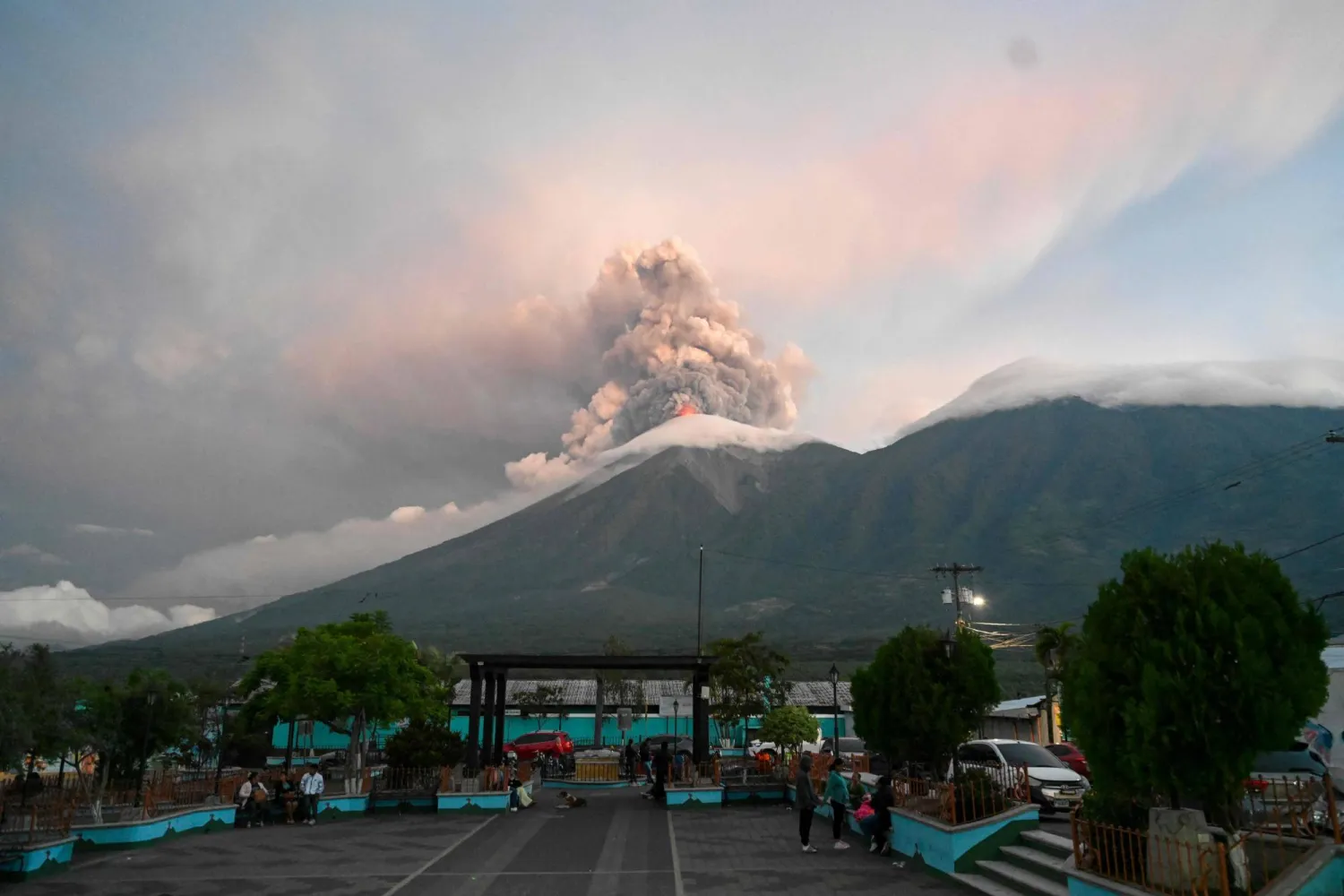
The Fuego volcano erupts in Alotenango, some 65 kilometers southwest of Guatemala City, on August 4, 2026. (AFP)
TT

Fuego Volcano Spews More Ash and Mud as Guatemala Shelters 1,700 Who Fled Nearby Villages

The Fuego volcano erupts in Alotenango, some 65 kilometers southwest of Guatemala City, on August 4, 2026. (AFP)

Guatemala remained on alert Tuesday after evacuating villages during an eruption of the Fuego volcano, one of Central America’s most active.

About 1,700 people remained in shelters with the evacuations to stay in place until conditions improve, according to the country’s disaster agency CONRED.

Officials raised the alert level to red in Sacatepéquez, Escuintla and Chimaltenango, where about 29,000 people are affected by ashfall and schools remain closed.

Authorities warned the next 72 hours were critical on Tuesday, as mudflows up to 7 kilometers (4.3 miles) long continue descending from the volcano, with incoming rain expected to increase the risk of additional volcanic mudflows.

Mudflows have not reached villages and no structures reported damaged or at risk. Claudinne Ogaldes, executive secretary of CONRED, recommended residents in the three municipalities cover their water deposits and use face masks as protection from ash.

The eruption started Monday morning, with clouds of gas and ash rising above the volcano as lava and pyroclastic flows rolled down the slopes. More mud and ash were emitted Tuesday.

Among those evacuated were around 250 people from El Porvenir and the hamlet of Las Lajitas. CONRED also warned of ash spreading to nearby towns.

A major highway that passes close to the volcano, National Route 14, was closed. The Education Ministry suspended classes in nearby towns.

During a previous eruption of Fuego, or the Volcano of Fire, in June 2018, hundreds of people were killed and a whole village was destroyed. Another eruption last year spurred preventive evacuations.


German Space Rocket Reaches Orbit in Europe's 1st Commercial Launch

Germany's Isar Aerospace rocket is launched into space from a base in Andoeya, Norway, September 5, 2026. Isar Aerospace/Franziska Kegel/Handout via REUTERS
TT

German Space Rocket Reaches Orbit in Europe's 1st Commercial Launch

Germany's Isar Aerospace rocket is launched into space from a base in Andoeya, Norway, September 5, 2026. Isar Aerospace/Franziska Kegel/Handout via REUTERS

German startup Isar Aerospace on Sunday said it would rapidly expand satellite deployments after the first orbital launch of its Spectrum rocket from Arctic Norway, a milestone for Europe's efforts to secure independent access to space.

The uncrewed Spectrum became the first commercial rocket to reach orbit from continental Europe, marking a breakthrough for a region where several countries are seeking a foothold in the fast-growing market for satellite launches.

"Launch capability is right now the biggest bottleneck in the entire industry," Isar co-founder and CEO Daniel Metzler told reporters.

He said privately owned Isar remains well-funded and that an initial public offering "is not on the table".

German ⁠Chancellor Friedrich Merz ⁠hailed Saturday's launch in a statement, calling it "the beginning of a new era".

Merz visited Isar's launch site in March, underscoring Europe's efforts to establish greater autonomy as the global order once championed by the United States is shifting under US President Donald Trump.

Blasting off from Norway's Arctic Andoeya Spaceport, Spectrum carried five small satellites along with an in-flight technology experiment, according to Isar. The rocket is designed to serve the growing market for small and medium-sized payloads.

"Europe's independent access ⁠to space just got a major boost," EU Defense and Space Commissioner Andrius Kubilius wrote on social media platform X.

It was Isar's second launch, coming 18 months after the company's first rocket plunged into the sea and exploded in a fiery spectacle shortly after takeoff from the same site. No one was injured.

Reuters quoted Isar as saying that it already has five more rockets in production and is now focused on scaling up operations to meet rising demand, with a long-term goal of conducting around 40 launches a year.

The German company is developing a second launch site in Nova Scotia in eastern Canada, and said on Sunday this could be ready for lift-offs in 2028.

Saturday's launch was intended as "both the vehicle's qualification mission and its first flight carrying payload," the Bavarian company ⁠said.

"The fact that ⁠we can now launch satellites from Andoeya strengthens Norwegian and European security in the turbulent times we live in," said Norway's minister of industry and commerce, Cecilie Myrseth.

Global players in the satellite launch market include Elon Musk's SpaceX, which launches from the United States, and French ArianeGroup, a joint venture between Airbus and Safran that uses a spaceport in South America's French Guiana.

SpaceX, a company spanning rockets, satellites and AI, in June listed on the Nasdaq exchange in a record initial public offering.

Sweden, with its Esrange launch site, and Britain with its SaxaVord Spaceport in the Scottish Shetland Islands, are the nearest rivals to the Norwegian site, all of which aim to give Europe greater autonomy in space flights.

Isar last week said it had secured about €200 million ($232 million) from the European Space Agency to help fund development of new rockets and expand its testing and launch infrastructure.


Saudi Arabia, Kuwait Strengthen Cooperation in Combating Desertification and Restoring Lands

The center is holding five specialized workshops on combating desertification - SPA/File photo
TT

Saudi Arabia, Kuwait Strengthen Cooperation in Combating Desertification and Restoring Lands

The center is holding five specialized workshops on combating desertification - SPA/File photo

The National Center for Vegetation Cover Development and Combating Desertification, in cooperation with Kuwait's Environment Public Authority, has launched a series of virtual training and technical workshops in September and October 2026 as part of the implementation of a memorandum of understanding between Saudi Arabia and Kuwait on environmental protection, rehabilitation, and conservation.

The center is holding five specialized workshops on combating desertification and restoring degraded land, contributing to the development of policies and strategies to address desertification and reduce land degradation, support decision-making, and protect and sustain ecosystems, SPA reported.

The workshops will highlight the importance of green belts in mitigating sand encroachment and showcase the Kingdom’s experience in the integrated management of invasive plant species, as well as the results achieved in this field.

The initiative reflects the Kingdom’s commitment to enhancing cooperation and sharing expertise to combat desertification, restore degraded lands, and improve methods for assessing land degradation. It also supports efforts to protect ecosystems, advance the goals of Saudi Vision 2030, and contribute to global climate action.


Avalanche Hits Glacier on China's Muztagh Ata in Xinjiang

People walk through a flood-affected area in Devighat, Nuwakot district, Nepal, 05 September 2026. EPA/NARENDRA SHRSTHA
TT

Avalanche Hits Glacier on China's Muztagh Ata in Xinjiang

People walk through a flood-affected area in Devighat, Nuwakot district, Nepal, 05 September 2026. EPA/NARENDRA SHRSTHA

An avalanche struck Glacier No. 2 on Muztagh Ata, near China's border with Tajikistan in the northwestern Xinjiang region, with several tourists capturing footage on their phones, state broadcaster CCTV reported on Sunday.

Video showed a massive wall of snow and ice ⁠cascading down the mountainside, ⁠forming a snow cloud more than 100 meters (328 feet) wide, the broadcaster said.

There were no casualties or property damage ⁠because the avalanche took place in an unpopulated area far from major roads, CCTV reported, according to Reuters.

The main peak of Muztagh Ata, covered by ice and glaciers, is 7,546 meters high. Glacier No. 2 is closed to the public because ⁠of ⁠heightened risks of glacial activity.

The local culture and tourism bureau on Saturday warned tourists not to enter unauthorized high-risk restricted zones on Muztagh Ata, citing complex terrain, volatile weather, weak communication signals and extremely poor rescue conditions.