


Why Were There No Tiny Dinosaurs? You Might Blame the Mammals

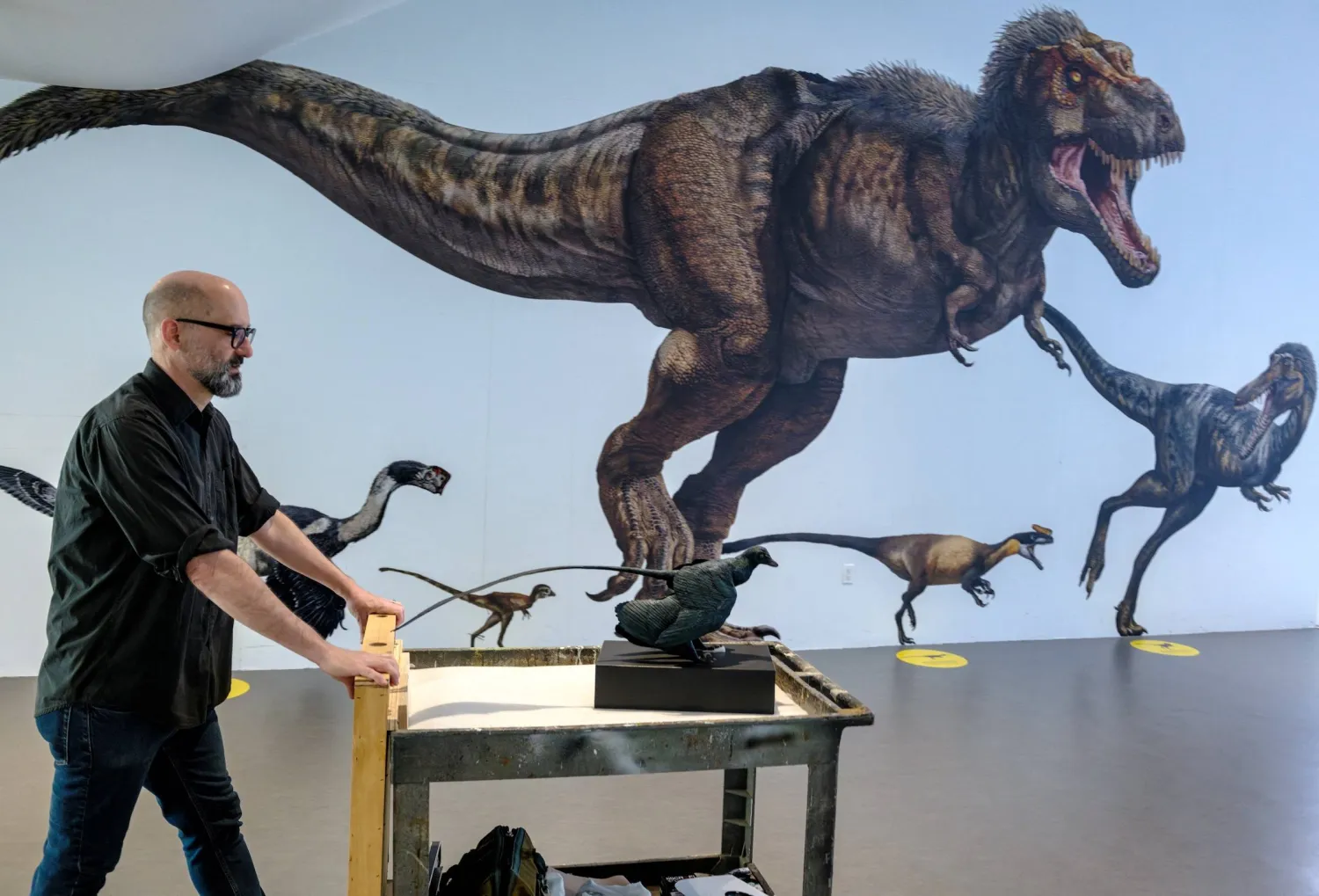
A model of the small dinosaur Microraptor being put on display at the American Museum of Natural History in New York, seen in this photograph released on August 5, 2026. Alvaro Keding/American Museum of Natural History/Handout via REUTERS
TT

Why Were There No Tiny Dinosaurs? You Might Blame the Mammals

A model of the small dinosaur Microraptor being put on display at the American Museum of Natural History in New York, seen in this photograph released on August 5, 2026. Alvaro Keding/American Museum of Natural History/Handout via REUTERS

Everyone knows dinosaurs got really big. Some of the long-necked plant-eaters were the largest land animals ever on Earth, as shown by Argentinosaurus, perhaps 70 to 90 tons and upwards of 100 feet (30 meters) long. But how about tiny dinosaurs, like the size of a mouse? As far as we know, none ever existed.

New research investigates this phenomenon. Scientists employed mathematical models to explore the evolution of body size across vertebrate groups. They determined that energetics and physiology can account for the sizes of mammals, birds that fly and turtles, but these factors fail to explain the absence of really small dinosaurs, aside from their avian descendants.

The researchers see other dynamics at play. They hypothesized that because early mammals — most of them puny shrew-sized critters — had ably filled ecological niches for small animals, their presence prevented dinosaurs from evolving tiny body sizes adapted to such niches.

"We know based on observations of living animals and the fossil record that most animal groups have members that achieve very small body sizes, and that these small animals typically dominate their ⁠ecosystems," said paleontologist ⁠Stephanie Lechki, a postdoctoral fellow at Princeton University in New Jersey and co-leader of the study published in the journal Evolution.

"A small animal typically requires fewer resources and can achieve reproductive maturity and reproduce more quickly than a large-bodied animal," Reuters quoted Lechki as saying.

The smallest dinosaurs included the likes of crow-sized Microraptor, weighing as little as 15 ounces (430 grams); Fruitadens, at 26 ounces (730 grams); and Anchiornis, at 19 ounces (530 grams). These were still much larger than today's smallest bird, the bee hummingbird (about 1.75 grams); smallest mammal, the Etruscan shrew (about 1.8 grams); and smallest lizard, the dwarf gecko (about 0.15 grams).

"Most living species are small, much smaller than us, and smaller than even the smallest dinosaurs," said paleontologist and study co-leader Roger ⁠Benson, curator of dinosaur paleobiology at the American Museum of Natural History in New York.

That includes approximately 90% of extant bird species and 75% of extant mammal species.
"Think of rodents, shrews, bats, songbirds, most lizards, frogs, so many small species. This suggests that there are many more niches available to small-bodied species. The absence of tiny dinosaurs means that all those abundant niches were closed to them," Benson said.

Dinosaurs first appeared roughly 230 million years ago and eventually became the dominant land animals, holding that status until an asteroid struck Earth 66 million years ago, causing a mass extinction of species. Mammals during the age of dinosaurs thrived in ecological niches perfect for small body sizes like insectivores and seed eaters.

"It is likely that small-bodied early mammals outcompeted dinosaurs, preventing them from reaching small body sizes. Similarly, large dinosaurs likely outcompeted early mammals, preventing them from reaching large body sizes," Lechki said.

It was only after the asteroid struck that mammals achieved larger body sizes and expanded into ecological niches previously occupied by dinosaurs like large plant eaters ⁠and apex predators.

Another potential explanation for ⁠the lack of evidence for tiny dinosaurs is that they did exist but their fossils have been elusive. The researchers said this seems improbable because fossil deposits containing dinosaur remains often also preserve the remains of numerous small animals.

MATHEMATICAL MODELS

The mathematical models forecast how evolutionary forces drove body size based on the physiology of an animal's energy uptake from ecosystem resources, and the rate at which the animal converts that to offspring. Evolutionary forces favor body sizes at which the rate of energy invested in offspring is maximum, Benson said.

Dinosaurs defied the models even though birds, which evolved from small feathered dinosaurs and first appeared about 150 million years ago, conformed to the models — though not flightless birds. Snakes and crocodilians also deviated from the mathematical models.

The dinosaurs from which birds evolved were from a lineage called theropods to which giants like Tyrannosaurus rex — which reached roughly 40-1/2 feet (12.3 meters) long and perhaps 8 tons — also belonged. Some flightless birds became sizable. For instance, the elephant birds that inhabited Madagascar until about a millennium ago reached more than half a ton.

"Birds evolved most of their flight adaptations around 130 million years ago and immediately became small," Benson said. "We think that flight might have allowed birds to escape from ecological competition and invade tiny body sizes. This ultimately explains the tremendous biodiversity of living birds, which have more than 12,000 species."



Prince Harry, Wife Meghan Arrive in the UK as They Make a Fresh Start in Britain

Britain’s Prince Harry and his wife, Meghan. (AP)
TT

Prince Harry, Wife Meghan Arrive in the UK as They Make a Fresh Start in Britain

Britain’s Prince Harry and his wife, Meghan. (AP)

Prince Harry and his wife Meghan arrived in the United Kingdom on Wednesday, as they make a fresh start in Britain after six years in the United States, UK media reported.

The news comes less than a week after the couple surprised fans and critics alike with plans to return to Britain. The return was reported by media outlets including the BBC and Sky News, with the Daily Telegraph reporting their plane landed at Birmingham International Airport around noon.

Flight tracking websites showed a private charter flight from Van Nuys, California, arrived at the airport at 11:56 a.m.

The couple’s children, Prince Archie, 7, and Princess Lilibet, 5, have already enrolled at British schools and will start classes in September. The family plans to live at a private, nonroyal residence outside of London, but haven’t said exactly where that will be.

Harry and Meghan gave up their royal duties and moved to California more than six years ago to earn their living through lucrative contracts with Netflix and Spotify.

Relations with the rest of the royal family quickly soured as the couple said palace staff had been insensitive to Meghan’s mental health and leveled charges of racism and media manipulation at members of the royal family.

Harry recently expressed an interest in reconciliation so he could spend more time with his father, King Charles III, who is being treated for an undisclosed form of cancer. But relations with his brother, Prince William, who is heir to the throne, remain tense.


Social Media Use on the Rise Among Australian Under-16s After Ban

The TikTok logo is displayed on signage outside TikTok social media app company offices in Culver City, California on September 30, 2025. (AFP)
TT

Social Media Use on the Rise Among Australian Under-16s After Ban

The TikTok logo is displayed on signage outside TikTok social media app company offices in Culver City, California on September 30, 2025. (AFP)

Australian under-16s are increasing their use of social media apps, such as Instagram and TikTok, despite a world-leading ban, data provided by a parental control software company showed Wednesday.

Australia implemented legislation barring children from social media platforms in December, with the UK, France and others following suit.

Youngsters' use of social media fell across the board when the legal restrictions were first implemented, data from parental control app Qustodio showed.

But since then their social media activity has climbed -- even approaching pre-ban levels for some apps.

The use of apps TikTok, Instagram and Snapchat among 10–12-year-olds and 13- to 15-year-olds was on the rise, data from parental control app Qustodio showed.

In the case of video-sharing site TikTok, 25.9 percent of 13-15 year-olds are still using the app -- just over a percentage point lower than before the ban came into force.

And use among 10–12-year-olds was just 0.06 percentage points below where it was before the ban.

"They could be accessing these platforms with VPNs, or obfuscating their ages," Yasmin London, Global Online Safety Expert for Qustodio, said.

"But it could really be as simple as they're just accessing these apps because the restrictions aren't working."

The data also showed children increasingly turning to messaging platform WhatsApp, which is not affected by the ban.

Qustodio said the data was gathered by analyzing anonymized monthly social media app usage among Australian children and showed the percentages of kids that had used the app for more than five consecutive minutes at least once in a given month.

Australian officials have said the ban is designed to protect children from online bullying and "predatory algorithms".

A team of Australia-based researchers in a peer-reviewed study published in June found little evidence to suggest teenagers have turned away from social media as a consequence, however.

New Zealand's government also this week said it would introduce legislation that could see firms like Meta fined up to 10 percent of their global revenue if they fail to comply.


Drought-Hit Danube Gives Way to Fossil Hunt in Bulgaria

This photograph taken on August 21, 2026, shows unidentified remains found in the dried-out Danube riverbed near the village of Ryahovo, during an organized fossil hunt after a record low water level revealed mammoth bones there at the end of July. (AFP)
TT

Drought-Hit Danube Gives Way to Fossil Hunt in Bulgaria

This photograph taken on August 21, 2026, shows unidentified remains found in the dried-out Danube riverbed near the village of Ryahovo, during an organized fossil hunt after a record low water level revealed mammoth bones there at the end of July. (AFP)

Volunteers scanned the dried-up bank of the Danube in northern Bulgaria, close to where receding waters laid bare mammoth bones last month, hoping to find more fossilized fragments exposed by Europe's parching drought.

"I've found a tooth!" exclaimed Aleksandar Denkov, a 30-year-old amateur photographer, holding up a yellowish fragment protruding from the sand.

Denkov last week joined some 20 other volunteers, many hoping to find more mammoth fossils during the search organized by the regional history museum of the nearby city of Ruse, around 250 km (155 miles) northeast of Sofia.

Though their hopes were not fulfilled, the group found remains of a mammal -- "probably an aurochs or a European bison," according to the museum -- a horse jawbone in a subfossil state and a cluster of fossilized oysters dating back around 60 to 65 million years.

Europe's drought, exacerbated by human-induced climate change according to experts, has seen major rivers slow to a trickle, causing serious problems for cargo shippers and nuclear plants normally cooled by river water.

But the low waters have also revealed remains and historical artefacts not seen for decades -- or even millennia.

Finds in recent weeks along the Danube, Europe's second-longest river, have included World War II shipwrecks in Austria and Serbia and the remains of two German soldiers and a motorbike in the middle of Budapest.

- 'Close to history' -

Ruse Regional History Museum curator Krasimir Kirov said the museum decided to organize the field day "to teach people how to recognize different finds, show them what they might uncover, and give them safety tips."

"After the mammoth was discovered, I started getting dozens of calls from people telling me about what they'd found," he told AFP.

Last month, a resident of the village of Ryahovo -- some 30 kilometers from Ruse -- spotted by chance what museum specialists then identified as a mammoth jaw bone, fragments of tusks, part of a shoulder blade and a femur.

Announced on social media, the initiative to gather near Ryahovo for a guided search quickly sparked keen interest, with requests already pouring in for the next outing, according to Kirov.

The search began with a few instructions: the volunteers must advance in a line and, if someone spots something, raise a hand so that the whole group stops.

Above all, they must not touch any metal objects, which could be ammunition or explosives.

But the walk had barely begun when the line broke apart: enthusiasm won out over discipline.

"It's a very rare opportunity to feel this close to history," Ekaterina Yordanova, a 34-year-old psychologist, told AFP.

"Seeing the Danube in this state is worrying, but it also gives us the chance to discover new things."

Vladimir Tsvyatkov, a 44-year-old business owner, said he, his wife and their two children mainly came "for the adventure".

Having grown up on the banks of the river, he said he had "never seen the Danube so dried up."

- WWII remnants -

Further upstream in Bulgaria, the low Danube levels have also allowed archaeologists to document the foundations of a bridge, more than two km long, inaugurated under Emperor Constantine I in 328.

And elsewhere along the Danube, World War II weaponry and other remnants have been found.

In central Austria, two wrecks of German warships are protruding from the water.

Damaged in fighting with American tanks in 1945, they were later sunk by their own crews, according to local media.

In Serbia, near Prahovo, the receding river has likewise exposed wrecks of German warships, which were among dozens sunk by their own side in 1944 in an attempt to slow the Soviet Red Army's advance along Europe's second-longest river.

And in Budapest, a motorbike and the remains of two German soldiers were found, according to the German War Graves Commission.

The findings come as vast tracts of many of Europe's largest rivers have fallen to levels never recorded before in the month of July, according to data from European climate observatory Copernicus.