

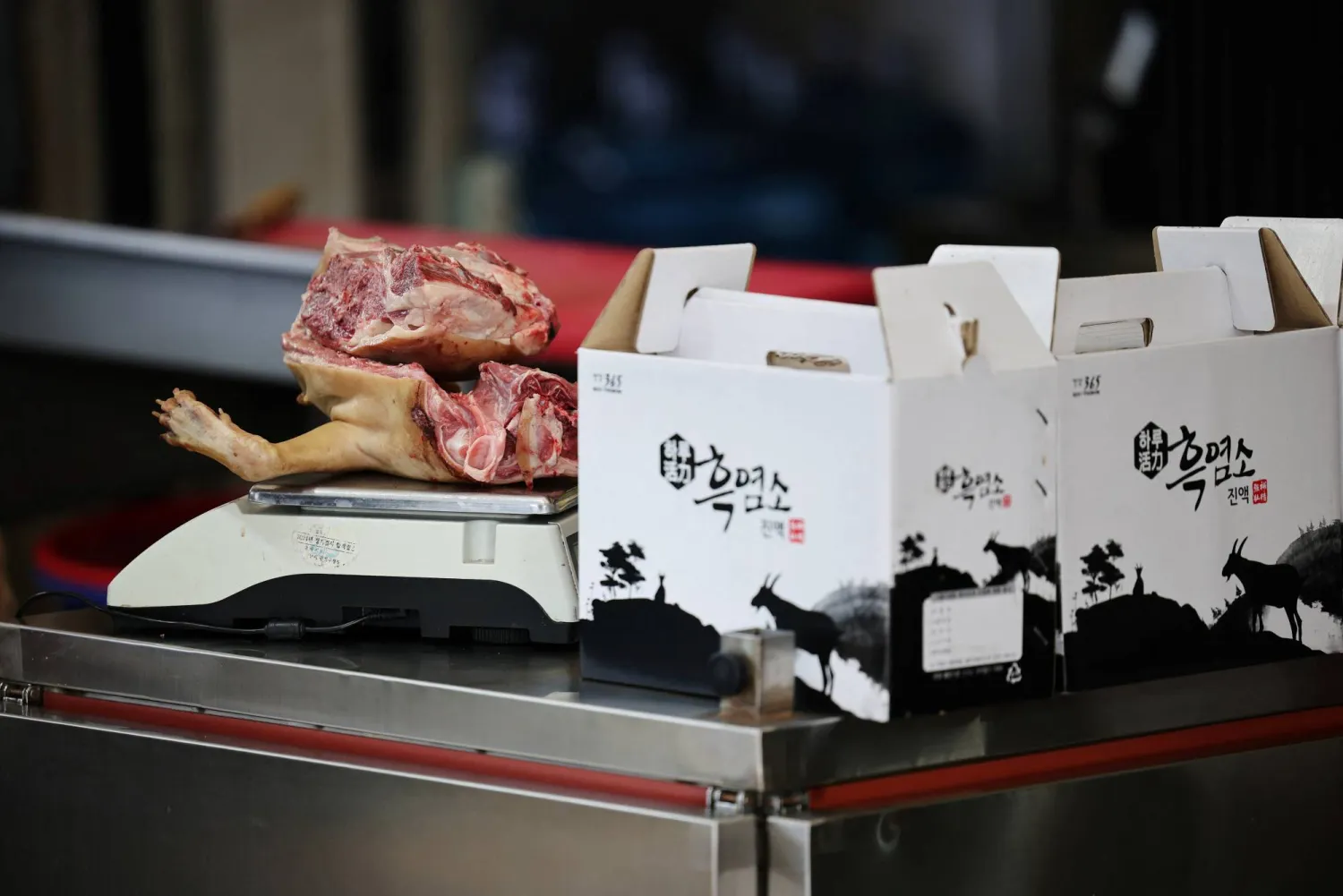

In South Korea, Some Savor Last Season of Legal Dog Meat

Dog meat placed on a scale during Malbok, the last of Korea's traditional hottest days of summer, at a restaurant selling dog meat and black goat meat stews in Seongnam, South Korea, August 14, 2026.   REUTERS/Kim Hong-Ji
Dog meat placed on a scale during Malbok, the last of Korea's traditional hottest days of summer, at a restaurant selling dog meat and black goat meat stews in Seongnam, South Korea, August 14, 2026. REUTERS/Kim Hong-Ji
TT

In South Korea, Some Savor Last Season of Legal Dog Meat

Dog meat placed on a scale during Malbok, the last of Korea's traditional hottest days of summer, at a restaurant selling dog meat and black goat meat stews in Seongnam, South Korea, August 14, 2026.   REUTERS/Kim Hong-Ji
Dog meat placed on a scale during Malbok, the last of Korea's traditional hottest days of summer, at a restaurant selling dog meat and black goat meat stews in Seongnam, South Korea, August 14, 2026. REUTERS/Kim Hong-Ji

For decades, the three days of summer considered the hottest of the year were among the busiest for South Korea's dog meat restaurants, as diners sought traditional stamina-boosting foods to endure the heat.

The third "boknal", or hot day, of 2026 on Friday carried an added sense of finality. It was the last before a nationwide ban on the breeding, slaughter and sale of dogs for meat takes full effect in February 2027.

At the Moran Market in Seongnam, once the country's best-known hubs for dog meat, lunchtime crowds filled alleyways lined with restaurants.

Yet many businesses have shifted to black goat stew and other alternatives, while the few customers still ordering "bosintang", or dog meat stew, were overwhelmingly elderly.

"It's really desolate now," said Kim Yong-book, head of the Moran Market Merchants' Association, who has worked in the area, which is near Seoul, for more ⁠than 40 years.

What ⁠was once a bustling trade hub has become "a town of old people," he said.

The ban caps a long decline in dog meat consumption as rising pet ownership and changing attitudes toward animal welfare transform public opinion.

In a survey released just before the law passed in 2024, more than 90% of 2,000 respondents said they had no intention of eating dog meat in future, while more than 80% supported a ban. Nearly 95% said they had not eaten dog meat during the previous year.

Government data showed more than 5,600 businesses were affected by the legislation, while officials said most dog farms had already closed ahead ⁠of next year's deadline.

The campaign to end the dog meat trade gathered momentum under ousted former President Yoon Suk Yeol and his wife, former first lady Kim Keon Hee, an outspoken animal welfare advocate who publicly backed a ban.

Parliament passed legislation in January 2024 banning the breeding, slaughter, distribution and sale of dogs for human consumption.

The law provided a three-year grace period and will be fully enforced from February 2027, with violators facing prison terms and fines. Authorities have also promised support for affected farmers, distributors and restaurant owners.

For restaurant owner Lee Kang-chun, a former merchants' association chairman who has spent 37 years in the trade, the change evokes mixed emotions.

Lee said he believed it was right to end dog meat consumption considering South Korea's global image and shifting social attitudes. Yet he struggled to hide his sadness when discussing customers, many in their 70s, 80s and 90s, who travel long distances for a meal that they believe restores strength.

"When I ⁠see elderly people come ⁠all this way and leave because there's no dog meat left, it nearly brings me to tears," Reuters quoted him as saying. The market is one of the last places near Seoul still serving dog meat.

Despite soaring supply costs and minimal profits, he continues serving the dish largely for loyal regulars.

He said authorities should do more to help elderly vendors transition to new businesses.

Many restaurants in Moran Market have switched to black goat stew, marketed as another traditional health food, but owners say the shift has been difficult and does not fully make up for lost dog meat sales.

Among those having dog meat stew on Friday was Yoo Jin-sam, who said he had eaten the dish since his early twenties.

"I'm very disappointed," Yoo said. "People keep looking for it because they believe it's good for their health, and now they're getting rid of it."

Yoo, 69, said he accepted the government's decision, but would miss dog meat.

"I love dogs very much," Yoo said. "But it's still unfortunate. If there were a way, I'd like to be able to eat it again."

Another customer, Kim Jin-suk, 71, said he had few regrets about dog meat going off the menu: "I can just eat something else."



Don’t Ban Children from Social Media, Estonia Tells EU

The TikTok app icon on a smartphone in this illustration taken October 27, 2025. (Reuters)
TT

Don’t Ban Children from Social Media, Estonia Tells EU

The TikTok app icon on a smartphone in this illustration taken October 27, 2025. (Reuters)

The European Union should make social media platforms change instead of banning children from using the apps, Estonia's digital minister told AFP Monday, just over a week before the EU is due to announce an age limit.

Estonia has been a lone voice in opposing the EU's plans to restrict children's access to social media, instead calling for online platforms to change.

EU chief Ursula von der Leyen is expected to announce a social media ban on September 16, with officials saying an age limit of 13 or 15 is under discussion.

But IT-savvy Estonia argues the tech giants have prime responsibility for making their popular platforms safer for minors.

"As children are members of the information society, it's actually the platforms who should change," Estonian Justice and Digital Affairs Minister Liisa-Ly Pakosta said.

"The best interests and rights of the child must guide platforms' design, and that is useful for the whole society," she said in a video interview.

Pakosta pointed to the EU's content law known as the Digital Services Act (DSA) as one way for the bloc to demand platforms change.

She argues for instance that the EU's recommendations for platforms under the DSA to protect children online should be made legally binding.

The EU has already deployed the law to probe Meta's Facebook and Instagram as well as TikTok, and told the platforms to change their "addictive" designs.


‘Slumping’ South Korean Corals Worry Divers, Scientists Studying Climate Change

Kang Do-hyung, principal research scientist at Korea Institute of Ocean Science and Technology and former Oceans and Fisheries Minister, checks corals with researchers at a lab called Jeju Tropica, in Jeju, on Jeju Island, South Korea, August 20, 2026. (Reuters)
TT

‘Slumping’ South Korean Corals Worry Divers, Scientists Studying Climate Change

Kang Do-hyung, principal research scientist at Korea Institute of Ocean Science and Technology and former Oceans and Fisheries Minister, checks corals with researchers at a lab called Jeju Tropica, in Jeju, on Jeju Island, South Korea, August 20, 2026. (Reuters)

Ko Myeong-hyo loved the vibrant color and thriving life of South Korea's soft corals when she first began diving off the coast of Jeju island six years ago, looking to harvest seafood for sale.

"Watching the coral garden collapse and turn white, it was so disorienting," Ko says now, after two years of rising temperatures and harsher weather brought by climate change have led to many corals slumping over and dying.

"I was afraid the whole sea might be collapsing."

The "slumping" phenomenon is showing up again this year, says the Paran Ocean Citizen Science Center, a group of divers who monitor the island's UNESCO-listed soft corals, mostly around uninhabited islets south of Jeju.

Roughly half of one cluster off the islet of Beomseom has been struggling in past months, the group says.

Unlike hard corals supported by rigid calcium carbonate skeletons, soft corals rely on internal fluid pressure to keep upright. Environmental changes can disrupt that pressure, leading them to sag or collapse.

"If another large-scale 'slumping' happens, corals partially recover and ‌then a lot ‌break off and deteriorate again, and that keeps repeating, their capacity to recover just keeps declining," ‌said ⁠researcher Kim Taihun.

Kim ⁠and Anna Beate Jöst, a colleague at the Korea Institute of Ocean Science and Technology (KIOST), documented Jeju's 2024 soft coral slumping event for the first time in a May article in the journal Scientific Reports.

In an email, Korea Heritage Service, which manages the soft coral colonies designated a national monument, said it has monitored the situation this year and will keep up long-term research to identify the reasons for the changes.

The Oceans Ministry, which oversees marine protected species and areas such as soft corals, added that it plans detailed investigation to gauge the scale of damage.

EL NINO COULD WORSEN THIS YEAR'S EVENT

Kim said this year's event looked similar to that of 2024, but could worsen should high water temperatures persist ⁠through September, and the El Nino weather phenomenon may trigger typhoons and heavy rains.

But he called for ‌consistent and quantitative monitoring of the loss of soft corals through slumping, citing a ‌lack of research support.

Climate change has hit corals globally, with perhaps the world's most famous colonies on Australia's Great Barrier Reef getting the most attention.

A record ‌heatwave has parched the Korean peninsula this year while heavy rains have pelted the south.

Coral researchers say such weather conditions, as ‌well as water flowing down from China's Yangtze River to affect the area's salinity, are potential triggers for "slumping".

Jeju's waters have given safe harbor to soft coral communities, sensitive to environmental conditions and living on the edge of tolerable conditions in the northernmost limit of coral distribution in the East China Sea.

Soft coral functions as the nursery underpinning Jeju's marine ecosystem, and soft coral communities reside in the UNESCO-listed Jeju Island Biosphere Reserve.

"The seaweed sea, the coral ‌sea, is the foundational ecosystem underlying Jeju's marine ecology," said Yoon Sanghoon, an environmental expert at Paran.

"So if this base ecosystem collapses, there's a real possibility the entire marine ecosystem could collapse."

Over the ⁠past decade, marine heatwaves around ⁠Korea have extended almost four times longer, at 83.3 days, weather authorities say.

RIPPLING IMPACT

Paran, formed in 2023 by Jeju residents concerned by marine changes, brings together office workers, traditional divers and documentary filmmakers who flock there for monthly dives.

They plunge to the coral bed to take photograph and document changes they provide to scientists.

While Ko, a third-generation Jeju "haenyeo" or "sea woman", can dive to a depth of as much as 8 m (26 ft) relying on her own breath, she carries an oxygen tank on coral dives to greater depths.

The warming waters have affected the seabed in other ways, said her mother, 70-year-old Son Choon-sook, who began diving 45 years ago, when species such as turban shells, abalone and sea cucumber were abundant and thick seaweed festooned the rocks.

"I've worked at the sea for about 45 years, earned money, and sent my children to school on it," she said. "Now the catch has run dry, and it makes me very sad."

The thinning catch of the past few years follows summers that make the water too hot for species to spawn, she added, and her workday has shrunk to three hours from five formerly, as there is less to gather, but partly also for reasons of health.

Ko said her most recent dives in the summer have worried her again. "Rather than the beautiful coral shapes, I feel like I'm seeing more sick coral now," she added.


Can Dogs Sniff Cancer? AI Joins the Hunt in India

A growing body of global research suggests dogs can be trained to detect cancer and other human illnesses. Idrees MOHAMMED / AFP
TT

Can Dogs Sniff Cancer? AI Joins the Hunt in India

A growing body of global research suggests dogs can be trained to detect cancer and other human illnesses. Idrees MOHAMMED / AFP

When rescue dog Chloe is not tumbling across the grass on a farm outside India's tech capital Bengaluru, she is learning to sniff human breath for cancer with a little help from AI.

Fitted with a 3D-printed helmet and harness packed with sensors, Chloe is part of experimental efforts to use dogs' extraordinary sense of smell to develop a non-invasive test for the disease.

A growing body of global research suggests dogs can be trained to detect cancer and other human illnesses, from Parkinson's to Covid-19.

The Bengaluru-based startup Dognosis is using AI to analyze dogs' brain activity, respiration and body language -- turning their reaction to scent into data.

"In an hour, they can do thousands of sniffs," co-founder Akash Kulgod, 26, told AFP. "Each sniff can evaluate a sample."

Dognosis hopes to launch commercially next year, which it says would make it the third company of its kind, after firms from Germany and Israel.

Early detection can make a crucial difference to cancer survival rates, but in India many patients are diagnosed only after the disease has advanced.

Dog sniffs could provide an easy and affordable first layer of screening to be deployed at scale, finding potential cases for further testing.

As it chases commercial approval, Dognosis -- backed by venture-capital firms including Accel India -- is collaborating with government medical institutions for its research.

Chloe, a Labrador mix, is one of 15 dogs being coached by the startup, clad in customized data-gathering helmets.

"It's like a doggy 'Iron Man' suit," said Kulgod, who comes from a family of doctors and studied cognitive science at the University of California, Berkeley.

- 'Promising' study -

Research suggests diseases can alter the chemicals released by the body, creating distinctive odors.

Dogs have around 300 million scent receptors, compared to about five million in humans.

The testing method is simple: a patient breathes into a cotton mask for about 10 minutes, and the mask is then sealed in a bag and taken to the lab. Patients do not meet the dogs.

A recent Dognosis study of more than 1,500 participants, involving six hospitals in Karnataka state, was published in the Journal of Clinical Oncology.

The company said it achieved an accuracy rate of more than 90 percent across seven major types of cancer, and now plans to test in real-world programs.

Cancer specialists in Bengaluru independent of the project voiced cautious optimism.

"The study is promising, as an early signal," said Santhosh Kumar Devadas, head of oncology at Ramaiah Memorial Hospital.

"But they need to do the study with a much larger group before we make any definitive conclusions."

Neelesh Reddy, a senior consultant oncologist at Manipal Hospitals, told AFP that "only time will tell how this technology will be useful to the actual patients".

- Dog 'work-life balance' -

India has described cancer as a major public health concern, saying one in nine of its 1.4 billion people are likely to develop the disease.

Dognosis says it aims to improve "proactive and preventative medicine" while boosting "human-canine communication".

Most of the dogs are beagles, along with some Malinois and Shepherd mixes, brought on board through adoption or legal breeders.

But only the best are selected, said Kulgod. The dog team individually lists each animal on the company website as an official "sniffer", alongside their photographs.

All have a great "work-life balance", with work time limited to around 30-45 minutes a day, he added.

At a center called "Sniffspace", dogs test human samples on platforms equipped with automatic feeders dispensing dog treats.

Kulgod's co-founder Itamar Bitan, 28, who spent four years in an Israeli special-forces canine unit, said the dogs were trained using "positive reinforcement" to detect a "specific funky smell" for a reward.

"Some of the dogs run directly to the feeder expecting rewards, some dogs freeze, some dogs will scratch the sample with excitement," Bitan said.

"But, as long as the machine that learns how the dogs react to the sample is very consistent... we don't really mind."